Stealth Aircraft in War: Flying Under the Radar in Panama, Venezuela, and Beyond

Introduction
Five days before Christmas in 1989, a revolutionary technology debuted in combat over Panama. After flying undetected past Soviet-built ZPU4 air defense artillery, two Lockheed F-117As—the first developed “stealth” aircraft—detonated 2,000-pound, precision-guided bombs on Panamanian military installations to help parachuting Army Rangers seize the Rio Hato Airfield. The raid was one of the first kinetic actions of Operation Just Cause, the US invasion of Panama to extradite narco-dictator Manuel Noriega and restore Panamanian democracy.
As critical as securing the airfield was to Just Cause’s operational success, the raid’s aerial component carried far greater, decades-lasting strategic consequences for the US military that would shape the future of warfare. In US military engagements since, stealth aircraft have delivered tactical advantages over technologically-deficient enemies, enabling US forces to fly through enemy air defense systems and deliver decisive strikes without being detected. Since the F-117’s development in the late Cold War, US aircraft companies have developed even more advanced stealth planes, including the B-2, the F-22, and the F-35, which have played critical roles in successful US interventions in Kuwait, Kosovo, Yemen, Iran (in 2025), and Venezuela.
This essay explains how stealth aircraft originated in the Cold War, how they have been deployed in kinetic operations since, and how they have delivered decisive advantages to US forces when paired with overwhelming force and limited, attainable political goals.
Created in the Cold War
In the early Cold War, conventional thinking held that flying faster, lower, and at night was key to evading detection; events in the early-1970s, however, challenged these assumptions. Existing low-detectable aircraft such as Lockheed’s U-2 and YO-3A spy planes could only inform ground forces and supporting jets where to fire. They could not deliver strikes themselves. Furthermore, Soviet air defenses had become increasingly sophisticated with surface-to-air missile (SAM) batteries capable of neutralizing North Atlantic Treaty Organization (NATO) states’ airpower. Soviet-made SAMs were so capable that in the 1973 Yom Kippur War, outmatched Arab forces shot down 109 Israeli aircraft in just 18 days with them.
Facing these challenges, US war planners recognized the need to create aircraft entirely undetectable to radar. But how? Research, innovation, and deep partnership with the defense industrial complex were necessary.
The first breakthrough came in 1972, when a 36-year-old engineer at Lockheed named Denys Overholser found a decade-old paper by the chief scientist at Moscow’s Institute of Radio Engineering. The Russian paper used mathematical theories to predict how geometric configurations—shape, not size—could greatly influence electromagnetic radiation levels. Overholser presented the paper and its implications to Ben Rich, the new director of Lockheed’s Advanced Development Programs (nicknamed Skunk Works) aeronautics legend Kelly Johnson.
Together, Rich and Overholser determined that an airplane with flat and angular (called “faceted”) surfaces would have minimal radiation. As radar cross section (RCS), the measure of how large an object appears on a radar screen, determined radar detectability, the Skunk Works developers realized that this new shape could make an aircraft infinitesimally small to radars and thus undetectable. To further decrease RCS, they built the exterior of a new faceted model with mostly hollow radar-absorbing structures (RAS) filled with composite radar-absorbing materials (RAM), coatings (usually carbon-based compounds) that absorb rather than reflect incoming electromagnetic energy. RAM-filled RAS could absorb 90-95% of incident radar energy, preventing beams from reaching metallic components underneath and from reflecting them to enemy radar.
In 1975, Rich and Overholser’s team built the Have Blue. By 1977, the prototype had taken its first flight, registered the lowest RCS ever recorded during Air Force-administered tests, and attracted the attention of President Jimmy Carter’s National Security Advisor Zbigniew Brzezinski. Air Force contractors awarded Skunk Works a deal to manufacture a stealth fighter the following year, and by 1983, the final product—titled the F-117A—became operational.
Simultaneously, the Air Force also helped create a stealth bomber. In 1978, the US military launched the development of an Advanced Technology Bomber (ATB), later renamed the B-2 Spirit, and hosted secret bidding among airplane manufacturers, selecting a Northrop proposal in 1981. Drastic improvements in computer capabilities enabled Northrop engineers to perform billions of calculations on test models and thus realize that a smooth, contoured shape could be even more efficient than the diamond-like F-117 exterior. The B-2’s flying wing design—inspired by Northrop’s YB-35s and YB-49s with no fuselage or tailplanes—enabled an exceptional, 15,000-mile range with only one mid-air refueling. This range meant that the 172-foot-wide B-2 bomber could strike anywhere in the world and return to a US airbase in a single flight.
To prevent radar-detectable shapes and heat emissions, both the F-117 and the B-2 carried payloads internally and lacked afterburners. Although these modifications lowered speed and strike capacity, the US Air Force and airplane manufacturers had jointly achieved a tactical milestone: US forces could now strike deep into Soviet territory without Moscow even knowing before it was too late.
Meanwhile, these projects were shrouded in Manhattan Project-like secrecy. Lockheed and Northrop employees took polygraphs, had frequent inspections, and stored “TOP SECRET”-labeled documents in locked cabinets. In 1985, a Northrop employee caught by undercover FBI agents received a life sentence for attempting to sell documents to Moscow. The following year, the Air Force concealed a fatal F-117 crash site in California, evading questions and transporting debris of a publicly-known aircraft to mislead anyone scouring the site.
The overall treatment of these planes’ development showed that amid tense competition with the Soviet Union, which Reagan called the “Evil Empire” and pledged to defeat, no chances were to be taken on losing a major technological advantage over enemy forces.
First Deployed in the Unipolar Moment: Panama, Kuwait, and Kosovo
Though designed to overcome Soviet challenges, the revolutionary F-117 and B-2 ultimately helped defeat smaller and technologically-deficient forces.
In July 1989, the B-2 flew for the first time: a public, 2-hour test flight from Northrop’s secret facility in Palmdale, California. Secretary of Defense Dick Cheney commented on the historic event, releasing a statement that declared, “It is good to see that the test program appears to validate the judgments made previously by the Department of Defense and Congress to go forward with the B-2.”
By this point, however, the Cold War was ending. Soviet troops had withdrawn from Afghanistan, and in November, the Berlin Wall fell. That same month, the Commander of US Central Command, General Norman Schwarzkopf, reviewed Soviet contingency plans then told the regional command, “Put them on the shelf, we are never going to use them. We will never fight the Russians.”
Panama: Operation Just Cause
Weeks later, Reagan’s White House successor George H.W. Bush authorized a unilateral invasion to extradite CIA-asset-turned-drug-trafficker Manuel Noriega and end his repressive dictatorship. This operation debuted stealth in combat, when two F-117A fighters helped the 75th Ranger Regiment capture the Rio Hato Airfield by dropping precision-guided bombs on outnumbered and outmatched Panamanian Defense Forces (PDF).
Planning the mission, Cheney doubted stealth’s necessity, asking Chairman of the Joint Chiefs Colin Powell, “Why the hell do you want to use the 117?”
Powell responded that simply because the operation’s commanders, Generals Carl Stiner and Wayne Downing, had requested the aircraft, they should be employed. Stiner and Downing knew securing Rio Hato was essential, as pro-Noriega forces in 1983 had quashed an anti-Noriega coup attempt in Panama’s capital after flying in from this base. Army-commissioned historian Lawrence Yates explained that Stiner and Downing wanted aircraft to deliver a “devastating payload” with “maximum shock effect” for the mission, first considering Apache helicopters and F-111s, then choosing to debut the new stealth plane in combat.
Indeed, by striking PDF facilities there with 2,000-pound bombs, the F-117s helped the parachuting Rangers secure the base and prevent PDF forces from reaching the capital. Additionally, Noriega owned an adjacent beach house (and potential hideout), which Ranger units quickly captured after securing the airbase.
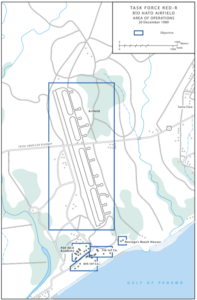
Map detailing objectives of the Battle of Rio Hato, where stealth aircraft was first deployed in combat (Source: Yates)
Although US forces took two weeks to capture Noriega, the operation was remarkably successful. The swift invasion secured the Panama Canal from Noriega’s erratic dictatorship and restored the country’s democracy.
Kuwait: Operation Desert Storm
Stealth was even more decisive in Washington’s next military engagement. After Saddam Hussein refused to withdraw from Kuwait by the UN Security Council’s deadline of January 15, 1991, Operation Desert Shield became Operation Desert Storm: a US-led coalition invasion against Iraqi forces.
The day after the deadline, the coalition launched an all-out aerial campaign with over 1,000 daily missions. First, US attack helicopters of Task Force Normandy destroyed Iraqi early-warning radar sites. The surprise attack helped 10 F-117As evade then destroy Baghdad’s air defenses and command-and-control facilities the very first night. The overall air campaign included 112,000 combat missions, 7,400 tons of laser-guided bombs, and 40 downed aircraft. The initial 38-day air assault—with British, French, Kuwaiti, and Saudi support—enabled a rapid land invasion on February 25 that forced Iraqi forces to immediately withdraw. Largely due to stealth’s success, Bush declared all objectives completed 100 hours after the invasion began.
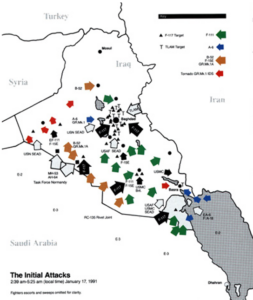
Map depicting the air sorties of F-117s and other involved aircraft in Desert Storm’s initial airstrikes (Source: Coyne).
Kosovo: Operation Allied Force
The development of stealth aircraft was exceptionally expensive, but these cutting-edge planes were still compatible with shrinking defense budgets in the early 1990s. The B-2 was the costliest plane ever built, with the first unit costing $22 billion and later ones still requiring $2 billion each by the mid-1990s. Still, stealth aircraft’s exceptional capabilities made low quantities sufficient. In 1990, Bush began major defense spending cuts, and in his January 1992 State of the Union address, announced that he would cut total B-2 production from 75 to 20. Desert Storm’s air campaign commander, Air Force General Chuck Horner, explained in 1995, “Two B-2s, without escorts or tankers, could [perform] the same mission as a package of thirty-two strike aircraft, sixteen fighters, twelve air-defense suppression aircraft, and fifteen tankers.”
Few were needed to intervene decisively in Kosovo in 1999. After Yugoslav dictator Slobodan Milosevic ordered ethnic cleansing of Kosovar Albanians on March 24, President Bill Clinton announced a NATO air campaign on humanitarian grounds with three stated objectives: demonstrate the alliance’s opposition to aggression, prevent Milosevic from going further, and, if necessary, debilitate Serbia’s military capabilities for future deterrence.
Operation Allied Force followed, debuting the B-2 in combat. Like Desert Storm, initial attacks targeted air defense and command-and-control facilities with help from allies and warship-launched missiles. Completing 30-hour nonstop missions from Whiteman Air Force Base in Missouri and back, B-2s penetrated already-weakened Yugoslav air defenses to drop satellite-guided 2,000 and 5,000-pound bombs inside Yugoslavia. On June 9, 78 days after NATO’s airpower-only operation began, Yugoslav forces signed the Kumanovo Agreement, recognizing a UN-administered demilitarized zone around Kosovo and thereby ending the war.
Clinton was so pleased with the bombers’ performance that he flew to Whiteman himself to congratulate the crews. “Listen to this: The B-2’s from Whiteman flew less than one percent of the total mission, but dropped 11 percent of the bombs… Yes, I am very proud of the B-2’s,” the president declared in his speech.
While occurring on three different continents, US operations in Panama, Kuwait, and Kosovo all demonstrated stealth’s revolutionary potential to achieve decisive battlefield victories.
Evolving in the 21st Century: Yemen, Iran, and Venezuela
Stealth aircraft have since evolved and continued to define warfare.
Radar improvements including passive, bistatic, and multistatic models have spurred the creation of aircraft with less observability than the F-117. Lockheed Martin has risen to the occasion with the F-22 Raptor and the F-35 Lightning, capable of flying supersonically at Mach 2.25 and 1.6, respectively. The F-35 can even carry nuclear payloads. Helicopters also have gained stealth capabilities now, as a downed “Stealth Black Hawk” in the 2011 Osama Bin Laden raid revealed.
Simultaneously, US allies and adversaries in Europe, Israel, India, China, and Russia have all acquired stealth aircraft, some US-developed and others made by the countries employing them.
Meanwhile, the US has continued to use stealth technology in effective limited operations. In October 2024, former President Joseph Biden authorized B-2s to destroy five underground Houthi weapons storage facilities in Yemen. Eight months later, President Donald Trump gave the green light to Operation Midnight Hammer, in which seven B-2s dropped bunker-busting bombs on Iranian nuclear sites—including the first use of 30,000-pound GBU-57 Massive Ordnance Penetrators— following preemptive strikes on Iranian air defenses by low-observable F-22s and F-35s. Trump praised “those incredible B-2s” in the mission for their 36-hour sorties that he claimed left the sites “totally obliterated.”
On the third day of 2026, US forces used stealth to depose Venezuelan dictator Nicolás Maduro, in a historic operation. In the surprise night-time raid, F-22 and F-35 stealth fighters, as well as the RQ-170 Sentinel drone, penetrated then destroyed Russian-provided air defenses—allowing Delta Force operators to seize and transport Maduro and his wife in helicopters to US custody unharmed.
The raid was high-risk but spectacularly successful. Estimates approximate that 80 people were killed—many of them Cuban soldiers guarding the compound—and not one US servicemember perished (although seven were wounded). These numbers are notable considering Just Cause—an operation that similarly extradited a narcotics-linked Latin American dictator—killed hundreds of Panamanian civilians, 314 Panamanian soldiers, and 23 US servicemembers. Similarly, recent Middle East deployments delivered decisive strikes on Houthi and Iranian sites, while demonstrating notable operational improvements since the 1990s, when upwards of 300 troops and thousands of civilians died in the Desert Storm air raids as well as hundreds of civilians during Kosovo’s campaign.
Conclusion
Examining the development and deployments of stealth aircraft reveals a remarkable innovation in military technology that has enabled decisive battlefield victories for US and allied forces.
The aeronautical engineers at Lockheed and Northrop used revolutionary thinking and scientific theory to design an entire new class of airplanes that were entirely undetectable to radar. Although created to deter the Soviet Union’s nuclear threat, these aircraft played decisive roles in restoring Panama’s democracy, ending Iraq’s invasion of Kuwait, and terminating Serbia’s ethnic cleansing in Kosovo.
Stealth aircraft have evolved since. The F-22 and F-35 were developed in the 21st century and can fly at supersonic speeds. These planes enabled US forces to disrupt Houthi operations, destroy Iranian nuclear facilities, and depose a Venezuelan dictator.
Stealth’s technological evolutions and operational uses demonstrate that great-power competition can prompt innovation that ultimately proves decisive in smaller-scale operations against outmatched enemies. In an age of growing strategic competition with China, the US military and defense industrial base are engaged in a tense push for technological innovation and advantage against Chinese competitors, spanning artificial intelligence, autonomous weapons, and aerial, aquatic, and terrestrial drones. US war planners in the 2030s and 2040s may find that weaponry developed to deter Chinese aggression against Taiwan may prove more consequential in specialized operations across the globe, as Air Force generals found with their Soviet-facing stealth aircraft in the 1990s and 21st century.
Furthermore, it is strategically significant that stealth has proven indecisive in other 21st-century interventions: namely Afghanistan, Iraq, and Iran. Why?
The answer lies not in the operational tasks at hand, but rather in the greater strategic objectives at play. Stealth fighters could assist US forces in overthrowing the Taliban, but they could not compel US-trained Afghan Security Forces to defend liberal democracy. These aircraft could help topple Saddam Hussein’s dictatorship, but they could not quell the dispersed insurgency that followed Hussein’s removal. In Operation Epic Fury, stealth fighters destroyed much of Iran’s Air Force and Navy, and stealth bombers again destroyed Iranian nuclear sites. However, these planes could not end Iran’s nuclear ambitions, change the country’s political regime, or re-open the Strait of Hormuz.
Considering stealth’s evolution and deployments from Lockheed office desks to Iranian nuclear sites, it is evident that great-power competition can spur technological innovation that becomes decisive in smaller-scale wars. The historical record shows that such innovation has been decisive only when political objectives have been clear, limited, and attainable. This confluence reinforces the core tenets of Colin Powell’s eponymous doctrine: the idea that the United States should only deploy force with vital national security interests threatened, diplomatic options exhausted, clear and attainable objectives, a viable exit strategy, overwhelming force, and broad domestic and international support.
As he wrote in a 1992 Foreign Affairs article explaining how to decide when to deploy force:
Relevant questions include: Is the political objective we seek to achieve important, clearly defined and understood? Have all other nonviolent policy means failed? Will military force achieve the objective? At what cost? Have the gains and risks been analyzed? How might the situation that we seek to alter, once it is altered by force, develop further and what might be the consequences?
The historical record shows that when the answers to these questions have been satisfactory, US technological dominance has prevailed. Otherwise, weaker enemies have neutralized these advantages, making force deployments ineffective at best and catastrophic at worst. The advance of military technology into the age of unmanned weaponry and artificial intelligence is unlikely to change these timeless truths of warfare.