





From Hub-and-Spokes Alliances to Operational Coalition Warfare in Northeast Asia

A System Built for a Different Strategic Environment
For much of the post–Cold War period, Washington’s strategy in the Pacific depended on a stable alliance architecture: a set of bilateral relationships anchored by forward-deployed American forces in Japan and the Republic of Korea (hereafter South Korea). This hub-and-spokes alliance system proved remarkably durable. It preserved allied sovereignty, enabled flexible burden-sharing, and provided a reliable framework for deterring regional conflict. Notwithstanding, this system’s ability to effectively fight modern warfare is under significant strain—not because it has failed in its original purpose, but because the operational environment it was designed to support is changing faster than its institutional logic. Simply, the operational reality of the Pacific demands that allies move past geographically isolated, theater-segregated planning.
The emerging security challenges in Northeast Asia are defined less by the prospect of a single regional contingency than by the possibility of simultaneous crises unfolding across multiple theaters. A conflict over Taiwan would inevitably affect the Korean Peninsula and the East China Sea. Long-range precision strike systems, persistent surveillance, cyber operations, and space-enabled targeting have compressed decision timelines while dissolving the geographic boundaries that once separated military theaters.
Under these conditions, the principal constraint on military effectiveness is no longer force structure alone. It is the ability of the United States and its allies to transform dispersed capabilities into coordinated operational effects at the speed of modern conflict. The central challenge for Washington and its allies in the Pacific is organizational rather than technological. The question is no longer whether allies possess advanced military capabilities, but whether existing structures can employ those capabilities as a coherent operational system while preserving national sovereignty and political control.
The Structural Mismatch in Alliance Design
The strength of the hub-and-spokes alliance system has always been its political flexibility. Japan and South Korea maintain distinct command structures, legal authorities, and national decision-making processes while relying on the United States as the principal strategic mediator. This arrangement minimized political friction during an era in which military contingencies were generally viewed as geographically discrete and sequential.
That assumption is becoming increasingly difficult to sustain. Modern military operations unfold across multiple domains simultaneously. Missile launches, cyber-attacks, electronic warfare, and space-based surveillance produce effects that extend well beyond national boundaries. Information generated in one theater may determine operational success within minutes or even seconds.
A future crisis in Northeast Asia would certainly demand the rapid integration of capabilities distributed across allied forces. Early warnings generated by South Korean sensors could support United States naval operations near Taiwan. Japanese missile-defense systems might contribute to protecting coalition forces operating far beyond Japan’s territory. Space-based surveillance and cyber operations would influence military activity across the entire region rather than within discrete theaters of responsibility.
Under such conditions, operational success depends less on the performance of individual platforms than on the speed with which information can move across allied networks and be translated into coordinated action. Therefore, the principal limitation is institutional. Existing alliance structures remain optimized for coordination among sovereign militaries rather than continuous operational integration during high-intensity conflict. More importantly, legacy classification barriers remain optimized for coordination among sovereign militaries rather than continuous operational integration during high-intensity conflict.
From Interoperability to Operational Coupling
For decades, alliance modernization has focused primarily on interoperability—the ability of national forces to exchange information, communicate effectively, and operate compatible systems. Interoperability remains necessary, but it is no longer sufficient.
It assumes that national military systems remain fundamentally separate and connect only when circumstances require cooperation. Modern warfare increasingly challenges that assumption. Surveillance networks, drone-centric competition, missile tracking, cyber operations, electronic warfare, and space-based sensing already function as persistent, interconnected systems whose effectiveness depends upon continuous information sharing rather than episodic coordination.
What is emerging is better understood as operational coupling. In an operationally coupled environment, the effectiveness of each military asset depends increasingly upon the responsiveness of the wider coalition network. Sensors, decision-makers, and strike platforms become interdependent regardless of national ownership. Delays in information processing or decision authority within one part of the network can reduce the effectiveness of the entire coalition.
Missile defense illustrates this challenge clearly. Washington, Tokyo, and Seoul collectively possess one of the world’s most capable missile-defense architectures in the Pacific. Yet these systems remain connected primarily through arrangements designed to facilitate cooperation rather than conduct genuinely integrated operations.
During a large-scale missile attack, delays measured in seconds may become operationally significant. Thus, the core question is not whether sufficient interceptors or sensors exist, but whether command arrangements allow coalition capabilities to function as a single operational system under combat conditions.
In short, the challenge is no longer technological interoperability. It is institutional responsiveness.
Building the First Island Chain Warfighting Network
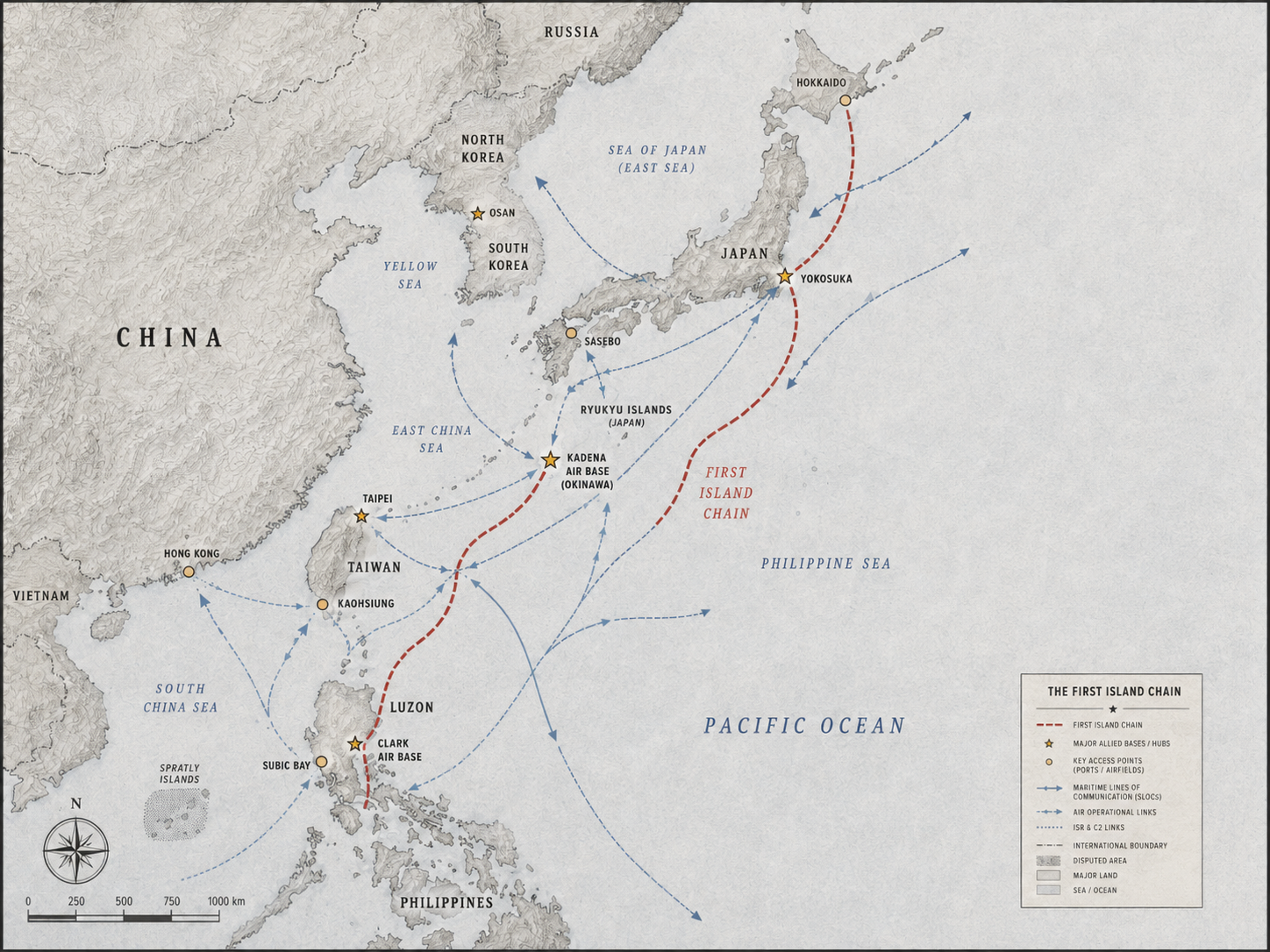
Meeting this challenge requires moving beyond the traditional logic of bilateral alliance coordination toward what may be described as a First Island Chain Warfighting Network. This concept is not a proposal for a new alliance or a centralized command structure. Rather, it is an operational framework in which allied military capabilities function as components of a persistent coalition combat network while political authority over the use of force remains national.
Within such a network, any available sensor contributes to a common operational picture. Information is distributed across coalition networks in near real time, allowing the most effective available interceptor, strike platform, or supporting capability to respond regardless of nationality, subject to pre-established political authorities.
This represents a shift from linear kill chains toward multi-domain kill webs. By knitting together disparate national sensors and shooters, this network-of-networks removes single axes of attack and provides theater commanders with unprecedented operational optionality. Instead of predetermined relationships between sensors and shooters, coalition forces gain the flexibility to match available information with the most effective response across multiple services, domains, and allied militaries.
The objective is not technological novelty. Most of the necessary sensing, communications, and strike capabilities already exist. The central innovation lies in organizational design: reducing decision latency while preserving resilience under conditions of disruption and uncertainty. Success in future coalition warfare will increasingly depend upon the speed and adaptability of the network rather than the performance of individual military platforms.
Industrial Capacity as Operational Depth
Operational integration extends beyond command and control. A prolonged conflict in the Pacific would place extraordinary demands on munitions production, ship repair, logistics, transportation, and maintenance. Industrial capacity would become a decisive component of military effectiveness rather than merely a supporting function.
The alliance possesses substantial but underutilized strengths. South Korea’s advanced shipbuilding and defense-industrial base, Japan’s transportation infrastructure and maintenance capacity, and the United States’ global logistics network collectively represent strategic resources that exceed the capabilities of any single ally. Yet these assets remain organized primarily through national planning processes rather than coalition operational design.
In a sustained regional conflict, industrial resilience would directly influence sortie generation, platform availability, and munitions replenishment. Operational endurance would depend upon the coalition’s ability to integrate sustainment as effectively as combat operations. The boundary between battlefield performance and industrial production is therefore becoming increasingly blurred.
The Limits of Integration
Greater operational integration also creates new vulnerabilities. Tightly coupled networks are inherently more exposed to cyber disruptions, communication degradation, and political disagreements during crises. They also raise difficult questions regarding delegated authority, escalation management, and sovereign decision-making.
Consequently, integration cannot be treated as a binary choice. Rather, the transition to a coupled network must actively navigate classification restrictions that currently hamper real-time intelligence sharing. Instead, alliance evolution is likely to produce a layered architecture. Mission areas in which speed and cross-domain coordination are decisive—such as missile defense, maritime domain awareness, and selected strike coordination functions—may require high levels of operational integration. Other areas will continue to rely primarily upon national command structures and political coordination.
As a result, the objective is not seamless fusion but calibrated integration: designing coalition networks that maximize operational effectiveness while preserving political legitimacy and strategic resilience. This balance between operational speed and sovereign control is likely to become the defining institutional challenge of alliance warfare in Northeast Asia.
The Future of Coalition Warfare
The Pacific alliance system is entering a period in which military effectiveness will depend less on the strength of individual armed forces than on their ability to function as a coherent operational network under conditions of simultaneous crisis. The hub-and-spokes system was built for geographically bound and largely sequential contingencies. Future conflict is more likely to be interconnected, multi-domain, and mutually reinforcing across the First Island Chain.
In such an environment, competitive advantage will accrue not simply to the side possessing superior military platforms, but to the coalition capable of maintaining decision speed, operational coherence, and logistical endurance despite disruption. Hence, the central strategic question is no longer whether Washington and its allies possess sufficient military capability in Northeast Asia. It is whether they can transform that capability into coordinated operational effect at the pace required by modern warfare without undermining the political foundations upon which their alliances rest.
The First Island Chain Warfighting Network should be understood in precisely this light: not as a formal organization or command structure, but as an evolving model of coalition warfare. It reflects the growing recognition that deterrence in the twenty-first century will depend increasingly on the ability of allied states to fight not merely alongside one another, but as selectively integrated operational networks capable of sustaining coherent action across multiple domains and simultaneous theaters.
Disclaimer: The views expressed are those of the author and do not reflect the official position of the Department of the Army or the Department of War.


