





Staff Processes in Large-Scale Combat Operations Part IV: Targeting as Part of Combined Arms

ADP 3-0 defines combined arms as “the synchronized and simultaneous application of arms to achieve an effect greater than if each element was used separately or sequentially.” Unfortunately, units struggle to actually conduct combined arms and specifically integrate fire and maneuver at the division and above echelons. This is in part the consequence of a focus on targeting to synchronize operations. During twenty years of counterinsurgency operations, the U.S. military was generally not conducting ground maneuver operations continuously on a large scale at the battalion and above level. Given the lack of maneuver operations, targeting replaced maneuver and the targeting process became the primary planning process.
Current targeting in Large-Scale Combat Operations (LSCO) Warfighter Exercise (WFX) scenarios is unresponsive, inflexible, and dominates the planning process with varying degrees of integration into the Military Decision-Making Process (MDMP) or Operations Process. Counter-Insurgency (COIN)-era targeting during the Global War on Terror (GWOT) was usually focused on an individual human being and required a great deal of precision and conditions setting; it did not require out-maneuvering an enemy formation. How do we change our deliberate targeting process from the GWOT to a fast-acting, agile, lethal process in both the planning and execution horizons to make our divisions and corps win with intelligence collection, fires, and combined arms maneuver supported by deliberate and dynamic targeting- all while reducing the time, personnel, and inputs required for working groups and boards?
Prior U.S. Army experiences in large scale combat placed an emphasis on massing of ground-based and joint fires in support of planned operations and not merely spreading assets evenly along the forward line of troops. In July 1944, the U.S. VII Corps attacked along a narrow 7,000-yard front with previously coordinated support from over 1,000 bombers and fighter-bombers and twenty-one artillery battalions. This massing of fires devastated opposing German units and helped the corps achieve a long-awaited breakthrough in support of army group objectives. In one of many more recent examples from Operation Desert Storm in 1991, the 197th Infantry Brigade (Mechanized) received twenty-eight close air support aircraft sorties and heavy artillery and rocket support to seize a single airfield from Iraqi forces. Doctrine throughout the twentieth century reflected this incorporation of massed fires planning into the broader operations process. Published in 1996, FM 6-20-10 Tactics, Techniques, and Procedures for the Targeting Process emphasized that “Targeting is an integral part of the planning process,” or what was at that time called the “command decision cycle,” akin to the current military decision making process. However, the process was not always perfect, and even success in Operation Desert Storm was dampened by a rigid U.S. Air Force-driven targeting process that could not keep up with the dynamic reality on the ground.
This is the fourth installment in the Staff Processes in LSCO series. This paper will explore the relationship between (or the divorce of) the MDMP and the Targeting Process and how our divisions currently apply the two processes to good or poor effect. The Mission Command Training Program (MCTP) has seen a trend in Warfighter Exercises where divisions staffs develop a scheme of maneuver for a phase of an operation through MDMP but separately develop detailed plans for employing long range artillery, Close Air Support (CAS), Multi-domain Operations (MDO), and other effects by Joint Air Tasking Order (ATO) day with varying degrees of synchronization with the maneuver plan. There seem to be two camps in the U.S. Army: one which believes that divisions fight with fires and that maneuver brigades exist simply to seize more terrain to be used for subsequent artillery positions; and another which believes that divisions are intended to be a tactical, combined arms maneuver formation that utilize both fires and maneuver to support each other and create exploitable opportunities using mass at decisive points. Those advocating the use of massed firepower, with maneuver units merely seizing firing points for fires units, should tread carefully lest the army adopt a twenty-first century version of the rigid French “methodical battle” doctrine from the 1930s and early 1940s, a doctrine which had fatal consequences for the French army when it faced the German Wehrmacht in 1940. Given that, a division must emphasize the integration of fires and maneuver based on a planning process that goes beyond targeting alone.
To fight and win against our current competitors in LSCO, our divisions must fight as tactical units of action with all brigades and enablers fighting in unison using doctrinal forms of maneuver. To do so, units must use targeting to support maneuver in the close area in addition to shaping the deep area. Doing so requires units to mass effects at decisive points. Finally, units must master the art of dynamic execution with whatever assets are available rather than wielding an inflexible targeting plan in the face of a very flexible enemy.
Tactical Unit of Action
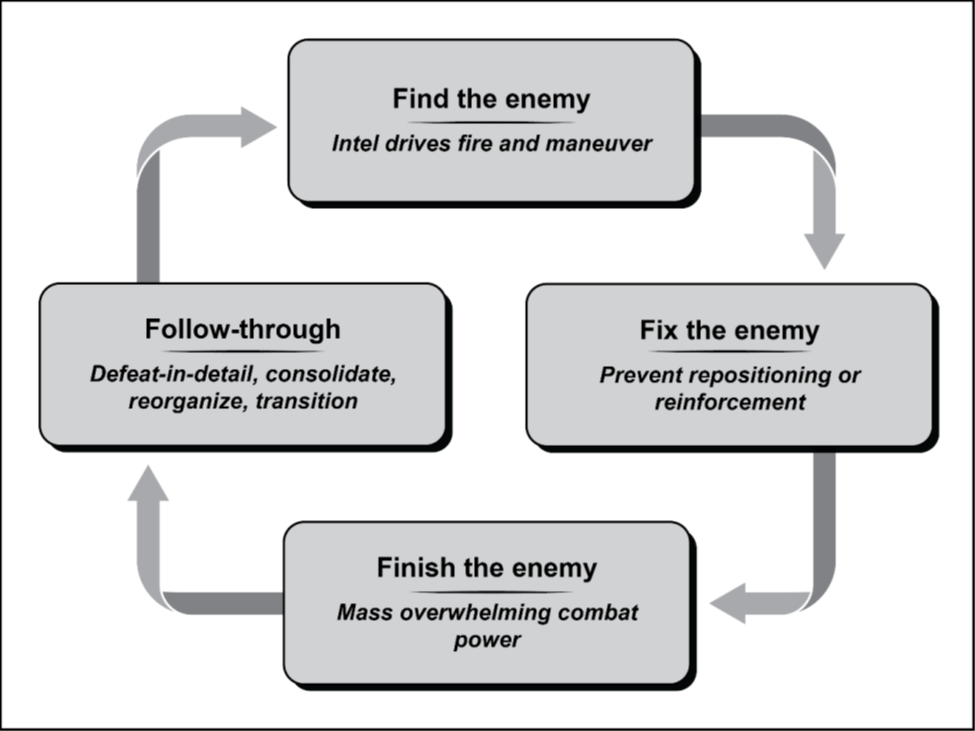
According to the latest version of FM 3-94, “The division is the Army’s principal tactical warfighting formation during large-scale combat.” While divisions often acted as an operational headquarters during counterinsurgency, their reemergence as a tactical headquarters for large scale combat operations requires a shift to focusing on tactical frameworks to facilitate combined arms synchronization. Because it is a tactical headquarters, the division’s staff processes should focus on driving the tactical framework of find the enemy, fix the enemy, finish the enemy, and follow-through during large-scale combat outlined in FM 3-90 Tactics.
Figure 1: Tactical framework
To be successful, divisions must synchronize the aggregated combat power at their disposal during each step of the tactical framework. FM 3-0 Operations notes, “Combat power is the total means of destruction and/or disruptive force that the unit/formation can apply against the opponent at a given time.” One of the dynamics of combat power that divisions struggle to synchronize is firepower. Firepower is the primary source of lethality for tactical units and combines direct and indirect fires.
How does “find, fix, finish, and follow-through” look in practice? An example for a division might include a Brigade Combat Team (BCT) with intelligence, surveillance, and reconnaissance (ISR) attached in a movement to contact to find an enemy unit. Once found, the division would fix the enemy with the combination of that BCT’s organic assets and division fires. To finish the enemy, it would employ another BCT and the Combat Aviation Brigade (CAB). Finally, the division would follow-through with a third brigade. Importantly, the division must deliberately plan the movement and maneuver of the brigades during each step to enable the positioning of fire capabilities where they can be most lethal.
Instead of firing to support maneuver and maneuvering to fire, MCTP is observing units fight with long range fires to shape the deep area and leave the close fight to the brigades. The division plan typically centers around reducing enemy combat power on future objectives to a low enough strength to set up a brigade for its next attack with a 3:1 combat power ratio. The BCTs are typically assigned tasks by the division, but those tasks are not nested in a division form of maneuver, resulting in multiple individual brigade fights, often in a disjointed frontal attack, instead of one division fight. For example, when a division wants one of its BCTs to seize an objective that is occupied by an enemy brigade, there is a 1:1 ratio there, so the division attempts to shape the enemy with fires (reduce that enemy to 1/3 of its full strength) in order to achieve the 3:1 ratio required for a deliberate attack. Employing fires sequentially with maneuver, and not simultaneously, does not achieve combined arms, which, recalling the definition at the beginning of this article, is “…the synchronized and simultaneous application of arms to achieve an effect greater than if each element was used separately or sequentially.” Put another way, the MCTP FY24 Key Observations publication notes, “Corps and divisions must recognize the relationship between fires and maneuver is complex and complementary rather than simple and sequential. It is not just fire to maneuver or maneuver to fire.” While the division is responsible for engaging targets in the deep area to set desired conditions for the BCTs in the next phase of an operation, the division is also responsible for supporting the BCTs as they maneuver in the close area. Units must find the right balance here.
To find this balance, instead of tasking single brigades to attack enemy brigades, divisions must strive for a 3:1 ratio in the maneuver plan. In practice, for a division, brigades should attack battalions, or the division should employ three of its BCTs to attack one enemy brigade. Units should base the maneuver plan on a doctrinal form of maneuver centered around a decisive point with clearly defined end state conditions by phase. Targeting can create even more favorable conditions and support the brigades in the close area to combine arms in execution. Fires should target the things that will be the most detrimental to the enemy commander’s success (High Value Target List) as well as things that will create the greatest advantage for friendly units (High Payoff Target List).
Mass at Decisive Points
During the planning process, all echelons owe their subordinate units resources for operations, especially those which allow a force to achieve mass. Throughout LSCO, units remain eager to request joint assets to support their operations; however, they often fail to mass these, their organic assets, and their effects onto a specific enemy formation. Additionally, divisions have gotten into the habit of requesting joint or higher headquarters assets routinely when they are not needed to accomplish an assigned mission. In future large-scale combat, such assets will be in short supply across the joint force, so divisions should understand that they will only be allocated significant outside resources if they are a main effort, if at all. Staffs of tactical units must do a thorough analysis of relative combat power necessary to accomplish a given mission and request assets appropriately. Unlike counterinsurgency or counterterrorism operations, the U.S. Army cannot count on receiving joint assets at the lowest levels to support large scale combat operations.
FM 3-0 Operations describes the operational framework consisting of three parts. One of those considerations describes assignment of main and supporting efforts (ME and SE) as well as a reserve. As observed in practically every recent Warfighter Exercise, higher echelons prefer to conduct frontal attacks as their form of maneuver. Frontal attacks require a plethora of assets being evenly distributed across the frontage to “set conditions” for success. While frontal attacks simplify targeting and associated fire support coordination, doctrine argues that they should generally be employed to overrun a weaker enemy or when assailable flanks do not exist. However, Warfighter Exercises typically see frontal attacks against enemy forces of equal or greater strength in relation to attacking friendly forces. Units base this scheme of maneuver on the false assumption that friendly fires assets can easily reduce force ratios to an acceptable level across the entire front.
However, this dilution of combat power across the breadth of a frontal attack typically fails to achieve the mass required to accomplish a given objective or tactical task. The commitment of resources across a wide area may degrade the enemy forces by 10%, however, this does not present the enemy with any significant dilemma, and they will simply redistribute combat power as needed. To mass effects, it may be prudent for a corps to slow its tempo and allocate resources from one division to support another adjacent division which is designated as the corps main effort. By slowing tempo, adjusting the form of maneuver, and massing effects on a singular enemy sector, the force ratios would overwhelmingly shift in favor of U.S. forces at a decisive point and present a dilemma to the enemy. Therefore, it is incumbent on the corps to properly identify and resource its main effort and then shape the battlefield effectively prior to transitioning to the main effort for execution. These actions need to be properly developed throughout the MDMP and refined via the assessment process and running estimates.
Recall Staff Processes in LSCO Part III: Division Planning. That article discussed the need for divisions to plan by phase and build a doctrinal operational approach in each phase (include a decisive point and end state conditions for each phase). In this discussion we will go a step further and discuss forms of maneuver in each phase. To achieve mass, staffs should plan for doctrinally-correct force ratios from the very beginning during MDMP by aligning BCTs against enemy battalions or by aligning multiple BCTs against enemy formations in a doctrinal form of maneuver. The trend is that divisions almost exclusively fight using three brigades abreast in a frontal attack and use the CAB as a unilateral unit in out-of-contact deep attacks. Instead, we recommend employing the BCTs in a division form of maneuver. FM 3-90, Figure 2-16 illustrates a single envelopment using multiple BCTs. Figure 2 below is a modified version of this illustration. It depicts two battalions fixing enemy brigades to their front, two BCTs (one being the division main effort) conducting an envelopment supported by an aviation attack by fire, and an uncommitted battalion in reserve. If the main effort needs additional combat power to accomplish its mission, the uncommitted battalion could add mass to the main effort at the decisive point, or it could become the new main effort and seize a different objective that still achieves the desired end state conditions (branch plan), or it could pass through the main effort and exploit success (sequel/follow through). Regardless, by using more sophisticated forms of maneuver than a frontal attack, units will likely see more success in identifying and exploiting enemy vulnerabilities like an exposed flank or gap in the enemy forward line of troops.
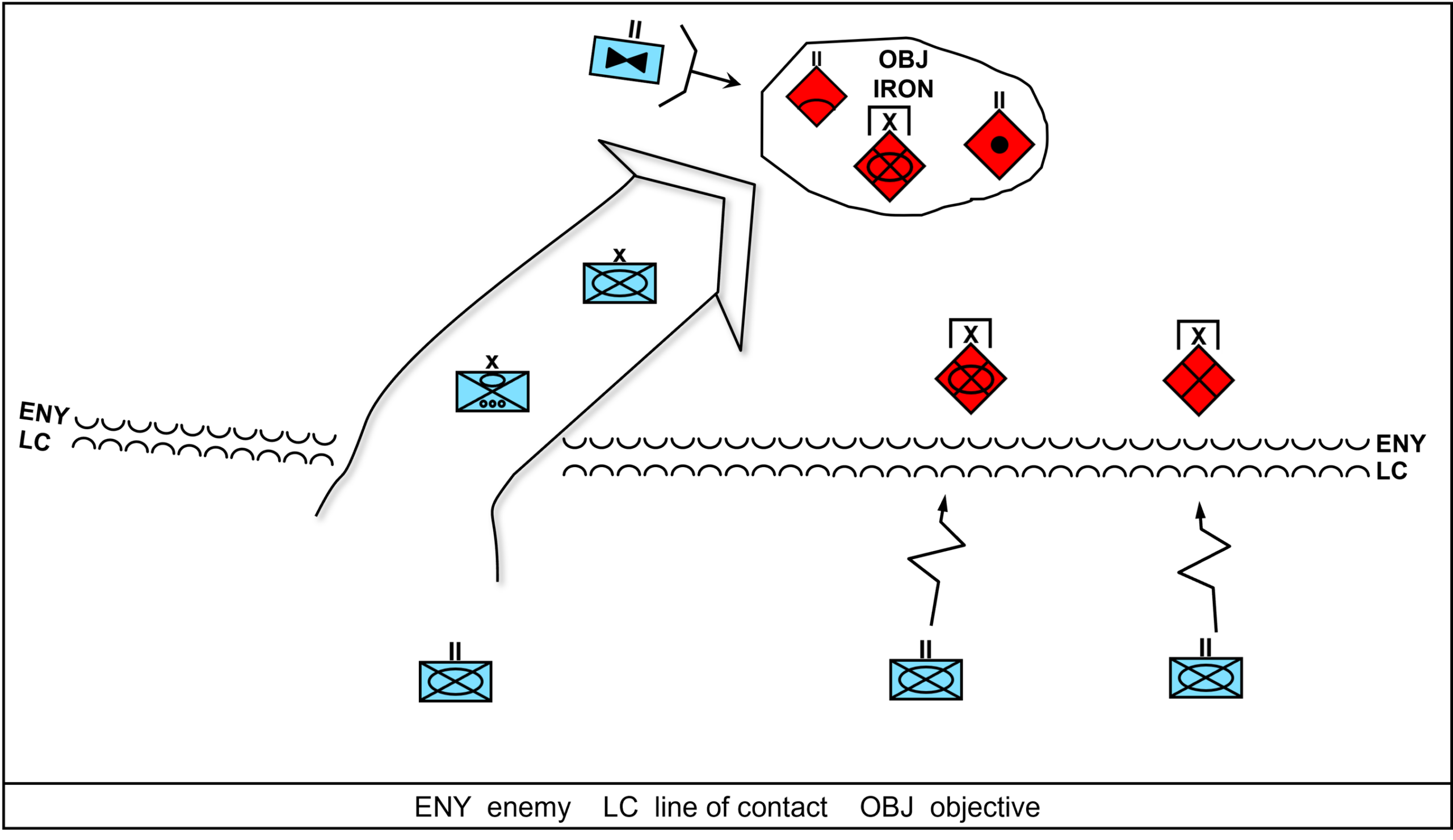
Figure 2: Division Envelopment
To support all of this with targeting we must now discuss how to take the maneuver plan as an output of MDMP by phase and overlay that with targeting by ATO cycle.
Planning and Targeting Overlaid
“Targeting remains a critical integrating function within the operations process and will be applied through all phases of planning, preparing, executing, and assessing the operation. It will exist as part of the MDMP but will also be applied to changes in plans during execution.” -FM 3-60, Army Targeting, August 2023
“The number and frequency of targeting working group meetings varies based on the battle rhythm, operating tempo, or the commander’s guidance.”- FM 3-60 Army Targeting, August 2023
As operations are planned by phase through staff-integrated and thorough MDMP, similarly, the targeting process needs to prioritize effects by ATO cycle within those phases to achieve the commander’s intent and end state conditions. As a starting point, this article will dissect the division planning process. Regardless of how divisions plan in garrison, the MDMP in LSCO becomes an iterative and fast-paced grind with planning transitions from one planning horizon to the next. While divisions typically name their battle rhythm events non-doctrinal terms, like calling a “Course of Action (COA) Approval Brief” a “Plans Update Brief,” they do often follow the steps of MDMP throughout the Operations Process. However, recalling Staff Processes in LSCO Part III: Division Planning, divisions tend to skip COA Analysis and replace it with the Targeting Working Group (TWG). Unfortunately, focusing almost exclusively on targeting creates plans that are often incomplete; for example, while the sustainment of critical Class V is commonly a discussion in a TWG, the TWG will not discuss other important sustainment functions, such as replacing critical Class VII, replacing key personnel losses, or conducting a Class III resupply.
Instead of focusing exclusively on targeting in planning, a best practice from Staff Processes in LSCO Part III: Division Planning for staff integration is to maintain a time on the battle rhythm for wargaming, separate and prior to the TWG. Representatives from each WfF and unit LNOs must attend this wargame and produce a fully-staffed execution matrix (EXMAT) and decision support matrix/template (DSM/DST). Those products, along with a concept of the operation (CONOP) by phase, are then inputs to the TWG. This will result in a fully synchronized plan and fighting products that account for all WfFs, not just maneuver, collection, and fires. This will also help address the tendency of units to fight with a Targeting Synchronization Matrix (TSM) in lieu of an EXMAT (again, a symptom of replacing holistic planning with targeting). The CONOP is the holistic plan for the entire phase that may span several ATO cycles and the EXMAT should dive into each ATO cycle within that CONOP.
Now think back to Staff Processes in LSCO Part I: Rhythm of the Battle and Part II: Running Estimates. If units plan by phase using MDMP and wargame down to the ATO day level of detail (Plans Cell) and then refine that to smaller 1-to 4-hour blocks on the EXMAT (Future Operations Cell), then when the division is heavily engaged in fighting and does not have time for key leaders to sit in meetings for hours per day, they should be able to fight off of published orders by phase and use running estimates and other tools to support rapid adjustments in execution and agile fighting rather than relying on meetings to do that. See Figure 3. This depicts a series of division phases overlaid with ATO cycles and with tempo changes per the rhythm of the battle. It also provides a focus for the planned meetings during the daily battle rhythm. A product like this will enable a staff focus for each meeting and enable the attendees to be prepared to discuss the correct problem sets, time horizons, and battlefield framework for the meeting they attend.
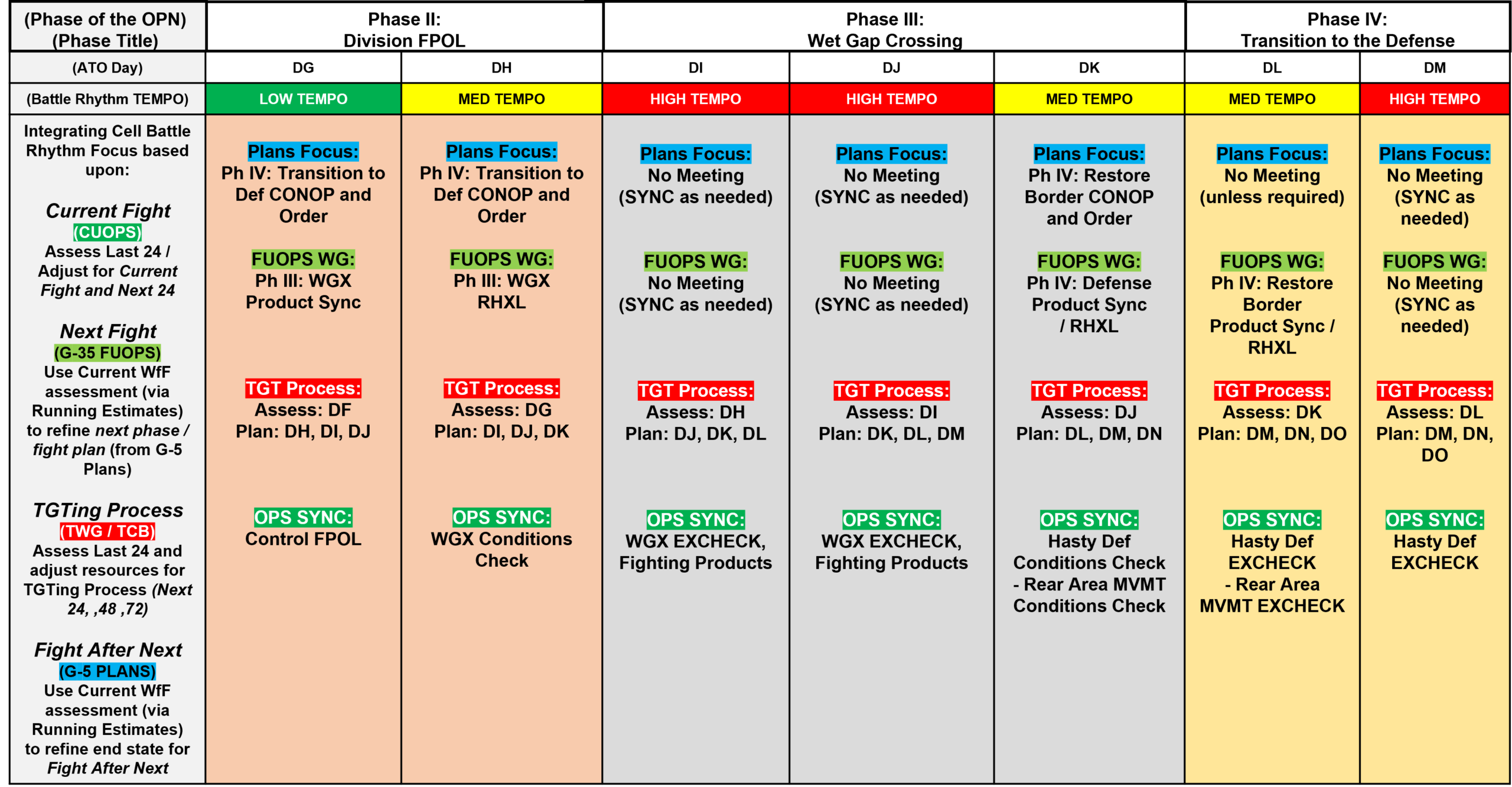
Figure 3: Staff Battle Rhythm Daily Focus
Maintaining Flexibility
The MCTP observes that units tend to lock in every detail of a targeting plan in advance and then rigidly adhere to the plan in execution. Large scale combat is very dynamic and requires a great deal of flexibility in execution. This is not to say that planning is not important, but there is an undeniable tension between the current, rigid targeting process and the need for more agile fighting in execution. How can units use the targeting process to enable dynamic execution against a maneuvering and constantly adjusting enemy?
If the targeting process aligns resources with units, objectives, or tasks, and then those units, objectives, and tasks change after the resources have been locked in, then there are resources available for employment, but perhaps not exactly the way they were originally intended. Tactical units must become comfortable with using what assets they have when they have them as they best support the current priorities, regardless of whether it is what we had originally planned or not. In other words, units must fight the enemy, not the plan. Additionally, as professionals and good stewards of scarce resources, units must be willing and able to tell their higher headquarters when they no longer need an asset because of a change in the situation and support their higher headquarters when it reallocates those assets.
An example of a lack of flexibility manifested itself during a recent Warfighter Exercise. The division ordered its reconnaissance squadron to advance to gain contact with the enemy. The squadron was inadequately supported by other units and was quickly destroyed by enemy indirect fires. The friendly division had prioritized enemy air defense artillery assets in its high payoff target list (HPTL) and continued to engage those targets. In retrospect, the division should have flexibly changed its targeting priorities and destroyed or suppressed the enemy fires assets to allow its reconnaissance squadron to continue its advance. While units must request assets through a rigid 96-hour ATO cycle, they cannot restrict themselves to it, especially with regard to organic assets. Fires must fight the enemy, not the fires plan.
In conclusion, while the targeting process was often able to replace the operations process during the Global War on Terror, a shift in focus back to large scale combat operations will require units to focus planning on combined arms integration using the MDMP and Operations Process. Units must mass assets simultaneously at decisive points, achieve favorable force ratios through integration of fires, maneuver, and all other warfighting functions, and maintain flexibility in employment of fires. Units cannot just fight with fires while adhering to a rigid ATO cycle; they must flexibly mass all elements of combat power in the deep, close, and rear areas as required to achieve desired effects and end states.
Final Recommendations
Units must fight with mass by planning forms of maneuver around a decisive point supported by effects synchronized in the targeting process as well as a daily OPSYNC. They must maintain flexibility by avoiding frontal attacks unless fixing a larger force or destroying a weaker force. Instead, tactical units must use more preferred forms of maneuver with branch plans and decision points that allow the commander the option to shift the main effort from one brigade to another based on opportunities or failures on desired objectives. This lends itself to agility in the targeting process because shifting the main effort and adhering to a general timeline allows a commander to flex assets on station and continue fighting rather than transitioning to hasty defenses and losing tempo and initiative.
During COA Development, units must create an integrated combined arms plan. When considering targeting, they have to specify ways in which effects can support each subordinate unit, and incorporate conceptual targeting planning into COA analysis/wargaming. Units cannot treat targeting as a completely separate process; they must use the targeting working group to apply detail to the conceptual plan developed in COA analysis.
Tactical formations must plan to fight with doctrinal force ratios from the beginning rather than relying entirely on targeting shaping operations to attrit enemy formations and set feasible correlation of force ratios. Divisions and above echelons must allow the DIVARTY or other fires commander to chair the Targeting Coordination Board (TCB) on most days. The CG may decide to chair the TCB as needed if he needs help visualizing the mid-range horizon, if there is a reframe and therefore a need for direct CG engagement, or if needed to keep the maneuver and targeting plans nested.
The DCG-M or DCG-O must control the division in execution from the Current Operations Integration Cell (COIC). The DCG-M/O must make constant adjustments in execution to keep the fight moving toward the desired end state conditions. Dynamic re-tasking of assets and constant adjustments require a DCG’s authority and experience levels.
The CAB’s tactical tasks and purposes should nest with the division scheme of maneuver; the CAB is not merely another fires asset. The CAB can operate in the close or rear areas as well as the deep. CAB deep (or close) attacks can be horizontally nested with a ME in a form of maneuver, or the CAB can be the ME.
Senior leaders, especially the Chief of Staff and ACofS, G-3, must keep the staff focused on the commander’s desired end state conditions by phase and avoid letting the entire staff converge on the current ATO cycle. Use the Plans Update Brief (chaired by the CG and executed as needed in accordance with the rhythm of the battle) to force detailed planning by phase and plans transitions.


