





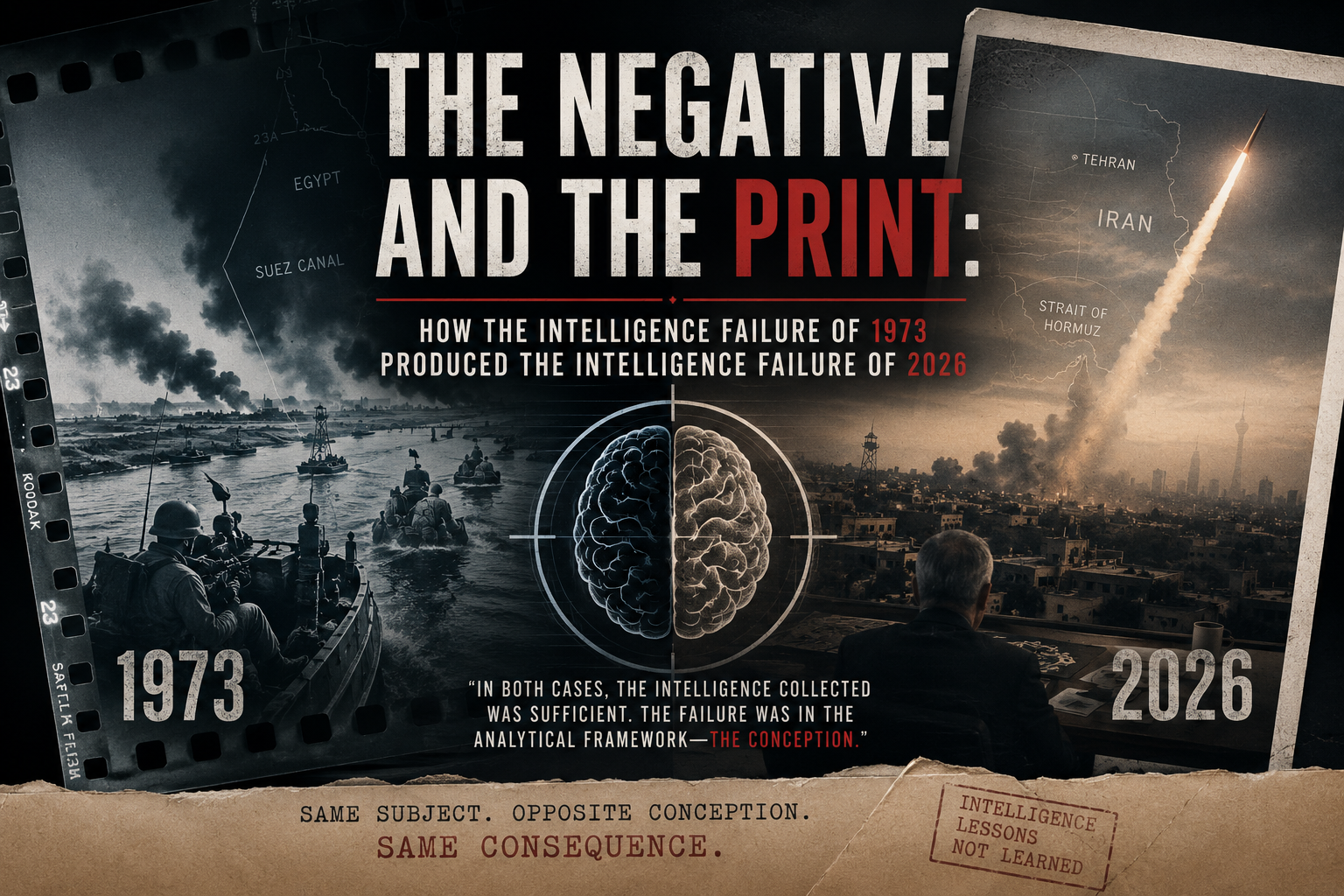
The Negative and the Print: How the Intelligence Failure of 1973 Produced the Intelligence Failure of 2026

Introduction
According to Simcha Dinitz, “Israel’s Intelligence, known to be among the best in the world, was always able to supply crucial and accurate data on countless tactical moves and military movements by the enemy, but failed to predict in advance any of the wars, and the one peace that came about…”.
Drawing on Simcha Dinitz’s remark, the article connects two landmark failures separated by five decades. On October 6th 1973, Egyptian and Syrian forces launched a coordinated assault that Aman, Israel’s Military Intelligence Directorate, had assessed as virtually impossible. On February 28th 2026, the United States and Israel struck Iran during active diplomacy, predicting rapid regime collapse, manageable missile retaliation, and a limited missile arsenal, Iranian restraint over the Strait of Hormuz, and non-aggression toward Gulf states. In both cases every prediction failed. In both cases, the intelligence collected was sufficient. In both cases, the failure was in the analytical framework -the conception-through which information was processed and converted into strategic and operational assessment.
The article’s main thesis is that these failures are causally connected. The root of the 2026 intelligence failure lies in the 1973 intelligence failure and its consequences. The collective trauma it generated activated a series of underlying assumptions and beliefs that created the second conception in 2026. We might say that the two failures are connected like the negative of a film and its printed photograph. The subject is the same — an intelligence failure caused by a dominant analytical paradigm — but expressed in a diametrically opposite way.
Before proceeding, two methodological notes are worth acknowledging. First, findings regarding 2026 remain provisional, pending fuller documentary evidence. Primary sources consist of real-time reporting, think tank assessments, and official statements whose full context is not yet established. Secondly, the paper makes no argument about the justice or legality of military action — only that the analytical framework through which the threat was understood was partial in ways that structurally distorted operational planning, in a manner directly analogous to 1973.
Defining Intelligence Failure
First, we must clarify the difference between an “intelligence error”, that is, a mistake in the analysis of incoming information, and an “intelligence failure.” Rob Johnston defines intelligence errors as “factual inaccuracies in intelligence analysis stemming from inadequate or incomplete data” and intelligence failures as “the systemic surprise of the intelligence organization resulting from incorrect, missing, rejected, or inadequate assumptions.” Consequently, an intelligence failure is a broader, systemic breakdown within the intelligence organization itself — one that leaves leadership caught off guard due to flawed, overlooked, or entirely absent analytical assumptions.
With this distinction in mind, we propose the following definition grounded in the characterization of strategic surprise found across the academic literature:
“Intelligence failure is a sudden realization that the intelligence services and the political and military leadership of a country were operating based on a flawed perception of the strategic environment. They either failed to correctly assess the magnitude of a serious emerging threat directed against the vital interests of the state, in some cases overestimating it and others underestimating it, or failed to take advantage of an emerging opportunity to advance them.”
Underestimating a threat leads to strategic surprise, and overestimating leads to false warning. When a false warning is accepted as credible, the consequences extend well beyond the immediate situation. Tangible resources such as finances and military assets are needlessly mobilized, but perhaps more damaging is the erosion of intangible assets — most notably, a nation’s international credibility and its diplomatic standing. During the Cold War, and particularly during periods of high tension between the US and the USSR, one of the most important functions of American intelligence was to convey, “Today is not the day.”
The Conception in Intelligence Analysis
In intelligence analysis, a flawed perception of the strategic environment, if left unchallenged over time, becomes a “conception”. In the immediate aftermath of the 1973 war, the term “conception” was used in Israeli strategic discourse to characterize the prevailing intellectual framework that had made the Arab attack imperceptible. In the broader literature of intelligence studies and philosophy of science, it belongs to a family of concepts whose most influential formulation is Thomas Kuhn’s theory of the scientific paradigm.
A conception operates with the same structure as a scientific paradigm. It is a foundational belief, one upon which an entire architecture of strategic evaluation, threat assessment, force posture, and political decision-making rests. A conception is nearly impossible to change from within the system it organizes because so much depends on it. The ramifications of forsaking it extend beyond simple intelligence error correction; they encompass institutional, political, and personal dimensions.
Every analyst whose career is built upon it, every policymaker who has publicly endorsed it, and every military leader who has organized forces around its forecasts — all have a vested interest in its preservation. The conception thus develops a kind of social immune system that neutralizes incoming evidence before it can become threatening.
The 1973 Conception
On October 6th 1973, Egypt and Syria launched a coordinated attack against Israel, which Aman had confidently assessed as impossible. The October War – the Ramadan War for the Arabs and the Yom Kippur War for the Israelis – had begun. The failure of Aman to timely predict the combined Arab attack was rooted, at the strategic level, according to the Agranat Commission, in the “Conception“. According to the Conception, Egypt would not go to war unless it acquired the capability to counter the Israeli Air Force and strike targets deep inside Israel in response to any corresponding Israeli raids. Syria would not go to war against Israel alone, without Egypt’s participation. The logic of the conception was that any attack on Israel would almost certainly fail, and since Arab leaders could presumably calculate this probability better than Israeli planners, no rational Arab leader would initiate war.
Additionally, in Israel, there was a heightened sense of security following the conquest of the Sinai and the Golan Heights, which gave Israel strategic depth and consequently the necessary time to mobilize its reserves after a timely strategic warning, which Aman’s leadership had promised it could provide. Furthermore, according to Shlomo Ben-Ami, “The politicians fully participated in creating and encouraging a national mood of complacency that penetrated the military system and was also influenced by it, thus paving the way for the success of Arab deception at the tactical level.” Trapped by perception, Aman failed to anticipate the shift in Egyptian strategy, which sought not military victory but rather to leverage a limited military conflict to force Israel to come to the negotiating table.
According to Abraham Rabinovich, the Yom Kippur War was, simultaneously, “the greatest military victory Israel has ever had and the most traumatic event in Israel’s history.” It destroyed something more fundamental than tactical security. It destroyed the confidence on which Israeli strategic culture rested since 1967: the certainty that Israeli intelligence was penetrating, doctrine superior, and deterrence decisive. As a result, the question that haunted every Israeli defense planner in the years that followed — ‘Can it happen again?’ — was the constitutive anxiety of a transformed strategic culture. In the words of Liebman:
“The residue of fears which the War raised, the fear for the viability of the Jewish state, the realization that there are safer places in the world for the Jew than in Israel, and the knowledge that Israeli sovereignty depends on the goodwill of at least one superpower, remains present in the minds of Israeli Jews.”
The 2026 Conception
The trauma of the Yom Kippur War gave birth to a new strategic philosophy centered on Israel’s survival, known as the Begin Doctrine. Its first expression was the bombing of Iraq’s Osirak nuclear reactor. This doctrine formalized what the 1973 trauma had made a psychological imperative: the principle that Israel would never again disregard a major threat, especially one with weapons of mass destruction. The cost of being wrong about an adversary’s intentions was simply too high to bear, and that preventive action, however politically costly, however legally contested, however diplomatically isolated it might leave Israel, was always preferable to the alternative of strategic surprise.
This created an analytical loop, rigorous and vulnerable at the same time. Ephraim Kahana, in his article, identified the Israeli tendency to exaggerate a threat post-1973. The 1973 trauma produced the Begin Doctrine; the doctrine in turn created the tendency to judge any major threat as existential; and Iran — with its nuclear ambitions, long-range missiles, regional proxy forces, and openly hostile rhetoric toward Israel — fit that role perfectly, thus creating the new conception. Soon the new conception was embedded deep within Israel’s institutional thinking, making it almost impossible to challenge or revise.
The perception of Iran as an existential threat was not merely a single belief but a conception of three major interlocking assumptions, each reinforcing the others. Together, they formed a foundational analytical structure that guided all aspects of Israeli threat evaluation, strategic planning, and operational decision-making regarding Iran.
The first assumption was that Iran’s theocratic leadership was seen as genuinely committed to Israel’s destruction, not performing for domestic audiences but sincerely pursuing it. Public displays like Tehran’s countdown clock and Khamenei’s statements were read as declarations of real intent. Second, Iran’s nuclear and ballistic programs were understood as the mechanism through which this destruction would eventually be realized. Third, Iran’s proxy network — Hezbollah, Hamas, Houthis, and the Iraqi and Syrian militias- was understood as a centrally directed architecture designed to encircle Israel, sustain pressure, and provide retaliatory capacity against any Israeli preemptive strike on Iranian nuclear infrastructure.
The conception rendered an alternative reading of Iran’s strategic logic, making it analytically invisible, much like the 1973 conception had made the Egyptian crossing invisible. It interpreted Iran’s anti-Israel rhetoric as a manifestation of operational purpose, rather than acknowledging its domestic legitimacy and regional strategic roles. Iran’s ideological commitment and strategic survival logic are separate concepts; combining them distorts threat assessments. Regarding the nuclear and ballistic program, an equally well-evidenced alternative reading was available: that they were primarily defensive, designed to deter regime change in the manner that had destroyed Saddam Hussein and Muammar Gaddafi after they abandoned or lacked deterrent capability. Furthermore, the conception failed to recognize that Iran’s proxy network is a constellation of independently motivated organizations with their own agendas, not simply an extension of Iranian strategy.
The political embodiment of the conception is visible with unusual clarity in the career of Benjamin Netanyahu, who has been issuing warnings about the imminence of an Iranian nuclear threat since 1992, with a consistency that has outlasted every intelligence assessment and every diplomatic development. In 1992, he told the Knesset that Iran would achieve nuclear capability within three to five years. The prediction was renewed in 1995, in 2002 before the US Congress, at the United Nations in 2012 with a cartoon bomb illustration, and in multiple formulations thereafter. The Stimson Center’s February 2026 analysis of Israeli strategic consensus documents the structural depth of the paradigm:
“Iran functions as a unifying organizing principle in Israeli national security policy. It generates broad political consensus, justifies sustained defense spending, and aligns with the post-October 7, 2023, security doctrine that prioritizes preemption and risk minimization. In that sense, the Iran file is not tied to one political figure; it is embedded in the strategic culture.”
The failure was therefore not merely operational but foundational: it converted a real, long-term proliferation danger into an urgent imminent threat. Moreover, it mischaracterized the nature of Iranian strategic logic in ways that made every specific operational prediction wrong simultaneously. The operational failures were not independent miscalculations laid on top of a correct foundational assessment; they were the direct and predictable consequences of a foundational mischaracterization of what Iran’s nuclear and missile programs were strategically for.
The Role of Conception as a Bias Generator: Comparing 1973 and 2026
One of the most important and least understood features of the conception is that it does not merely coexist with cognitive biases — it generates them. Richards Heuer, whose Psychology of Intelligence Analysis remains the foundational text of the field, captures the mechanism precisely: the analyst’s mental model governs complex mental processes that determine which information is attended to, how it is organized, and the meaning attributed to it.
The mental model – the conception – is the necessary precondition for biases, confirmation, anchoring, the availability bias, and wishful thinking to become dangerous. Without it, biases are correctable. With it, even corrective analytical techniques may fail. The conception is not tested against evidence; evidence is tested against the conception. This is the mechanism that converts an initially reasonable analytical framework, built from real experience, into an instrument of catastrophic self-deception.
Furthermore, intelligence analysis operates in classified environments, where dissent is usually circulate but is systematically discounted by those in higher echelons, before it reaches the point of decision. In addition, conceptions are tested against adversaries who actively study and exploit them using deception. These facts explain why an intelligence conception is harder to revise and often leads to intelligence failures. We trace and compare three major biases in both the 1973 and 2026 failures, demonstrating that in both cases, all information was evaluated and analyzed through the prism of the respective conception, creating the same biases but in inverted form.
Confirmation bias: In 1973, information inconsistent with the conception (the evacuation of Soviet advisors, the unusual scale of Canal-side mobilization, King Hussein’s personal warning, Ashraf Marwan’s last-minute intelligence) was subjected to intense analytical interrogation and consistently reinterpreted as non-threatening. In 2026, all threatening signals were amplified (the inflammatory rhetoric, the extent of nuclear and ballistic programs), while information inconsistent with the conception of the IAEA’s finding of no evidence of an active Iranian weapons program and US intelligence reports that contradicted the threat assessment was ignored.
Availability bias: In 1973, the Six-Day War’s humiliation of Arab armies was the most available image of Arab fighting ability, causing Israel to disregard evidence of Egyptian adaptation and improvement. In 2026, the most available precedents were the instances of Iranian retreat under pressure: the relatively restrained response to the US killing of Soleimani in 2020, the absence of escalation following the June 2025 nuclear site strikes, the pattern of Iranian proxy caution in the face of direct Israeli military action, and the failure of Iran to support its proxies Hamas and Hezbollah after 2023 terror attacks. These precedents provided little basis for evaluating Iran’s genuine capacity for escalation, including attacks on Gulf states and closure of the Strait of Hormuz.
Wishful Thinking: In 1973, wishful thinking ran toward inaction. The Blue-White mobilization of April 1973 had cost Israel millions, generated political embarrassment, and damaged the credibility of future warnings. A second mobilization within months was institutionally intolerable. The conception provided the analytical basis to believe what this constellation of incentives required: that Sadat was bluffing, that the Egyptian mobilization was another exercise, that the strategic situation was under control. In 2026, wishful thinking ran in the opposite direction toward action. The conception of Iran-as existential threat provided the analytical basis to believe what policymakers wanted to believe: that Iran was vulnerable, that the regime was fragile, that military action would produce rapid results, and that the massive protests and the high death toll numbers in January 2026 confirmed the regime’s terminal crisis, and that despite a crucial indicator namely the willingness of the regime to massacre its own people, pointed to the regime’s resilience as stated by General James Mattis.
Conclusion
The article has advanced three connected arguments. First, the 1973 and 2026 intelligence failures share an identical deep structure: in both cases, a dominant analytical paradigm – a conception – organized the entire interpretive framework through which warning signals were processed, filtering out the evidence that would have corrected it.
Second, the two failures are not merely analogous but causally connected: the trauma of 1973 through the Begin doctrine generated the institutional corrective that became, over five decades, the second conception. Where the first conception underestimated the genuine threat, the second overestimated it. The relationship is that of a photographic negative to its print: the same subject — paradigmatic blindness to an adversary’s actual strategic logic — expressed in precisely inverted tonal values, the second image causally generated by the first.
Third, in both cases, the conception was not merely an intelligence error, but the active generative source of the cognitive biases that converted ambiguous evidence into false certainty. The individual biases were the conception’s instruments; the conception was their organizing structure. Correcting the instruments without dismantling the structure has never been sufficient. It was not sufficient after 1973. It was not sufficient before 2026. The watchmen fell asleep in 1973. In 2026, they were wide awake — and still could not see what was coming.


