





Defeating Dialectic and Alchemic Warfare in Cognitive Operations: Reclaiming Rational Doctrine for Western Resilience

Editor’s note: The word ‘Israeli’ was removed from the phrase ‘Israeli intelligence operative’ as it pertained to Oriane Cohen.
After years of layered, sequenced, and cumulative operations in the information environment, the corrosion of Western cohesion is no longer difficult to see. The central problem is not simply that hostile actors are active in the cognitive domain. It is that Western institutions have repeatedly allowed adversaries to define the terrain, tempo, and tactics of the fight. This essay argues that the West remains trapped by a doctrinal flaw that is simultaneously epistemological, ontological, and operational.
Epistemologically, Western institutions continue to assume that transparency, proceduralism, and coordinated messaging can stabilize reality, even when hostile actors weaponize ambiguity, emotional overload, and frame capture. In practice, this “transparency” is selective and instrumental, deployed as a shield rather than a discipline, while cognitive warfare assets dabble in “taking the initiative” by imitating the enemy’s signature tradecraft, with little effort to decompile its actual components or operational design.
Ontologically, we still imagine conflict as if it were primarily a contest among visible sovereigns, formal institutions, and discrete narratives, when in practice cognitive warfare increasingly operates through deniable distributed networks, clandestine platform architectures, and informal leverage which is rarely sufficiently demystified, investigated or attributed—at least officially. Operationally, this mismatch has pushed NATO and related Western institutions into a reactive fight on terrain chosen by our adversaries.
Western institutional mitigation efforts are suffering from reactiveness and programmatic responses that lack a deeper doctrinal foundation—as if there were a tacit agreement among practitioners and command to pretend that the enemy not only plays according to our rules, but that we have him on the run. Desperation is in the air, but unfortunately, the direction we are driving in will likely aggravate the situation, since the more panic sets in, the more attractive the delusions to “outsmart” the enemy by beating him with our enhanced versions of his own tactics. Such maneuvers, however, demonstrate a lack of understanding the operational and strategic depths of the adversary’s order of battle.
Hostile Actors
In this context, the term “hostile actors” refers primarily to foreign adversaries and strategic competitors already recognized in U.S. and allied frameworks—most notably Russia, China, Iran, North Korea, and other state or state‑linked entities—whose combined information, cyber, and influence operations deliberately target Western perception and decision‑making below the threshold of open war.
Yet if hostile cognitive campaigns were only external and recognized as such, the problem would be simpler. The last decade has shown that operations like the QAnon complex—whatever mixture of foreign, domestic, and opportunistic actors ultimately lies behind it—can run for years inside Western information environments, shaping belief, behavior, and threat perception at scale while receiving, at best, superficial and often deflective mitigation. Investigations have primarily focused on symptoms rather than attribution.
In effect, this raises a second question: if billions in Western capabilities and resources have been devoted to countering cognitive threats, how is it that such an operation could so deeply penetrate domestic consciousness without a proportionate, transparent, and effective response?
Components of Cognitive Campaigns
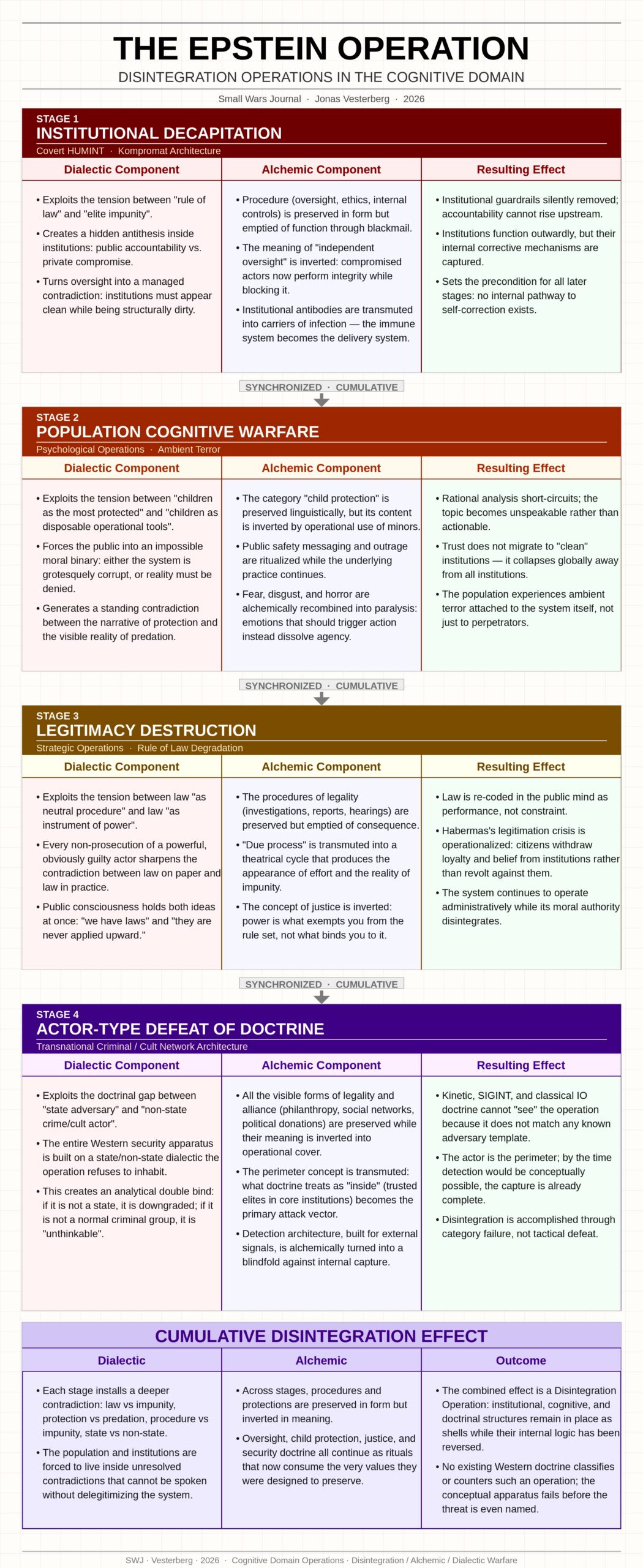
Cognitive warfare campaigns against the West can be understood through two interlocking lines of operation: dialectic warfare and alchemic disintegration. Dialectic warfare traps the target in a reactive battlespace. It forces the opponent to respond inside categories, crises, and symbolic frames selected and designed by our adversaries, thereby surrendering initiative over timing and meaning. Alchemic warfare works at a different level. It does not merely circulate falsehoods; it corrodes stable identity, institutional confidence, and the population’s shared sense of reality through inversion, symbolic manipulation, guilt, spectacle, and managed contradiction.
This distinction matters because it clarifies why many Western responses underperform. If the problem is treated as a collection of isolated disinformation artifacts, extremist pathologies, or messaging deficits, the deeper structure of the operation remains intact. The objective is not only persuasion on discrete issues. It is fragmentation, demoralization, and the degradation of the target’s ability to distinguish signal from noise, truth from spectacle, and authentic civic conflict from engineered destabilization.
This is also why the distinction between narrative warfare and cognitive warfare matters. Narrative warfare still suggests competition among stories, claims, and symbolic packages. Cognitive warfare goes deeper. It targets the interpretive apparatus itself: how human beings classify, trust, remember, and decide. This includes the ability to distinguish rumor from evidence, assign credibility to institutions or witnesses, remembering relevant contexts, and deciding which claims warrant action rather than reaction. Once this apparatus is destabilized, even true information can become cognitively corrosive, because the person or population no longer possesses a stable framework to receive it. As an example, this could be due to the degradation of public trust and the collapse of institutional integrity.
Dialectic Warfare
Dialectic warfare is perhaps not a common concept in contemporary research and doctrine—but it should be. The term “dialectic” comes from philosophy, most famously from Hegel, who theorized that history and thought advance through conflict between an initial position and its negation, producing a new synthesis. In a military‑political register, dialectic warfare exploits that logic by staging or amplifying conflicts for the purpose of forcing an opponent into reactive counter‑moves, then harvesting the resulting “synthesis” on terrain chosen in advance by the attacker.
Beyond Hegel, Marx, Gramsci, Merleau‑Ponty, and Marcuse all treated the dialectic not just as a logic of ideas but as a practical method for provoking, sustaining, and steering social conflict, with the aim of dissolving existing orders and bringing new ones into being. Foucault and Derrida pushed this trajectory further, normalizing permanent critique, inversion, and deconstruction. It is in many cases this repertoire that adversaries now adapt, often without attribution, in dialectic warfare against Western polities.
Alchemic Warfare
Alchemic warfare is defined here as the deliberate reshaping of society and power relations through clandestine, manipulative, and opaque tactics which bypass democratic deliberation and lawful institutional procedure.
In its ancient philosophical and mystical sense, alchemy meant transforming one thing into another through secret knowledge and obscure rituals. Political alchemy applies the same logic to societies and institutions: it seeks to recast them into something they are not through covert means.
Dr. Agnes Horvath’s work on liminality provides a deeper analysis of what this kind of warfare does. In her account of political alchemy, “useful idiots” with idealistic visions of societal improvement contribute to the dissolution of familiar, functioning identities and institutions, causing destabilization and insecurity—replacing them with societal constructs disconnected from common norms and popular legitimacy. This is why alchemic warfare should be understood as fundamentally opposed to the Western commitments it exploits.
Hans Christian Andersen’s The Emperor’s New Clothes captures the basic mechanism: nothing is there, yet everyone is compelled to affirm that something is there because the interpretive frame has already been captured.
Alchemic warfare is a formidable threat to democratic societies, as it can maintain form and structure but erase or distort contents. The result is not simply deception but disorientation: citizens can still see events occurring, yet they can no longer determine what those events mean, who is acting, or whether institutional language corresponds to institutional behavior.
Western Vulnerability
Western societies—defined here not as a claim of moral perfection, but as shorthand for nations whose constitutional self-understanding still rests, however unevenly, on democracy, free expression, reason, and the rule of law—necessarily embody certain civilizational conditions that make legitimate authority possible. The problem is that these same societies have often responded to cognitive warfare with frameworks that weaken the very ground they claim to defend.
If Western doctrine is serious about defending democratic civilization, then it cannot treat its civilizational foundation as illegitimate—nor its civilian populations as expendable surfaces for experimentation, perception management, or managed unreality. A doctrine that preserves state machinery while leaving the public open to cognitive disintegration has already surrendered its civilizational purpose.
That is why this is not merely a technical or psychological problem. It is a political one. A polity depends on a minimally shared reality within which disagreement can remain intelligible, institutions can remain legible, and decisions can retain legitimacy even when contested. Once that common frame disintegrates, power flows toward those actors best able to manipulate ambiguity, manufacture emotional tempo, and exploit the resulting dependency.
An expert on Gray Zone operations, former intelligence operative Oriane Cohen has described in detail how contemporary power operates through fluid architectures, distributed “conspiracy‑like” networks, and defaults that present themselves as mere normality. Yet having acknowledged the existence of these opaque networks, her argument then recenters a new arbiter of reality: a vantage point from which she decides which perceptions of these structures are lucid and which are paranoid, which actors are to be taken seriously, and which are dismissed as deluded.
In effect, this contradictory take is useful for our analysis, insomuch as Cohen concedes a conspiratorial architecture of power while simultaneously claiming the authority to police who is allowed to see it and how. This is precisely the epistemic asymmetry that cognitive warfare exploits: those closest to the machinery insist that they alone can distinguish reality from “conspiracy,” even as they admit how little of that machinery is visible to the public.
The NATO Gap
NATO’s current posture remains structurally constrained by the assumptions above. NATO’s Strategic Concept emphasizes resilience, deterrence, and defense across domains, while its policy on Strategic Communications stresses coherence, coordination, and deconfliction. These are necessary functions, but they still assume that reality can be stabilized through better synchronization of official narratives rather than by hardening the population’s underlying interpretive integrity.
NATO’s own chief scientist reporting on cognitive warfare, however, warns that adversaries target perception, cognition, and decision-making across the bio-psycho-social domain rather than merely information content. In other words, the alliance increasingly understands the threat analytically while remaining insufficiently adapted to it doctrinally.
That gap is visible in recent work from the field. For example, Dr. Remi Whiteside argues that the U.S. Army lacks an institutionalized program-of-record to train information professionals to detect and scrutinize malign information in the open information environment. His later work on large language model poisoning and adversarial noise frames an emerging kind of ontogenic warfare: attacks on the conditions that allow coherent shared reality to form.
According to Sarah P. White, the U.S. Army’s entire doctrinal trajectory from C3CM (1981) through Information Warfare (1993) through Information Operations (1996) through MISO (2010) through Information Advantage (2020) has been reactive at each stage—driven by the need to counter adversary capabilities first, then retrofitted with a positive doctrine, none of which having produced an enduring framework.
In the European theater, Dr. LtCol (Ret.) Arne Norlander has for years treated cognition and complex adaptive systems as primary operational concerns within NATO-related research, including work on indicators, warnings, and responses for cognitive warfare in cyberspace.
Together, these sources point to the same conclusion. The problem is not that Western institutions are unaware of cognitive warfare. The problem is that they still struggle to translate that awareness into doctrine that protects meaning, legitimacy, and civilian integrity upstream rather than merely reacting downstream.
Citizens and Legitimacy
Citizens subjected to managed contradiction, symbolic inversion, and manipulative cognitive pressure by their own authorities will experience that not as stewardship but as abuse, betrayal, and alienation from their own political and institutional leaders.
This point carries strategic consequences. If Western institutions participate in alchemic or dialectical operations against their own populations, the result is not merely tactical blowback. It is political estrangement. If citizens are subjected to managed contradiction, symbolic inversion, and manipulative cognitive pressure from their own authorities, this will severely weaken cohesion—hence significantly weaken potential defense posture against an external threat actor.
Once a population begins to sense that its institutions are acting upon it as a target rather than acting for it as a public trust, legitimacy degrades from within. In that condition, even formally lawful institutions risk appearing opaque, hostile, or foreign to the people they claim to represent.
That is why a Western doctrine of cognitive warfare cannot be built on manipulative operations against the very population whose loyalty and trust constitute the polity. To do so would be a form of self-liquidation.
Somaticization
The endpoint of cognitive warfare is not simply confusion or political paralysis. It is the degradation of human agency through the disintegration of the mind. The active phase of inversion—in which good is rendered evil, truth becomes lie, and reality is recursively recoded through managed contradiction—is not an endpoint, but rather a precursor for deeper destabilization. So long as inversion remains active, it may still be resisted and reversed. But research on thought reform, coercive control, cult programming, chronic stress, dissociation, and learned helplessness makes clear what happens when such conditions consolidate.
Psychological pressure stops being merely cognitive and begins to work its way into the organism itself. Programs of identity destabilization, milieu control, induced exhaustion, and emotional overload do not simply alter opinion. They degrade executive function, weaken resistance, intensify dependency, and produce psychiatric injury with physiological consequences. Once inversion penetrates the full spectrum of the human domain in that way, the cognitive domain becomes somaticized: psycho-social pressure begins to drive chronic stress responses, somatic symptoms, and the progressive incapacitation of human action.
We have long known what happens in cultic and high-control settings: hypervigilance, anxiety, dependency, exhaustion, memory distrust, and somatic overload. The novelty today is that similar pressures can be ambiently applied at scale through digital platforms, social architectures, and information operations directed at entire populations.
This matters because the line between cognitive pressure and bodily consequence is no longer hypothetical. The literature on dissociation, trauma, coercive persuasion, and chronic stress consistently shows that sustained assaults on agency and reality-testing alter cognition, mood regulation, and somatic functioning together. The body keeps score not only of overt violence but of prolonged psychic destabilization. That is why I would argue that driven to its full endpoint, cognitive warfare becomes ontological warfare: an attack on the security of reality by targeting the epistemic layers through which reality is known and inhabited.
Legitimation Crisis
The failure of Western institutions to design, build and implement doctrine that embodies democratic norms, protects our citizens, bolsters resilience and proves effective in defeating the enemy can be traced to a structural drift that social theorist Jürgen Habermas diagnosed decades ago:
When democratic institutions can no longer produce legitimacy through genuine communicative consensus, they substitute steering—technocratic, opaque, managerial control of social outcomes. The cognitive domain became the next frontier of that substitution. Once information was reclassified as infrastructure, the agencies managing it imported the same administrative logic applied to power grids and supply chains: identify threats, neutralize variables, optimize outputs; essentially, citizens as variables.
Three compounding failures accelerated this development. First, the securitization of epistemology after 9/11 reclassified beliefs and narratives as threat vectors—which made the full apparatus of threat response applicable to domestic speech and deliberation. Second, the expert class staffing these programs was professionally formed in behavioral science, nudge theory, and computational social science: disciplines whose foundational assumption is that cognition is a mechanism to be calibrated, not an autonomy to be protected. The civilizational norm of rational agency was not consciously abandoned; it was simply absent from the professional formation of the practitioners. Third, Western cognitive operations turned inward not through malice but through a structural failure of civilizational self-awareness: institutions trained on adversary tradecraft, staffed by experts who treat cognition as a calibration problem, and compelled by Habermasian steering logic to substitute management for legitimation, reproduced the adversary’s operational logic on home soil.
The result is precisely the legitimation crisis Habermas predicted: not formal revolt, but the withdrawal of mass loyalty—disengagement, reflexive distrust, and a population that has become progressively ungovernable through the normal channels of democratic deliberation. Institutions that deployed cognitive management against their own populations in order to prevent legitimacy crises have, by doing so, produced the deeper one.
The irony is structurally necessary. Legitimacy cannot be manufactured through illegitimate means. The attempt consumes what it was designed to preserve. That is precisely why we need a new doctrine for cognitive and information operations.
Towards a Rational Doctrine
If the West is to recover the initiative, doctrine must change at the level of first principles. What is required is a doctrine capable of confronting hostile cognitive design without reproducing its logic.
None of this requires the West to imitate its adversaries. On the contrary, the first requirement of sound doctrine is to refuse the conceit that civilization can be defended through the routine violation of its own premises. The task is not to become more sophisticated manipulators. It is to become more disciplined defenders of reality, legitimacy, and public trust:
First, Western doctrine must refuse hostile frames. It should not accept adversarial premises as the neutral starting point of debate, nor allow managed contradiction to define the battlefield. We choose our own order of battle, our own weapons, and we strike at the time of our choosing. We take the initiative, and we attack with full resolve. We do not attach more interest or importance to the enemy’s activities beyond what is necessary to destroy him.
Second, it must agnostically map circulation rather than fixate only on visible authorities. Influence now moves through channels, platforms, defaults, brokers, and swarm dynamics as much as through formal institutions. Mapping circulation agnostically means accepting an uncomfortable intelligence finding: Some of the most consequential influence architecture in Western polities is not foreign-injected but domestically grown—and structurally indistinguishable from adversary tradecraft. A cognitive campaign that does not need to breach Western defenses because those defenses have been colonized by alchemic operational logic presents a threat no counter-messaging strategy can adequately address. Agnostic circulation mapping must therefore also include “friendly” nodes.
Third, it must restore epistemic friction. Open societies require institutional and cultural conditions in which claims can be tested, dissent can remain genuine, and meaning is not immediately collapsed into spectacle. Through modern history, our openness, dynamic creativity and commitment to transparency have been our core strengths—they should not be construed as weaknesses, just because the enemy want to take them away from us.
Fourth, it must protect civilians as primary terrain. Cognitive warfare doctrine that does not explicitly defend the interpretive integrity of the public is strategically incomplete and morally incoherent. Protecting civilians as primary terrain is not satisfied by a defensive posture alone. It requires an affirmative doctrinal commitment: civilian epistemic autonomy—the capacity of citizens to reason, interpret, and dissent without engineered cognitive pressure—must be codified as a defended value, not a residual assumption. The layered architecture of behavioral science units, surveillance platforms, and legal grey zones that has emerged in Western polities is not the product of individual bad actors. It is what fills a doctrinal vacuum. Doctrine that does not explicitly name and defend civilian cognitive integrity will be colonized by operational expediency
Fifth, it must renounce the temptation to turn inward with alchemic or dialectical methods against its own citizens. A polity that cognitively brutalizes its own population in the name of defending it should expect the legitimacy crisis that follows. At that point the distinction between hostile external cognitive operations and internal capture of the cognitive domain collapses. The adversary’s strategic objective is substantially accomplished not by penetrating Western defenses but by inducing Western institutions to perform the penetration themselves.
The way forward is neither surrender to opacity nor imitation of the adversary’s method. It is a doctrine of clarity, restraint, judgment, and protection: one that preserves reality against engineered obscurity and defends the people who placed their trust in us to protect them.



Jonas,
I found your distinction between Dialectic Warfare and Alchemic Warfare particularly compelling. In my view, it provides a useful conceptual framework for understanding how cognitive campaigns progressively undermine legitimacy, institutional trust, and the interpretive capacity of democratic societies. I would like to suggest one possible extension to your model: temporality.
While the article convincingly explains how cognitive operations function, it says comparatively little about how long they are designed to unfold. Yet time itself may constitute a strategic variable. Not all cognitive campaigns pursue the same temporal horizon. Some seek immediate behavioral effects during a crisis, others aim at gradually reshaping institutional legitimacy, cultural norms, or collective identity over decades. In that sense, cognitive warfare is not only cumulative, as you rightly describe, but also deeply temporal.
This perspective may be particularly relevant when comparing different strategic cultures. Western institutions often operate within relatively short political and electoral cycles, whereas some competing powers appear willing to pursue objectives across generational timescales. Such asymmetry can itself become a strategic advantage. I therefore wonder whether your framework could be strengthened by integrating a temporal dimension alongside the mechanisms you describe. Understanding not only how an operation is conducted, but also over what timeframe its effects are expected to emerge, may improve both strategic anticipation and doctrinal development.