





Gas from Above: How UAVs Are Bringing Chemical Warfare Back to the Battlefield in Ukraine
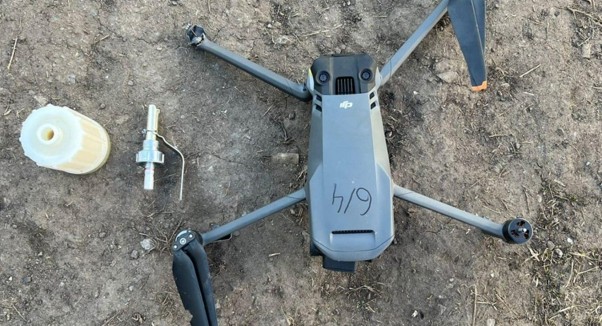

Since Russia’s full-scale invasion of Ukraine on February 24, 2022, unmanned aerial vehicles (UAVs) have revolutionized modern warfare. These small consumer-grade and home-made drones have been adapted to drop munitions, crash into targets, or supply cut-off units. Simultaneously, the war has also been shaped by significant trench warfare when opposing sides face each other from well-protected positions, and the frontline moves relatively little. In combination, both these developments have given rise to the use of UAVs to deliver chemical munitions on the battlefield as both sides struggle to dislodge entrenched enemy units. Notably, since the early 2000s, various defense contractors have worked on delivering irritant agents via drones for domestic riot control, and police forces in India and Israel have been documented using such UAVs to disperse protestors. However, the war in Ukraine appears to be the first time UAVs have been used to deliver chemical agents as weapons on the battlefield at a significant scale.
This article examines the role of drones in deploying chemical munitions in Ukraine, drawing on open-source images and Telegram posts from military bloggers as well as publicly available sources. The phenomenon is underreported but poses significant legal, ethical, and military challenges. While these chemical agents are often classified as less-lethal munitions, commonly known as tear gas and riot control agents, their use raises the specter of escalating brutality in the war in Ukraine. Importantly, the Chemical Weapons Convention (CWC), to which both Russia and Ukraine are States Parties, specifically outlaws the use of less-lethal chemical agents on the battlefield, while permitting their use for domestic riot control purposes.
The Evolution of COTS/DIY UAVs in Warfare
Once almost exclusively used for reconnaissance, small commercial off-the-shelf (COTS) and DIY/home-built drones have quickly evolved into one of the most versatile strike platforms in modern conflicts. By 2014, COTS and custom-built drones – mostly small quadcopter-type multicopter UAVs – had been modified by combatants in Ukraine to drop munitions and accurately hit targets on the ground. The relatively low cost and easy availability of COTS and DIY drones have allowed even small units to use UAVs for precise strikes and by now, UAVs have fundamentally changed the face of warfare in Ukraine.
These UAVs can be weaponized in two ways: first, by attaching a clamping mechanism to the bottom of the aircraft that allows the drone to carry a munition, which the operator can drop onto a target. Alternatively, an explosive munition can be fixed to the UAV and set up to explode on contact. Such ‘one-way-attack drones’—commonly referred to as ‘suicide/kamikaze’ drones or based on their fixed camera perspective as ‘first-person view’ (FPV) drones —can then be steered into a target and detonate upon impact. Chemical munitions are usually deployed by dropping them from drones in the war in Ukraine.
Methodology
Describing and discussing an emerging tactic in an ongoing war with any level of reliability is notoriously difficult, as information is scarce and colored by the fog of war. Thus, to describe the deployment of chemical munitions by UAVs, the author collected and verified video footage of drones dropping chemical grenades and the aftermath, usually recorded by the UAVs themselves. Further, the author collected photographs of deployed chemical munitions, analyzed them for the type of munition, the method of deployment, and, wherever possible, attempted to determine if these munitions were used by Russian or Ukrainian forces.
In addition, the author leveraged his access to Russian and Ukrainian open and closed Telegram channels where combatants and supporters communicate their experience and, for example, coordinate the crowdsourcing of UAV production for frontline troops. These channels provide insights into their users’ attitudes and use of chemical weapons, allowing for a more nuanced discussion of the phenomenon. Lastly, the author used public information provided by the Permanent Representation of Ukraine to the OPCW and from the OPCW Technical Assistance Visits to Ukraine, to supplement the analysis with a quantitative description of the phenomenon.
Overall, the author bases his analysis on videos showing 18 incidents of chemical grenades being deployed by UAV, 50 images of deployed chemical munitions, and 31 comments from Telegram users. Ukrainian state authorities have further documented more than 13,300 instances of Russian use of chemical munitions so far in the war, and provide an overview of munition types and their deployment methods. With the context established, the tactical use of drones and chemical munitions in Ukraine can be discussed.
Trench Warfare and the Role of Chemical Agents
Munitions
The vast majority of documented chemical munitions are industrially made hand-grenade-type munitions containing a less-lethal agent. Modified riot-control projectiles or improvised chemical munitions are used to a lesser extent. The hand-grenade-type munitions are attached to the UAV via a clamping mechanism that holds the spoon in place when the safety pin is pulled. Thus, when the clamp is released, the grenade’s spoon flies off, and its fuse is initiated. The clamping mechanism can be as sophisticated as a purpose-built 3D-printed mechanism or as trivial as a plastic cup holding the grenade and spoon together, which separates from the grenade while falling.
The most commonly observed type of chemical grenade is the Soviet-era K-51 grenade. However, the 2023-unveiled Russian RG-Vo (РГ-Во) grenade is also often documented. This observation aligns with the statement made by the Permanent Representation of Ukraine to the OPCW, who state “[m]ost of the [documented] munitions used (82%) were hand gas grenades of the type K-51 and RG-VO types”.
The K-51 was most likely developed in the late 1970s and is believed to contain the irritant agent chlorobenzylidenemalononitrile (CS). When functioning, the grenade continues to emit the CS agent for about 16 seconds, which is intended to fill a room of 400m2 with a concentration high enough to incapacitate unprotected people. In contrast, the RG-Vo (РГ-Во) is a new design produced in Russia, which has been documented since December 2023. According to the markings applied to the grenades, it is clear that the RG-Vo production only began in 2023. Chemical analysis of some RG-Vo grenades, have identified some containing the irritant agent chloracetophenone (CN) and others containing 2-Chlorobenzylidenemalononitrile (CS).
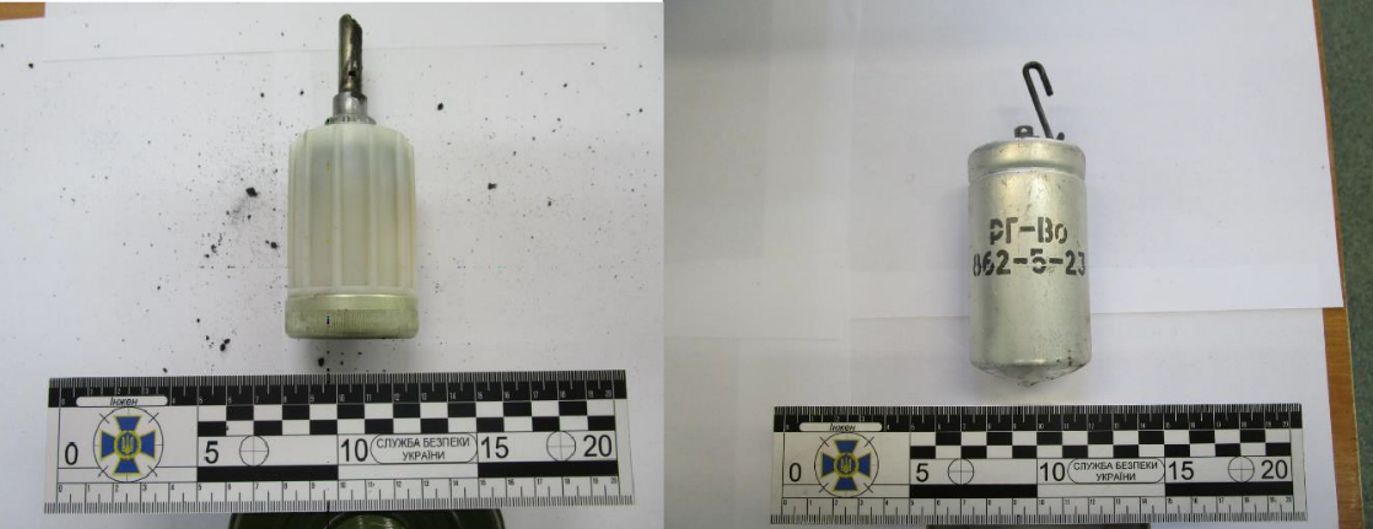
Left: A K-51 grenade with installed fuse. Right: an RG-Vo without fuse (source: Permanent Representation of Ukraine to the OPCW)
Besides these two main types, several other less-lethal grenades have been documented. Among them are RGR (РТР) tear-gas grenades and the Drofa-РМ (Дрофа-ПМ) flash, bang, and gas grenades. Besides these munitions, the Ukrainian Teren-6 less-lethal grenade was also documented on several occasions. All are believed to contain a CS or CN-based agent. Improvised chemical munitions have been documented in individual cases where, for example, an aerosol self-defense spray was taped to a modified explosive grenade, or improvised munitions containing ammonia, chloropicrin, and other irritant agents were modified to be dropped from a drone. Understanding the specific munitions used provides critical context for how these weapons are employed tactically in the field.
Tactical Use
All the videos of UAV-based strikes with chemical munitions obtained by the author show a relatively similar operation. Using the drone’s camera, the operator locates a fortified position like a trench or building, hovers over it, and precisely drops the chemical grenade. The grenade falls, ignites, and releases a dense cloud of the irritant agent. Some videos cut out at this time. However, several then show combatants running to abandon their position, only to then be engaged by mortar fire or by a second drone. One video shows the perspective of a Ukrainian soldier inside a dugout that was hit by a chemical grenade. The soldiers can be heard coughing and cursing, and are shown hastily leaving their position into an open field. The Telegram commentaries echo this effect of the chemical exposure. One commentator sums up a strike as “after a soldier falls into an aerosol cloud, he is unable to breathe normally, resist, and is forced to leave the shelter, making him an easy target for the next attack.”
The next attack typically consists of a second munition dropped either by the same drone, a second drone attack, or infantry using indirect fire weapons to attack the fleeing soldiers. Based on the collected commentaries, this double-strike tactic appears popular and effective. One comment states, “the first UAV drops a gas grenade, and the second hunts for the fleeing enemy.”. Another observer, describing the battle over a dugout, noted “This hole was repeatedly filled with [conventional] grenades, VOGs and other explosive things, the effect of which did not bear any fruit […] Now [the use of tear gas grenades] gives very good results. The enemy, like a blind kitten, crawls out of the dugout and tries to find cover by touch, then another drone throws itself along it or support weapons are used.” A Ukrainian combatant echoes the effectiveness of ‘smoking fighters out and then striking them’, he writes, “if [the Russians] can’t get us with FPVs [First-person view drones], they just throw gas grenades at us, and such people are damned.”
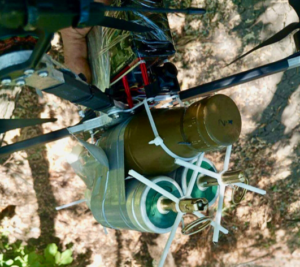
A Russian combatant holding a drone that can drop two RG-Vo grenades and is equipped with a shaped-charge warhead to engage fleeing soldiers (source: Russian social media). Note: a watermark was removed by the author using AI.
Discussion of Effect
Using gas grenades to ‘smoke fighters out’ is effective in entrenched positions because the gas cloud can reach fighters in positions that other conventional munitions may not. This forces unprotected soldiers out of their position and prevents them from returning. In one example, Russian soldiers document accidentally setting off a K-51 grenade in their shelter:
“During one of the attacks, the UAV crew and a bunch of special forces hanging around rushed into the cellar. The operator was holding a copter with a grenade attached, which they did not have time to launch. In the crowd, someone touched the fishing line attached to the pin, tore it out, and the grenade went off right in the basement. It turned out to be a real mess of those who were trying to hide in the basement (and those who were trying to get out of it). We opened the windows and doors to air it out. I tried to go into the house twice to pick up the machine gun. I managed to do it only after an hour and a half.”
In contrast, conventional high explosive fragmentation munitions (like the commonly drone-dropped F-1 hand grenade) create casualties by their fragmentation and blast effect. However, the blast effect and flying fragments of such comparatively small munitions are quickly absorbed by the ground and walls of a position. Thus, as long as a reasonably massive object separates the soldier from the exploding munition, they are generally likely to remain unharmed.
Unlike explosive munitions, the chemical munitions documented in Ukraine are not designed to kill, but to disperse a cloud of irritant gas. As discussed, the frequently documented K-51 grenade releases enough gas to force unprotected individuals out of a 400m2 room. Naturally, this cloud fills the space of a position and forces the soldiers inside it out of cover. Once out of cover, these soldiers are then easily picked off.
Continued Use
The available dataset hardly allows for a discussion of the extent to which either side deploys chemical munitions compared to conventional munitions. However, using auxiliary information, a more detailed picture can be formed. For example, a Russian commentator notes that:
“In the first days of the SVO [war in Ukraine], such grenades [K-51] were issued to the troops in boxes, apparently thinking that the enemy would have to be dispersed, like protesting grandmothers. Now their practical use remains only in this form [deployed by UAV on the battlefield], which gives very good results”.
This indicates that, initially, Russian forces were not envisioned to use chemical munitions on the battlefield but rather in their intended role as riot control tools. As the war progressed and localized stalemates set in, Russian soldiers began to repurpose these grenades and deployed them from UAVs. It appears that as this tactic became successful and the supply of chemical grenades became insufficient, new chemical grenades had to be manufactured. Based on the “862” factory code marked on the often documented RG-Vo, it is believed that one of these production lines has been established at the JSC Production Center “Research Institute of Applied Chemistry” in Russia. Thus, the existence of newly produced Russian chemical grenades and their manufacturing infrastructure – as well as their supply to the front in significant quantities – indicates that the use of chemical munitions on the battlefield is expected to continue by the Russian leadership. Further, based on all the above, it seems clear that their continued use is anticipated and the Russian leadership does not oppose this development. Taking these points together lends credence to the conclusion that Russian forces have standardized on using chemical grenades in combat, and this practice is an accepted doctrine.
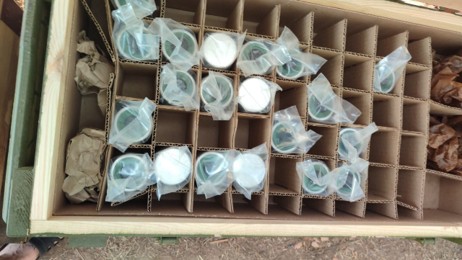
Picture of newly delivered RG-Vo to Russian forces. (source: Russian social media)
On the other hand, the author found only a small number of incidents where Ukrainian forces had used chemical munitions (mostly K-51 and Teren-6 grenades) and could not find incidents of Ukrainian Telegram users describing the handling of gas grenades or solicitation instructions for their use. Of course, the absence of proof is not, in itself, proof of absence. However, it appears that while some Ukrainian forces sporadically employ chemical grenades, the practice is generally avoided.
Conclusion
This article set out to illuminate the practice of deploying chemical munitions via UAVs in Ukraine. Based on a moderately sized dataset and secondary sources, the author was able to establish a tentative description of this tactic.
For one, it has become clear that only a handful of types of chemical grenades are frequently being used, specifically the K-51 and the RG-Vo. Secondly, the author was able to describe the pattern of use for such grenades, deployed via drone to force soldiers out into the open to be engaged by enemy forces. Thirdly, using the dataset of incidents and the reception in the Telegram groups, the author has been able to substantiate the assertion that Russian forces regularly deploy chemical munitions via UAVs and Russian leadership anticipates this to continue, supporting this tactic by supplying newly produced chemical grenades. On the other hand, Ukrainian forces have been documented to use chemical grenades occasionally; their use has, however, remained isolated.
Even though the chemical grenades discussed herein are considered ‘less-lethal,’ they clearly have a lethal effect on the battlefield. By being used in tandem with lethal munitions, UAVs and less-lethal grenades have become a deadly combination. However, this tactic also poses significant risks of escalation. For one, the less-lethal grenades are effective because they turn a significant amount of air around them unbreathable and, thus, force soldiers away from them. This effect is special because it generally cannot be achieved with explosive munitions. Thus, the more potent the agent in the chemical grenade is, the larger the area the grenade can clear of unprotected soldiers. Since there are no more potent, less-lethal gas grenades available, using lethal chemical weapons seems a logical next step in deploying chemical munitions via drones. For the moment, only time may tell whether the deployment of chemical munitions via UAVs in Ukraine will remain confined to less-lethal munitions or evolve into the use of more potent and lethal chemical weapons.
Acknowledgements
I would like to express my gratitude to Faine Greenwood, Brian Castner, and Elisabeth Baer for their invaluable feedback and support in shaping this article. Their insights and suggestions greatly contributed to improving this work.


