Member Login Become a Member
Advertisement

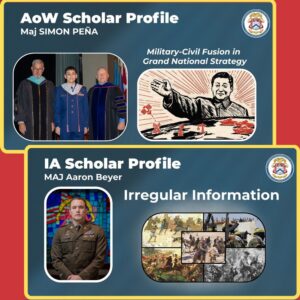
CGSC Scholar Profiles: Maj. Simon Pena and Maj. Aaron Beyer
  |  
07.23.2026 at 02:50pm
CGSC Scholar Profiles: Maj. Simon Pena and Maj. Aaron Beyer Image


How does China’s Military-Civil Fusion strategy support its 2035 and 2049 national objectives, and what are its hidden weaknesses? What lessons should U.S. and joint force leaders apply when facing this peer adversary?


In this interview, MAJ Simon Pena (U.S. Air Force), an Art of War Scholar at the U.S. Army Command and General Staff College (CGSC), discusses his MMAS thesis on China’s Military-Civil Fusion (MCF) national strategy. He explores how the PRC integrates civilian and military resources to advance its global ambitions, the strengths and significant frictions within the approach, and practical insights for officers heading to INDOPACOM and other commands.


Hosted by MAJ Tyree Meadows, the conversation covers the Art of War Scholars Program experience, the rigorous thesis process, the transformative use of AI for data analysis (sorting 650+ sources), perspective shifts during research, and the enduring value of studying military history for modern leaders.


This interview is part of the 2025–2026 Scholar Profile Interview Series highlighting members of the Information Advantage Scholars Program and Art of War Scholars Program at the U.S. Army Command and General Staff College. The series explores student research, professional development, operational insights, and the evolving challenges shaping the future of warfare and military leadership.

Topics Discussed:
  • China’s Military-Civil Fusion (MCF) Strategy
  • PRC 2035 and 2049 National Objectives
  • Strengths and weaknesses of Chinese grand strategy
  • AI-assisted research and data analysis in professional military education
  • The Art of War Scholars Program at CGSC
  • Value of military history for today’s leaders
  • Lessons for INDOPACOM and joint force operations
  • Thesis development, revision, and defense process
Interviewee: MAJ Simon Pena, U.S. Air Force (Incoming 436 Force Support Squadron Commander, Dover AFB)


Interviewer: MAJ Tyree Meadows


The U.S. Army Command and General Staff College (CGSC) develops agile, adaptive leaders through professional military education focused on leadership, operational art, history, and the evolving character of warfare.


Subscribe for additional discussions covering: Information Advantage • China Strategy • Military-Civil Fusion • Art of War Scholars • Multi-Domain Operations • Leadership • Professional Military Education • INDOPACOM
Disclaimer: The views expressed in this video are those of the individual speakers and do not necessarily reflect the official policy or position of the Department of the Air Force, Department of the Army, Department of Defense, or the U.S. Government.


Video Chapters
00:00 Introduction
00:59 Discovering the Art of War Scholars Program
01:27 What is the Art of War Program?
02:18 Application Process
03:26 Thesis Evolution & Perspective Changes
04:24 Thesis Topic: China’s Military-Civil Fusion Strategy
05:34 AI for Data Analysis (650+ Sources)
07:07 Most Surprising Discoveries & Weaknesses
08:19 Key Takeaways for INDOPACOM Leaders
09:24 Why Study Military History?
10:43 Advice for Future CGSC & Art of War Students
12:27 Closing Thoughts

How can resistance movements contribute to information advantage in modern competition and conflict?

In this interview, MAJ Aaron Beyer discusses his research on achieving Information Advantage by, with, and through resistance partners. The conversation explores how resistance networks, influence activities, and irregular warfare can shape the information environment, support strategic objectives, and create opportunities for military and national decision-makers in competition and conflict.

Hosted by MAJ Tyree Meadows, this discussion also examines lessons learned from MAJ Beyer’s experience in Psychological Operations (PSYOP), insights gained through the Information Advantage Scholars (IAS) Program, and the relationship between influence, resistance movements, and modern military operations. The conversation highlights how understanding human behavior, narratives, and partner networks remains critical to achieving information advantage in increasingly complex operational environments.

This interview is part of the 2025–2026 Scholar Profile Interview Series highlighting members of the Information Advantage Scholars Program and Art of War Scholars Program at the U.S. Army Command and General Staff College. The series explores student research, professional development, operational insights, and the evolving challenges shaping the future of warfare and military leadership.

Topics Discussed:

• Information Advantage by, with, and through resistance partners

• Resistance movements and irregular warfare

• Psychological Operations (PSYOP) and influence activities

• Information advantage in strategic competition

• Human behavior, narratives, and influence

• Lessons learned from military research

• The Information Advantage Scholars (IAS) Program experience

• Future challenges in the information environment

Interviewee: MAJ Aaron Beyer

Interviewer: MAJ Tyree Meadows The U.S. Army Command and General Staff College (CGSC) develops agile, adaptive leaders through professional military education focused on leadership, operational art, history, and the evolving character of warfare.

Subscribe for additional discussions covering: Information Advantage • Psychological Operations • Irregular Warfare • Strategic Competition • Military Leadership • Influence Activities • Operational Art • Professional Military Education


About The Author

  • SWJ Staff searches the internet daily for articles and posts that we think are of great interests to our readers.

    View all posts

Article Discussion:

0 0 votes
Article Rating
Subscribe
Notify of
0 Comments
Oldest
Newest Most Voted