





New Lessons from Côte d’Ivoire: Countering Violent Extremism in West Africa’s Borderlands

Abstract:
Recent developments in Mali and Burkina Faso demonstrate that JNIM continues to adapt operationally while extending pressure toward the northern border regions of coastal West African states. Drawing on field experience and research in northern Côte d’Ivoire, this article argues that security presence and territorial control alone will not prevent extremist expansion. For policymakers, effective counterterrorism efforts across West Africa’s peripheries require continuous understanding of evolving local dynamics, including community perceptions, governance gaps, and economic incentives that shape vulnerability to violent extremist influence.
Instability Is Building Across the Borderlands
As the French proverb goes, Petit à petit, l’oiseau fait son nid, or “Little by little, the bird makes a nest.” So too has instability in Mali spread outward, increasing pressure on countries along its southern and western flanks, notably Côte d’Ivoire, Guinea, and Senegal. On April 25, a coalition of armed groups, including al-Qaeda affiliate Jama’at Nusrat al-Islam wal-Muslimin (JNIM) and the Tuareg separatist group Azawad Liberation Front, launched coordinated attacks against government forces and their Russian auxiliaries across multiple sites in Mali, including the capital, Bamako. The collaborative nature of this attack signals a new phase in the capacity of JNIM to project territorial control within Mali’s borders. JNIM’s overt presence in areas along the border with Côte d’Ivoire is likely to persist and marks a significant shift in its operational posture.
Burkina Faso, one of Mali’s neighboring countries, continues to be highly ranked by the Global Terrorism Index as being among the countries most affected by terrorism. While total terrorism-related deaths and incidents declined significantly over the previous year, the south-eastern flank of Burkina Faso also has reemerged as an effective staging area for attacks inside neighboring Benin. On March 6, JNIM launched an attack on a military installation in northern Benin, killing and wounding at least 20 soldiers. Taken together, developments in Mali and Burkina Faso show that terrorist groups are both adapting tactically and systematically extending pressure toward the northern border regions of the coastal states, such as Côte d’Ivoire and Ghana. To date, however, this pressure has not translated into sustained cross-border attacks in Ghana or Côte d’Ivoire, suggesting a possible degree of deliberate restraint by extremist groups.
Since 2022, Côte d’Ivoire has not recorded a lethal terrorist attack on security forces, and Ghana has not experienced a major terrorist attack to date. It is important to note that the absence of attacks does not equate to the absence of terrorist activity. Porous borderlands with limited state presence enable persistent illicit trade and uncontrolled cross-border movement. Côte d’Ivoire shares hundreds of miles of border with Mali and Burkina Faso, while Ghana shares similar mileage with Burkina Faso. Despite some progress in maintaining stability and promoting growth, deteriorating regional dynamics demand sustained attention from policymakers.
Civil-military Collaboration Depends on Governance and Security Force Behavior, Not Security Presence Alone
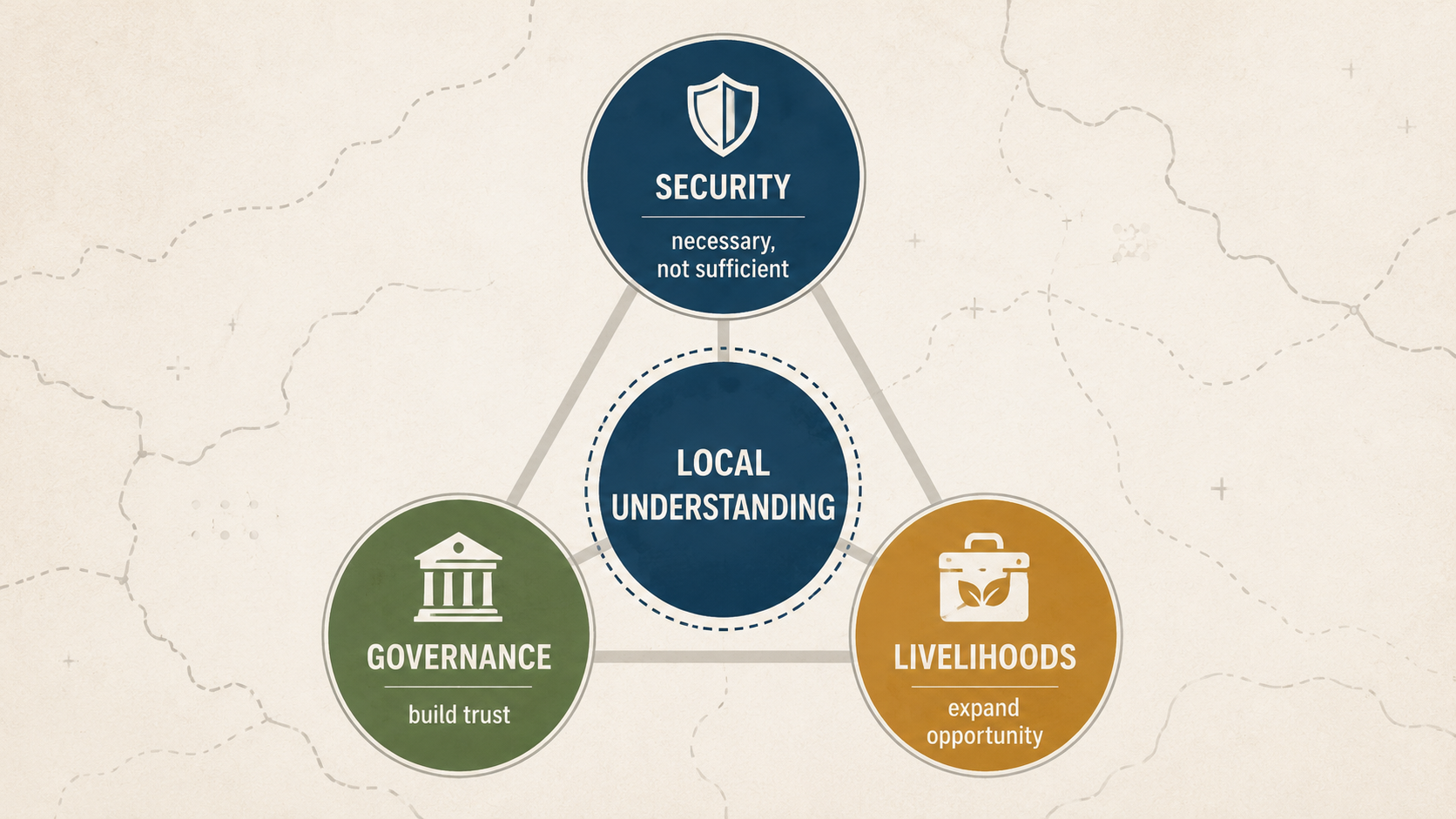
Understanding local context is key to effective counterterrorism. Doing so requires a nuanced understanding of how communities perceive security forces and government performance, what drives civil-military collaboration, and the economic incentives linked to engagement with violent extremist groups. Côte d’Ivoire invests heavily in security approaches to address terrorism. It prioritizes weapons, personnel, and intelligence to reinforce territorial control. At the same time, it acknowledges the crucial role that border communities play in collective security, including intelligence sharing, early warning, and local mediation. Alongside security investments, it supports locally driven resilience efforts focused on social cohesion, livelihoods, governance, and service delivery. From conversations with senior and local Ivoirian officials, Côte d’Ivoire recognizes that border communities do not stand passively. They react and adapt to the evolving threat situation, make rational decisions based on incentives and costs, and are willing to partner with credible government actors. Yet even these comparatively proactive approaches reveal important blind spots that extremist groups may exploit.
Since 2020, field research and longitudinal assessments, conducted to support national and foreign assistance efforts and civil-military coordination, have suggested that expanded security presence alone has not sufficiently strengthened civil-military collaboration with border communities. While “boots-on-the-ground” can convey a sense of protection against potential attacks, they also can cultivate fear in the daily lives of border communities. Additional security forces often parallel the creation of checkpoints along roadways in the northern border region. When local security officials use such checkpoints to intimidate civilians and extort bribes, they at best reduce community willingness to cooperate and at worst fuel deep-seated frustration. Such frustration allows attitudes of indifference towards or, in extreme cases, support for potential terrorist attacks against government actors. Interviews conducted in northern Côte d’Ivoire in 2024 suggest that perceptions of checkpoint corruption and abusive treatment by security actors contribute to local frustration and distrust toward state institutions. This grievance could be manipulated by JNIM as it has previously portrayed itself as an alternative to corrupt or abusive state authority. Security actor behavior around border communities may undermine the legitimacy of the state. Evidence from previous research indicates that the distance between border communities and the government is heavily influenced by the quality of their interaction with someone in uniform.
Increasing investments by the Government of Côte d’Ivoire and its international partners, including strengthening civil-military engagement, seem to be effective in some communities of northern Côte d’Ivoire. New research suggests that these communities have demonstrated a measurable increase in their capacity to resist the influence of terrorist groups. However, the same findings indicate that weak service delivery, perceived injustice, and limited community engagement in security collectively drive dissatisfaction with state security actors. These findings highlight that security actors alone do not automatically guarantee increased trust in the state. Rather, the quality and access to state-provided public services shape how communities perceive government security actors. Without credible, sustained improvements in state governance and service delivery, an expanded security presence in the border areas alone may fall short in building trust and resilience.
Economic dynamics also complicate the picture. Contrary to common assumptions, poverty alone does not appear to drive support for or engagement with terrorist groups in northern Côte d’Ivoire. Instead, field research conducted in some border communities suggests that certain individuals view engagement with extremist networks as a faster route to income than available livelihoods. In this context, vulnerability stems less from absolute deprivation than from the perceived speed and accessibility of economic opportunity. These dynamics also reflect broader perceptions of state credibility and opportunity structures. Recently completed research in northern Côte d’Ivoire further suggests that individuals with secondary education may be more likely to perceive groups affiliated with JNIM as credible alternatives to the state. These findings align with broader research from across the Sahel and coastal West Africa, suggesting that armed groups can gain local traction when communities perceive them as offering opportunities or economic access that state institutions fail to provide.
Security Alone Will Not Stop Violent Extremism
While the 2026 U.S. Counterterrorism Strategy emphasizes territorial control and the denial of safe havens, evidence from northern Côte d’Ivoire suggests that local perceptions and lived experiences shape terrorist groups’ ability to exert influence and control in West Africa. All too often, policy responses rely on broad assumptions about state security, poverty, and at-risk youth rather than a nuanced understanding of local vulnerabilities and resilience. As policymakers refocus attention on the southward spread of Sahelian instability, the experience of Côte d’Ivoire offers some important lessons. In addition to security-focused counterterrorism measures, effective strategies require continuous analysis of evolving local dynamics. Conditions are shifting, and policymakers must meet communities where they are, learn from them, and adapt policies accordingly. They should also prioritize improvements in governance and service delivery alongside improved security presence in vulnerable border areas. JNIM is building its nest across the borderlands, and without targeted, locally grounded approaches, that expansion will continue unchecked.




One of the key pieces missing is the effect of Islamic ideology on sustaining these groups and their successes. The focus on the economic benefits misses a key feature in holding the line against these groups because these alone don’t explain, for example, why the Roman Christian Empire collapsed in the 1600’s. Islam offers a life beyond death, provided one is faithful, and this faith will sustain a person’s commitment beyond the economic or political struggle. By adhering to the tenets of Islam, one is guaranteed many benefits in the afterlife, which includes dominating one’s enemies, especially their women. A terrorist group focused only on “political” or “economic” ends eventually fails to deliver, but a faith-based one cannot be destroyed, only contained. The nations mentioned only offer the “here and now” and nothing of permanence, especially as there is no compelling ideology behind their actions. They change leaders who often have no apparent moral code, whereas in Islam the leaders only are temporarily in charge of enforcement. The rules are immutable and apply to all, regardless of individual behavior or position.
The article should address why these groups are successful as that truly is the key to national resistance. As in Vietnam, the eventual defeat of the South was due to the lack of a philosophy which would let the people tolerate government oppression. The VC and North Vietnamese terrorized communities but offered something more than security or “peaceful existence”. They offered independence and a stable government with immutable “justice”, along with a timeline of history which would crown their efforts with success beyond the current generation. Sacrifice was an explicit part of the commitment required.
As is seen with Iran, as indicated with Germany and Japan in WWII, ideology is broken only by the complete destruction of its structure and not by eliminating the idea itself. Containment is the key and succeeds only if there is a competing ideology backed by great force and a sense of justice. None of the nations mentioned, and too few around the world have such an underpinning. Why else would harsh Sharia law exist otherwise? It is because of the Faith it supports, not because it promises richness across the board.
A final comment: humanity for nearly all its history has been ruled by monarchies of various sorts, from kings to a few oligarchs, who dispense justice and compliance. Islam sets the authority even higher. Those in charge submit to Islam first and are legitimate only as long as they follow the faith, unlike what is expressed in our Declaration of Independence as the proper duty of government.