





Winning the Peace, One Cell at a Time

Out-Governing the Insurgency
From the beaches of Lamu to the mangroves of Mocímboa da Praia, the Swahili Arc forms a single cultural and economic corridor that binds Somalia, Kenya, Tanzania, Mozambique, and the Comoros into a shared space of movement, trade, and identity. It is a region where people and goods travel faster than state authority, and where governance is often negotiated rather than imposed. Across this arc, and deep into the interior through Malawi, the eastern Democratic Republic of Congo (DRC), and the Great Lakes, insurgent groups have learned to exploit the seams of state control more effectively than the governments that claim sovereignty over them. The Allied Democratic Forces (ADF) in eastern DRC and Ansar al‑Sunna Wa‑Jama’a (ASWJ) in Mozambique, both designated terrorist organizations responsible for severe harm and human rights violations, have demonstrated a capacity not only to survive military pressure but to embed themselves as alternative governing authorities. Armed Conflict Location & Event Data Project reports that more than 200 civilians were killed in a series of ADF attacks across North Kivu and Ituri in early 2025, while conflict‑monitoring organizations estimate that ASWJ violence in Cabo Delgado has resulted in over 4,000 civilian deaths since 2017. Their resilience is not a mystery; it is a governance problem. As Phillips and Kwayu argue in their study of Tanzania’s ten-cell systems, rural governance structures endure when they function as “an infrastructure of rural statecraft but also of rural citizenship,” enabling communities to meet basic needs even when the state is weak. This insight helps explain why insurgents across the Swahili Arc continue to out‑govern formal authorities in contested spaces. In effect, where household‑level governance structures are absent or hollowed out, groups like ASWJ step in to perform the everyday functions, dispute resolution, protection, taxation, and social regulation that communities depend on, allowing them to convert state weakness into local legitimacy.
The central challenge facing East Africa is not simply defeating insurgents on the battlefield. It is out-governing them. Insurgents thrive where the state is absent, predatory, or distrusted. They provide dispute resolution, taxation, protection, and rudimentary social services in places where the state has failed to deliver. Their ability to function as proto-states is the foundation of their durability. Insurgents do not merely exploit governance vacuums; they actively manufacture them. By targeting local administrators, teachers, and health workers, they collapse state presence and force communities into dependency, creating political space in which their authority becomes the only functioning alternative. This mirrors governance‑seeking insurgencies from Mali to Afghanistan, where armed groups deliberately degrade state capacity to elevate their own legitimacy.
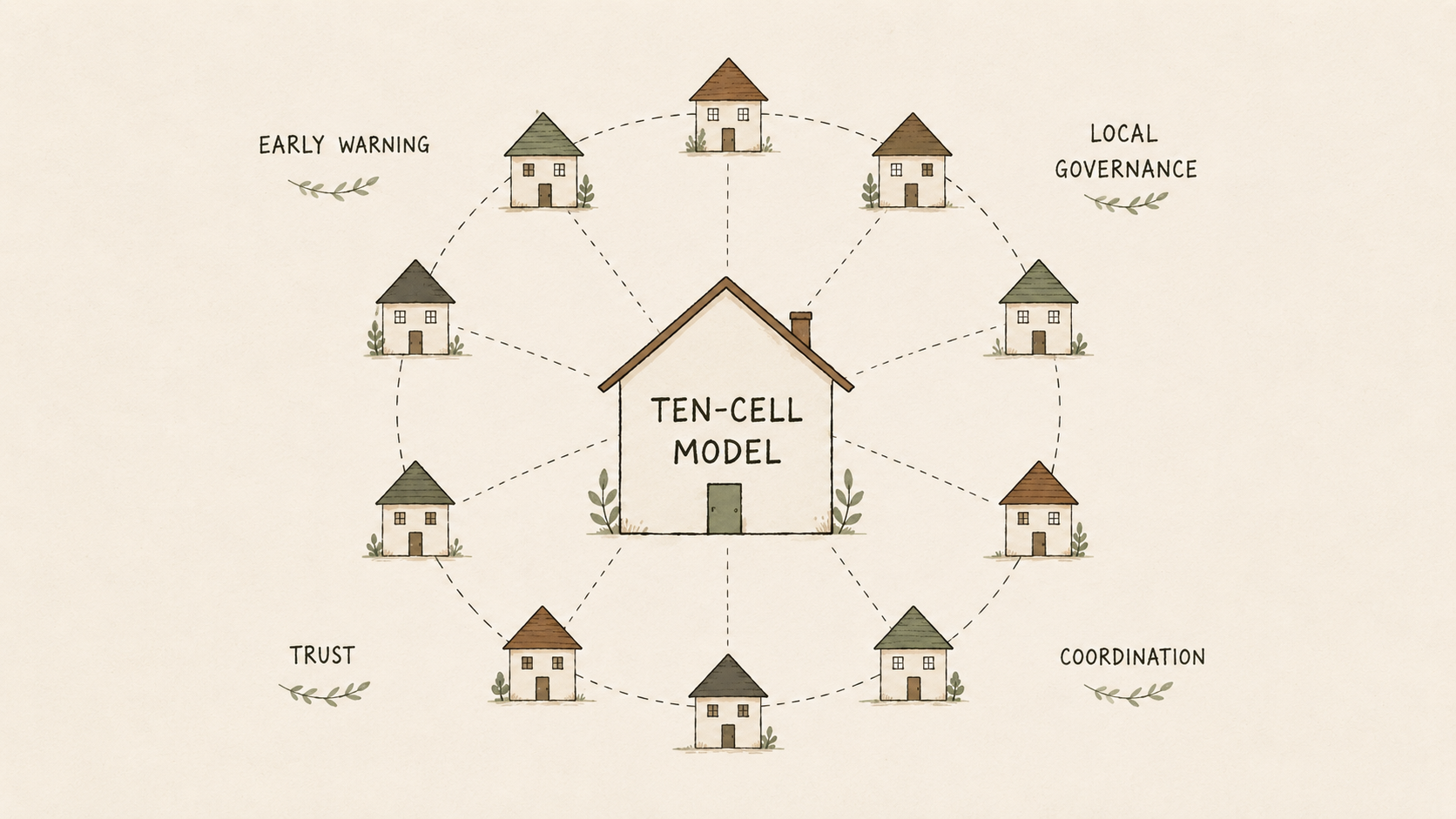
The ten-cell security model underscores the challenges and opportunities of modern governance in Africa. Tanzanian communities historically used the ten‑cell system to “exercise (and grow) the functionality of the state from below,” a pattern that insurgents now mimic by embedding themselves in the everyday governance needs of marginalized populations. To break this cycle, East African governments must reinvest in the granular, community-anchored security architecture that denies extremists the ability to embed themselves in society. A unique entry point and foundational platform for bottom-up governance is the ten-cell (Nyumba Kumi) system, a decentralized governance structure with deep roots in Tanzania and Kenya. Its persistence, even after Tanzania transitioned to multiparty politics, demonstrates the durability of people‑based infrastructures that are transparent, modular, and embedded in community practice. But for this model to succeed, it must be implemented not only nationally but regionally, across the interconnected spaces where migration, trade, and extremist networks converge. These networks operate on predictable rhythms, market days, fishing seasons, trucking timetables, and religious calendars, which insurgents map with precision. States, by contrast, rotate personnel frequently and rarely maintain a persistent presence along these corridors, creating an asymmetry that extremists exploit with ease. Embedding a household‑level governance system across these corridors would reduce this asymmetry by creating a continuous, community‑anchored visibility grid that insurgents cannot easily bypass. In essence, the state must harness the Nyumba Kumi before the insurgents.
The Governance Contest: Why Insurgents Endure
The ADF and ASWJ have survived years of military pressure because they operate as governing entities in areas where the state is weak. In eastern DRC, the ADF has built parallel systems of justice, taxation, education, and healthcare, exploiting the chronic absence of state institutions. UN Group of Experts Reports on the Democratic Republic of Congo have repeatedly documented the ADF’s ability to administer territory and regulate local populations. In Mozambique’s Cabo Delgado, ASWJ capitalizes on grievances around natural gas extraction, land dispossession, and corruption to present itself as a more just alternative to the state. International Crisis Group’s analysis of the conflict shows how ASWJ frames itself as a defender of marginalized Muslim communities excluded from the benefits of the gas boom. Crucially, these groups do not simply fill governance vacuums; they deliberately create them. By assassinating local officials, intimidating teachers, and destroying administrative infrastructure, they collapse state presence and force communities into dependency. This strategic degradation of governance mirrors patterns seen in Mali, northern Nigeria, and Afghanistan, where insurgents weaken already fragile and neglectful state institutions to elevate their own authority. Such vacuums emerge most sharply where communities lack stable, embedded structures of everyday governance, leaving them exposed to alternative authorities that step in to perform essential functions.
This legitimacy crisis is not confined to national borders; it is regional in scope. Mozambique’s Cabo Delgado insurgency spills into southern Tanzania, exploiting porous borders and shared Swahili‑Muslim identity. Malawi serves as a transit corridor for human smuggling, illicit minerals, and extremist recruiters moving between Tanzania, Mozambique, and South Africa. Armed Conflict Location & Event Data shows that extremist networks use Malawi’s M1 and M5 corridors to move people and goods undetected. Eastern DRC remains a sanctuary for ADF fighters who move across Uganda, Rwanda, Burundi, and Tanzania through the Great Lakes trade routes. Also, the Institute for Security Studies Africa indicates that Kenya’s coast continues to be a recruitment and financing hub for extremist networks linked to Somalia’s al‑Shabaab. These cross‑border dynamics highlight the absence of the kind of hyperlocal visibility and relational accountability that Nyumba Kumi historically provided in rural Tanzania.
These flows are facilitated by the same infrastructure that sustains legitimate commerce: fishing dhows, trucking corridors, informal markets, and cross‑border kinship networks. Insurgents understand these systems intimately. States, by contrast, govern them lightly or not at all. What makes these networks so resilient is their predictability. Trade and migration corridors operate on fixed rhythms, market days, fishing seasons, trucking timetables, and religious calendars, which insurgents map with precision. State forces, which rotate frequently and lack local language skills, rarely maintain a persistent presence or human sensors along these routes. This asymmetry allows insurgents to move with ease while states respond episodically and often too late. The absence of durable, community‑anchored governance structures, those that persist beyond state personnel cycles, creates openings that insurgents exploit with ease.
Why Current Approaches Fail
Beyond the absence of formal governance, regional responses have been overwhelmingly kinetic. Uganda and DRC have launched joint operations against the ADF under Operation Shujaa. Rwanda and SADC forces have deployed to Mozambique through the SADC Mission in Mozambique (SAMIM). These operations have degraded insurgent capabilities but have not dismantled their local sustainment networks. They succeed tactically but fail strategically because they target symptoms rather than the governance conditions that allow insurgents to regenerate. Short‑term operations cannot substitute for governance systems that must be rooted, negotiated, and continuously maintained at the community level. Ultimately, three structural failures persist.
The first is a fragmented regional security architecture. The East African Community (EAC) deploys forces in eastern DRC, while SADC operates in Mozambique. Tanzania is the only country straddling both blocs, yet coordination remains limited. Insurgents exploit these institutional seams. ADF and ASWJ understand these bureaucratic divides better than the states confronting them, using cross‑border mobility to evade pressure and reconstitute cells in jurisdictions where coordination is weakest. These gaps mirror the broader unevenness of state reach, where infrastructural voids create opportunities for non‑state actors to entrench themselves.
The second failure is the pattern of civilian displacement and mistrust that follows heavy‑handed operations. Communities uprooted by fighting become vulnerable to recruitment, and the state’s legitimacy erodes further. United Nations Development Program reports show that displacement in eastern DRC and Cabo Delgado has reached historic levels, creating new humanitarian and security challenges. Every new wave of displacement expands the pool of ungoverned people, precisely the population insurgents target with promises of protection, justice, and economic opportunity. Where trusted, proximate intermediaries are absent, states struggle to rebuild legitimacy after displacement.
The third failure is the inability to hold territory after clearing it. States often retake ground but fail to build governance structures or to anchor them to pre-existing local authorities to prevent insurgents from returning. This is the classic “clear without hold” dilemma that has plagued counterinsurgency campaigns from Afghanistan to the Sahel. Without a trusted, community‑anchored presence to fill the vacuum, cleared areas revert to contested spaces within weeks or months, allowing insurgents to re‑embed themselves with minimal resistance. The lesson here is clear: military force can clear territory, but only governance can hold it. Enduring stability requires governance infrastructures that are people‑based, routinized, and socially embedded—not temporary extensions of state coercion.
The Ten‑Cell Model: A Grassroots Security Architecture
The ten‑cell (Nyumba Kumi) system offers a way to embed governance directly into communities. It is intentionally simple, one leader for every ten households, but its effectiveness depends on how it is embedded in local political and social conditions. In Kenya, studies in Kayole, Nairobi County, show that 86% of residents were aware of Nyumba Kumi, based on a survey of 300 respondents, though youth participation remained limited. A more recent study in Nairobi City County found that 61.5% of respondents rated community partnership levels as strong, and 50% rated Nyumba Kumi as very effective in reducing crimes such as theft, robbery, and drug‑related offenses, drawing on a mixed‑methods study with 270 valid responses and a 95.7% response rate. These findings highlight that the model improves information flow, strengthens early warning, and enhances community–police cooperation where trust and institutional support are present. In Tanzania, where the ten‑cell structure has deeper historical roots, governance research notes its role in dispute resolution, neighborhood surveillance, and monitoring of new arrivals, particularly in urban areas such as Dar es Salaam and rural districts in Kilimanjaro and Arusha, though its effectiveness remains highly dependent on local cohesion and accountable leadership. Together, the evidence suggests that Nyumba Kumi can deliver meaningful security gains, but only when implemented with community consent, clear accountability, and safeguards against politicization or coercive misuse. Its durability in Tanzania shows how people-based governance structures can endure when woven into everyday social life rather than imposed from above.
Applied to insurgency‑affected regions, the ten‑cell model can be the tip of the spear of national security. It can create a decentralized intelligence grid capable of identifying newcomers, detecting suspicious movements, monitoring early signs of radicalization, and reporting extremist preachers or recruiters. In places like Beni, Butembo, and Ituri, where the Allied Democratic Forces (ADF), a violent extremist organization responsible for severe harm and human rights violations, blend into civilian populations, this granular oversight is invaluable. UN Group of Experts reports have repeatedly documented how ADF fighters exploit weak local governance and porous community structures to move undetected. This level of micro‑visibility is something national forces cannot replicate but can certainly harness; only embedded community structures can detect the subtle behavioral shifts that precede insurgent infiltration. This level of micro-visibility is something national forces cannot replicate but can certainly harness; only embedded community structures can detect the subtle behavioral shifts that may precede insurgent infiltration. Such shifts may include small but telling deviations from routine: an unfamiliar newcomer avoiding ordinary community registration or interaction, a household receiving late-night visitors, or a trader altering long-established travel patterns. These signals are often immediately legible to neighbors but invisible to external security forces. Such micro‑visibility is possible only when governance is anchored at the household level, where social familiarity and routine interaction make anomalies immediately noticeable.
The ten‑cell model also restores the social contract. Insurgents thrive where the state is absent. By bringing governance to the household level, the ten‑cell system provides a mechanism for resolving disputes, addressing land conflicts, and rebuilding trust between citizens and the state. It offers a functional alternative to the proto‑state governance provided by insurgents. Traditional chiefs often govern large territories and are vulnerable to corruption. Ten‑cell leaders, by contrast, are accountable to their immediate neighbors and cannot be easily bribed because their authority is exercised in full view of the households they represent, making any preferential treatment, collusion, or unexplained wealth immediately visible. Public shaming, community sanctioning, and removal by higher ward or village authorities create a layered accountability structure that discourages corruption at the micro‑level. By limiting opportunities for collusion and local capture, this accountability structure can reduce the influence of “war entrepreneurs” who profit from instability and help sustain conflict in eastern DRC. It also creates a governance footprint that is too small, too distributed, and too socially embedded for insurgents to co‑opt or intimidate at scale. This kind of intimate, socially enforced accountability is precisely what large, centralized state structures struggle to replicate.
In high-threat environments such as North Kivu, Ituri, or Cabo Delgado, the ten‑cell model must be professionalized. Tanzania’s Public Service College (TPSC) can provide training in governance, intelligence basics, and community engagement. Standardized reporting procedures, integration with police and intelligence services, and pilot programs in Beni, Ituri, and Mocímboa da Praia would transform the model from a community tradition into a strategic counterinsurgency tool. Professionalization ensures that the system does not become another informal structure vulnerable to elite capture, but a disciplined governance instrument aligned with national security objectives. Professionalization also preserves the model’s grassroots character while giving it the procedural backbone required for high‑risk environments.
Mozambique presents a particularly compelling case for piloting the ten-cell system. After years of violence by Ansar al-Sunna Wa-Jama’a (ASWJ), districts such as Mocímboa da Praia, Macomia, and Metuge remain vulnerable despite the presence of Rwandan and SADC forces. Institute for Security Studies Africa reporting shows that these districts continue to face governance vacuums, weak administrative capacity, and persistent community mistrust of state institutions. As displaced populations return under the Cabo Delgado Reconstruction Plan, the absence of reliable local oversight creates opportunities for ASWJ cells to re‑infiltrate communities, rebuild networks, and exploit unresolved grievances. Without a household-level governance mechanism, reconstruction risks becoming a physical rebuilding effort that lacks legitimate local foundations, a pattern that has repeatedly failed in post-conflict environments across Africa. Embedding a ten-cell structure would ensure that a parallel rebuilding of trust, visibility, and everyday order accompanies reconstruction.
Introducing the ten‑cell model in these districts would allow Mozambique to rebuild legitimacy from the bottom up. By empowering trusted local leaders to monitor population movements, mediate disputes, and report early signs of extremist activity, the system would strengthen the state’s presence where it is currently weakest. The model aligns with the government’s stated priorities of community policing, local participation, and stabilization under the Reconstruction Plan. A pilot in Mocímboa da Praia, where the state is attempting to re‑establish administrative control after years of ASWJ occupation, would provide a controlled environment to test training, reporting procedures, and integration with the Polícia da República de Moçambique (PRM). If successful, the model could be scaled across Cabo Delgado and eventually integrated into national community policing reforms. This would create a governance architecture that grows organically from community practice rather than being imposed as an external administrative layer.
Together, the DRC and Mozambique illustrate how the ten‑cell system can serve as a regional governance tool that denies insurgents the social space they need to survive. By embedding the state at the household level, the model transforms communities from passive victims of insurgency into active participants in their own security. It shifts the center of gravity away from reactive military operations towards proactive governance, the only domain in which insurgents cannot outcompete a legitimate state. In this sense, the ten‑cell model functions as both a security instrument and a civic infrastructure—one that strengthens the community and, in turn, strengthens the state.
Tanzania’s Strategic Role in a Regional Governance Strategy
Tanzania is uniquely positioned to lead this regional governance strategy. It is the only state with full membership in both the EAC and SADC, giving it diplomatic reach across the entire conflict ecosystem. Its long history of community policing provides a credible model for neighbors. Geographically, Tanzania sits at the crossroads of ADF infiltration routes from eastern DRC, ASWJ spillover from Mozambique, smuggling corridors through Malawi, and extremist recruitment networks along the Swahili coast. Equally important, Tanzania possesses a political culture shaped by decades of administrative decentralization dating back to the Ujamaa era, which normalized local‑level governance and collective responsibility. This legacy gives Tanzania both the legitimacy and institutional muscle memory to champion a household‑anchored model regionally, an advantage no other state in the conflict ecosystem can match. Its long‑standing use of community‑rooted governance gives it a practical foundation for leading a household‑level approach.
This makes Tanzania the natural hub for a regional stabilization, consolidation, and normalization strategy. By advising DRC, Mozambique, and Malawi on the ten‑cell model and providing training through TPSC, Tanzania can help build a regional governance architecture capable of out‑governing insurgents. Its neutrality in regional rivalries, relative political stability, and reputation for pragmatic diplomacy further strengthen its ability to convene states that rarely coordinate effectively on security matters. Its experience operationalizing local governance at scale reinforces its suitability for this role.
Migration, Trade Routes, and Extremist Mobility
Insurgencies in East Africa are sustained by the same networks that support legitimate commerce. Migration routes from Somalia through Kenya, Tanzania, Malawi, and into South Africa are used by migrant workers, smugglers, human traffickers, and extremist recruiters. Studies on irregular migration in the region show that these flows bypass state control and create opportunities for insurgent mobility, as noted by the Mixed Migration Center. These routes operate on predictable rhythms, seasonal labor movements, market days, fishing cycles, and religious travel, which insurgents map with precision. States, by contrast, rarely maintain a persistent presence along these corridors, creating an operational asymmetry that extremists exploit with ease. The lack of local oversight along these routes allows illicit actors to blend into the flow of normal traffic.
Trade corridors such as the Tanga–Mtwara–Nacala coastal route, the Lake Tanganyika basin, and the Great Lakes mineral routes enable insurgents to tax goods, move fighters, and finance operations. Illicit economies, including gold smuggling from Ituri and North Kivu, gemstone trafficking through Tanzania and Malawi, charcoal and timber exports along the Swahili coast, and human smuggling networks into South Africa, provide insurgents with revenue streams that thrive in areas of weak governance. These activities flourish where communities lack structured mechanisms to flag unfamiliar actors.
The ten‑cell model, by embedding oversight at the household level, can help disrupt these networks by identifying illicit businesses, monitoring suspicious movements, and supporting law enforcement operations. It transforms communities from passive observers of illicit flows into active nodes of early warning, shrinking the permissive space in which insurgent logistics thrive. Household‑level visibility closes the micro‑spaces insurgents rely on.
A Multi‑Dimensional Approach to Normalization
For the ten‑cell model to succeed, it must be embedded within broader lines of effort. Economic disruption is essential. ADF and ASWJ rely on urban business centers like Beni, Butembo, Palma, and Pemba. Ten‑cell oversight can help identify illicit businesses and disrupt extremist financing. Land and judicial reform are equally important. Digitizing land registries and resolving disputes removes one of the insurgents’ most effective recruitment tools. Information warfare must be conducted in Swahili, Kinande, Luganda, Makonde, and Yao, exposing insurgent hypocrisy and highlighting state efforts to restore justice. Cross‑border coordination among Tanzania, Malawi, Mozambique, and the DRC is critical. Border surveillance, community policing, intelligence sharing, and migration monitoring must be synchronized. The insurgency is regional; the response must be too. Without synchronized governance reforms, even the most effective ten-cell system risks becoming an isolated national initiative surrounded by ungoverned spaces that insurgents can exploit. Normalization requires aligning household‑level oversight with regional coordination.
Conclusion: Out‑Govern or Be Out‑Governed
East Africa’s insurgencies endure not because extremists are militarily superior, but because they exploit governance vacuums that states have ignored for decades. The ten‑cell model offers a way to reverse this dynamic by embedding the state directly into the communities’ social fabric. But this cannot be a national effort alone. The ADF and ASWJ operate across borders, along trade routes, and through migration corridors that link the region’s economies and communities. To defeat them, East Africa must build a regional governance architecture that is as interconnected as the insurgencies themselves. The region does not face a military deficit; it faces a governance deficit. Closing that gap is the only path to durable security. The choice is stark: either the region out‑governs the insurgency, or the insurgency will continue to out‑govern the region. Durable success depends on making governance a daily, community‑anchored practice.



