





The Digital Scramble for Africa: Understanding Chinese Smart Cities in Africa

Abstract
The United States must compete with China’s growing influence in Africa. China invests in information technology architecture to increase its influence in Africa. This deepening presence challenges the United States’ influence in Africa. African states can grant the People’s Liberation Army (PLA) access, basing, and overflight opportunities. China also leverages its influence to access African states’ data pools and refine its military intelligence apparatus. The United States can still strengthen its role as the region’s partner of choice through a cohesive strategy.
Introduction
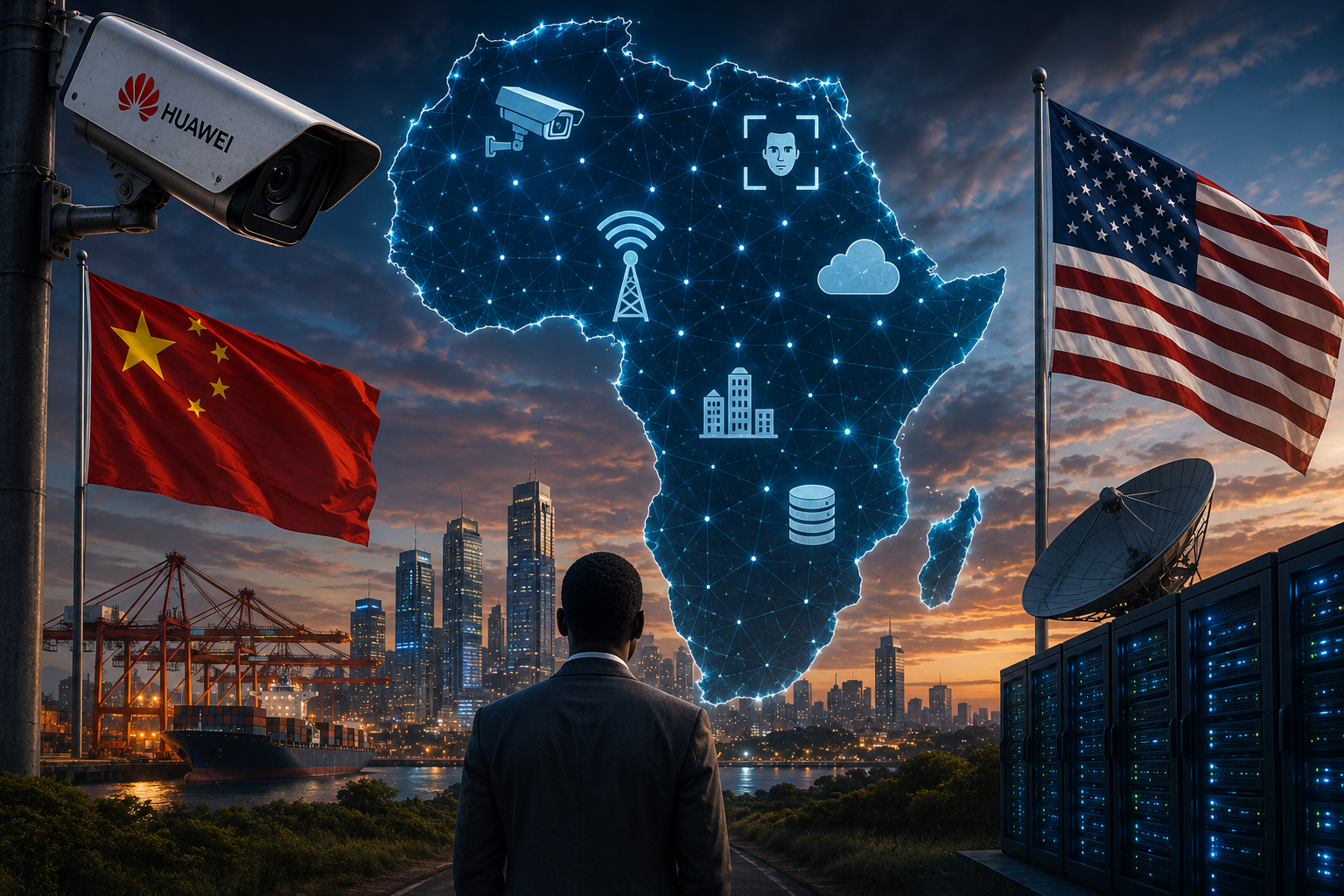
In early 2017, China and Djibouti signed an agreement under which the Chinese government committed $20 million USD to the Djiboutian Urban Security Monitoring System Project. China installed 600-800 closed-circuit television (CCTV) cameras with facial recognition technology, developing a modern surveillance system across Djibouti. This project indicates China’s growing interest in infrastructure investment and development in Africa in cooperation with state governments. The arrangements provide opportunities for China to strengthen relationships in Africa, expand its national intelligence efforts abroad, and compete with the United States for influence on the continent. The United States faces the challenge and opportunity of competing with and countering China’s growing leverage in Africa through the information space, while protecting the United States and its partners’ interests.
China’s Digital Investment Efforts
China outlined its Digital Silk Road initiative in developing countries in a 2015 government-produced white paper. The initiative focuses on investing in the information technology architecture of developing countries to expand Chinese influence. As of 2021, the Chinese information technology company Huawei Technologies Co. Ltd. had built over 70% of Africa’s fourth-generation networks, with plans to build fifth-generation infrastructure. China’s investments in Africa have also created digital smart cities across the continent. Smart cities are urban centers that incorporate automated technologies, such as facial recognition systems and artificial intelligence, into the infrastructure. African countries such as Djibouti have adopted these technologies through China’s Digital Silk Road initiative. African governments integrate these technologies into urban infrastructure development to propel their countries’ development.
Kenya is one of the Digital Silk Road’s beneficiaries. In 2013, Kenya began constructing the Konza City project. The project would result in the creation of an urban technology and research center. In 2019, the state-owned Export-Import Bank of China, which operates under China’s State Council to finance overseas projects to further Chinese foreign and economic policies abroad, provided a concessional loan of approximately 166,600,000 USD to Kenya for the project. Kenya would use the loan to contract with Huawei as the lead contractor responsible for the project’s construction, including the creation of a cloud data center, an information and communication technology network, a government cloud and enterprise services, and other infrastructure. In March 2022, Zimbabwe partnered with the Chinese company CloudWalk Technology to develop a nationwide artificial intelligence-powered facial recognition system initially for security and law enforcement usage. Under the agreement, Zimbabwe would share collected biometric and surveillance data with CloudWalk, enabling the company to refine its artificial intelligence models. In 2019, Uganda purchased a similar CCTV system with facial recognition technology from Huawei for 126,000,000 USD.
China’s digital development efforts in Africa extend into sectors beyond infrastructure and surveillance. In October 2025, the Rwandan Education Ministry and Huawei, with the China International Development Cooperation Agency’s support, announced they would jointly invest in Rwandan schools, integrating cloud-based technology and connecting them to newly constructed data centers. China also sends medical teams with contemporary medical technology to Africa. These teams treat local patients, train local medical professionals, and donate medical equipment to hospitals. From mid-2024 to early 2025, the PLA naval ship Peace Ark visited 13 African countries, providing medical care and portable medical technology to host nation citizens. Likewise, the Chinese Ministry of Commerce provided approximately 30,000,000 USD between 2008 and 2023 to fund the Sino-Guinean Friendship Hospital’s construction in Ratoma, Guinea. Through this holistic approach, the Digital Silk Road becomes a strategy for China to enhance its influence and reputation in Africa.
Geopolitical Implications and Risks
African countries benefit from Chinese investments and outreach efforts. In exchange for tangible benefits, such as expanded access to information and communication technology, African governments integrate China’s growing presence on the continent. In 2017, China used its influence in Djibouti to establish the PLA’s first overseas base. This base lies a few miles from the United States’ bases of Chabelly Airfield and Camp Lemonnier. China will likely continue to use its growing influence to extract similar benefits and protect commercial and national interests abroad.
African states’ growing relationships with China have consequences for the host governments. African countries often rely on Chinese-provided loans to fund these projects. Chinese state-owned financial institutions such as the Export-Import Bank of China and the China Development Bank are often the principal loan providers. As of 2023, China had cumulatively provided Djibouti with 1,472,000,000 USD in loans, making it the largest creditor to Djibouti and giving it significant leverage over the country. By 2023, China had also cumulatively provided over 6,000,000,000 USD to Kenya. Chinese loans, which often don’t come with extensive conditions for receiving them, raise concerns about recipient countries’ ability to repay them. Countries become financially dependent on Chinese loans which gives China leverage.
Integrating Chinese digital technology and infrastructure carries security risks. In June 2017, China enacted the National Intelligence Law (NIL) of the People’s Republic of China, making national intelligence a collective responsibility of the Chinese citizenry and entities, domestically and abroad. The NIL’s Article Seven states, “All organizations and citizens shall support, assist, and cooperate with national intelligence efforts in accordance with law, and shall protect national intelligence work secrets they are aware of.” The NIL’s Article Ten expands this responsibility to Chinese national intelligence efforts abroad, “As necessary for their work, national intelligence work institutions are to use the necessary means, tactics, and channels to carry out intelligence efforts, domestically and abroad.” Chinese private companies, such as Huawei, that develop and install these technologies, must follow the Chinese government’s national intelligence policies and priorities as part of this collective responsibility. The installed digital infrastructure serves as a technical and biometric data source, over which the host nations maintain nominal ownership. The Chinese government may have access to the infrastructure and data sources through the private companies that created them. In 2018, the French newspaper Le Monde reported that sensitive data from the Chinese-built African Union headquarters in Addis Ababa, Ethiopia routinely transferred to data servers in Shanghai, China. Huawei, while denying involvement, had created most of the headquarters’ digital infrastructure.
Formulating an American Response
The United States needs to engage holistically with African states to counter Chinese efforts to expand and leverage its outreach into the information space in Africa. The United States has already initiated similar investment efforts. In December 2022, the United States launched the Digital Transformation with Africa initiative, committing over 350,000,000 USD to digital infrastructure development in Africa. In January 2026, the United States and the African Union agreed to establish a joint Strategic Infrastructure and Investment Working Group, providing a platform for the United States public and private sectors to engage with African Union members in investment initiatives. China possesses a significant lead in funding efforts. As of 2023, China had cumulatively provided approximately 500,000,000,000 USD in loans to African states. Increased American economic engagement, while positive, will likely struggle to succeed in isolation when it needs to catch up to China’s investment lead. The United States must also accept some risk in investing in developing African countries. Some investments in Africa would likely not provide short-term material benefits for the United States; however, the United States can cement its influence and positive reputation among the younger populations that would benefit from them. Long-term sustained messaging and engagement are required to enable the United States to present itself as a reliable and sustainable alternative to Chinese loans and the debt they entail.
Combatting Chinese coercion in Africa requires American military engagement with African partners to go beyond the joint military exercises that the United States already conducts. The United States also possesses military intelligence and information capabilities to compete with China’s growing technological investments in Africa and to build resiliency among partner states. Using intelligence and information, the United States can approach the issue with the goal of reinforcing its status as a secure, reliable, and preferred partner of choice in Africa. The United States limits intelligence sharing with African partners, focusing on immediate security threats such as violent extremist organizations. The United States should implement greater intelligence-sharing frameworks with its African partner nations. The United States needs to develop intelligence-sharing frameworks regarding smart city infrastructure, Chinese technology integration, and associated vulnerabilities. It may also be necessary for the United States to develop a joint intelligence-sharing infrastructure in cases where potential African partners lack the capability to exchange sensitive information with the United States. The United States must also consider cases in which potential partners have ties to China. The United States can still cooperate with those countries, with further restrictions and the goal of gradually pulling them away from China’s influence. This sharing will help the United States and its African partner nations identify and mitigate Chinese coercion and information technologies’ risks.
Conclusion
China’s investments in Africa invoke the often-quoted adage, “Every time China visits, we get a hospital. Every time Britain visits, we get a lecture.” Substituting Britain with the United States conveys the same message: African states integrate Chinese investments and technologies into their development because they provide tangible benefits. The United States must renew its regional alliance-building efforts to counter the positive perception of these investments. Information, intelligence, and integration are critical components to the United States formulating a strategy to help its African partners understand vulnerabilities and strengthen their resiliency against external coercion. Integrating this effort would strengthen the United States’ role as a preferred partner of choice in Africa.
Disclaimer: The views expressed are those of the author and do not reflect the official policy or position of the United States Army, the Department of Defense, or the United States Government.


