





Operational Windows: How Context Determines Campaign Feasibility

Abstract
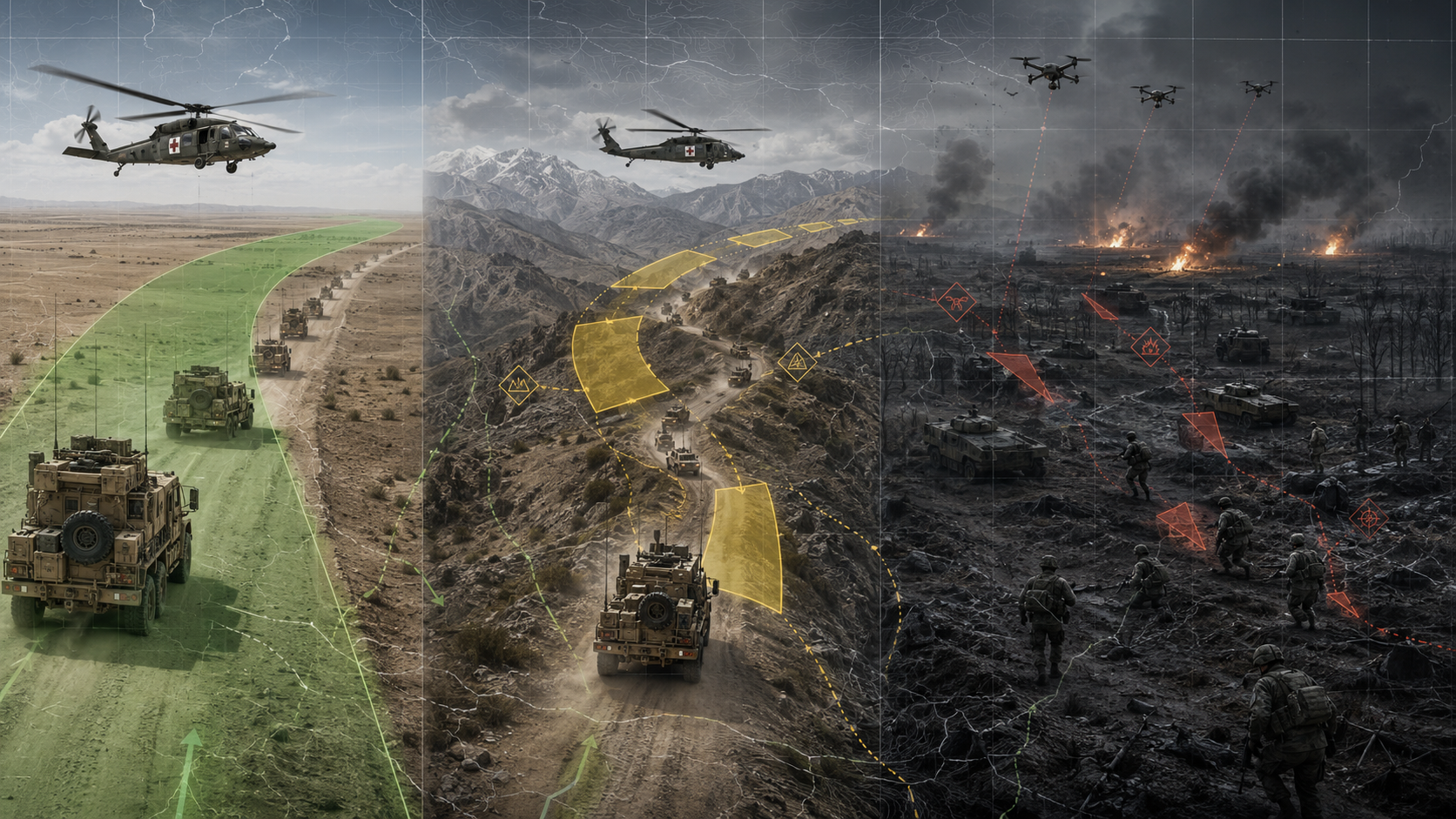
Operational windows—brief periods when forces can move, maneuver, or evacuate under suppressed enemy observation and fires—determine what military operations remain feasible. Windows emerge from the balance between enemy and friendly suppression capabilities. Available windows are shaped by operational context. In Iraq, absence of air-to-air threat created continuous windows for logistics and casualty evacuation. In Afghanistan, medical evacuation windows remained continuous due to minimal air threat, but logistics required a hybrid approach: route clearance patrols created brief suppression windows while commanders identified safe periods between threat indicators to time movements. In Ukraine, persistent drone reconnaissance and distributed fires compressed windows across all functions simultaneously, preventing commanders from either creating continuous suppression or reliably identifying natural gaps. Commanders must determine what windows are available and what windows operations require, then design layered protection to create and maintain them. Campaign endurance depends on answering the window-availability question accurately before planning operations.
Introduction
In February 2023, Russian forces advanced into positions around Bakhmut that gave them artillery control over the primary Ukrainian ground lines of communication leading into the city. Ukrainian defenders faced a compressing operational window: Russian artillery fire threatened movement on the main access routes from Chasiv Yar and western approaches. The cost of abandonment was operationally and politically unacceptable.
Movement depended on concealment, route discipline, engineering support, dispersion, and timing maneuver during periods when Russian observation or fire coordination degraded. Ukrainian commanders identified brief gaps in Russian observation and fires—moments when reconnaissance was reorienting or fire coordination lapsed—and rapidly exploited these windows before re-engagement. Windows were not created through suppression but rather discovered and seized. As Russian artillery control became more complete, windows compressed, further constraining Ukrainian freedom of maneuver.
Yet Ukrainian forces continued operations—moving personnel, evacuating casualties, moving supplies—by identifying windows (gaps when Russian observation lapsed or fires couldn’t immediately re-engage) and exploiting them before closure. This reveals a fundamental principle: operational feasibility depends on managing windows—gaps in enemy observation, surveillance, or fire coordination that allow movement, concentration, or sustainment before re-engagement. The operational environment determines what windows exist and how they can be created or discovered. Bakhmut reveals a central insight: operational windows are determined by operational context, not by static doctrine or organizational structure. What windows are available? What can be created through suppression? What gaps can be identified and exploited? The answers determine what operations remain feasible. This article examines three operational contexts—Iraq, Afghanistan, and Ukraine—showing how available windows shape campaign design and why commanders must answer the window-availability question before planning operations.
Understanding Operational Windows
Different operations require fundamentally different windows. A logistics movement requires suppressed observation on a supply route for sufficient time to move vehicles. A casualty evacuation demands protected routes and suppressed observation to move wounded from collection points to aid stations. A maneuver operation requires concealment of unit concentration and concealment of movement signatures during assault phases. The window requirement emerges from operational demand, not doctrine.
Windows are determined by what can be suppressed and what gaps exist, or can be created, in enemy observation and fires. Enemy intelligence, surveillance, and reconnaissance defines what can be seen. Enemy fires, including artillery, air, and precision strikes, define what can be hit. Available windows represent the duration enemy observation or fires can be suppressed, evaded, or rendered ineffective. The wider the suppression capability, the wider the window. Context determines this balance: absence of enemy air capability eliminates aerial observation and strike threats; perpetually contested roads strain and overwhelm the capacity of limited suppression assets; distributed reconnaissance narrows windows across all domains simultaneously.
In Iraq from 2003–2008, absence of air-to-air threat and limited Iraqi ground-to-air capability created fundamentally different operational conditions. This absence enabled rotary-wing medical evacuation. Casualties moved from point of injury to Role 3 surgical facilities via medical evacuation assets within hours—a continuous window that resulted in significantly improved soldier survival rates. This medical evacuation capability became a permanent operational feature, not a constrained function dependent on brief windows.
Logistics operations benefited equally from absent air threat. Supply patrols operated on predictable schedules along established routes, with centralized forward operating base maintenance and routine replenishment cycles. The operational windows required for medical evacuation and logistics remained open continuously because enemy air threats were absent. Commanders planned accordingly, establishing stable supply lines, centralized maintenance facilities, and predictable casualty management protocols. This continuous window availability shaped campaign design fundamentally—operations assumed uninterrupted logistics flow and reliable casualty evacuation rather than constrained, episodic windows for critical functions.
In Afghanistan on contested Kunar Province roads from 2009–2013, windows compressed unevenly. Medical evacuation windows remained continuous—absence of air-to-air threat enabled rotary-wing operations. Logistics faced different constraints. Route clearance patrols periodically suppressed ground threats on mountain roads, creating brief suppression windows. Between route clearance operations, when threat indicators lowered, additional safe periods emerged for patrol movements. Unlike Iraq’s continuous logistics flow, Afghanistan’s windows opened episodically: a patrol might move for thirty minutes, then threat indicators would rise and windows close for twelve hours until the next clearance operation. This compressed, episodic availability prevented centralized supply models.
In Ukraine from 2023–2025, persistent drone reconnaissance and distributed fire systems compressed operational windows across all functions more severely than either Iraq or Afghanistan. Unlike Iraq, where absence of enemy air threat created continuous windows, or Afghanistan, where intermittent gaps permitted episodic operations, Ukraine faced compressed windows that could not be reliably suppressed or predictably discovered. Operational windows existed, but they were brief, unpredictable, and required acceptance of higher operational costs (casualties, extended timelines, dispersed operations) to exploit. Logistics suppression was required across dispersed route segments, but enemy reconnaissance was distributed. Maneuver concealment was theoretically possible, but enemy drone coverage was persistent. Casualty evacuation required forward medical capability because no operational window remained reliable.
These examples demonstrate a principle fundamental to operational planning: the operational window required for any critical function is determined by the specific conditions of the operational environment, not by predefined templates or doctrinal assumptions.
Layered Protection and Window Constraints
Windows are acquired through layered protection that combines suppression of enemy observation/fires with exploitation of existing gaps. The balance between these elements shifts by context. In Iraq, suppression was unnecessary because almost no air threat existed. In Afghanistan, suppression of ground threats enabled windows that commanders then exploited tactically. In Ukraine, distributed threats prevent reliable suppression across all domains, forcing reliance on brief window discovery and acceptance of higher operational costs to exploit them. Layered protection creates windows; rapid exploitation identifies and seizes them. Different contexts demand different approaches.
To create a logistics window, multiple protective layers must work together. Air defense suppresses drones and reconnaissance systems while electronic warfare masks vehicle signatures. Fires suppress reconnaissance positions capable of redirecting incoming fire, and concealment through timing moves vehicles at night or during poor visibility. Each layer addresses a different threat element. When one fails, others hold the window open.
Creating a maneuver window requires different layering priorities. Concealment of unit concentration areas takes priority over route suppression, while electronic warfare masking movement signatures takes priority over air defense suppression of static positions. Deception positioning forces enemy reconnaissance toward dummy locations. Timing of movement phases relative to enemy reconnaissance cycles determines when concentration becomes possible.
At Pokrovsk in late 2025, Ukrainian units demonstrated how compressed windows are exploited despite persistent observation. Forward casualty collection points operated in temporarily occupied locations, protected through concealment and frequent relocation rather than suppression. Evacuation routes changed constantly to evade predictable targeting patterns. Timing of evacuations around reconnaissance cycles—when drone coverage momentarily shifted or reconnaissance was reorienting—created brief windows. These operations continued despite compressed windows by accepting extended casualty timelines and constant movement rather than fixed, defensible collection points.
Windows and Operational Feasibility
Different operational contexts produce different window availability. In Iraq under absence of air-to-air threat and lack of coordinated air defense, windows for movement, logistics, and medical evacuation remained open continuously. Commanders planned accordingly. Large forward operating bases functioned with centralized maintenance, established supply routes, and predictable casualty evacuation.
Some operational contexts compress windows without eliminating them, forcing operational redesign. In Afghanistan on contested roads, logistics windows became too brief and unpredictable to support Iraq’s centralized supply model. Windows didn’t disappear—commanders identified them episodically between threat windows—but relying on them required accepting higher costs. Rather than centralized forward operating bases with routine resupply, commanders dispersed supply caches and accepted slower, episodic resupply cycles. Medical evacuation windows remained adequate for most casualties, but commanders deployed forward medical capability to handle cases where window timing failed. Operations adapted; they didn’t cease.
Some operational contexts compress windows into brief, mission-critical periods. In Ukraine, under distributed observation and fires, logistics movement windows might exist for thirty to ninety minutes depending on suppression effectiveness and route choice. Windows for maneuver concentration exist only when reconnaissance cycles align with deception and electronic warfare masking. Windows for casualty evacuation depend on forward medical capability and acceptance of extended casualty timelines—not because windows vanish, but because reliable windows are rare enough that commanders must disperse medical response rather than concentrate it.
The 2023 Ukrainian counteroffensive near Zaporizhzhia demonstrated the limits of window management, not tactical failure. Breakthrough operations demand a large, sustained window: concentration of assault forces, bridging equipment, supporting fires, command and control, and sustainment must operate in coordinated timing across a concentrated area. Ukrainian layered protection could create windows for components—individual bridging columns, assault force movements, exploitation operations. But breakthrough requires integration of all components within a single large window. The density of forces required generated observable signatures; continuous Russian reconnaissance would detect concentration. Dispersal sufficient to evade detection prevented the force concentration breakthrough requires.
Unlike operations at Bakhmut or Pokrovsk that continue despite compressed windows by accepting casualties, extended timelines, and dispersed operations, breakthrough cannot be achieved through dispersal. The large, integrated, and sustained window requirement exceeded what suppression and concealment could provide. To accept the near-certain destruction of concentrated forces operational cost of attempting breakthrough exceeded acceptable limits. Commanders chose not to proceed.
Campaign operations demand windows for multiple simultaneous functions: movement for main effort columns, logistics for supply patrols, and medical evacuation for casualty movement. These functions operate on different timelines, each requiring distinct layered protection to create and maintain its specific window.
Campaign operations succeed when all these windows operate in coordinated timing while each receives layered protection required for its specific function. Failure in any single window cascades through the operation. If logistics windows close while the main effort remains advanced and separated from supply sources, and commanders cannot establish forward supply caches or accept extended resupply cycles, the campaign culminates through supply exhaustion. Afghanistan and Ukraine demonstrate that campaigns endure, rather than culminate, when commanders redesign logistics around available windows. Similar cascades occur when medical evacuation, command post displacement, or movement windows close—each failure reduces combat power, exposes leadership, or prevents maneuver. Coordinated timing across all functions is the operational requirement.
Window Availability as the Decisive Factor
Operational context determines what windows are available and what operations remain feasible. The three cases examined here span different operational environments: continuous windows from absent air threat, intermittent windows in contested terrain, and compressed windows under distributed observation and fires. Each environment imposed different constraints on what operations commanders could plan and execute.
Iraq, Afghanistan, and Ukraine demonstrate three different operational contexts where available windows shaped what operations remained feasible. Campaign planners and commanders must answer three questions: What operational windows are available? What does the mission require? What layered protection must create and maintain them? Window availability does not operate in isolation; rather, force quality, enemy decision-making, and logistical capacity constrain operations equally. Yet understanding windows clarifies what operational designs remain feasible under specific threat environments.
Commanders must answer the window-availability question with accuracy and clarity before designing operations. Campaign endurance depends on the precision of that answer and the integration of protection measures required to sustain the windows on which operations depend. Campaign planning must begin with systematic assessment of what windows exist, what windows each critical function requires, and what layered protection can reliably create or maintain them. Forces that answer this question rigorously design campaigns that endure; those that do not invite cascading failure across coordinated functions.


