





Capability is Not Enough: Why Authority Decides Whether SOF Protect Critical Maritime Infrastructure
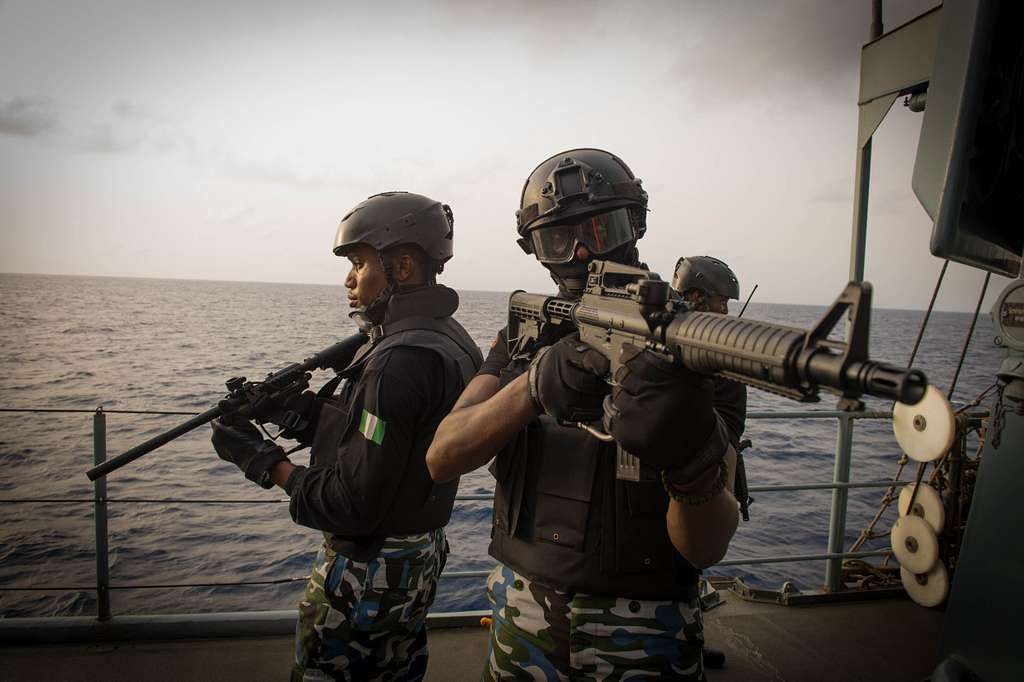

On June 19, 2008, Niger Delta militants in open-hulled boats stormed Shell’s Bonga floating production, storage and offloading vessel (FPSO), 120 kilometers off the Nigerian coast. They shut down 200,000 barrels of daily production. The Movement for the Emancipation of the Niger Delta (MEND) announced afterward that the target had been “deliberately chosen to remove any notion that offshore oil exploration is far from our reach.”
Nigeria already had a maritime special operations force. The Special Boat Service (SBS) had been established specifically to protect offshore infrastructure. It made no difference. Bonga was not a capability problem. It was an alignment problem. A generation of maritime protection planning has rested on an implicit assumption: that the presence of special operations forces (SOF) translates into protection. It does not. Capability, authority, and integration do not compensate for one another. Below the threshold at which all three align, SOF presence is theater.
This article presents the Capability-Authority-Integration (C-A-I) model, draws on cases from three continents, and argues that authority—not capability—is the binding constraint that determines whether maritime SOF actually protect anything in the gray zone.
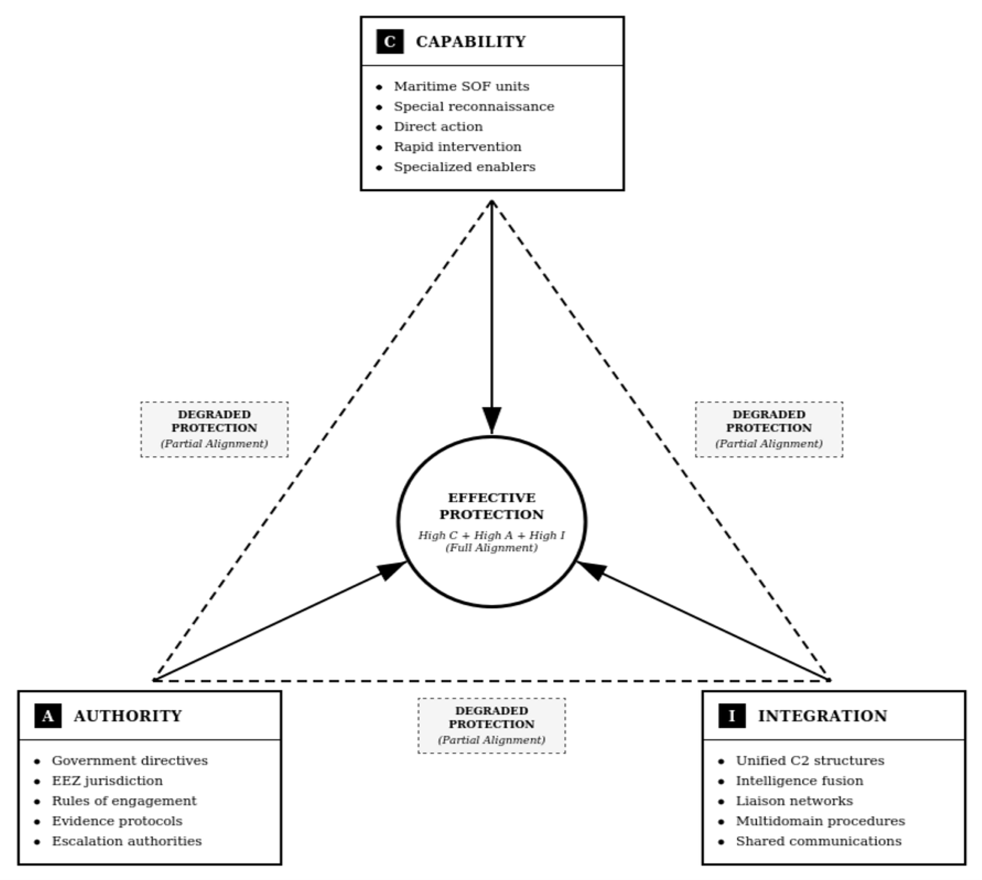
The Capability-Authority-Integration Alignment Model
The C-A-I model rests on a simple premise: maritime SOF protect critical infrastructure through three components that must function as a system, not as substitutes. Each answers a different question. Each is necessary. None is sufficient.
Capability is what maritime SOF can do on paper. It answers a single question: can SOF do it? It is assessed against platform-specific mission requirements such as counter-platform assault, maritime interdiction, underwater approach, and hostage rescue, along with the selection, training, and equipment that produce and sustain those competencies. Capability is the most visible component and the easiest to overstate. Exercise hours, unit pedigree, and equipment inventories tell a planner what SOF can do in isolation. They do not predict whether SOF can act when it matters.
Authority answers a different question: are SOF allowed to do it? It is assessed through the constitutional and statutory foundations governing SOF action, the rules of engagement, the legal architecture across territorial waters and the Exclusive Economic Zone (EEZ), and the existence or absence of frameworks for action below the armed-conflict threshold. Authority is invisible until something goes wrong, when its absence produces operational paralysis even where capability is world-class.
Integration answers the third question: can SOF act in time? It is assessed through cross-agency coordination with intelligence services and civilian authorities, cross-domain coordination with naval and air forces, and the procedures that compress decision cycles below the speed at which adversaries operate. Integration is rarely visible in peacetime and becomes decisive in the seconds and minutes that separate detection from execution. Without it, capability arrives late, and authority arrives unused.
The Capability-Authority-Integration (C-A-I) Alignment Model. Effective protection requires high alignment across all three dimensions; partial alignment, including uniform medium across all three, falls below the threshold needed to activate protective mechanisms.
Source: reproduced from Ciprian Clipa, Special Operations Forces, Hybrid Threats, and Critical Maritime Infrastructure Protection: A Comparative Analysis with Application to Romania (master’s thesis, Naval Postgraduate School, 2026).
The model predicts a threshold effect, not a continuum. Below the level at which capability, authority, and integration are simultaneously sufficient, the mechanisms through which SOF deliver protection (deterrence, rapid response, and calibrated action below the armed-conflict threshold) fail to activate. Strength in one dimension does not compensate for shortfall in another. Uniform medium alignment across all three is operationally indistinguishable from severe weakness in any one. The next section tests this prediction against three cases
Three Cases, One Threshold
The model predicts that all three components must clear a minimum threshold for protection to activate. Three cases test that prediction: Norway in the North Sea, Israel in the Eastern Mediterranean, and Nigeria in the Gulf of Guinea. Each operates against a different adversary type. Each manages a different category of offshore infrastructure. The alignment pattern is consistent across all three.
Norway: The Authority Experiment
Norway is the cleanest test of authority as a binding constraint because the same country, with the same SOF, produced different protection outcomes within a single decade, as authority changed and the other components held roughly steady.
By the early 2010s, Norway’s capability was world-class. Forsvarets Spesialkommando (FSK), established in 1982 with British SAS and SBS support specifically to counter terrorist threats to North Sea offshore installations, and Marinejegerkommandoen (MJK), Norway’s maritime SOF, maintained shared national counter-terrorism standby duties and validated platform-specific competencies through the annual Gemini exercises. The Norwegian contribution to Task Force K-Bar earned the U.S. Navy Presidential Unit Citation.
The authority architecture had not kept pace. From 2012 to 2015, Gemini exercise evaluations documented significant disagreement between police and military agencies over operational leadership and execution authority. Norway SOF operators could exercise but could not execute. The continental shelf remained under Ministry of Justice and Public Security jurisdiction even though offshore installations sat operationally beyond police reach. This contradiction produced what a Norwegian SOF officer characterized as a domestic “grey zone” within Norway’s own legal architecture. Capability was present. Integration was developing. Authority was missing.
The reforms came in sequence. The 2015 amendment to Police Act Section 27a provided the constitutional foundation for defense assistance, with explicit force authority. The 2017 Instructions on Defense Assistance to the Police operationalized it, establishing that “in aid to maritime counterterrorism, within the framework of the police mission, the defense’s responsibility is to lead and carry out operations.” The 2019 Gemini evaluation, the first to assess the post-2017 framework, marked the first positive report on assistance request procedures and coordination effectiveness.
The protection record reflects the shift. Norway’s offshore petroleum infrastructure has experienced no maritime terrorist attacks since FSK commenced operations in 1984, and the September 2022 Nord Stream sabotage triggered an unprecedented peacetime military deployment to Norwegian platforms that was executed without the coordination paralysis the 2012 to 2015 evaluations documented.
A practitioner caveat is necessary. Norway’s forty-year operational record is counterterrorism, not hybrid threats per se. The framework’s relevance carries over because the alignment principles operate at the mechanism level: deterrence, rapid response, and calibrated action below the armed-conflict threshold are the same whether the adversary is a terrorist cell, a state-sponsored proxy, or a sabotage unit operating under deniability. Norway’s within-case shift, from documented exercise paralysis to documented operational reach, isolates authority as the variable that changed while capability and integration held.
Israel: Proactive Authority
If Norway’s framework reformed under pressure, Israel’s was pre-built. Israeli maritime SOF operate under an authority architecture put in place before protection requirements reached crisis levels, and against a threat type closer to what hybrid adversaries elsewhere now bring to the gray zone.
The threat environment is unambiguous. Hezbollah, the Islamic Revolutionary Guard Corps, and Hamas have demonstrated maritime strike capability against Israeli offshore infrastructure. In May 2021, the Israel Defense Forces intercepted Hamas rockets and suicide drones targeting the Tamar platform. In July 2022, Hezbollah UAVs approached the Karish FPSO and were intercepted before impact. The adversaries are state-directed or state-sponsored. They operate deliberately below the threshold of armed conflict. Of the three cases, this is the threat type closest to the gray-zone problem hybrid adversaries pose elsewhere.
Authority sits at the center of how Israel handles it. The 2012 government decision designating offshore platforms as “strategic assets” triggered military protection obligations and formally assigned the Navy responsibility. The decision was made before the major threat manifestations of 2021 to 2022. It pre-authorized military protection of EEZ infrastructure, gave Shayetet 13 explicit operational authority across maritime zones, and reduced the legal ambiguity that hybrid adversaries elsewhere systematically exploit.
The operational reach this architecture enables is clearest in offensive counter-threat action. During Operation Protective Edge in 2014, Shayetet 13 conducted maritime raids that located and destroyed rocket and missile launchers threatening Israeli offshore platforms, neutralizing the threat at source rather than waiting for it to reach the infrastructure. This is sophisticated SOF employment distinct from conventional force capabilities. It requires maritime infiltration, legal authority for offensive action beyond territorial waters, and intelligence-driven coordination locating the launchers—all three pillars, working together.
Israeli offshore gas infrastructure has experienced no successful attacks since Tamar commenced production in 2013. Geographic factors, conventional defenses, and adversary prioritization warrant methodological caution. But the architecture that enabled the 2014 maritime raids is the same architecture that defeated the Hamas and Hezbollah attempts against Tamar and Karish. Full alignment, built proactively, produces operational reach against the gray-zone threat type.
Nigeria: The Threshold Failure
Let’s return to Bonga. The Nigerian SBS existed in 2008. It had been established in 2006, modeled on the British SBS and U.S. Navy SEALs, specifically to counter asymmetric threats to oil infrastructure in the Niger Delta. The militants reached the platform anyway. Eight years after Bonga, in the 2016 Niger Delta Avengers campaign, attacks on the Forcados terminal and multiple Chevron facilities cut more than 750,000 barrels per day. No open-source record documents the SBS successfully interdicting a direct assault on an offshore platform in any of these years.
This is not a story about a weak unit. The SBS is real. It runs a 36-week selection pipeline with attrition rates of nearly 50%. It has rescued crews from hijacked vessels 140 nautical miles offshore, led multinational boarding operations under regional protocols, and dismantled illegal-refining networks that were costing Nigeria billions annually. Against piracy, bunkering, and lower-threshold maritime threats, it performs.
That is exactly what makes Nigeria the decisive case. Capability is real but medium: a trained force stretched across too many concurrent theaters, from northeast counterinsurgency to Gulf of Guinea anti-piracy, with deployments running years instead of months. Authority is medium: the 2019 Suppression of Piracy and Other Maritime Offences Act criminalizes platform attacks, but no platform-specific rules of engagement exist, so operators confronting armed speedboat swarms fall back on general self-defense principles, and the Navy lacks prosecutorial authority. Integration is medium: the Deep Blue Project (2021) and the Special Operations Command (2025) are real coordination mechanisms, but both postdate the major attacks and remain developmental rather than institutionalized.
The Nigerian SBS has no single catastrophic weakness. Medium capability, medium authority, medium integration. And the protective mechanisms never activated against sophisticated adversaries.
This is the threshold prediction confirmed. Nigeria did not fail because one dimension collapsed. It failed because uniform medium alignment never crossed the level at which deterrence, rapid response, and gray-zone counter-action switch on. A force that succeeds against piracy and fails against a determined platform assault is not a force with one fixable gap. It is a force operating below the threshold, where tactical competence in easier missions coexists with strategic failure in the hard one. Bonga was not an anomaly. It was the predictable output of medium-across-the-board, and it is the most common posture among states still building maritime security architecture.
C-A-I Alignment and Protection Outcomes
| Case | Threat Type | Capability | Authority | Integration | Protection Outcome |
| Norway
(North Sea) |
Counter-terrorism | High | High | High | No successful attacks
In 40 years |
| Israel (Mediterranean) | Gray-zone;
State-sponsored proxy |
High | High | High | No successful attacks
In 12 years |
| Nigeria
(Gulf of Guinea) |
Asymmetric militant | Medium | Medium | Medium | Multiple successful attacks |
Source: reproduced from Ciprian Clipa, Special Operations Forces, Hybrid Threats, and Critical Maritime Infrastructure Protection: A Comparative Analysis with Application to Romania (master’s thesis, Naval Postgraduate School, 2026).
The Part You Cannot Train
The three cases protect, or fail to protect, through three mechanisms. Capability, authority, and integration are the inputs. Deterrence, rapid response, and calibrated action below the armed-conflict threshold are the outputs. The cases show these mechanisms switching on together or not at all, and they show one of the three inputs to be unlike the other two: the one a force cannot build for itself.
Deterrence operates through the adversary’s cost calculation. When Israel’s Shayetet 13 seized the Karine A 500 kilometers from shore in seven minutes, the operational signal was unambiguous: distant targets are within reach. Nigeria sends the opposite signal. MEND chose Bonga precisely to demonstrate that offshore distance bought it nothing, and no SBS response corrected that impression.
Rapid response compresses the adversary’s operating window. The Karine A interdiction, intelligence to execution in seven minutes, is what compression looks like, and it was achievable only because intelligence fusion, pre-positioned assets, and rehearsed inter-agency procedure already existed. That is integration determining response speed. Nigeria’s coordination mechanisms remain developmental, so the window stays open long enough for the attack to complete.
Gray-zone counter-action is the ability to act against a threat that is deliberately ambiguous. This mechanism is the one that does not activate without explicit legal authority, and it is where the article’s central finding sits.
Authority is the binding constraint. Not because it matters more in the abstract, but because of an asymmetry in how the three components are built. Capability develops through training investment. Integration develops through operational experience and time. Both can be grown by the force itself. Authority cannot. It requires a political decision to establish a legal framework for action below the armed-conflict threshold, and no amount of training or operational experience substitutes for that decision.
Norway proved this within a single case: world-class capability and developing integration produced operational paralysis until the authority reforms of 2015 to 2017, after which all three mechanisms began to function. The capability had been there the whole time. The authority had not.
This is why uniform medium fails. The mechanisms are an interdependent system, not a menu. Below the threshold on any dimension, and most decisively on authority, the system does not partially work. It does not work.
Presence Without Protection
Let’s return to the assumption with which this article opened, that the presence of special operations forces translates into protection of the infrastructure they are assigned to defend. Bonga showed it does not. Norway, Israel, and Nigeria explain why not. Protection is not a function of the mere existence of a state’s maritime-capable SOF. It is a function of its capability, authority, and integration clearing a minimum threshold at the same time, and the three do not substitute for one another. A force that is strong in two and weak in the third does not deliver two-thirds of the protection. It delivers the protection of a force operating below the line, which is to say very little.
The model is a diagnostic any planner can run on their own architecture. A planner must consider not whether the unit exists, but whether all three dimensions have crossed the threshold, and which one has not. The answer is most often authority, because authority is the one dimension a force cannot build for itself. Capability can be trained. Integration can be strengthened. Authority someone has to decide. Until they do, the rest is presence without protection.
______________________________________________________________________
This article draws on the author’s master’s thesis, Special Operations Forces, Hybrid Threats, and Critical Maritime Infrastructure Protection: A Comparative Analysis with Application to Romania (Naval Postgraduate School, 2026). The views expressed are the author’s own and do not represent those of the Naval Postgraduate School, the Romanian Armed Forces, or any government.


