





NATO’s Critical Minerals Security Runs Through the Eastern Flank. Why Bucharest 9 Should Lead It

Abstract
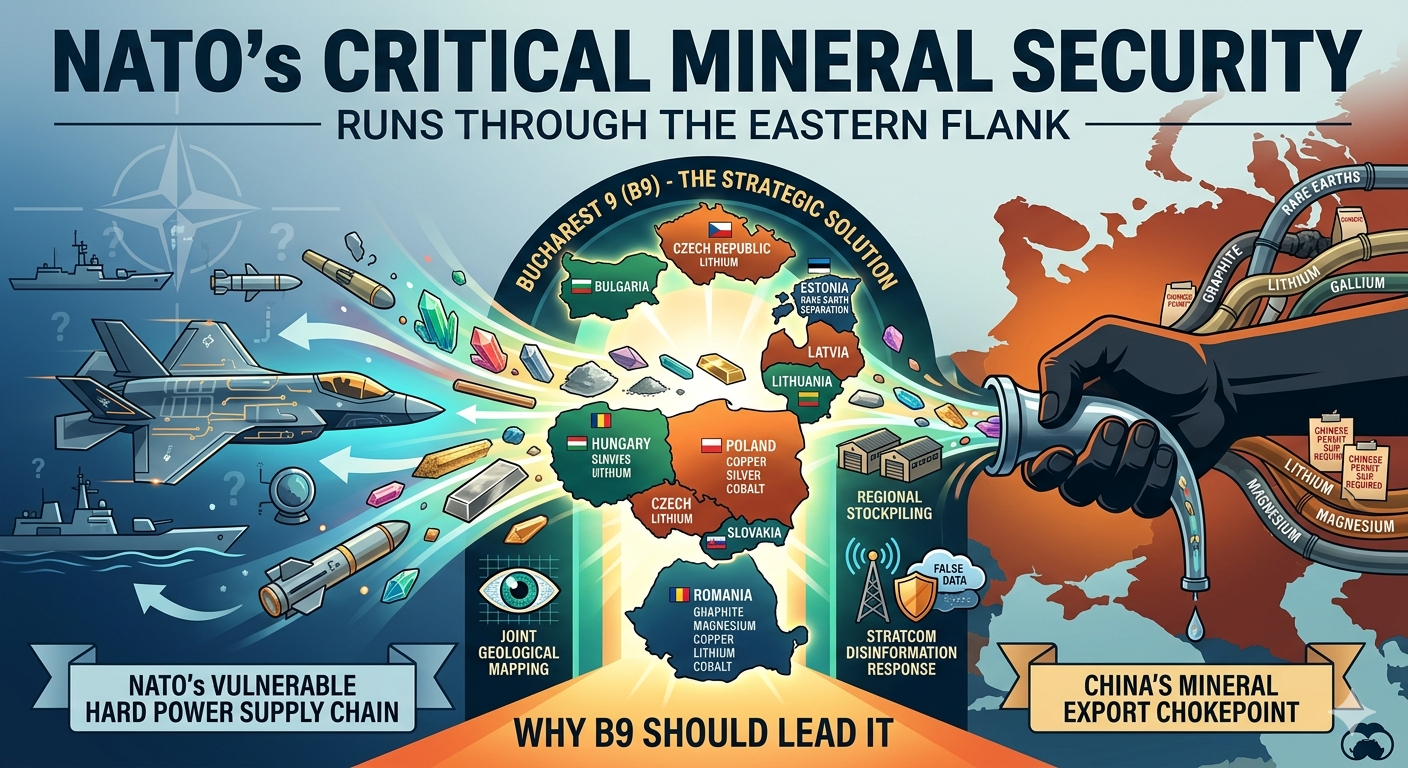
Washington demanded that Europe shoulder NATO’s conventional defense by 2027, but Beijing’s new export controls mean every European magnet, motor, and missile component now requires a Chinese permit slip. The Bucharest 9 – sitting atop most of the eastern flank’s mineral wealth – is the right platform to close this gap, and this paper sets out the geological mapping, stockpiling, and counter-disinformation agenda that would make it work.
Introduction
Each F-35 that rolls off Lockheed Martin’s line in Fort Worth carries roughly 417 kilograms of rare earths and specialty alloys – in its engines, its AESA radar, its stealth coatings, and the permanent magnets that drive its actuators. Multiply that by the thousands of fighters, ships, sensors, and munitions NATO will field over the next decade, then add the magnets, gallium, and graphite that the AI and energy transitions consume, and you arrive at the strategic problem of our time: the Alliance’s hard power increasingly rests on supply chains it does not control.
At The Hague Summit last June, NATO leaders accepted this fact in writing. The new commitment to invest 5% of GDP to defense carries a less noticed but no less consequential clause: 1.5% is earmarked not for core defence requirements like tanks and missiles, but for security enablers such as critical infrastructure, supply chains, the industrial base, and civil resilience, including strategic stockpiles. Securing the materials that make Allied deterrence possible has become an alliance-level obligation. NATO has identified twelve defense-critical raw materials it must reliably source. The unanswered questions are: where and how?
The instinctive answer is “anywhere but China.” Beijing controls 60 to 90 percent of global processing for most critical minerals, has vertically integrated mining, refining, magnet production, and battery cells into a single national approach, and has demonstrated – with its export restrictions on gallium, germanium, graphite, and heavy rare earths – that it will use that dominance coercively. In October 2025, Beijing went further. MOFCOM Announcement No. 61 imposed export controls explicitly directed at the defense sector, stipulating that license applications involving foreign military end users will, in principle, be denied – the first time China has imposed restrictions specifically targeting foreign defense supply chains. Coupled with an extraterritorial clause that captures any product containing 0.1 percent or more of Chinese-origin rare earths, the measures function as a near-blanket denial. The implications for Europe are particularly acute. At precisely the moment Washington is pressing European allies to take over the bulk of NATO’s conventional defense by 2027, and as Brussels rolls out the ReArm Europe / Readiness 2030 plan and its €150 billion SAFE loan instrument to fund the build-out, Beijing has effectively placed a Chinese permit slip on top of every European magnet, motor, and missile component that touches a rare earth. The European armament drive Washington has demanded, in other words, runs straight into a chokepoint Beijing has just tightened and proved it has no shame to use coercively.
Washington has responded to China’s dominance with what one could call a turn from Pax Americana to Pax Silica: the Defense Production Act, the CHIPS and Inflation Reduction Acts, direct U.S. government equity stakes in companies like MP Materials, a recapitalized Development Finance Corporation, and minerals-for-access agreements such as the one signed with Ukraine. These policies had administrative continuity from the Biden to the second Trump administrations, demonstrating that this is a sustained, bipartisan-supported shift in U.S. economic statecraft. Brussels has developed a path of its own with the Critical Raw Materials Act, on April 11th, 2024, (after critical minerals export controls) mandating that by 2030 the EU extract at least 10 percent, refine 40 percent, and recycle 25 percent of its critical materials domestically, with no single third country supplying more than 65 percent of any one mineral. The strategies are in place. The geography of the solution is not yet widely understood – and it is overwhelmingly continental, not transatlantic.
The Undervalued Corridor From the Baltic to the Black Sea
When the European Commission published its updated list of 34 critical raw materials, of which 17 are deemed strategic, a fact became apparent to anyone willing to read the geological surveys: a substantial majority of those minerals have confirmed or potential deposits along NATO’s eastern flank. Sweden holds Europe’s most significant rare earth deposit at Per Geijer, near Kiruna, alongside major graphite reserves. Estonia operates one of the few rare earth separation facilities in the EU, at Silmet. Poland sits on the continent’s largest copper and silver basin, with associated cobalt. The Czech Republic’s Cínovec deposit is among the largest hard-rock lithium resources in Europe. Slovakia has tungsten and magnesium; Bulgaria, copper, lead, and zinc; Romania, a strategically significant combination of graphite, magnesium, copper, lithium, and cobalt. And Ukraine – which the Alliance treats as a partner of existential importance – holds deposits of 22 of the 34 minerals classified as critical by the EU, including titanium, manganese, graphite, and lithium.
This is not a marginal contribution. If the CRMA’s 65 percent diversification target is to be met without simply trading dependence on China for dependence on, say, Indonesia or the Democratic Republic of Congo, the difference must come from somewhere reasonably close, reasonably stable, and reasonably aligned. NATO’s eastern flank fits all three criteria. It has been overlooked because the post-Cold War narrative treated this region as a security consumer rather than a strategic asset or security provider. That framing is now obsolete, especially as the continental security landscape is being reshaped following U.S. withdrawal.
In March 2025, the European Commission designated 47 strategic projects across 13 member states under the CRMA. Romania alone has three of them, representing roughly €615 million in announced investment: graphite at Baia de Fier in Gorj County, magnesium at Budureasa in Hunedoara County (developed by an American firm and feeding directly into the aerospace and defense alloy market), and the Rovina copper project, the second-largest copper deposit in Europe. These are not aspirational discoveries – they are bankable assets awaiting capital, permitting, and political will.
Why the Bucharest 9 Is the Right Platform
NATO has many forums. Few are well-suited to this problem. The North Atlantic Council moves at the speed of consensus among 32 members. The EU’s institutions, while indispensable for regulation and financing, do not align cleanly with Allied military planning. Bilateral arrangements, like the U.S.–Ukraine minerals agreement, work case by case but do not generate regional coherence.
The Bucharest 9 format, launched in 2015 by Romania and Poland in the wake of the Crimea annexation, is uniquely positioned. It groups the nine NATO members along the eastern flank – Bulgaria, the Czech Republic, Estonia, Hungary, Latvia, Lithuania, Poland, Romania, and Slovakia -and has spent a decade building habits of cooperation on deterrence, force posture, and energy security. It is small enough to act, large enough to matter, and already plugged into both Brussels and Washington through its summits. Critically, the B9 collectively sits on most of the eastern flank’s mineral wealth, and its members face a common set of Chinese influence vectors and Russian information operations targeting their mining sectors.
Three concrete extensions of the B9 mandate would convert this geographic accident into strategic leverage. First, shaping a regional geological mapping initiative, AI-assisted and cost-shared. Most Allied governments are still working from Soviet-era or early post-communist geological surveys. Modernizing them is expensive – aerial LiDAR, hyperspectral imaging, and magnetometric surveys cost tens of millions of euros per country, but the marginal cost of pooling drops sharply when nine states share methodology, data architecture, and AI models trained on aggregated historical survey data. The output would be a B9 cadastre of bankable reserves, harmonized to a single standard that the European Investment Bank and the U.S. Development Finance Corporation could co-finance with proportional national allocations. Although costly for national governments, this is the kind of project that justifies the 1.5 percent of GDP under the Hague commitment in a way that is verifiable, productive for building deterrence, and durable.
Second, integrating critical minerals into B9 military planning. A regional stockpile arrangement for the twelve NATO defense-critical raw materials, with distributed depots and a crisis-use agreement, would close the most acute vulnerability the Alliance faces: a sudden cutoff during a contingency. Annual supply chain stress-test exercises and war-games – simulating bottlenecks in gallium, germanium, or neodymium-iron-boron magnets, conducted alongside Steadfast Defender – would do for critical minerals what the Cold War’s POL (petroleum, oil, lubricants) exercises did for fuel. And a serious B9 conversation on “full-value mining,” including recovery of critical materials from retired military equipment and mining waste, would acknowledge that recycling is no longer a green-economy aspiration but a strategic discipline. exercises did for fuel. And a serious B9 conversation on “full-value mining,” including recovery of critical materials from retired military equipment and mining waste, would acknowledge that recycling is no longer a green-economy aspiration but a strategic discipline.
Third, establishing a coordinated StratCom response to the disinformation campaigns now targeting mining projects across the region. Romania’s Rovina case is instructive: a CRMA-designated strategic project, with clear environmental and economic upsides, contested in court and besieged by orchestrated narratives whose origins do not appear organic. Similar patterns have appeared around Cínovec, around Kiruna, and around proposed sites in Poland.
A joint B9 StratCom cell, working with the NATO StratCom Centre of Excellence in Riga, could monitor, attribute, and respond to these campaigns at a regional scale, while also developing the transparency and community-engagement playbooks that legitimate projects require. The positive narrative is straightforward and underutilized: critical minerals are not extracted for their own sake, they mean autonomy for NATO and the EU.
The Risks of Doing It Wrong
This pitch should not be made naïvely. Three failure modes loom. The first is staying at the bottom of the value chain. If eastern flank states simply ship raw ore to the highest global bidder – which, today, is almost always a Chinese refiner – they will repeat the raw-materials trap that has historically defined the region’s economic place in Europe. The strategic point of the CRMA designation and DFC equity is precisely to capture the refining and downstream processing steps where margins, jobs, and security all concentrate.
The second is institutional fragmentation. Romania’s own permitting framework is currently fragmented across multiple ministries with no single coordinator, and most of its neighbors face comparable problems. The CRMA’s accelerated permitting timelines – 27 months for mining and 15 months for refining – are achievable only with serious administrative reform, especially in the permitting process that can currently last from five to 10 years.
The third is the information environment. The disinformation problem is real, especially during tense electoral moments, and it will get worse as projects move from announcement to construction. Treating StratCom as an afterthought, as several governments in the region currently do, guarantees lost projects.
What Romania Should Bring to the Table
Romania has the geological inventory, the U.S. partnership history, the EU membership, the strategic location, and, with three CRMA projects already designated, the operational credibility to convene this regional conversation. Following Poland’s model of taking thematic leadership on energy and defense within the B9, Romania can credibly position itself as the regional hub for transatlantic off-take agreements, propose a European Centre for Critical Raw Materials, and bring a coherent package of recommendations to the next B9 summit, the next NATO industrial capacity discussion, and the FORGE and Pax Silica formats in Washington.
The eastern flank has spent the post-1989 era earning its seat at NATO’s table as a consumer of security. The critical minerals agenda is the first major dossier in which the region holds resources that the Alliance genuinely needs. Whether Allied leaders recognize that fact – and whether the B9 chooses to formalize it into a working mechanism – will go a long way toward determining whether NATO’s deterrence in the 2030s rests on supply chains it controls, or on Chinese forbearance.


