





Divergent Doctrines, Convergent Failure: France, Wagner, and the Limits of External Counterinsurgency in Mali

Abstract
Under opposing doctrinal frameworks, both France—through Operation Barkhane—and the Wagner Group conducted counterinsurgency campaigns in Mali. Yet both failed to produce sustainable security outcomes. This essay argues that a common analytical dichotomy in counterinsurgency (COIN) studies, which contrasts a population-centric counterinsurgency against a more coercive approach, is insufficient. A different variable—decisive in the case of Mali—was not doctrinal orientation, but host-state legitimacy. France eroded this legitimacy through apolitical intervention, and Wagner never sought it, instead optimizing its operations for regime survival and resource extraction.
Introduction
Mali’s long history of rebellions and insurgencies has made it a recurrent theater for foreign counterinsurgency missions. After a loose coalition of Tuareg rebels and jihadists launched an insurgency in the north, Mali invited France to help quell the rebellion. The initial counterterrorist campaign, Operation Serval, eventually morphed into the open-ended COIN-centric Operation Barkhane.
Despite achieving certain operational goals, French friction with its host state, the rise of Russian influence operations stoking anti-French sentiment, and France’s insistence on democratic conditionality ultimately led to Barkhane’s termination by a military junta seeking unconditional regime protection. The junta instead invited the Wagner Group, a private military company (PMC). Wagner’s coercive methods had demonstrated results in comparable African theaters and came without democratic strings attached.
After initial successes including the recapture of Kidal, organizational turbulence soon followed. The death of Yevgeny Prigozhin—Wagner’s founder and leader—and the Russian Ministry of Defense’s subsequent reassumption of control severely degraded Wagner’s operational capacity, eventually leading to the group’s subsumption by the Africa Corps.
This sequence offers an illuminating comparative opportunity: two state actors with opposing doctrines conducted militarily effective COIN campaigns in the same theater, yet both failed to produce sustainable security outcomes. Such failure is made clear by the persistence of jihadist insurgent activity and the absence of durable political stabilization.
This raises the central question: does the population-centric vs. coercive COIN dichotomy explain mission failures in Mali, or do both models share a convergent structural failure? Given the absence of a formal Wagner doctrine, the group’s operational logic can be reconstructed from field reports, academic analysis, and open-source intelligence. This essay argues that the dichotomy is analytically insufficient. Both interventions failed, not because of doctrinal divergence, but because neither could generate—and France actively undermined—the host-state legitimacy upon which any sustainable counterinsurgency outcome depends.
The essay first examines French conduct of Operation Barkhane, assessing the gap between its population-centric doctrine and the enemy-centric reality of its operation, before turning to Wagner’s coercive model and the structural limitations thereof. A comparative synthesis then identifies the shared structural failure underlying both interventions.
Barkhane: Population-Centric in Doctrine, Enemy-Centric in Practice
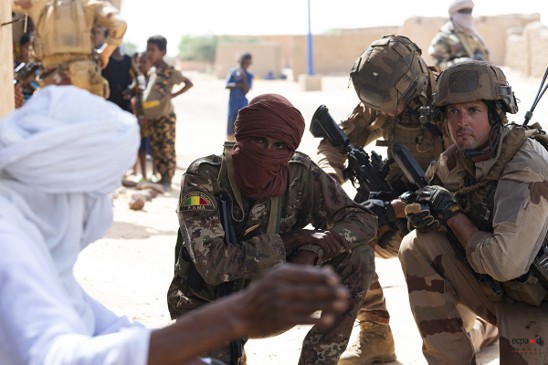
French counterinsurgency doctrine has its roots in the colonial campaigns of the nineteenth and early twentieth centuries, where officers such as Gallieni and Lyautey developed a population-centric model. This model emphasized protecting and rallying the population by limiting violence in favor of political action, later codified as “hearts and minds.” Gallieni operationalized this through the “oil spot” concept, securing specific zones and progressively expanding outward. Emphasis on mastering the “human terrain” required troops to live among the populace with minimal force protection. This tradition stood in diametric opposition to the dominant Western preference for decisive, symmetric battle. Subsequent post-colonial doctrine, codified in Contre-insurrection, updated these practices for twenty-first century intervention. France would shore up host-state legitimacy rather than impose its own rule, explicitly refusing to assume political governance. This restraint led French planners to regard their interventions as essentially apolitical, despite profound political consequences.
This intellectual tradition—in the French general staff’s own assessment—uniquely equipped France for the challenges it would face in Mali. General François Lecointre, who then commanded French forces in the Sahel, expressed confidence in the French strategy during a parliamentary hearing: “We know what we’re doing with Barkhane.”
However, a careful post-mortem of Barkhane reveals a significant gap between doctrine and practice. The weight of evidence suggests that Barkhane was prosecuted primarily as an enemy-centric COIN campaign, rather than as the population-centric global approach French doctrine prescribes. The enemy-centric approach locates the center of gravity, i.e. the focus of the operation, in the adversary itself. This approach pursues the adversary’s defeat through strategies of annihilation, exhaustion, decapitation, and territorial denial.
Barkhane effectively comprised a high-value target decapitation campaign executed through increasing reliance on drone strikes. Yet these eliminations followed a tactical rather than strategic logic—the rapid reconstitution of AQIM after the death of its leader Abdelmalek Droukdel demonstrates this clearly. This kinetic orientation was reinforced at the political level, with President François Hollande framing Barkhane’s sole objective as “destroying the terrorists.” Ground operations reflected the same logic, under a strategy of “ratissage”, the French model of cordon-and-search operations aimed primarily at neutralizing targets, seizing materials, and denying enemy sanctuaries rather than securing the population.
This kinetic emphasis came at the cost of a coherent civil-military engagement strategy, despite its prominent place in French doctrine. Hearts-and-minds efforts were reduced to token tactical goodwill gestures, handing out soccer balls, digging wells, heavily promoted for public relations purposes but offering no substitute for genuine political pacification. Consequently, the socioeconomic and demographic root causes underpinning the insurgency were never addressed at the strategic level. Rather than running civil-military engagement concurrently with security operations from the outset, Barkhane prioritized defeating the enemy first, inverting the logic of France’s own COIN doctrine.
France’s departure from its own doctrine was driven by a confluence of structural and contextual factors. The sheer scale of the Malian theater made the oil-spot model operationally unfeasible: securing and holding population centers across a territory twice the size of France would have required a force commitment French political will and defense budgets could not sustain. Barkhane also coincided with the height of IS’s terrorism campaign across Europe, with France as its most prominent target. The trauma of the Paris and Nice attacks fostered a political environment in which counterterrorism language was more domestically legible than counterinsurgency strategy, and that framing cascaded downward into operational priorities at the expense of the population-centric engagement the doctrine required.
Where the gap between doctrine and practice became most severe was in the erosion of French mastery of the human terrain. A creeping “Americanization” or “bunkerization” of French operations saw soldiers increasingly withdraw behind fortified base walls and inside armored vehicles. Though more common in American COIN operations—prioritizing force protection over winning hearts and mind—this tendency uncharacteristically severed the physical contact with the population that French doctrine considers essential. Combined with four-month deployment rotations, this operational posture made it impossible to build the local trust, contextual knowledge, and human intelligence networks upon which effective population-centric COIN depends.
Beyond its operational dissonance, Barkhane was underpinned by a distinctly apolitical logic, France’s effective surrender of its usual “liberty of action” to an incapable host state. Political, developmental, and military training responsibilities were outsourced either to the Malian government or to a series of EU-affiliated training missions, on the assumption that France’s role was to provide security while the host nation granted the counterinsurgency its own legitimacy. This assumption was structurally incompatible with Contre-insurrection’s own requirement that only a host nation legitimate in the eyes of its population can carry forward the political project COIN depends upon.
France’s misdiagnosis of Malian instability as primarily a problem of military weakness compounded this error. Mali historically devoted a disproportionate share of its budget to defense, a pattern that undermined state legitimacy by diverting resources away from public goods and civilian governance. Rather than addressing this dynamic, France restored failed elites to power and continued to prop up an unpopular government, systematically misreading local political conditions. The result was a structural trap. By treating security as a precondition for politics rather than vice-versa, France perpetuated the status quo ante it should have been reforming. This misinterpretation of Malian sociopolitical dynamics made durable stabilization impossible. Worse, it inadvertently created the conditions for the 2020 coup.
The Wagner Group in Mali: Coercive Logic and Its Limits
Attributing a formal doctrine to the Wagner Group, a Russian Ministry of Defense-steered PMC, is a difficult task. This section instead reconstructs its operational logic inductively from its modus operandi in Mali. The junta sought Wagner’s services primarily to provide regime security, with little concern for legitimacy or popular support. The junta hoped to increase its coercive capabilities to secure the “useful Mali”: the country’s cities, roads, and mines. Its rationale for replacing France with Wagner was a desire for a more aggressive, enemy-centric approach. Wagner’s broader strategic role as a Russian “quasi-state agent of influence” reinforced this—the PMC sought to entrench itself through state capture and securing the survival of embattled strongmen in exchange for political and economic payoffs.
These strategic objectives are laid bare by Wagner’s revenue model. Wagner’s incentives were perversely structured by a classical principal-agent problem: defeating the insurgency would render the mercenary group expendable and terminate its access to mining concessions, making prolongation of the insurgency profitable.
Wagner maintained a high operational tempo, particularly in joint operations with the Malian Armed Forces (FAMa). The intensity emboldened Malian troops and local ethnic militias such as the Donzo. The enemy-centric approach Wagner championed was progressively overtaken by ethnic grievances, as indiscriminate use of force and intelligence gathering through systematic violence became standardized operational procedures. Operating with far weaker human terrain knowledge than the French, Wagner proved unable to solve the identification problem—the challenge of distinguishing insurgents from the civilian population—a necessity in an effective counterinsurgency. Unable to resolve this problem through intelligence, Wagner gradually abandoned enemy-centric COIN logic altogether, defaulting instead to a strategy of annihilation rooted in Russian military thought. Under that strategy, the destruction of the entire potential support base replaces the selective targeting of active combatants.
The campaign increasingly gained a collective punishment dimension, with the Fulani population targeted and massacred, such as in the Malian town of Moura, where over three hundred civilians were killed by FAMa and Wagner. Wagner operations also frequently relied on the purveyance of disinformation to manufacture a favorable social environment, obscure civilian casualties, and accelerate the French withdrawal. Wagner’s most visible operational success was the recapture of Kidal, an achievement with some significance—the French never managed it.
Nevertheless, Wagner’s record proves such doctrine is not without enormous costs. Despite gaining more ground geographically than the French forces, Wagner faced an insurmountable manpower ceiling. With a peak deployment of roughly 2,000 men, later falling to approximately 1,000, Wagner lacked the resources to reclaim and hold substantial territory. Its victories were thus temporary: once Wagner withdrew, insurgents rapidly returned.
Furthermore, Wagner’s pursuit of military annihilation exacerbated the insurgency. The mercenaries’ excessive use of force generated sustained resentment and moral outrage, functioning as a recruitment tool for insurgents, most acutely among Fulani communities subjected to collective punishment. This erosion of Mali’s social fabric alienated the civilian population and perpetuated precisely the instability that Wagner was originally hired to rectify.
Wagner’s ulterior motives thus produced a dysfunctional force effective at the tactical level but incapable of strategic resolution. The junta’s pursuit of an enemy-centric campaign to restore sovereignty only accelerated the state capture conducted by its own client force. Wagner’s coercive model demonstrates that an enemy-centric approach—even when unencumbered by the doctrinal constraints with which the French wrestled—does not resolve the fundamental problem. Without the precondition of host-state legitimacy as a political foundation, tactical dominance cannot be converted into strategic stability.
Beyond the Dichotomy: A Shared Structural Failure
The population-centric versus enemy-centric dichotomy offers a useful organizing framework, but it is not a sufficient explanation for why both campaigns failed in Mali. In both cases, operational and strategic friction quickly shifted both campaigns into enemy-centric operations, and both failed to achieve a sustainable status quo. COIN literature has long challenged this dichotomy, calling it a “caricature” that oversimplifies modern warfare: effective COIN requires a balance of targeting insurgent support and active insurgents via both physical force and political efforts.
The common failure in both campaigns is a shared assumption that external military force, whether French technocratic assistance or Wagner’s brutal coercion, could act as a substitute for the host-state’s political legitimacy. In the French case, the civil side of the Malian government was too weak to counterbalance the military strengthening the French advocated eroding the Malian state’s legitimacy, simultaneously freeing the civil government of any accountability, removing pressure to reform, and stripping away its leverage over its own armed forces, paving the way directly to the military coup.
In the Wagner case, host-state legitimacy was never an objective. Securing the long-term viability of the host state was deliberately eschewed in favor of propping up the regime and extracting resources.
Fittingly, this is the exact pitfall identified by French counterinsurgency doctrine itself: only an “autochthonous power that is legitimate in the eyes of the host-nation” can lead the political reconciliation project that COIN depends upon. Yet the doctrine leaves a fatal question unanswered: “What if the host nation is not up to the challenge of conceiving of and promoting an alternative political project that would improve on the status quo ante?”
French military culture—and Western military culture writ large—with its persistent preference for “large-scale decisive battles” using massive force and technology, has long struggled with this tension. Recent Russian military tradition also tends toward resolving conflict through a violent, decisive clash of wills as quickly as possible. Veterans of the Chechnyan Wars—in which the Russian state combined brutal crackdowns with absolute authority—made up a proportion of the Wagner contingent, including Wagner co-founder Dmitry Utkin. These institutional pathologies undermine patient COIN work. While Wagner’s brutality might be read as deliberate strategic choice rather than institutional default, the two are not mutually exclusive.
Conclusion
The failures of counterinsurgency in Mali by the French Army and the Wagner Group eschew the typical population-centric vs. enemy-centric dichotomy, because the dichotomy held insufficient explanatory power there. It was not a failure of doctrinal theory that weakened the Malian state and empowered the rebels. Rather, the decisive variable was host-state legitimacy. France eroded this legitimacy through shallow state-building and apolitical intervention; Wagner never sought it, optimizing instead for regime survival and resource extraction. Despite their many differences, both forces converged on kinetic logic: France through institutional drift and post-colonial self-restraint, Wagner through deliberate coercive design. The dichotomy of COIN describes intent, and perhaps ideology, but not operational reality.
Above all, the legitimacy of the host-state acts as the political foundation on which the dichotomy is built. In Mali, that precondition was absent. A more faithfully population-centric Barkhane would still have been underwriting a government whose relationship with its own population was the root of the insurgency’s persistence. A stronger Malian state may have restrained the Wagner’s ulterior motives in favor of focus on the counterinsurgency mission.
The deeper lesson is one that doctrine—French or Wagner—could not account for. When a host state lacks the political capacity to generate its own legitimacy, no external military force, however doctrinally sophisticated or coercively effective, can substitute for it. Mali is not an exception. It is an illustration of a condition that recurs wherever external interveners prioritize military capacity-building over the political foundations upon which durable stabilization depends. As long as the COIN debate remains organized around doctrinal models rather than the political conditions of intervention, it will continue to misidentify the problem, and external interventions will continue to fail for the same structural reasons, dressed in different doctrinal language.


