





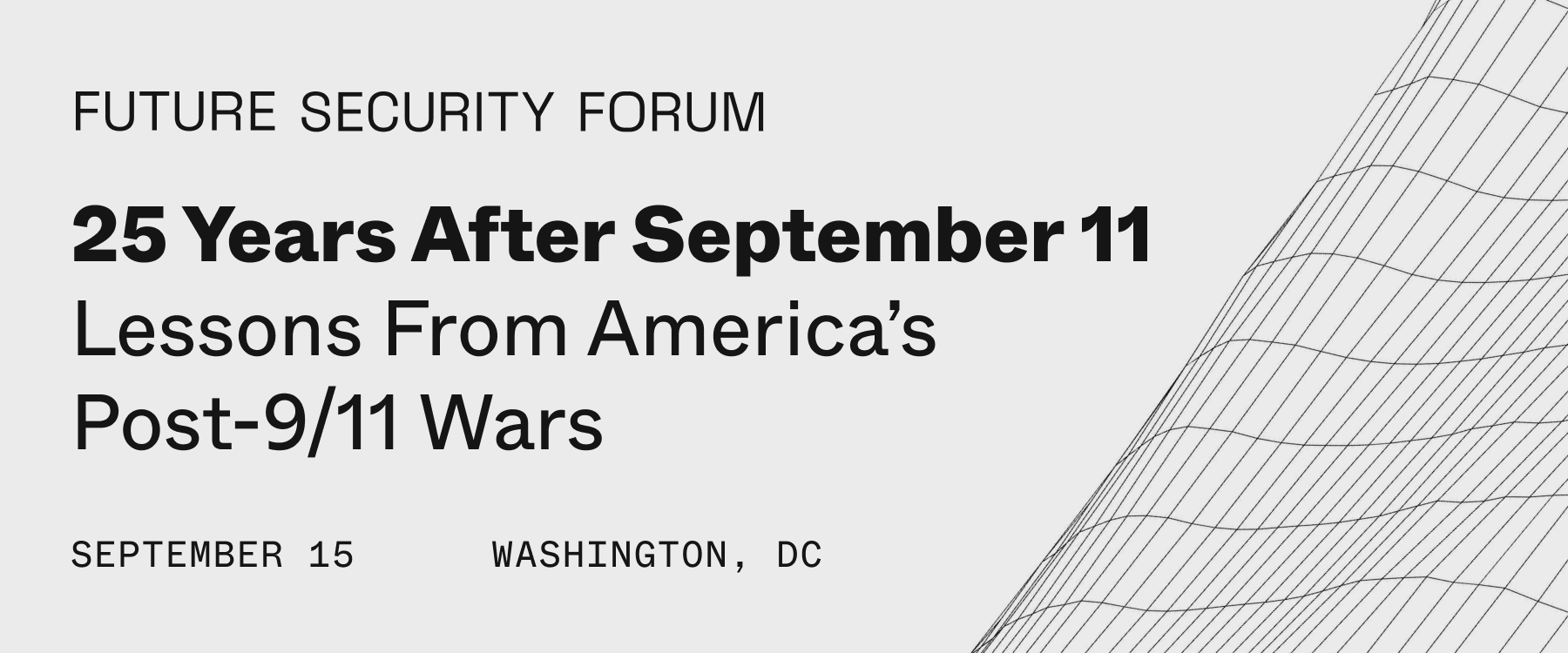
SAVE THE DATE: 25 Years After September 11, Lessons From America’s Post-9/11 War

“For many Americans under 25, the post-9/11 wars are history. For many of us over 40, they defined our professional lives, shaped our identities, and influenced nearly every major national security decision of our generation. This event brings those perspectives together to examine not only what happened, but what those wars still mean for the future of American strategy.”
-Col. (R) Jan Ken Gleiman, Ph.D., Editor-in-Chief of Small Wars Journal
New America and Arizona State University invite you to join leading voices in national security and foreign policy this fall to examine lessons learned in the years since 9/11 in this year’s annual Future Security Forum. The day’s discussions will explore America’s counterterrorism policies, insights from 25 years of war reporting, America’s allies’ views of the country today, and how the Iran War built on the precedents established by President Trump’s predecessors as commanders in chief, among other topics.
Speakers will include:
- General (Ret.) Joseph Votel, Former Commander CENTCOM; Former Commander, Special Operations Command; Former Commander, Joint Special Operations Command
- Dame Louise Richardson, President, Andrew Carnegie Foundation; Former Vice-Chancellor (President), University of Oxford and University of St. Andrews; Author, What Terrorists Want: Understanding the Enemy, Containing the Threat
- Peter Bergen, Vice President, New America; Professor of Practice, Arizona State University; Author, All the Presidents’ Wars: Twenty-Five Years of America’s War on Terror
- Col. (R) Jan Ken Gleiman, Ph.D. of Small Wars Journal
This year’s Future Security Forum is organized in collaboration with Global SOF Foundation, Security & Defence PLuS, and the McCain Institute.
Location: New America’s Washington, DC office (online viewing will be available but in-person attendance is recommended)
Space is limited. Reserve your spot today.
Please register using the above link so we know SWJ sent you! Thank you.


In my view, one of the most valuable discussions would be whether the lessons of the post-9/11 era have actually been institutionalized or whether policymakers continue to face the same challenges under different names. The evolution of terrorism, great-power competition, cyber operations, and autonomous technologies has fundamentally changed the security landscape. Yet, many of the core questions about intervention, coalition-building, intelligence, and balancing security with democratic values remain remarkably similar.