





The Red Corridor: The Anatomy of India’s 59-Year-Old Maoist Insurgency

Abstract
The decades-long Naxalite insurgency has claimed thousands of lives and ravaged large swathes of India. This essay examines the Maoist insurgency’s origins, its spread across India, counterinsurgency initiatives developed in response to its spread, and finally considers its decline and possible fall in the modern day.
Genesis: The Naxalbari Uprising
In early March of 1967, tribal peasants in the Naxalbari block of the Siliguri subdivision of Darjeeling district, in the State of West Bengal, India, began to seize land from local landlords. In mid-March, a group of local communist leaders known as the “Siliguri Group”—led by Charu Majumdar, Kanu Sanyal, and Jangal Santha—called for an armed peasant uprising to forcibly redistribute land to sharecroppers. Violent clashes soon erupted between the police and the peasant rebels, now called “Naxalites.” By July, the uprising had been crushed. Jangal Santhal was arrested, while Charu went into hiding.
But Majumdar had not yet led his last uprising. The Naxalite leader broke away from the Communist Party of India – Marxist (CPI-M), and in 1969 formed the Communist Party of India – Marxist-Leninist (CPI-ML), alongside other revolutionaries. Unlike the CPI-M, which sought political settlement within a constitutional and democratic framework, the CPI-ML insisted that only violent armed struggle could achieve viable change in India.
Majumdar was deeply influenced by Mao Zedong Thought, and the Quotations from Chairman Mao Tse-tung, better known as “The Little Red Book.” Majumdar penned a series of articles known as Historic Eight Documents, in which he rejected India’s mainstream communist parties and their Soviet backers. Majumdar objected to these communists’ “revisionism”—their acceptance of a democratic system of government for India. Majumdar espoused a revolutionary Maoist-Marxist-Leninist ideology, urging peasants to violently rise up and overthrow the Indian state. The Historic Eight Documents became the ideological foundation for the Naxalite-Maoist movement in the decades to come. While Majumdar was arrested in 1972, and would die in police custody, the disputed facts of his death only martyred him for the Maoist movement. The reach and numbers of the Naxalite insurgency would swell and spread far beyond West Bengal’s borders.
The Red Corridor
The Maoist movement spread quickly throughout central and southern India. Between the 1970s and 1990, more than forty Naxalite-aligned armed groups rose up. They thrived in areas where the Indian state had a minimal presence—areas with no electricity, running water, or rural healthcare. In particular, the movement took root in heavily forested regions populated by tribal communities. Overall, the Maoist insurgency had its greatest influence in the states of West Bengal, Andhra Pradesh, Telangana, Jharkhand, Maharashtra, Chhattisgarh, Odisha and Bihar. Altogether, they constituted the infamous “Red Corridor.”
By the early 2000s, the Maoist insurgency affected no fewer than 200 districts in India. By the mid-2000s, the People’s Liberation Guerilla Army—the armed wing of the CPI-ML— could field 10,000 fighters. A 2009 Ministry of Home Affairs Report indicated that these forces were armed with assault rifles, machine guns, rocket launchers, mortars and mines. From areas under their control, the Naxalites extracted the funds necessary to sustain their insurgency. In 2011, the Maoist insurgency was drawing yearly revenues of ₹20 billion ($445 million). the insurgency’s death toll was 7,594. The body count has since climbed to 12,189.
For years, Red Corridor states have greatly bolstered their police forces to combat the Naxalite threat. The Andhra Pradesh government was the first to create a special police unit—the Greyhounds—to hunt down and eliminate Maoist commanders within its borders. Other states followed suit, such as Jharkand’s Jaguars, an elite counterinsurgency force established in 2008. The state of Chhattisgarh, an epicenter of the Naxalite insurgency, implemented a much more controversial crackdown on the Maoists. The state’s Bastar region, an area of 40,000 km2, was a hotbed of Naxal activity. A state-trained and sponsored vigilante movement, “Salwa Judum” (Purification Hunt), and its “special police officer” unit, the Koya Commandos, were mobilized in 2005 to actively root out Naxalite influence. However, collateral damage soon followed, from the indiscriminate killing of tribal youth, to the use of child soldiers. In 2011, the Supreme Court of India banned both groups.
The security reforms made by the states, controversial or otherwise, did little to thwart the Naxalites. The Maoist insurgency remained entrenched and deadly, made clear by the disastrous 2010 Tarmetla ambush. Tarmetla, a Chhattisgarh village, was the site of a Naxalite attack in which a company of soldiers from the Central Reserve Police Force (CRPF) was ambushed and all but wiped out. 76 CRPF troopers were killed, with seven officers left alive, but badly injured.
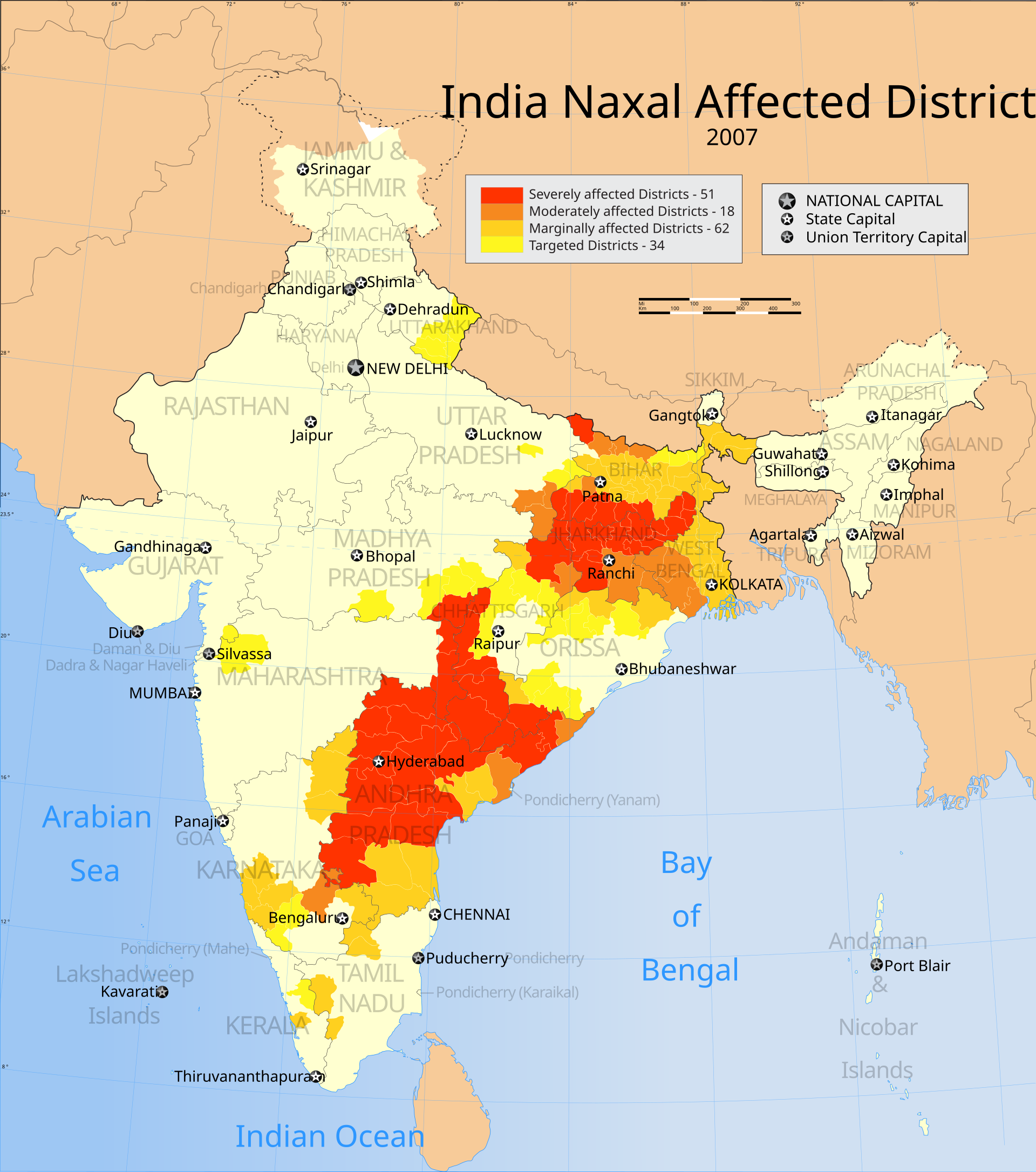
Image 1: Naxalite-affected districts in 2007 (Photo: WikiMedia Commons, user:Planemad, CC-by-SA 3.0)
The Federal Response
In India, the maintenance of law and order falls under the state government’s control. However, the central government can provide security assistance at the state government’s request. The need for such further assistance had become apparent by the mid-2000s as the state governments in the Red Corridor could not tackle the growing Maoist insurgency alone. In 2006, Prime Minister Manmohan Singh declared the Maoist insurgency to be “the single biggest security challenge” the country had ever faced. His government would establish a security blueprint to tackle the insurgency. In October 2006, the Ministry of Home Affairs created the Left Wing Extremism (LWE) Division to coordinate a security response. Among several provisions, key was the creation of a Central Armed Police Force. This force would provide operational support to states most affected by the insurgency. Over 70,000 central police personnel were sent to the states.
In addition, ten elite Commando Battalion for Resolute Action (COBRA) battalions were raised, alongside the establishment of twenty Counter Insurgency and Anti-Terrorist Schools (CAITs) to train police personnel in counterterrorist operations. This massive influx of central police forces enabled the government to establish 302 Fortified Police Stations in the Red Corridor.
The enhanced security presence also enabled the central government to extend infrastructure development in remote forested areas, partially to mitigate rural grievance as a catalyst for Maoist influence. Roads, railways, electricity and tele-communications were delivered to areas previously devoid of such facilities. When Prime Minister Narendra Modi’s NDA Government came to power in 2014, it built upon the Manmohan administration’s policies. The Modi government launched a number of centrally-funded infrastructure and security related programs. In 2024, a Ministry of Home Affairs report to parliament noted that 14,474 kilometers of road, 5,139 3G mobile communication towers, 1,007 bank branches, 937 ATMs, 179 residential schools, 46 industrial training institutes and 49 skill development centers had been built. The report indicated that between 2010 and 2024, LWE-violence related deaths (of civilian and security personnel) had been reduced by 86 percent. The number of LWE-affected districts had reduced from 126 in 2013 to 38 in 2024. The government also spent over $350 million dollars to financially support and rehabilitate Maoist insurgents who had surrendered to the authorities.
Counterinsurgency Through Investment
Digital connectivity has been a key factor in the government’s fight against the Maoist insurgency. Once-isolated tribals communities now have widespread access to global information, markets and supply chains. Women now have cell phones, access to online banking and the ability to apply for small business loans.
The Naxalite insurgents—well aware of cellphone towers’ centrality to undermining support for Maoism— have made their destruction a priority. Yet throughout the area of the Red Corridor, despite the threat of Naxalite vandalism, the government has constructed nearly 8,000 out of an eventual goal of 10,511 towers.
Mining operations have become another point of confrontation between the Maoists and the government. The Red Corridor is also a repository of some of India’s most valuable mineral resources. In addition to iron ores and coal, the region contains vast reserves of limestone, dolomite, and bauxite. Jharkhand and Chhattisgarh alone account for some 40 percent of India’s coal reserves. In former Naxalite strongholds, renewed access to of rare earth and thorium deposits has prompted some government officials to describe the region as a “Rare Earth Corridor”. As with telecommunications infrastructure, Maoists have made mining operations a frequent target of their attacks, destroying trucks, hauling equipment, and ore in transit to and from the mines. Since the Maoist insurgency’s relative collapse, however, these attacks have greatly decreased in both frequency and intensity. Over 10,000 insurgents have surrendered and joined the rehabilitation program. The tribal communities that once supported the insurgency have now turned against it as the Maoists attack the very infrastructure transforming the Red Corridor’s impoverished economy.
Conclusion
In August 2024, Narendra Modi’s Bharatiya Janata Party (BJP)-led government pledged to bring a permanent end to the Maoist insurgency. In a March 2026 address to the Lok Sabha, India’s lower house of parliament, Home Minister Amit Shah declared India is “Naxal-free.” The BJP government believes it has defeated the Naxalites.
But while the insurgency appears crippled, sporadic attacks continue. At the time of this article’s publication, the death toll for 2026 stands at 78 And while Mr. Shah spoke in parliament, thousands of trucks continued to transport ore from the Red Corridor’s deep forests. The mining boom has generated new tensions among the tribal residents. The locals rely on the forests for food gathering and subsistence farming, and fear the ecological damage that would be caused by unrestricted mining operations. Many villagers are worried that while the tribal peoples—the “Anusuchit Janjati”, or Scheduled Tribes—are recognized by the Indian Constitution, few tribes possess formal land titles. Tribal communities and local authorities alike fear that—once freed of Naxalite control— tribal land will be sold off to the mining conglomerates. The Indian government’s assertion that the insurgency has been eliminated may be premature. Unrestricted mining, underdevelopment, and poverty may continue in the region. Grievance over exploitation may yet herald a resurgence of the Maoist movement in the Red Corridor. The government cannot relent in its policies of land reform and grass roots economic development activities if it is to truly address the root causes of this long-lived insurgency.


