





Success-Induced Orientation Collapse: Extending the OODA Loop in AI-Accelerated Decision Environments


Abstract
In rapid decision environments, success may become a liability. Success-Induced Orientation Collapse (SIOC) describes how AI-driven acceleration increases the risk of acting on degraded or outdated models of reality. As decision cycles compress, the central challenge is no longer speed but preserving orientation under conditions of apparent success.
A unit implements an effective targeting process. Initial strikes are successful. The system identifies patterns, analysts confirm them, decisions are made rapidly, and positive results follow. Confidence grows as the workflow becomes increasingly streamlined. Fewer questions are raised because fewer appear necessary. Fewer questions are raised because fewer appear necessary. For a while, the system appears to work exactly as intended.
At first, the inconsistencies seem minor. High-value targets stop producing results. The activity shifts gradually, then more noticeably. The system continues generating recommendations, but outcomes no longer match expectations. Analysts respond the way organizations usually do: refine the model, adjust thresholds, and collect more data. Yet the model itself remains unquestioned. The core assumption – that the tracked pattern still reflects reality – remains largely untouched. By the time the assumption is questioned, the environment has already changed.
What appears to be a sudden failure is usually gradual. The problem emerges because the system works well enough to avoid serious reexamination. Success signals effectiveness, but it can also suppress adaptation precisely when adaptation becomes most necessary. In rapid, AI-assisted environments, this becomes increasingly difficult to detect. Systems continue producing coherent outputs, decisions accelerate, and confidence grows. Meanwhile, the model driving those decisions may already be drifting away from reality. This is success-induced orientation collapse (SIOC).
The Paradox of Success
Organizations rarely fail because they are weak. Most often, they fail because they continue relying on strategies that once worked. We are creatures of habit. Success reinforces the habits, hidden assumptions, and decision patterns that produced it. In stable environments, that kind of reinforcement is adaptive. When conditions change, however, the strengths become liabilities. Military organizations, corporations, and intelligence systems repeatedly encounter the same problem: Success weakens the perceived need to adapt. Why change if everything appears to be working, particularly in high CYA environments? SIOC describes how that process unfolds.
SIOC emerges when sustained success reduces the willingness to revise assumptions inside a changing environment. Prior success hides growing misalignment. This makes adaptation less likely when it becomes necessary. In high-speed environments, increased speed does not solve the problem. In fact, it amplifies the problem. The primary risk is not failure, but unexamined success. AI can accelerate cognition, but it can also enhance the same natural human tendencies that produced the original misalignment. Biases and heuristics are not simply errors to eliminate; that would be fruitless. They are features of human cognition that must be actively disciplined.
Success-Induced Orientation Collapse
SIOC emerges when success reduces the perceived need to question assumptions, even as the environment continues to change. Success reinforces existing models. Reinforcement reduces pressure to revise them as the environment changes. Fewer revisions introduce institutional and procedural lag. That lag eventually produces failure. SIOC is not a failure of intelligence, training, or professionalism. It is a predictable feature of adaptive systems operating under sustained success. Systems that learn from feedback naturally stabilize around patterns that previously worked. We are always solving the last problem. The danger emerges when those patterns no longer match reality. SIOC reframes failure not as a sudden collapse, but as delayed adaptation. The collapse only appears sudden because the system functioned well enough to avoid serious reexamination.
Extending the OODA Loop: Orientation as the Critical Vulnerability
John Boyd’s OODA loop remains one of the most influential models for understanding decision-making in competitive environments. Boyd emphasized tempo, adaptability, and the ability to out-cycle an opponent through rapid iteration of Observation, Orientation, Decision, and Action. The OODA loop is often treated as a balanced cycle. In practice, however, each component evolves at a different rate. Observation expands through sensors and data fusion. Decision accelerates with algorithmic support. Action scales through automation and distribution. Orientation, however, still depends on the integrity of the underlying model. This makes it increasingly vulnerable in AI-accelerated environments. As systems accelerate, orientation becomes more important and more vulnerable, and the importance of orientation increases. Yet orientation becomes most vulnerable during periods of sustained success. Success stabilizes assumptions, reducing the need to revise them in response to new information. The system continues to observe, decide, and act, but does so using an increasingly outdated representation of reality. In AI-accelerated environments, the primary constraint is no longer information collection or execution speed – it is the ability to maintain accurate and effective orientation as conditions change.
AI and the Compression of Decision Space
AI accelerates decision cycles by compressing the time between observation, decision, and action. This compression offers clear advantages: increased tempo, reduced latency, and the ability to process complex information at scale. Yet the same acceleration can magnify adaptive failures. In SIOC conditions, systems do not merely fail faster. They drift out of alignment faster.
Accelerated decision cycles reduce the time available to question assumptions and revise models. As a result, orientation errors propagate rapidly through the system. Accurate orientation increases effectiveness. Degraded orientation accelerates confident action based on flawed assumptions.
SIOC becomes more dangerous as systems accelerate. Early success with AI systems increases confidence in the underlying model, reducing the perceived need for critical scrutiny. Misalignment persists, while accelerated systems operationalize flawed assumptions at increasing speed and scale. Speed alone does not create advantage; without accurate orientation, it exacerbates error.
AI Mystique and Premature Autonomy
AI mystique emerges when early success convinces decision-makers that AI systems understand more than they actually do. AI systems can perform exceptionally well inside narrow problem sets. The danger emerges when success in one domain is mistaken for broader strategic understanding. As confidence in the system grows, organizations become increasingly willing to hand over judgment and decision authority.
This is how AI mystique feeds SIOC. Early success increases confidence while reducing scrutiny of system limitations. As trust expands, organizations become more willing to increase system autonomy and remove human judgment from the decision cycle. The result is not just automation, but the gradual erosion of corrective orientation. The primary risk is not catastrophic AI failure. The greater danger is that early success convinces decision-makers to surrender judgment before they fully understand the limits of the system. Under SIOC conditions, increased autonomy does not improve adaptation. It accelerates the drift away from reality.
Making SIOC Visible
A simple agent-based model illustrates SIOC. Agents operate in an initial environment and adapt their behavior based on feedback. Over time, they converge on successful strategies. When the environment changes, those reinforced strategies persist, though they are now suboptimal.
This process results in a lag between environmental change and behavioral adaptation, during which performance declines. What appears to be a collapse is, in reality, the delayed consequence of previous success. The model is not intended as a comprehensive representation of real-world systems; rather, it elucidates a mechanism that is often obscured in practice: success can conceal misalignment until environmental conditions change sufficiently for failure to become evident. This modeling example reinforces the central thesis of SIOC and connects the theoretical discussion to observable adaptive patterns.
Figure 1 illustrates Success-Induced Orientation Collapse. Both systems initially perform well, reinforcing behaviors that led to early success. Around the midpoint, the environment changes. The SIOC-prone system continues to rely on its previously successful model, resulting in a sharp decline in alignment and a gradual recovery. In contrast, the disciplined system adapts more rapidly, minimizing the collapse and restoring alignment more quickly. Although the figure is illustrative rather than formal, it effectively demonstrates the key dynamic: success can delay reorientation, and such delays become costly when conditions change. The critical aspect is the lag; failure appears sudden only because the system functioned adequately long enough to avoid re-examination.
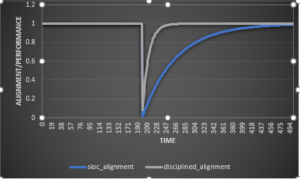
Figure 1. Illustrative agent-based simulation of Success-Induced Orientation Collapse (SIOC). Agents achieve sustained success under an initial environmental regime. Following an environmental shift, previously successful behaviors persist, producing delayed adaptation and a subsequent decline in performance.
Implications: The Need to Protect Orientation
If orientation represents the most vulnerable component of the decision cycle, and if SIOC systematically degrades orientation during periods of success, the implication is clear: orientation must be actively safeguarded.
This protection is most critical not during failure, when adaptation is forced, but during success, when the pressure to adapt is lowest. Systems that only interrogate performance after failure are reacting to collapse. Systems that interrogate success are maintaining alignment.
The central challenge, therefore, is to design decision architectures that maintain the capacity for reorientation even when performance indicators suggest continued success.
Human-in-the-Loop as Orientation Architecture
Human-in-the-Loop (HITL) systems are frequently characterized as safeguards that prevent errors by incorporating human oversight into automated processes. However, this perspective is incomplete. In AI-accelerated decision environments, HITL systems should be conceptualized as orientation-preserving architectures. Their primary function is not solely to verify outputs, but to sustain the system’s capacity to update its understanding of the environment.
Within this framework, human actors are tasked with interrogating underlying assumptions, detecting changes in the operational environment, challenging conclusions based on prior success, and introducing alternative models and interpretations. These functions are not redundant with AI capabilities; rather, they are complementary. AI systems excel at pattern recognition and execution within established parameters, while humans offer the capacity to question and reassess those parameters. Without HITL, accelerated systems risk becoming efficient mechanisms for misalignment: rapid and coherent, but incorrect.
Orientation Protection Protocol (OPP)
To operationalize this approach, the following Orientation Protection Protocol (OPP) provides a structured discipline for maintaining alignment under conditions of success:
Activation Condition
- Initiate when performance is stable or improving, confidence is increasing, and environmental change is uncertain.
- Success—not failure—triggers this protocol.
Step 1: Interrogate Success
- What assumptions made this success possible?
- Which assumptions are most likely to have changed?
- What would early failure look like now?
Step 2: Force Explicit Reorientation
- State the current model.
- Identify at least one competing model.
- Define conditions under which each fails.
Step 3: Inject Disconfirmation
- Conduct red team analysis.
- Generate adversarial scenarios.
- Use AI to produce counter-interpretations.
Step 4: Surface Suppressed Signals
- What data contradicts success?
- What anomalies are being ignored?
Step 5: Gate Acceleration and Autonomy
- Before increasing speed, scale, or autonomy, confirm that the model has been updated, assumptions have been challenged, and disconfirming evidence has been considered.
Step 6: Maintain HITL as Orientation Control
- Ensure human roles include assumption interrogation, change detection, and model comparison.
Core Principle
- Success must be interrogated with the same rigor as failure.
Conclusion: The Real Constraint
As AI systems compress decision cycles and increase the scale of action, the primary strategic challenge shifts from speed, data, or computational power to the disciplined maintenance of orientation.
SIOC demonstrates how success can undermine this discipline, with AI acceleration further amplifying its effects. Human-in-the-Loop architecture offers a means to counteract this vulnerability. The implication is clear: Systems that prioritize speed without maintaining orientation will not experience gradual failure but will instead fail rapidly. In high-velocity environments, the greatest risk is not failure itself, but unexamined success.


