Army looks to small UGVs as Ukraine war reshapes battlefield robotics
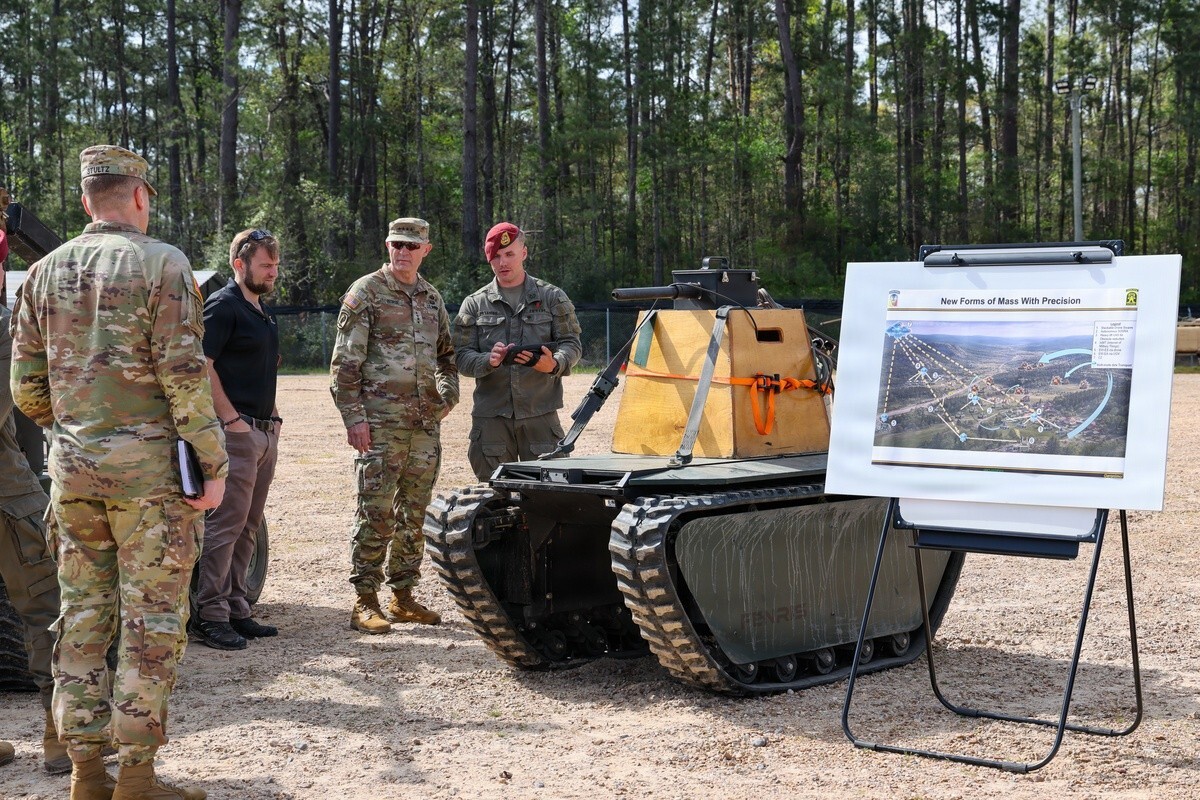

WASHINGTON – James Crowell, the founder and CEO of unmanned ground vehicle manufacturer Crow Industries, did not go into business intending to build a machine of war.
When Crowell started his company in Scottsdale, Arizona, he saw the vehicles commonly referred to as UGVs as a tool for exploring the cosmos. To make humanity’s interplanetary expansion possible, his team built a rover designed for mining operations with hopes it would eventually help industrialize the solar system.
That initial focus expanded when friends in the Army saw the model – the first American-made UGV of its size, thousands of pounds smaller than competitors – and asked for a demonstration. Since then, the Army has become a primary customer.
“We’re in a really exciting time right now, because we’re able to help the Army write those new doctrine of, ‘How do you fight with robots and people together?’” Crowell said.
Army officials have been increasingly interested in UGVs, a class of remotely-operated robots. The systems’ utility has been demonstrated on the battlefields of Ukraine. Among the applications are cargo transportation, reconnaissance, barricade breaching, evacuation of wounded personnel, detonation and engaging enemy combatants.
The U.S. defense industry was flirting with UGVs long before Russia’s invasion of Ukraine. In the 1960s, the Defense Advanced Research Projects Agency introduced a precursory vehicle that kicked off decades of innovation in which the Army has played a central role.
In recent years, the 18th Airborne Corps has experimented in its multi-year Sandhills Project with using the vehicles for breaching obstacles. The Army’s xTech program – which Crow Industries has participated in – has hosted several competitions to solicit UGV concepts and products.
Earlier this year, the Army offered a contract for a UGV model that can support troops over the “last tactical mile,” the most dangerous and complex phase of a mission, when forces face the greatest threat.
Brig. Gen. Anthony Gibbs, who leads the Capability Program Executive Office for Mission Autonomy (CPE Mission Autonomy), said the Army is pursuing “several commercial autonomous unmanned robotic capabilities” and working to get prototypes to soldiers for feedback.
“The Army is implementing autonomous unmanned robotic capabilities to enable commanders to dictate the terms of the engagement by shaping and degrading threats across the multi-domain battlefield,” he said by email. “The Army’s strategy aims to leverage commercial technology that will address capability gaps, enhance operational readiness, and ensure rapid prototyping, fielding, and integration of affordable, scalable, interoperable, and mission-critical autonomous systems.”
Crow Industries produces the Fenris, a rover that can carry up to 500 pounds and wield a turret, detonate explosives, transport supplies, evacuate wounded soldiers or gather intelligence, according to the company’s website. The vehicle can operate via teleoperations or autonomously.
True to its roots as a would-be space explorer, the Fenris retains its mining functionality.
The Army has been using it since September 2024.
Fenris comes in 700 and 1,500 pound variations. Crowell said the relative compactness makes it unique.
Other UGVs the Army has adopted are significantly larger – often by thousands of pounds.
In 2024, the Army awarded an $11.6 million contract to HDT Global for its Hunter WOLF model, weighing up to 3,600 pounds.
Even larger UGVs have also attracted Army investment. Textron Systems’ Ripsaw M3, which weighs 8 tons, was one winner of a $24.7 million contract in 2025 to produce a prototype. The Army later shifted to a consortium arrangement for developing robotic combat vehicles.
In contrast, Fenris is meant to be nimble, simple and inexpensive to build, Crowell said. Limiting the UGV to a couple of functions holds down the cost per vehicle – and the risk of losing an expensive Swiss Army knife in battle.
“It’s de-risking the capability set across the battlefield,” Crowell said.
Crow Industries started in 2018 and has just 12 employees. Crowell declined to disclose the magnitude of its contracts but said it is working on several Army contracts and is in talks to sell to U.S. allies as well.
Fenris has been tested on training deployments, and its design has proven capable of handling muddy and wooded terrain, Crowell said. Its low cost – which he declined to specify – means it is effectively expendable, allowing the Army to send it to disrupt an enemy’s position knowing it might be lost.
Crowell is hoping the Trump administration’s push for faster technology acquisition will help his company grow.
“It’s not just about innovating on the tech,” he said. “Innovating on the procurement pathways has been a huge benefit right now.”
Retired Army Col. Ben Fernandes, a former National Security Council director of defense policy and strategy who has spent years researching robotics and autonomous systems for the Army and Navy, said the technology has a variety of military applications.
“It’s going to end up being the first line of defense or first line of attack,” said Fernandes, now an Arizona State University professor.
UGVs can offer offensive and logistical capabilities without endangering humans, he said. They’re especially useful for “dull, dirty and dangerous” tasks – jobs like clearing land mines.
Under a new “forward line of robots” doctrine taking shape, unmanned systems will be sent ahead of troops to observe and engage adversaries, according to an article in Infantry, the Army’s magazine.
“That is really where the future of warfare is going,” Crowell said.
But Fernandes said development and adoption haven’t been steady. UGVs require further research. And integrating them fully will require structural changes within the Army.
Army leadership in particular has been slow to get on board.
“Trying to convince them to replace a manned tank with an unmanned tank is really, really hard to do,” he said.
More prototype testing and field evaluation will help demonstrate the battlefield advantage afforded by UGVs, Fernandes said. “We have not done enough experimentation, and we have not done enough development to really get those things to production value.”
Convincing the Army’s top brass to shift from larger UGVs to those the size of Fenris has also been challenging, Crowell said.
It wasn’t until soldiers asked for the more versatile UGVs, and as Ukraine’s success with the vehicles became apparent, that the Army truly started to pay attention to what Crow Industries had to offer, he said.
Gibbs pointed to the Army’s creation of his own Mission Autonomy organization and three upcoming awards for autonomous unmanned systems as evidence of its dedication to adopting the technology.
“The Army is committed to delivering autonomous capabilities to ensure our soldiers continue to have a decisive advantage on the battlefield,” he said.
Chris Haag, vice president of business development and strategy for the U.S. subsidiary of Rheinmetall – the fifth-largest arms manufacturer in Europe, with customers around the world – also sees the Army embracing UGV technology.
The largest UGV in American Rheinmetall’s flagship line weighs nearly 5,500 pounds.
A former U.S. Army engineer, Haag said UGVs are a way to augment human forces as standing armies shrink.
“It’s a very good tie-in in order to support the Army, the various armies that we support, with a product that supports soldiers doing their business and coming home safely,” he said.
Crowell foresees greater adoption of smaller UGVs like Fenris.
Over the next five years, he anticipates seeing fully unmanned military units consisting of ground vehicles, aerial drones and maritime vessels.
“The forward line of robots is coming,” Crowell said. “It’s going to be enabled by small, modular UGVs.”