Stars and Signals: Why Operational Advantage from Satellites and Drones Decays Faster Than We Think
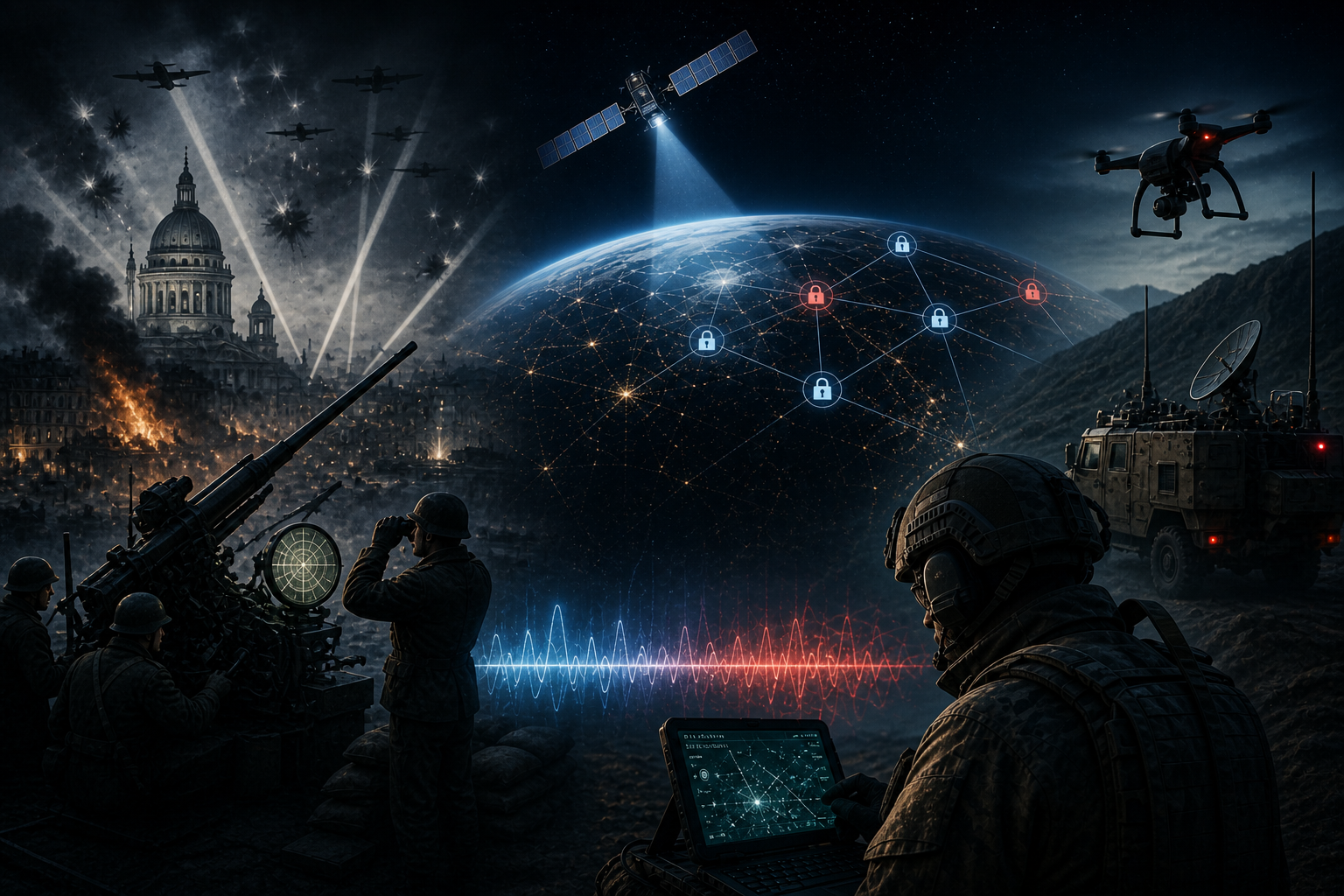

In February 1944, Soviet bombers attacked Helsinki in one of the largest air raids of the Continuation War. Proactive defensive actions ensured that much of the destruction fell outside the city center. Clever Finnish defenders lit deceptive fires on the outskirts of the city, maintained blackout discipline, utilized radar-guided anti-aircraft fire and false target arrays to mislead Soviet navigation and bombing patterns. These efforts shifted the impact of the strike away from critical urban targets, with only a few hundred of the 16,500 bombs hitting the city. The Finns deflected the Soviet raid not only in the air but also by shaping what the attacker saw and believed in the final moments of the kill chain.
Immediately following the Helsinki raids, Finnish bombers conducted audacious counter-airfield strikes against the very Soviet aviation bases near Leningrad that attacked them. While their territory was still burning, Finnish aircraft launched and merged with formations of the returning Soviet bomber fleet. The Soviets unsuspectingly led their enemy to their bases, where the Finns targeted parked aircraft and infrastructure, exploiting predictable recovery cycles to disrupt follow-on operations. These actions by the Finns, from initial deception to counterattack, illustrate a recurring operational truth: victory is often decided not by destroying platforms, but by shaping the conditions under which an adversary must make decisions. By manipulating what Soviet forces saw and believed at critical moments, Finnish defenders degraded the coherence of Soviet decision-making in the final stages of the kill chain.
This case is best understood through what Michael S. Neiberg describes as historical mindedness, the disciplined use of the past to identify patterns of continuity and change without imposing false equivalences. Viewed in this way, the Finnish defense highlights a recurring feature of armed conflict: the force that can preserve its own decision coherence while degrading that of its adversary achieves operational advantage.
Wars today challenge practitioners with a modern version of a similar problem. Modern military forces depend on satellites, networks, and precision navigation rather than the visual bombing cues of World War II. Nevertheless, the outcomes in battles still center on how long information remains usable enough to support decision-making before it is degraded, denied, or mistrusted. After two decades of fighting in Afghanistan and Iraq, modern militaries, such as U.S. and NATO forces, have become accustomed to persistent access to space-enabled services. This includes communications, as well as positioning, navigation, and timing (PNT), and intelligence, surveillance, and reconnaissance (ISR).
The Russia-Ukraine War shows that these capabilities remain critical but operationally vulnerable. The decision-making value from space-enabled systems decays under electromagnetic contestation, governance constraints, and rapid cycles of adaptation and counteradaptation. U.S. military doctrine frames space capabilities as providing temporal effects rather than guaranteeing a permanent presence. Meanwhile, the joint force relies on a contested electromagnetic spectrum to connect with space, making this invisible conduit an essential but vulnerable battlespace. Most importantly, the Russia-Ukraine War shows that the central challenge is not access to information but how long that information remains reliable enough to support coherent decision-making. This dynamic extends beyond military systems into the commercial space ecosystem.
Commercial SATCOM Is a Policy Weapon, Not Just Bandwidth
Commercial satellite communications (SATCOM), particularly through SpaceX’s Starlink, have proven to offer governed—not guaranteed—access with direct operational consequences. SATCOM, primarily through SpaceX’s Starlink, became a critical part of Ukraine’s infrastructure after Russian strikes significantly degraded the smaller country’s terrestrial networks. Nevertheless, the war has revealed that commercial SATCOM offers a critical, but regulated conduit. A February 2026 battlefield vignette illustrates the influence of business decisions in armed conflict. Russian units had begun using smuggled Starlink terminals mounted on drones to extend their strike ranges. These terminals enabled the Russians to attack Ukrainian logistics routes around Pokrovsk, a city the Ukrainians consider part of their stronghold in the east. Stolen Starlink terminals facilitated Russian beyond-line-of-sight drone operations that disrupted Ukrainian resupply and casualty evacuation. When SpaceX learned about these Russian actions, it disabled the unauthorized terminals and implemented a whitelist for Ukrainian systems. Ukraine further capitalized on the confusion, forcing Russian users to seek workarounds, charging them phony fees, collecting target location information from those transactions, and following through with precision strikes. The operational effect manifested immediately: Russian drone activity along key routes declined sharply, and Ukrainian freedom of movement improved within days.
SpaceX president Gwynne Shotwell stated that Starlink “was never intended to be weaponized,” underscoring the tension between commercial policy and battlefield use. While those intentions may be true, the takeaway from military planners is that access to commercial SATCOM is shaped as much by shareholders’ and policymakers’ concerns as by technical performance. For instance, SpaceX imposed restrictions on some military uses of Starlink, including on Ukraine and its drone operations, based on policy and contractual constraints. The operational value of this capability is contingent on provider risk tolerance and time constraints. This vignette illustrates that commercial SATCOM is more than simple infrastructure; it is an instrument of statecraft. Through the lens of the diplomacy, information, military, and economy (DIME) framework, commercial providers sit at the intersection of diplomatic clout, informational conduits, military support, and economic growth. The rapid disablement of Russian terminals was not simply a technical fix. Instead, it enabled a coordinated expression of unity of effort among public and private actors. As a result, decisions that depend on these systems must be made with an understanding that access and reliability may change without warning. As such, military planners should treat commercial SATCOM as an operational capability critical to national security, subject to policy friction and corporate risk tolerance, not as a constant, neutral utility. Military forces must not only understand these governance risks and opportunities of commercial SATCOM, but also know how to maximize the effects of electromagnetic warfare by employing it smartly. While SATCOM reveals governance constraints, well-timed electromagnetic warfare creates a decision advantage.
Electromagnetic Warfare as Temporal Maneuver
Electromagnetic warfare (EW) in Ukraine has functioned less as persistent spectrum dominance and more as a temporal maneuver, shaping the timing and effectiveness of strike packages. In January 2024, Ukrainian officials claimed that their use of electronic countermeasures neutralized more than twenty Russian missiles, disrupting Russian strike effectiveness without relying solely on their diminishing numbers of kinetic interceptors.
This Ukrainian use of temporal EW to disrupt battlefield effects highlights a broader trend stemming from the conflict. Russian strike packages frequently combine cruise missiles, ballistic missiles, and drones in layered salvos designed to saturate Ukraine’s defenses. On the other side, Ukrainian defenses have increasingly integrated electronic attack to disrupt navigation, degrade datalinks, and interfere with guidance systems. Ukraine’s well-timed disruptions of the electromagnetic spectrum reduced the accuracy and reliability of these Russian fires at critical moments. Similarly, the density of Russian GPS jamming and the countermeasures employed by Ukrainian forces highlight how both sides operate in heavily congested and contested spectrum conditions.
In practice, EW rarely produces continuous denial across the spectrum. Instead, it produces intermittent, localized effects that disrupt timing and coordination. Much like the clever actions of the Finns in 1944, modern-day EW can disrupt the coordination and timing of inbound strike packages, reducing the effectiveness of the adversary’s lethality. If a weapon’s guidance can be degraded or its strike timing disrupted, the attacker begins to question their decision-making and ability to employ new technologies. This intermittency creates a distinct challenge on the battlefield. When systems fail unpredictably, operators cannot easily determine whether a malfunction, user error, or electromagnetic interference caused the disruption. This ambiguity complicates troubleshooting, undermines confidence in equipment, and forces decision-makers to act without fully trusting the information or systems available to them.
Given their unpredictability on the battlefield, electromagnetic attacks and interference require rapid mitigation and authority coordination, a heavy cognitive task. Blinding and deafening opponents, EW becomes a practical tool for shaping decision windows, compressing the adversary’s ability to act while expanding one’s own. These dynamics align closely with “observe, orient, decide, and act” (OODA) loop logic, but with an important caveat. At its core, the OODA loop is not simply about deciding faster than an adversary, but about learning and adapting more effectively through cycles of observation, orientation, decision, and action. Under degraded conditions created by electromagnetic attacks, decision-makers are pushed from deliberate, analytical reasoning toward what Daniel Kahneman dubs “System 1” thinking. System 1 is not only fast and intuitive but also more prone to error, which can further compound the operational effects of EW. Well-timed electromagnetic disruption does not need to completely blind a weapon system. These invisible attacks only need to dislocate the adversary’s decision cycle long enough to render their actions ineffective.
Much like the military deception maxim that urges planners to husband deception assets, electromagnetic warfare should be withheld until its benefits are high, which makes timing essential to its employment. These lessons from Ukraine remind us that success in the electromagnetic battlespace is increasingly measured not by perfect signal integrity but by maintaining sound decision-making ability under degraded conditions. U.S. and European forces must plan to use electromagnetic warfare in time, while rapidly adapting tools, such as drones, at the speed of relevance. While EW can compress decision windows, drones accelerate how fast those windows emerge.
Drone Warfare and the Adaptation Cycle
The evolution of Russia’s first-person view (FPV) drone campaign demonstrates how ISR, PNT, and EW interact in a rapid cycle of adaptation. Analysts highlight how dense Russian FPV drone networks have created persistent observation and compressed kill chains, enabling near-continuous targeting of Ukrainian forces and civilians across the battlespace. Ukraine adapted to Russian FPV drones and Shahed Drones with increasingly effective electromagnetic warfare and small arms fire. By late 2024, Ukrainian EW efforts contributed to significant numbers of Russian unmanned systems being diverted or lost due to electronic interference, sometimes drifting into Russian or Belarusian airspace. Russia responded by modifying drone design to include fiber optic cables, increasing decoy use, and scaling the production of cheap and expendable drones to overwhelm defenses. The United States noticed this trend, and the Pentagon has begun buying less expensive “throw-away” drones as a result. This dynamic from the Russia-Ukraine War reflects a broader pattern identified by analysts: success depends less on any single technology than on the ability to rapidly adapt and iterate new systems and tactics in continuous cycles of innovation. This rapid cycle of adaptation also reflects deeper strategic tradeoffs. From a strategic choices perspective, militaries must continually balance investments in readiness, modernization, and force structure. The proliferation of low-cost, expendable drones reflects an ongoing shift in military force structures toward solutions that privilege lower-cost, adaptable tools over exquisite capability. Ukraine’s successful, radical changes were made possible due to the Ukrainian military’s rejection of a standard Soviet/Russian top-down military structure.
Since the initial invasion of Ukraine in 2014, the US, particularly through the National Guard State Parentship Program, has helped demonstrate to former Soviet Ukraine the benefits of a Western-modeled Non-Commissioned Officer Corps and bottom-up innovation. With over a decade of exposure and transition to a more decentralized system, the fruits of this evolution manifest in creative battlefield problem-solving, in stark contrast to brutish Russian mass assaults. Chief among them is the “gamification” of drone warfare, where small units earn points for kills and are rewarded with more equipment. This game-changing approach encourages competition and reasonable risk-taking while promoting achievement, snowballing success by turning the old Soviet force structure upside down. Armed conflict in Ukraine demonstrates the need for immediate capability fielding and for modernization efforts to keep pace with adversary innovation.
At the operational level, the Russia-Ukraine conflict continues to erode PNT reliability and force battlefield improvisation. Therefore, soldiers who understand mission command and can make decisions under degraded conditions will continue to adapt. Ukrainian drone operators describe navigating using visual landmarks and real-time imagery because their GPS signals are frequently degraded by heavy Russian jamming. The broader spillover of GNSS interference into European civilian aviation further demonstrates that contested PNT is not localized, but widespread. These events point to an operational trend in which space-enabled precision is no longer binary. Instead, it is often variable and degraded. Forces must continue to find procedural workarounds and constantly adapt.
The Real Contest: Decision Coherence Under Degradation
Across all three vignettes, the decisive variable is not uninterrupted access to space-enabled capabilities, but the ability to maintain coherent decision-making as those capabilities degrade. The lessons from Ukraine demonstrate that 1) commercial SATCOM can be constrained by governance and policy; 2) EW can disrupt strike timing without destroying platforms; and 3) drone warfare shows a relentless cycle of adaptation that erodes precision and trust in the information used to support targeting and decision-making.
In each case, we must consider if NATO forces can still make timely, confident decisions under degraded conditions. The Russia-Ukraine War suggests that the advantage will go to the force that maintains decision coherence, namely the ability to outthink the opponent, the longest, as operational advantages from satellite and drone effects will be fleeting. For NATO forces, this demands a shift:
- Assume degraded communications as the baseline condition.
- Train to operate with degraded PNT, ISR, and communications.
- Seek windows of localized space and EW superiority to perform specific missions.
- Design authorities for speed and decentralization.
- Treat commercial space as governed operational infrastructure.
NATO has already begun adapting to this environment by declaring space an operational domain, building space domain awareness capabilities, and investing in electromagnetic spectrum superiority and innovation initiatives such as the Defense Innovation Accelerator for the North Atlantic (DIANA). However, the Ukraine war suggests these efforts must go further and urgently so. Technical resilience and interoperability are necessary but insufficient in themselves. The decisive advantage will go to the force that can integrate space and electromagnetic spectrum operations (EMSO) effects at the tactical edge, delegate authority to exploit fleeting windows, and maintain decision coherence under degraded conditions. As Carl von Clausewitz reminds us, war is fundamentally a contest of wills conducted under conditions of uncertainty and friction. The Ukraine conflict reinforces this insight: technological advantage matters, but it is ultimately subordinate to the ability to think, decide, and act coherently when systems degrade.
The U.S. and our European allies have a residual advantage in space, but the lessons from Ukraine remind us that this advantage remains temporary, contested, and continually renegotiated. We must continuously learn and adapt like the Ukrainian military while seeking to disrupt our adversary’s decision cycle, much as the clever Finns demonstrated in the 1940s. In the next war, the decisive edge will belong to the force that can maintain decision coherence the longest after its modern systems begin to fail.
The views expressed in this article are those of the authors and do not necessarily reflect those of the US Army War College, US Army, US Navy, US Space Force, or Department of War.