2006 or 2026? Will the Sheinbaum Administration adopt a Calderón-Era Security Doctrine?

The extreme violence, vandalism, and chaos across Mexico that followed the death of “El Mencho” is a brutal reminder that the War on Drugs has never ended, only ebbed and flowed as criminal organizations have continuously evolved.[1] On 22 February 2026 at dusk, a contingent of Mexican Special Forces attacked a small residence near the outskirts of the small Mexican town of Tapalpa in Jalisco. While the intent of the operation was to capture the kingpin of Mexico’s largest and most sinister cartel, he was injured during the raid and passed away from his injuries while being transported to Mexico City.[2]
The Fall of a Kingpin: A Catalyst for Retaliatory Violence
Between 22 and 23 February, turmoil erupted across Mexico, and in nearly two-thirds of Mexican states, roads were blocked, with burning vehicles and vans filling highways in so-called “narcobloqueos,” or narco-blockades.[3] In some locations with heightened CJNG presence, the cartel’s soldiers burned commercial buildings, such as Oxxo, Costco, and other frequently visited stores.[4] Battles and skirmishes erupted in the streets as local police officers, Mexican Marines, and members of the Mexican Guardia Nacional (National Guard) engaged in brutal small-arms combat. After the disarray caused by the CJNG, twenty-five Guardia Nacional agents were reported dead, with total casualties reaching seventy-three deaths [5]
In late April 2026, Mexican Marines captured El Mencho’s chosen successor, Audias Flores Silva, also known as “El Jardinero.” Even though he was a short-term replacement for El Mencho, he had begun consolidating power within CJNG’s network and restabilizing the organization after the power vacuum left by El Mencho’s death.[6]
With two CJNG leaders removed from command in such a short time, Mexican security policy is beginning to echo that of the controversial Kingpin Strategy. As a result of these high-profile operations, the possibility of CJNG retaliation against the Mexican government and public, or an outright split within the organization leading to intra-cartel conflict, seems increasingly likely.
Mexican History and the Kingpin Strategy
A longstanding theme in the colloquially known “War on Drugs” has been the continued and questionable use of the Kingpin Strategy.[7] The hackneyed doctrine targets the leaders of major criminal organizations and is supported by the belief that taking down the leaders will weaken the organization. While the organization may be weakened, the level of violence and overall criminal activity typically increases.[8] Historically, the death of Pablo Escobar and the fall of the Medellín Cartel were held as proof that such a strategy was robust, sound, and legitimate. However, in the scope of Mexican cartels, it has historically been a catalyst for fragmentation, chaos, and internal criminal conflict.[9]
Looking back at the old Guadalajara Cartel, after the capture and imprisonment of its leader, Miguel Ángel Félix Gallardo, the confederation that once reached across nearly all of Mexico (excluding the entrenched Gulf Cartel in Northeastern Mexico) became a number of squabbling regional cartels.[10] Yet, Gallardo and his henchmen were behind one of the most infamous deaths of a US Federal Agent in modern history, with the kidnapping, torture, and murder of Drug Enforcement Administration (DEA) agent, Enrique Camarena in 1985, it is hard to argue that swift action against Gallardo shouldn’t have been taken.
The modern-day Sinaloa Cartel Federation, the former Arellano Félix Organization based out of Tijuana, and the Juárez Cartel led by Amado Carrillo Fuentes became separate organizations that often competed with each other through commercial, logistical, and violent means in an attempt to regain the national dominance that the Guadalajara Cartel once possessed.[11] Such conflict resulted in multiple instances of indirect violence upon the civilian population, including the accidental shooting of a Catholic Cardinal, Juan Jesús Posadas Ocampo, at the Guadalajara International Airport in 1993.[12]
Furthermore, the most damning example of the failure of the Kingpin Strategy was the capture of Osiel Cárdenas Guillén, the leader of the Gulf Cartel in the early 2000s. After his arrest, the Gulf Cartel began to splinter, and the armed wing of the Gulf Cartel, the infamous “Los Zetas” Cartel, rebelled and became an independent criminal organization after it was reported that the former cartel boss became a federal informant.[13]
At the time, the Gulf Cartel held its own against the emerging groups born out of the disintegration of the Guadalajara Cartel, but sought to increase its strength against its competition in what ultimately became an arms race between criminal factions.[14] Famously, they recruited many soldiers who were part of the Mexican Special Forces in the late 1990s and early 2000s in an attempt to create an elite armed wing of their cartel. In fact, many of these soldiers had been part of a contingent of troops sent to learn state-of-the-art counterinsurgency tactics with the US Army Rangers in Fort Bragg, North Carolina.[15]
Once independent, the Los Zetas Cartel ushered in an era of narcoterrorism and brutality that was once unimaginable.[16] One must speculate that without the removal of Cárdenas Guillén from power, the rise of the Zetas would have been much less probable, and the fracture of the Gulf Cartel into the Gulf and Zeta Cartels would not have been possible.
The Kingpin Strategy and the CJNG
The Kingpin Strategy has been the subject of widespread criticism and controversy, with many academics questioning its efficacy. Indeed, several studies shed light upon the negative effects of the abrupt removal of criminal leadership, which, in place of dismantling crime, empowers it indirectly.[17]
If we analyze the incentives of criminals and corrupt state actors, they do not align with the doctrinaire expectations of the kingpin strategy. Rather, the structural incentives of the Kingpin Strategy point to a voracious grab of power, organizational splintering, and the former corrupt bureaucratic or business allies of the old criminal power structure scrambling for cover, protection, and sponsorship in a new illicit playing field.[18]
Additionally, the application of this analysis to the CJNG has multiple unusual dimensions. Firstly, the organization grew as a direct result of being overlooked by security professionals during the height of the narcoterrorism orchestrated by the Los Zetas Cartel. Technically, it grew out of the Milenio Cartel, which was a minor ally of the large Sinaloa Federation, and before they were known as the CJNG, they began their operations with the self-given moniker of “Mata-Zetas,” or the Zeta killers.[19]
Ironically, the sheer brutality, greed, and embrace of narcoterrorism would mimic, and in many cases, surpass the methods used by the Los Zetas Cartel. In 2015, they caught the attention of many security professionals after shooting down a Cougar helicopter belonging to SEDENA in a military operation.[19] They have engaged in more direct violence against official state forces in a more direct manner than almost any cartel in Mexican history, with the brazen 2020 assassination attempt of Mexico City Security Chief Harfuch serving as a prime example.
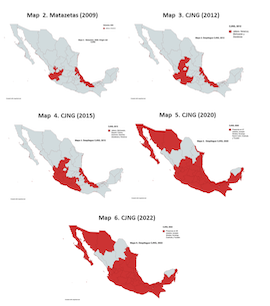
Figure 1: Documented CJNG Network growth across Mexico in recent decades Source: Benítez and González, “The Cártel de Jalisco Nueva Generación.”
In its adolescence, the CJNG expanded during the initial phase of the “Abrazos, no balazos” (“Hugs, not bullets”) policy from 2018 to 2022 as referenced in the figure above (Figure 1).[21] The group continues to grow not only in territory but as a form of dual power that rivals the official state. This directly threatens the legitimacy of Morena itself, with minor Morena politicians exposed as functionaries or allies of the cartel.[22]
The CJNG is arguably more brazen, cunning, and calculating than any of
its predecessors, not only toward the Mexican government, but toward the United States as well. It has assassinated key witnesses in US federal trials, [23] created a brutal tax system (cobro de piso) of lethal enforcement across a wide swath of several Mexican states,[24] spied on US Special Agents on American soil,[25] publicly assassinated Mexican politicians such as Carlos Manzo,[26] engaged in the wholesale capture of niche industries, such as the avocado trade,[27] has an estimated enterprise value of $50 billion dollars,[28] and all while possessing a more centralized network than any of its contemporaries.[29]
Despite the threat that the CJNG presents, history tells us that policies and enforcement measures that solely pursue the death or capture of a kingpin result in further criminal violence and societal disruption. In fact, a 2015 macro-level study conducted in Mexico demonstrated that the sole capture or death of a cartel leader is correlated with an average increase of 36.5% in drug-related homicides and a 34% increase in homicides against the rest of the population following the first six months of a capture on a regional level.[30]
Reversal of Previous Security Policy
The official stance of Mexico’s current ruling party under former President Andrés Manuel López Obrador (commonly known as AMLO), the Movimiento Regeneración Nacional, Movement of National Regeneration (Morena), has typically focused on a more indirect, pacifistic, and compromising approach to combating crime and cartel-related violence. Yet, stark realities and a worsening security environment have shifted official government policy toward a hesitant, reactive philosophy, which entails the continuance of basic security measures and reluctant physical confrontation against organized criminal elements when necessary.[31]
AMLO himself, who had coined the phrase: “Abrazos, no balazos,” called for the peaceful and gradual disarmament of Mexican criminal networks while widening access to welfare systems to combat socioeconomic causes of criminal activity, such as poverty and limited social mobility.[32] Such an approach was considered hopeful at worst and experimental at best, and was partially reversed through the middle of his presidential term as the CJNG ballooned in growth and the Sinaloa Cartel faced a bloody, internal fracture.[33]
A significant but subtle indicator that AMLO had changed his own approach to security was the high-profile capture of Ovidio Guzmán López, son of former Sinaloa Cartel leader, Chapo Guzmán, or “El Chapo,” under Operation Mongoose Azteca toward the conclusion of his six-year term.[34] Following this operation, instances of regional violence, skirmishes between Mexican security forces and criminal groups, and disappearances exponentially increased, and the national murder rate (both for total murders and femicides) rose sharply.[35]
After the AMLO sexenio (six-year presidency), Morena consolidated its political dominance in a manner unseen since the 20th-century rule of the Partido Revolucionario Institucional, Institutional Revolutionary Party (PRI). They passed a series of sweeping judicial reforms, nationalized critical minerals, undertook ambitious infrastructure projects like the “Tren Maya,” and established themselves as the preeminent leaders of Mexican policy for decades to come.[36]
Near the end of his presidency, López Obrador strongly favored Claudia Sheinbaum as his successor, given her well-known progressive track record, her impressive track record as the Mayor of Mexico City, which saw a massive decrease in local crime, and the opportunity she presented as the first female President of Mexico.[37] After the eruption of criminal violence at the hands of the CJNG, the rising insecurity across Mexico became a vulnerability that Morena could no longer ignore, and President Sheinbaum elevated her former Secretary of Citizens’ Security, Omar García Harfuch, as her Federal Security Chief.
The Harfuch Ascendency: Modern Intelligence-led Measures
A vast majority of the security investigations and arrests that occurred in the early years of the Sheinbaum administration were the product of the Secretaría de Seguridad y Protección Ciudadana, Secretariat of Security and Citizen Protection (SSPC), led by Secretary Harfuch.[38] During his time in the Mexico City Municipal government, Secretary Harfuch was able to achieve a historic reduction in crime through the enlargement of the capital’s police force and the intelligence-based policing placed throughout the city.[39]Moreover, Secretary Harfuch previously survived a brutal assassination attempt by the CJNG in 2020 and has led several high-profile arrests against criminals on the national level, including the attempted capture and death of El Mencho and the arrest of “Los Mayos” functionary, “El Limones” in Durango last December.[40][41]
Aside from his operational victories, Secretary Harfuch has overseen significant institutional reforms that have reshaped and revitalized the Mexican security apparatus.[42] Early in her term, President Sheinbaum met with party leaders and pursued a reform of Article 21 of the Mexican Constitution that would allow the SSPC to conduct and lead criminal investigations, execute arrest warrants, and separately compartmentalize military intelligence from the Mexican Army under the Secretaría de la Defensa Nacional, Secretariat of National Defense (SEDENA), the Mexican Navy under the Secretaría de Marina, Secretariat of the Navy (SEMAR), and the Centro Nacional de Inteligencia, National Intelligence Center (CNI).[43]
Secretary Harfuch’s expanded oversight, investigative capability, and executive authority have been followed by his frequent feature as a speaker in President Sheinbaum’s “mañaneras” or broadcasted morning speeches. In fact, he was one of the principal speakers on the state TV broadcast the morning following the death of “El Mencho.”[44]
Many political analysts predict that he is the emerging frontrunner for the Mexican Presidency in 2030, as he is both part of the ruling party and the current face of Mexican “law and order” political messaging, something that has seen increasing concern from Mexican voters in political polls.[45] Furthermore, he has been gaining popularity in the United States, among security professionals and politicians alike, as his image as the “Mexican Batman” spreads across the continent.[46]
Pressure from President Trump: Trade, Security, and Sanctions
Several months after President Sheinbaum took office, Donald Trump won his second term as President of the United States, and from his first day in office, he began an aggressive foreign policy agenda unseen in modern American history. One of President Trump’s principal concerns was the entrenched presence of Mexican organized crime in both the United States and Mexico, which he saw as a catalyst for undocumented immigration into the United States and a thorn in the side of American firms involved in cross-border commerce.[47]
Since his inauguration in early 2025, the Trump Administration has focused on curbing cartel activity, designating many Mexican criminal groups as Foreign Terrorist Organizations (FTOs), expanding sanctions, pursuing DOJ indictments against politicians and international firms with ties to drug trafficking, and occasionally threatening US-led airstrikes and American troops on Mexican soil.[48][49]
Trump has repeatedly voiced doubt on the continuation of North American free trade (the Agreement between the United States of America, the United Mexican States, and Canada or USMCA), which replaced the North American Free Trade Agreement (NAFTA) in 2020. NAFTA originally began in 1994, merging production and manufacturing chains among the United States, Canada, and Mexico, and has been cited as the impetus for transnational commercial growth for decades. Between the private sectors, labor unions, and policymakers of the three nations, almost no one would support the end of free trade aside from fringe nationalist cells within the Republican Party and Morena.[50]
Thus, if President Trump truly seeks to justify an exit from decades of North American Free Trade, he needs a solid explanation that he can give to GOP donors and his populist voter base, like that of rampant insecurity. That being said, the most likely rationale of the Trump White House follows the logic of not intentionally seeking to abandon the USMCA, but only continuing the agreement upon a set of strict conditions that are favorable to the goals of the Trump Administration.
A perfect example of such concessions was the pressure that the US Trade Representative exerted upon Mexico to limit Chinese imports in key sectors, such as electric vehicles and steel.[51] At a macro-level, Mexico sends over 83% of its exports and receives roughly 40% of its imports from the United States, leaving Mexico with minimal leverage at the negotiating table.[52]
Due to posturing by the Trump Administration, President Sheinbaum faces a difficult diplomatic situation. Security outcomes are now tied to binational relations and cross-border trade. Her populist voter base expects her to prioritize sovereignty and limit US cooperation, and with cartels increasingly penetrating social media and public opinion combined with a complicated binational history, public opinion of the United States as a whole, shifts rapidly, thus placing her in a truly unenviable position.[53][54]
Failure to deliver or to adequately comply with the Trump administration could place Mexico in a challenging bargaining position by the start of the USMCA revision, scheduled for July 2026. While the Mexican Secretary of Foreign Relations, Marcelo Ebrard, has announced an established framework already agreed upon by both nations, it would not be the first time a Trump-led White House changed an agreement at the last minute.[55]
Even after the death of “El Mencho,” Trump emphasized at the 2026 State of the Union that Mexican cartels were too powerful and had to be dealt with, and continued to claim that vast swaths of Mexico are controlled by criminal groups and that only through immense, violent confrontation can they be stopped. He did this to underline his desire for persistent and direct action against Mexican cartels by the Mexican government.[56] To complicate matters further, at the end of April 2026, the Trump Administration released criminal indictments of ten Mexican politicians affiliated with illicit activity, chief among them, the current governor of Sinaloa, Ruben Mocha Moya.[57] This occurred nearly a week after two US CIA Agents were killed in Chihuahua posing as officials working on behalf of the Department of State.[58]
Not only were the two killed in direct retaliation for a joint-force raid on a hidden cartel meth lab, but the news that they were foreign operatives quickly became mainstream within hours. Across both nations, many activists were outraged at the possibility of US intervention in Mexico. The reality is that there have been CIA operations in Mexico since the inception of the agency in the mid-20th century, almost always with the marginal knowledge and permission of top Mexican security officials and presidents.[59]
Yet, the admission of such by the Sheinbaum administration would have been impossible to explain to Morena party militants and its more nationalistic elements. To admit the knowledge and permission of the presence of CIA agents in Mexico by either President Sheinbaum or Secretary Harfuch would have been nothing short of political suicide, and subsequently made it politically impossible for them to allow the extradition of Governor Moya.
It must be stressed that despite the status and function of Sheinbaum and Harfuch as technocrats, Morena is fundamentally a left-wing nationalist party that operates on populism and progressivism. If they do not criticize the presence of CIA agents within Mexico or support one of their party’s governors despite his criminal history, the core of Morena party leaders will view them as lukewarm moderates.[60]
In reality, President Claudia Sheinbaum and Secretary Harfuch do want to collaborate with the United States to combat nationwide insecurity and cross-border corruption. However, they want to maintain Mexico’s sovereignty and want Mexico to be treated as a partner, not as an American protectorate or subordinate.[61]Thus, they must walk a razor-thin line. President Sheinbaum must maintain appearances domestically while placating President Trump so that a successful renewal of the USMCA and continued security cooperation can both take place.
They genuinely need the USMCA to continue; they cannot let the United States arrest Governor Mocha Moya, and the US cannot let another intelligence operation be exposed within Mexico for the near future. President Sheinbaum must carefully manage the next several months, as they will likely be the most challenging of her presidency.
A Return to Calderon-era violence?
Former President Calderón and his political party, the Partido Acción Nacional, National Action Party (PAN), are seen as the epitome of Mexican conservatism and are the antithesis of the policy and worldview of Morena. His presidency from 2006 to 2012 is infamous for his failed approach to combating cartels as if they were mere soldiers.[62] The implementation of his policies was followed by a massive increase in violence, kidnappings, and disappearances as an arms race erupted between competing cartels and the Mexican State. Furthermore, Mexican citizens became objects of retaliation by said cartels, especially by the Los Zetas Cartel, which engaged in the massacre of civilians as a response to law enforcement measures.[63]
In summary, his administration became one of the most condemned in modern Mexican history and has plagued the cause of conservative Mexican politics for years. Yet, President Sheinbaum and Secretary Harfuch could be forced to undertake similar policy approaches that Calderón and the PAN once pursued due to the aggravating circumstances of Mexico’s security environment and President Trump’s mounting demands.[64] While Secretary Harfuch and the Mexican military have utilized a mixture of indirect, systemic, and direct confrontation, a hard focus on direct confrontation alone would create 2006-like conditions and prime the Mexican nation for the public violence of the late 2000s.
Even though Calderón’s policies did result in diminished operational capacity of the Los Zetas Cartel and the Beltrán-Leyva Cartel, such policies are seen by the Mexican public as the catalyst for retaliatory narco-terrorism, escalation between cartels, and violence against the public on behalf of criminal organizations. The toll of the conflict was brutal, with approximately 50,000 deaths confirmed to be related to Calderón’s War (disappearances and the final year of Calderón’s presidency not added to this estimate), with some claiming north of 70,000 casualties as a result of these operations.[65] Despite the change from Calderon’s policy to increasingly relaxed policies under President Peña Nieto and AMLO, the number of total criminal groups has more than doubled since 2009, from 76 to 205, with smaller cells or gangs reaching an estimated total of 543 groups by 2020.[66]
A full or partial re-emergence of Calderón’s security policy has the potential to create conditions where organized criminal groups engage in quasi-terroristic acts against the public in order to spread fear, dissuade the government from effectively combating illicit activity, and blame the United States for their involvement in operations against said cartels.[67] To be fair, the growth of criminal groups, the diversification of their enterprises, the growth of their asset classes, and the strength of their weaponry have all continued to increase as they [the CJNG chief among them] have become competitors to the Mexican State itself. Such information demonstrates that these groups are no longer just fighting for riches or territory, but are actively threatening US and Mexican political infrastructure, playing their hand at regional geopolitics, and as formerly mentioned, forming dual power that rivals the infrastructure and authority of the Mexican state.[68]
President Trump wants to show decisive foreign policy victories to his supporters through direct action like the operation against El Mencho, and while the Trump administration is targeting the roots of criminal financing and illicit supply chains within the United States, it has a limited ability to directly confront Mexican criminal leaders, their resources, or their networks without violating Mexican sovereignty and alienating the Mexican public. Moreover, American law enforcement and intelligence advisors remain reliant on the “Kingpin strategy” as a pillar of counternarcotics doctrine.
Given the constraints that the Sheinbaum administration is facing, President Sheinbaum and Secretary Harfuch may have been placed between a rock and a hard place. They must do all they can to guard Mexican sovereignty, balance Mexico’s commercial interests, maintain a favorable trade policy with the United States, and satisfy the majority of the Mexican population, many of whom list public insecurity as their principal political concern; all while doing their best not to escalate such tension into total war and alienate a voter base that is skeptical to American interests and objectives.
Policy Recommendations
The rise in Mexico’s murder rate, number of disappearances, reported kidnappings, and extortions has exploded since 2017, and these issues continue to plague the Mexican Republic.[69] If Harfuch continues to rise within the Mexican state apparatus, will the utilization of the same tactics used by the Calderón administration prevail? Something must be done, yet policymakers must not confuse bravery with naivety and action with progress. A remedy to Mexico’s insecurity must be proactive and strategic, rather than a renewal of the Kingpin Strategy, public shootouts with pistoleros, and brazen attacks. Secretary Harfuch has proven that an intelligence-led strategy that attacks the financial and logistical organs of criminal networks must be utilized. However, such subtlety will likely be insufficient in the eyes of President Trump and his cabinet unless it can demonstrate visible victories that reach the American press and satisfy Trump’s voter base.
While many policymakers, academics, and security professionals see security measures against criminal organizations, particularly cartels, as a set of narrow and somewhat exclusive frameworks, the options are much broader than commonly imagined. There is no binary of either combating cartels or incentivizing the end of criminal activity through welfare programs and community intervention; that is a false dichotomy, and those policy measures are not mutually exclusive. Neither is the axiom that any assistance from a foreign nation, like the United States, is necessarily a breach of Mexican sovereignty in all cases or forms.
Most importantly, the sociological issues behind the formation of cartels must be addressed. Morena has begun this with an array of social programs that empower socioeconomically challenged youth, new and affordable state-run universities, increasingly accessible credit and lending programs through the Banco del Bienestar (Welfare Bank), and a variety of other measures meant to alleviate poverty throughout Mexico.[70] That being said, existing criminal networks must be stopped and neutralized, either through domestic incarceration, extradition, or outright combat (used sparingly and strategically).
Secondly, combating cartels is not simply warfare, whether traditional or irregular. The advancement of surveillance technology has not only proven to decrease crime and help solve existing criminal investigations in Mexico City, but has also proven to be highly effective in locating the whereabouts of criminal actors and their operational centers (labs and warehouses).[71] In fact, the most useful technology at the disposal of Secretary Harfuch is that which can be used to analyze and dismantle the supply chains, trade routes, and illicit financial networks of these organizations.[72] To argue that no action should be undertaken against these criminal warlords would be ludicrous. However, history has shown us that simply removing the top brass of an organized drug trafficking organization periodically increases violence and rarely stops the illicit trade itself.
In the case of the CJNG, their portfolio of criminal enterprises includes kidnapping, extortion, and hydrocarbon theft, human trafficking, the facilitation of illegal immigration, money laundering, the sale and manufacture of narcotics, and contract killings, among many others.[73] International criminal organizations like the CJNG have long surpassed the 20th-century traffickers, who were outlaws who solely trafficked 2-3 different kinds of narcotics into the United States. Their operations are now worldwide, their networks rival that of the largest Fortune 500 companies and investment banks, and it is suspected that their payroll of corrupt officials, compromised politicians, and inside informants is extensive not only in Mexico, but in the United States and other countries as well.[74]
Such influence and wealth cannot be removed with the simple death of a leader or periodic skirmishes with pistoleros (cartel henchmen). A multidimensional attack on the organization’s dual-power structure, their various criminal enterprises, their logistics, their digital communications, and their balance sheet must accompany any physical violence taken by Mexican state forces against the CJNG, or the cartel infrastructure will remain and be inherited by the CJNG’s successors.
In other words, a complete and utter blitzkrieg of special operations, lab raids, financial blockades, trade route closures, and the arrest of corrupt officials with deep institutional access across the United States and Mexico must all occur within a small window of several hours to do the maximum amount of damage to cartel networks and deliver them an historic blow. If binational forces can decimate both the criminals, illicit trade routes, and the Mexican underworld in a short period of time, it could delay the organizational and commercial recovery of cartels in a manner currently unimaginable. Ultimately, cartels function like a hydra; their networks and administration must be so cauterized that regeneration becomes painstakingly slow if not impossible.
The death of Mencho and the capture of El Jardinero have damaged the CJNG’s reputation as an untouchable criminal enterprise. Yet, it doesn’t take away its capability of a resurgent CJNG or a cartel that might take its place. Cartels must be challenged and defeated, but the illicit frameworks of global criminal enterprise, the economies within which they operate, and the incentives that motivate each generation of mafiosos must be swept into the dustbin of history to truly end Mexico’s security environment.
Additionally, joint task forces across both nations must be created so that federal entities of each country may be able to share intelligence, strategize, and respectfully cooperate. A prime example of such collaboration was the training between US and Mexican Special Forces about a month before the death of El Mencho.
Weeks before the operation in Tapalpa, undisclosed American personnel landed at the International Toluca Airport; furthermore, two weeks before, Navy SEAL Team 2 landed in Mexico City for a series of Joint Combined Exchange Training (JCET). SEDENA confirmed that American security advisors and intelligence under the newly formed cross-agency task force, aptly named the Joint Interagency Task Force-Counter Cartel, were critical to the operation that led to the death of El Mencho.[75] Such a task force is a prime example of the optimal binational cooperative structure that the US and Mexico should replicate and expand upon.
President Sheinbaum and Secretary Harfuch must cooperate with the United States under a strict set of conditions or redlines that maintain Mexican sovereignty and their public image as independent policymakers. Ultimately, direct US intervention, alienating the Trump administration, or distancing the more radical elements of Morena would spell disaster for the United States, President Sheinbaum’s policy goals, and Secretary Harfuch’s political career.[76]
Consolidating and streamlining operational authority within Mexico’s administrative security apparatus, allowing US-assisted intelligence operations without direct American manpower engaging in combat, facilitating and supporting increased and continued cooperation between US agencies and Mexican forces, and a series of highly advanced multifaceted attacks on large criminal organizations must all simultaneously occur for any major cartel to be truly weakened and for binational relations to improve.
Endnotes
[1] Anna Wyrwisz, “America’s Longest War—the War on Drugs.” Jagiellonian University (RUJ). January 2015, https:/ruj.uj.edu.pl/server/api/core/bitstreams/e4b97188-ff2b-41fc-8e17-153b22381e71/content
[2] Oliver Holmes and Tom Phillips, “Killing of Mexican Drug Cartel Boss ‘El Mencho’’Triggers Wave of Violence.” The Guardian. 23 February 2026, https://www.theguardian.com/world/2026/feb/23/el-mencho-mexican-drug-cartel-boss-killing-violence.
[3] “What Is Happening in Mexico? 25 National Guard Members Dead, Thousands Stuck in Zoo, Buses, Violence Across 20 States.” Economic Times. 23 February 2026, https://economictimes.indiatimes.com/news/international/us/what-is-happening-in-mexico-25-national-guard-members-dead-thousands-stuck-in-zoo-buses-violence-across-20-states/articleshow/128720182.cms?from=mdr.
[4] “Incendios de tiendas y gasolineras: Así atacaron negocios tras muerte de ‘El Mencho.’” Milenio. 22 February 2026, https://www.milenio.com/estados/asi-atacaron-negocios-tras-abatimiento-de-el-mencho-en-jalisco.
[5] Nicole Sganga, “25 Mexican National Guard Troops Dead in Jalisco after Notorious Cartel Leader’s Killing.” CBS News. 23 February 2026, https://www.cbsnews.com/news/el-mencho-killed-25-mexican-national-guard-troops-killed-jalisco-cartel/.
[6] Sofia Gabriela Martinez, “Mexico Arrests ‘El Jardinero,’ Second CJNG Boss Felled since February.”The Rio Times. 28 April 2026, https://www.riotimesonline.com/mexico-cjng-el-jardinero-capture-nayarit-april-2026/.
[7] Juan Del Rio, “Do High Value Target Strikes Reduce Cartel-Related Violence? An Empirical Assessment of Crime Trends in Tijuana, Mexico.” Trends in Organized Crime. Vol. 27, no 3. 2024, p. 432, https://www.researchgate.net/publication/357730966_Do_high_value_target_strikes_reduce_cartel-related_violence_An_empirical_assessment_of_crime_trends_in_Tijuana_Mexico.
[8] Oscar Contreras Velasco, “Unintended Consequences of State Action: How the Kingpin Strategy Transformed the Structure of Violence in Mexico’s Organized Crime.””Trends in Organized Crime. Vol. 28, no. 3, 2025, pp. 334–58, https://www.researchgate.net/publication/372247356_Unintended_consequences_of_state_action_how_the_kingpin_strategy_transformed_the_structure_of_violence_in_Mexico’s_organized_crime.
[9] Jane Esberg, “Why Mexico’s Kingpin Strategy Failed: Targeting Leaders Led to More Criminal Groups and More Violence.” Modern War Institute at West Point. 9 June 2022, https://mwi.westpoint.edu/why-mexicos-kingpin-strategy-failed-targeting-leaders-led-to-more-criminal-groups-and-more-violence/.
[10] Mahmut Cengiz, “Cartels, Terrorism Designations, and US Policy: A Mexican Perspective.” Small Wars Journal. 8 July 2025, https://smallwarsjournal.com/2025/07/08/cartels-terrorism-designations-and-us-policy-a-mexican-perspective/.
[11] Ibid.
[12] Ciro Perez Silva and Roberto Garduño Espinosa, “El Cártel de Tijuana, principal mafia del país.” La Jornada. 15 March 1996, https://www.jornada.com.mx/1996/03/15/cartel.html.
[13] Alfredo Corchado and Kevin Krause, “Drug Kingpin’s Deal with the U.S. Triggered Years of Bloodshed, Including a Southlake Murder.” The Dallas Morning News. 14 April 2016, https://interactives.dallasnews.com/2016/cartels/.
[14] Sebastian Rotella, “Mexico’s Cartels Sow Seeds of Corruption, Destruction: Crime: Fight for Control of U.S.-Bound Drug Trade Is Deadly Competition. Gangs Enlist Police and Politicians.” Los Angeles Times. 16 June 1995, https://www.latimes.com/archives/la-xpm-1995-06-16-mn-13754-story.html.
[15] Chris Arsenault, “Drug Gang’s U.S. Roots.” Al Jazeera. 3 November 2010, https://www.aljazeera.com/features/2010/11/3/us-trained-cartel-terrorises-mexico.
[16] Samuel Logan and John P. Sullivan, “Los Zetas: Massacres, Assassinations, and Infantry Tactics.” Police1. 3 February 2011, https://www.police1.com/terrorism/articles/los-zetas-massacres-assassinations-and-infantry-tactics-P55C81YakRLYCYk5/.
[17] “Americas: The Kingpin Strategy.” Organized Crime and Corruption Reporting Project (OCCRP). 23 October 2012, https://www.occrp.org/en/news/americas-the-kingpin-strategy.
[18] Stephen D. Morris, “Drug Trafficking, Corruption, and Violence in Mexico: Mapping the Linkages.” Trends in Organized Crime. Vol. 16, no. 2, 2013, pp. 195–220.
[19] Jason Beaubien, “Drug Violence Swamps a Once Peaceful Mexican City.” NPR. 26 October 2011, https://www.npr.org/2011/10/26/141727973/drug-violence-swamps-a-once-peaceful-mexican-city.
[20] Paulo Prada, “Mexico City Police Chief Shot in Assassination Attempt, Blames Drug Cartel.” Reuters. 27 June 2020, https://www.reuters.com/article/world/mexico-city-police-chief-shot-in-assassination-attempt-blames-drug-cartel-idUSKBN23X1P2/.
[21] Raúl Benítez Manaut and Josué González, “The Cártel de Jalisco Nueva Generación: The Most Significant Security Challenge in the Mexico-United States Relationship.”Small Wars Journal. 1 October 2023, https://smallwarsjournal.com/2023/10/01/cartel-de-jalisco-nueva-generacion-most-significant-security-challenge-mexico-united/.
[22] “CJNG Financió La Campaña Del Alcalde de Tequila, Acusa FGR.” N+. 11 February 2026, https://www.nmas.com.mx/nacional/politica/cjng-financio-la-campana-del-alcade-de-tequila-acusa-fgr/.
[23] “Terrorist Groups.” Office of the Director of National Intelligence: National Counterterrorism Center. 30 April 2025, https://www.dni.gov/nctc/terrorist_groups/cjng.html.
[24] Luis Carlos Silva, “Cárteles en México cobran hasta 570 millones por derecho de piso: Expertos.”” El Independiente. 24 April 2024, https://elindependiente.mx/economia/2024/04/24/carteles-en-mexico-cobran-hasta-570-millones-por-derecho-de-piso-expertos/.
[25] Julian Resendiz, “Cartels Spying on Law Enforcement on US Soil.” BorderReport. 24 June 2025, https://www.borderreport.com/border-report-tour/border-crime/cartels-spying-on-law-enforcement-on-us-soil/.
[26] Carlos Carabaña, “From Carlos Manzo to El Pirata de Culiacán: A Decade of Murders by the Jalisco New Generation Cartel.” El País. 24 February 2026, https://english.elpais.com/international/2026-02-24/from-carlos-manzo-to-el-pirata-de-culiacan-a-decade-of-murders-by-the-jalisco-new-generation-cartel.html.
[27] “Unholy Guacamole: Deforestation, Water Capture, and Violence behind Mexico’s Avocado Exports to the U.S. and Other Major Markets.” Climate Rights International. November 2023, https://cri.org/reports/unholy-guacamole/.
[28] John Hyatt, “How Rich Was Mexican Cartel Leader El Mencho?” Forbes. 27 February 2026, https://www.forbes.com/sites/johnhyatt/2026/02/27/why-drug-kingpin-el-menchos-billion-dollar-fortune-will-likely-remain-untouched-by-authorities/.
[29] Nathan P. Jones, Irina Chindea, Daniel Weisz Argomedo, and John P. Sullivan. “A Social Network Analysis of Mexico’s Dark Network Alliance Structure.” Journal of Strategic Security, Vol. 15, no. 4, 2022, pp. 76–105, https://digitalcommons.usf.edu/jss/Vol15/iss4/5/.
[30] Op. cit., Del Rio at Note 7.
[31] Sonja Wolf, “Is Mexico’s Security Policy Backfiring?” Americas Quarterly. 8 September 2022, https://www.americasquarterly.org/article/is-mexicos-security-policy-backfiring/.
[32] Jorge Monroy, “López Obrador defiende su idea de ‘Abrazos no balazos’ ante la delincuencia.” El Economista. 25 September 2021, https://www.eleconomista.com.mx/politica/Lopez-Obrador-defiende-su-idea-de-abrazos-no-balazos-ante-la-delincuencia-20210924-0102.html.
[33] Op. cit., Cengiz at Note 10.
[34] Zósimo Camacho, “Mongoose Azteca, La Operación Militar Que Ubicó a Ovidio Desde Agosto.” Contra Línea. 13 January 2023, https://contralinea.com.mx/interno/semana/mongoose-azteca-la-operacion-militar-que-ubico-a-ovidio-desde-agosto/.
[35] Parker Asmann, Patrick Corcoran, and Chris Dalby. “GameChangers 2019: Mexico’s Body Count Soars as AMLO out of Ideas.” InSight Crime. 16 January 2020, https://insightcrime.org/news/gamechangers-2019-mexico-body-count-amlo/.
[36] Pablo Rubio Apiolaza, “Mexico’s Elections Consolidate the ‘Fourth Transformation.’” The Diplomat in Spain. 1 July 2024, https://thediplomatinspain.com/en/2024/07/01/mexicos-elections-consolidate-the-fourth-transformation/.
[37] “Claudia Sheinbaum Named Mexico Ruling Party’s 2024 Presidential Candidate.” Al Jazeera. 7 September 2023, https://www.aljazeera.com/news/2023/9/7/claudia-sheinbaum-named-mexico-ruling-partys-2024-presidential-candidate.
[38] Jonathan Maza, “Omar García Harfuch and the Relaunch of Security as a Priority for the Mexican State: From Moral Discourse to Institutional Effectiveness.” Jonathan Maza (blog). 23 October 2025, https://jonathanmaza.com.mx/2025/10/22/omar-garcia-harfuch-and-the-relaunch-of-security-as-a-priority-for-the-mexican-state-from-moral-discourse-to-institutional-effectiveness/.
[39] Alfredo Molina Ledesma, “How Data Helped Mexico City Reduce High-Impact Crime.” World Economic Forum. 26 June 2023, https://www.weforum.org/stories/2023/06/how-data-helped-mexico-city-reduce-high-impact-crime/.
[40] Op. cit., Prada at Note 20.
[41] “García Harfuch informa golpe a ‘Los Mayos’ detienen a ‘Limones’, pieza clave de ‘Los Cabrera.'” N+. 10 December 2025, https://www.nmas.com.mx/seguridad/narcotrafico/los-mayos-detencion-edgar-rodriguez-ortiz-el-limones-miembro-los-cabrera-garcia-harfuch/.
[42] Op. cit., Maza at Note 38.
[43] César Arellano García. “Con reforma al Artículo 21 se amplían y fortalecen facultades de la SSPC.” La Jornada. 1 January 2025, https://www.jornada.com.mx/noticia/2025/01/01/politica/con-reforma-al-articulo-21-se-amplian-y-fortalecen-facultades-de-la-sspc-7039.
[44] “Mencho: Harfuch aparece en la mañanera y da saldos del abatimiento de Nemesio Oseguera” El Informador. 23 February 2026, https://www.informador.mx/mexico/mencho-harfuch-aparece-en-la-mananera-y-da-saldos-del-abatimiento-de-nemesio-oseguera-20260223-0057.html.
[45] Ian Hayden Parker, “Insecurity Tops List of Concerns for Mexicans, OECD Survey Reveals.” Puerto Vallarta News. 11 July 2024, https://www.vallartadaily.com/mexico-news/insecurity-tops-list-of-concerns-for-mexicans-oecd-survey-reveals/.
[46] Stella Horrell, “Mexico: ‘Mexican Batman’ Omar García Harfuch.” Latin America Bureau. 20 January 2026, https://lab.org.uk/mexico-batman-omar-garcia-harfuch/.
[47] Leo Tsao, Corinne A. Lammers, Braddock J. Stevenson, Daniel A. Holman, Andrew E. Sterritt, and Olivia Tyndall, “Caught in the Cartel Crossfire: Rising US Corporate Enforcement Risks for Companies and Financial Institutions.” Paul Hastings LLP. 6 May 2026, https://www.paulhastings.com/insights/client-alerts/caught-in-the-cartel-crossfire-rising-us-corporate-enforcement-risks-for-companies-and-financial-institutions
[48] “Treasury Sanctions Global Illicit Drug Supply Chain Supporting the Sinaloa Cartel.” US Department of the Treasury Press Release. 23 April 2026, https://home.treasury.gov/news/press-releases/sb0468.
[49] Jesús Sérvulo González, “Trump Insists ‘Cartels Are Running Mexico’ and Announces Ground Operations: ‘We Are Going to Start Hitting Land.'” El País. 9 January 2026, https://english.elpais.com/usa/2026-01-09/trump-insists-cartels-are-running-mexico-and-announces-ground-operations-we-are-going-to-start-hitting-land.html.
[50] Emily Green, “Mexican Companies Eager to Keep USMCA Treaty, Report Shows.” Reuters. 9 March 2026, https://www.reuters.com/world/mexican-companies-eager-keep-usmca-treaty-report-shows-2026-03-09/
[51] “Mexico.” United States Trade Representative. 2025, https://ustr.gov/countries-regions/americas/mexico.
[52] Megan Janetsky and Christopher Sherman, “Mexico Looks to China as It Navigates Trade Tensions with Trump.” Associated Press. 29 February 2025, https://apnews.com/article/mexico-china-us-trump-tariffs-dc6c572fe3ecfe2b2c976bccf28648c8.
[53] Antón Barba-Kay, “How Drug Cartels Took Over Social Media.”The Atlantic. 26 April 2025, https://www.theatlantic.com/international/archive/2025/04/drug-cartel-influencers-social-media/682588/.
[54] Arturo Sarukhan, “Una mirada ambivalente.” El Financiero. 29 April 2026, https://www.elfinanciero.com.mx/opinion/arturo-sarukhan/2026/04/29/una-mirada-ambivalente/.
[55] Jassiel Valdelamar, “Ebrard Da Adelantos Del ‘T-MEC 2.0’: Tendrá ‘Protocolos’ Para Meter Cambios Sin Reabrir El Tratado.” El Financiero. 29 January 2026, https://www.elfinanciero.com.mx/economia/2026/01/29/marcelo-ebrard-da-adelantos-del-nuevo-tmec-que-incluira/.
[56] Op. cit., González at Note 49.
[57] Nicholas Biase and Shelby Wratchford, “Governor of Sinaloa and Nine Other Current and Former Mexican Officials Charged with Drug Trafficking and Weapons Offenses.” US Department of Justice. 29 April 2026, https://www.justice.gov/usao-sdny/pr/governor-sinaloa-and-nine-other-current-and-former-mexican-officials-charged-drug
[58] Megan Janetsky and Maria Verza, “Mexico’s Government Keeps Contradicting Itself Over Role of CIA Agents in Chihuahua Operation.” FOX 5 San Diego & KUSI News. 22 April 2026, https://fox5sandiego.com/news/world-news/ap-international/ap-sheinbaum-weighs-sanctions-on-chihuahua-state-after-cia-agents-died-after-drug-lab-raid/.
[59] Claire Dorfman, “The Modern Surveillance State: Mexico and the CIA during the Cold War.” North American Congress on Latin America (NACLA). 19 May 2025, https://nacla.org/modern-surveillance-state-mexico-and-cia-during-cold-war/.
[60] Leticia Villegas, “Noroña acusa presencia de la CIA en México y alerta violación a soberanía.” El Debate. 24 April 2026, https://www.debate.com.mx/sinaloa/culiacan/titular-norona-acusa-presencia-de-la-cia-en-mexico-y-alerta-violacion-a-soberania-20260424-0125.html.
[61] Jack Nicas, “Mexico Is Caught between Trump and the Cartels.“ New York Times. 24 February 2026, https://www.nytimes.com/2026/02/24/world/americas/trump-sheinbaum-us-mexico-cartel.html.
[62] George Grayson, The Impact of President Felipe Calderón’s War on Drugs on the Armed Forces: The Prospects (Executive Summary). Carlisle Barracks: Strategic Studies Institute: US Army War College. 1 December 2012, https://media.defense.gov/2025/Jan/15/2003628682/-1/-1/0/1137-SUMMARY.PDF,
[63] Mark Stevenson, “Mexico Convicts 11 Cartel Gunmen in Killings of 122 Bus Passengers near US Border over 2 Years.” Associated Press. 21 August 2024, https://apnews.com/article/mexico-2010-massacre-bus-passengers-drug-cartel-06b887ec07d5c0041ca93bc852163ff3.
[64] Op. cit., Nicas at Note 60.
[65] Op. cit., Grayson at Note 62.
[66] Op. cit., Esberg at Note 9.
[67] Adam Elkus, “Mexican Cartels: A Strategic Approach.” Military Strategy Magazine. 28 June 2011, https://www.militarystrategymagazine.com/ij-exclusives/mexican-cartels-a-strategic-approach/.
[68] Diego Enrique Osorno, “How a Mexican Cartel Demolished a Town, Incinerated Hundreds of Victims, and Got Away with It.” VICE News. 31 December 2014, https://www.vice.com/en/article/how-a-mexican-cartel-demolished-a-town-incinerated-hundreds-of-victims-and-got-away-with-it/.
[69] Mary Anastasia O’Grady, “Mexico’s Descent into Cartel Hell.” Wall Street Journal. 23 March 2025, https://www.wsj.com/opinion/mexicos-descent-into-cartel-hell-gangs-violence-killings-politics-d0d4e302.
[70] Secretaría de Bienestar. “Programas.” Programas para el Bienestar, Gobierno de México. 20 May 2026, https://programasparaelbienestar.gob.mx/programas-bienestar/.
[71] “Five Drug Labs Dismantled in Jalisco, Nayarit and Sinaloa.” Lakeside News Chapala, 19 May 2026, https://lakesidenewschapala.com/2026/05/19/five-drug-labs-dismantled-in-jalisco-nayarit-and-sinaloa/.
[72] Zdravko Ljubas, “Massive Dark Web Sweep Leads to 270 Arrests Worldwide.” Organized Crime and Corruption Reporting Project (OCCRP). 23 May 2025, https://www.occrp.org/en/news/massive-dark-web-sweep-leads-to-270-arrests-worldwide.
[73] “Americas Strategic Update.” International Institute for Strategic Studies. 2024. https://www.iiss.org/globalassets/media-library—content–migration/files/publications—free-files/acs-2024/acs2024_00-1_editors-introduction.pdf.
[74] Vanda Felbab-Brown, “The Foreign Policies of the Sinaloa Cartel and CJNG – Part I: In the Americas.” Brookings. 22 July 2022, https://www.brookings.edu/articles/the-foreign-policies-of-the-sinaloa-cartel-and-cjng-part-i-in-the-americas/.
[75] Julian Resendiz, “Navy SEAL Team 2 Headed to Mexico on Training Mission.” BorderReport, 13 February 2026, https://www.borderreport.com/news/military/navy-seal-team-2-headed-to-mexico-on-training-mission/.
[76] Kevin Zapata Celestino, and Omar Alejandro Loera Gonzalez, “Why a US Invasion of Mexico Would End in Disaster.” LSE [London School of Economics] United States Politics and Policy. 25 March 2025, https://blogs.lse.ac.uk/usappblog/2025/03/25/why-a-us-invasion-of-mexico-would-end-in-disaster/.