





Drone Swarm vs. US Navy Frigate
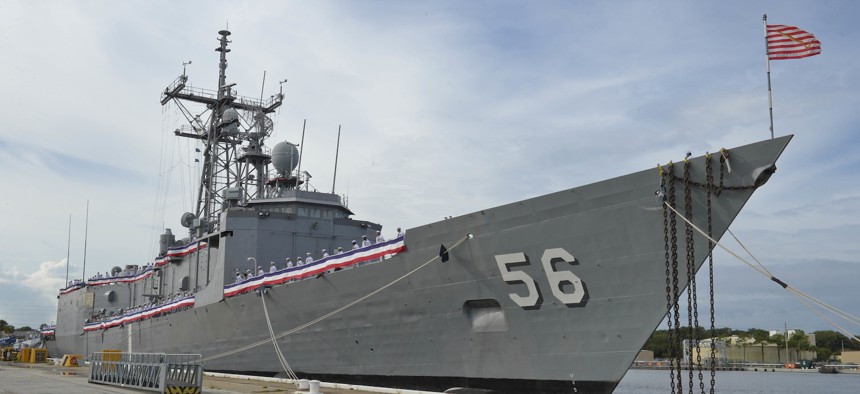

The U.S. Navy crossed an important threshold last fall when unmanned systems executed kinetic strikes that sank a decommissioned warship, reports Defense One’s Lauren Williams in “The Navy used drones to sink a retired warship.” Aerial and surface drones launched from a single littoral combat ship, the Cooperstown, to put the USS Simpson at the bottom of the Atlantic.
Three takeaways for strategists and defense observers:
- Distributed command architecture. Shore-based Maritime Operations Centers, not shipboard personnel, coordinated the engagement. This decoupling of command from platform suggests a structural shift in how crew requirements and ship design will be conceptualized going forward.
- AI-enabled targeting at scale. Onboard deployable data centers processed multi-vessel imagery across more than twenty ship classes simultaneously, compressing the training timelines for AI targeting models in operationally realistic, high-density maritime environments.
- Autonomous systems integration doctrine. The exercise exposed a persistent organizational gap: the absence of dedicated robotics coordination personnel at the platform level. The Navy’s acknowledgment of this deficiency signals imminent doctrinal codification around robotics officer roles aboard unmanned-system motherships.
Our Thoughts:
The former USS Simpson—ironically the last U.S. warship to sink an enemy vessel—became the first to be sunk by an autonomous swarm. The era of drone-enabled sea control is here. The challenge now is organizational adaptation. How can we build the command structures, personnel frameworks, and acquisition pipelines that autonomous warfare at scale demands?
While you’re here…
Check out this piece by Brandon Schingh on how policymakers must grapple with the inevitable shift towards autonomous maritime warfare: “The Future of Unmanned Autonomous Vehicles in the Maritime Battlespace.”

