





Coming to Terms With Our Strategic Inadequacies
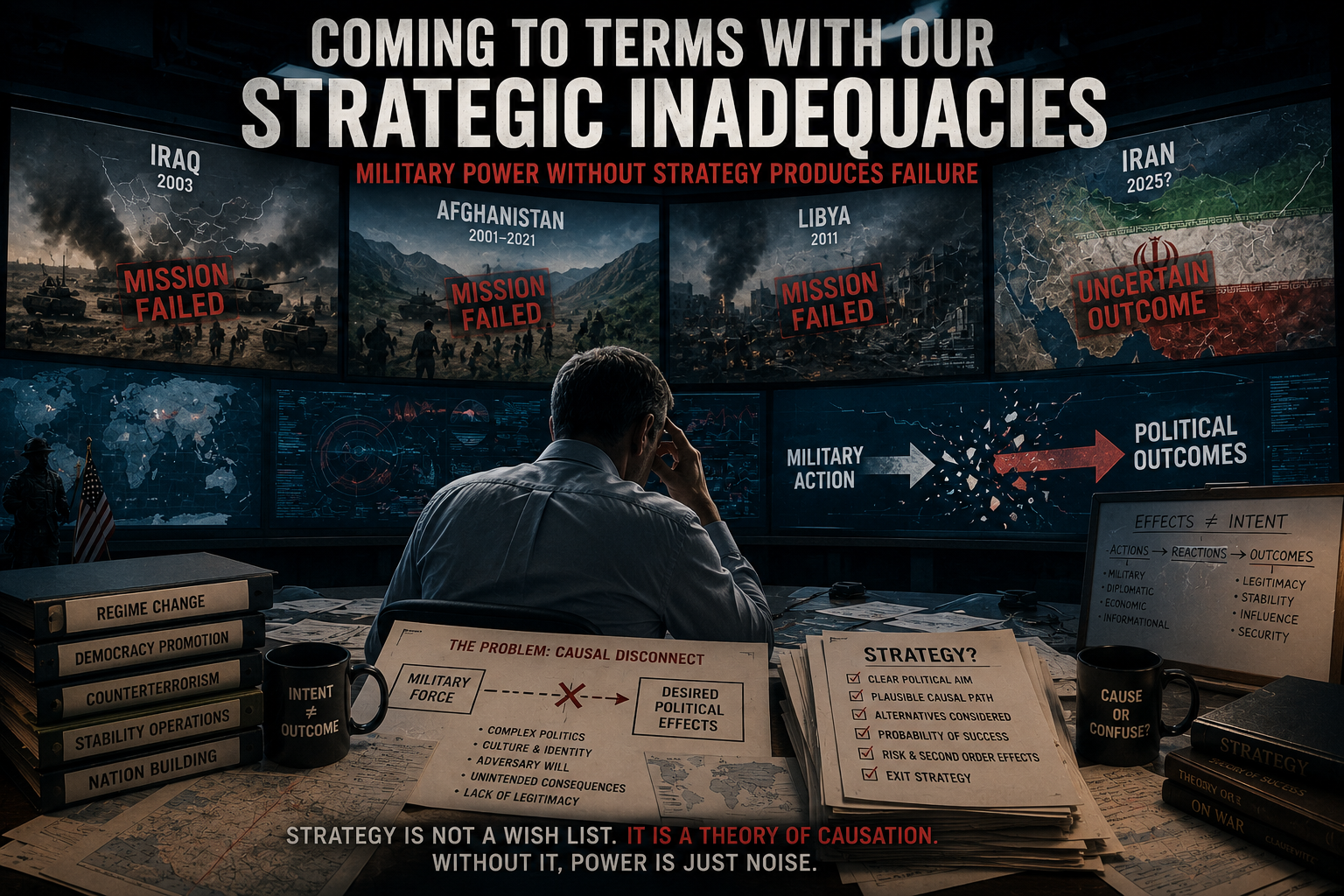

The United States military is the most capable in the world. And yet, our political leaders have demonstrated an inability, across decades, to effectively utilize this powerful kinetic tool to achieve broader strategic aims.
Iran is the most recent case in point. Although the result of America’s war there remains uncertain, it is clear that the White House’s air campaign failed to achieve its originally stated aim of regime change. This problem extends across administrations, whether with the Biden administration’s withdrawal from Afghanistan, the Obama White House’s intervention in Libya or the Bush administration’s invasion of Iraq.
A strategy is a theory of success or causal explanation of how to create a preferred outcome.
These failures did not result from insufficient resources or will or lack of masculine virtue. The root cause of the problem is the unwillingness to confront a central challenge of strategy: how to use military force to cause desired political effects. American leaders, and supporting national security staffers and intellectuals, must confront this challenge and commit to resolving our strategic inadequacies.
The Political-Military Problem
Understanding when, where, and how to use military force to achieve political goals can sometimes seem like an unsolvable equation. It is also part of a larger question of how to create positive effects, across domains, a question fundamental to crafting national security strategies for the United States. The U.S. military and foreign policy apparatus love to recite the “elements of national power,” but not much attention is paid to how to cause effects across these elements.
Despite the importance of the military-political problem, the U.S. keeps failing to solve it and has taken few, if any, steps to identify the problem. Perhaps the most remarkable facet of this issue is how thoroughly the U.S. has failed and continues to fail. In fact, a foreign and military policy history of the United States in the twenty-first century suggest a peculiar and persistent commitment to military-political failure. This history suggests that the U.S. has used military force to great effect, just not the effects it hoped to have. Meanwhile, the U.S. military budget gets larger and larger, but the effects it produces continue to be paltry.
Too often, strategies developed across the U.S. inter-agency include a pie in the sky goal followed by a laundry list of actions various bureaucratic entities can execute. This is not strategy.
We suggest two main reasons for the persistence of American commitment to using military force to achieve political effects. The first is American exceptionalism, particularly the American sense of moral superiority and belief that those that oppose the United States are morally suspect. This can lead to the United States getting locked into the posture that the U.S. should always dictate terms to other countries and to do so, it needs a strong military to get what it wants. This is not to say the United States is not a great nation. Indeed, it is. Rather, it is to affirm the importance of recognizing our adversaries’ capabilities and viewpoints when devising strategy.
Diplomacy entails negotiation. This means that you only get some of what you want—not all of it—and that you must accept the moral standing of your opponent. This reality is anathema to the core beliefs of American exceptionalism. It does not help that there are strong incentives for political opponents at home to use American exceptionalism as a weapon, alleging appeasement (and worse) at any dealmaking that seems to violate America’s unquestionable moral superiority.
Second, there is a set of factors that make military force attractive to U.S. presidents. In the American political system, the president’s power is at its height in the military realm. Constitutional practice has allowed the president the authority to deploy and use military force anywhere in the world unilaterally. Thus, in the military realm, the president can largely avoid the scrutiny of the federal courts and bypass a ponderous Congress to build his legacy. Under these conditions, American presidents are likely to continue to rely on military force to achieve their foreign policy goals.
Solutions
What is the solution to the political-military problem? The first option is to lower our expectations by compartmentalizing. We can do a much better job predicting the military effect of military action than we can do predicting the political effects of military action. For example, the U.S. military could degrade the military capabilities and capacity of the Taliban by killing its members and destroying their matériel, but military action could not—nor did not—cause Afghans to believe in the legitimacy of their own government. Compartmentalization may be the ideal solution, but it is probably unrealistic. We see no reason why American presidents will stop attempting to use military force to cause political outcomes. It’s a bad habit that no one is trying to break.
The second option is to reinvigorate the U.S. government’s commitment to developing sound strategies that clearly articulate realistic causal chains linking how military action will plausibly lead to our desired political outcomes. Across the U.S. government, everyone involved in policy and strategy must internalize the importance of causation (and especially causal mechanisms) in the development of strategy. A strategy is a theory of success or causal explanation of how to create a preferred outcome. We need to put inferior definitions of strategy far in our rearview mirror. If your definition of strategy is not based fundamentally on causation, it is wrong—nefariously wrong. Too often, strategies developed across the U.S. inter-agency include a pie in the sky goal followed by a laundry list of actions various bureaucratic entities can execute. This is not strategy.
In applying this approach to strategy development strategists must ask: what political effects are we trying to cause with military force? What makes us think this causal effect is plausible? Are other methods likely to be more effective? Intense debate should follow. This is also where deep knowledge of history, politics, and military affairs is crucial. To have even the smallest chance of understanding how the leadership of country X is going to react to being attacked (or not attacked) is exceedingly challenging. U.S. leadership needs to know how the U.S. choices of attack or restraint will be processed by the adversary and what the mostly likely response will be. The whole point is to cause a reaction we want, and we need to know how likely that response is.
Political goals are irrelevant if there is no plausible way to make them happen.
Is this option of getting better at strategy realistic? Is it possible to get political leaders and their advisors to do better at strategy? The United States does not have a strategy and policy curriculum. There are no uniform standards across or within Executive branch agencies for what a strategy should entail, let alone the best process for developing one. In addition, if the reporting is accurate, the current administration does not seem to value rigorous vetting of strategy, and instead seems to focus on implementing President Trump’s decisions. Or to put it more precisely, it appears that top members of the Trump administration do not believe that Trump values a rigorous vetting of the president’s initiatives. He just wants execution. This leaves us with two possible levers and neither is ideal.
The first lever is our national security education system, including the main programs that feed the national security apparatus of the United States. We are thinking Johns Hopkins School of Advanced International Studies, Georgetown, George Washington, Harvard Kennedy School, and many others. But this system is highly diffuse, and each institution must consider whether it is doing its best to train future practitioners. They need to do better, but there is no obvious mechanism to cause them to improve (except perhaps public shaming).
The second lever is the one institution in American government that can systematically shape the knowledge and skills of its members: the U.S. military. It is unfortunate to put this burden on service members, already we depend far too much on the professional ethics of our troops and, as many have noted, it is a profession under significant stress. But, in theory, the profession military education system could adopt a curriculum focusing strongly on strategy as fundamentally about causation and inculcate into the profession ethos the commitment to rigorously vetting all military actions in the manner suggested above. The main stress point would be the willingness of military advisors to the President and the Secretary of Defense to criticize decisions to take military actions that have inadequate vetting of causal mechanisms. In an ideal world, military officers would not have to stand alone in this effort. The non-military branches of the Executive – the State Department chief among them – should also embrace a systematic approach to placing causality at the center of strategy and policy and should institute a standardize strategy curriculum and mandate all officers learn it.
Looking Forward
Political goals are irrelevant if there is no plausible way to make them happen. All of Trump’s goals for Iran require the Iranian government to agree to something, e.g., limiting their ballistic missile program, limiting their nuclear program, limiting their support of terrorist groups, etc. Political goals require negotiation and compromise, and not just the use of force. The Trump administration seems to have belatedly turned to diplomacy, but it remains to be seen whether this will lead to sustainable peace. What is clear is that this administration has already failed to achieve its desired political effects through military force and now must try to salvage what it can as pressure mounts at home and abroad.


