





Ordinary Crime, Hybrid Threat, or Irregular Warfare?
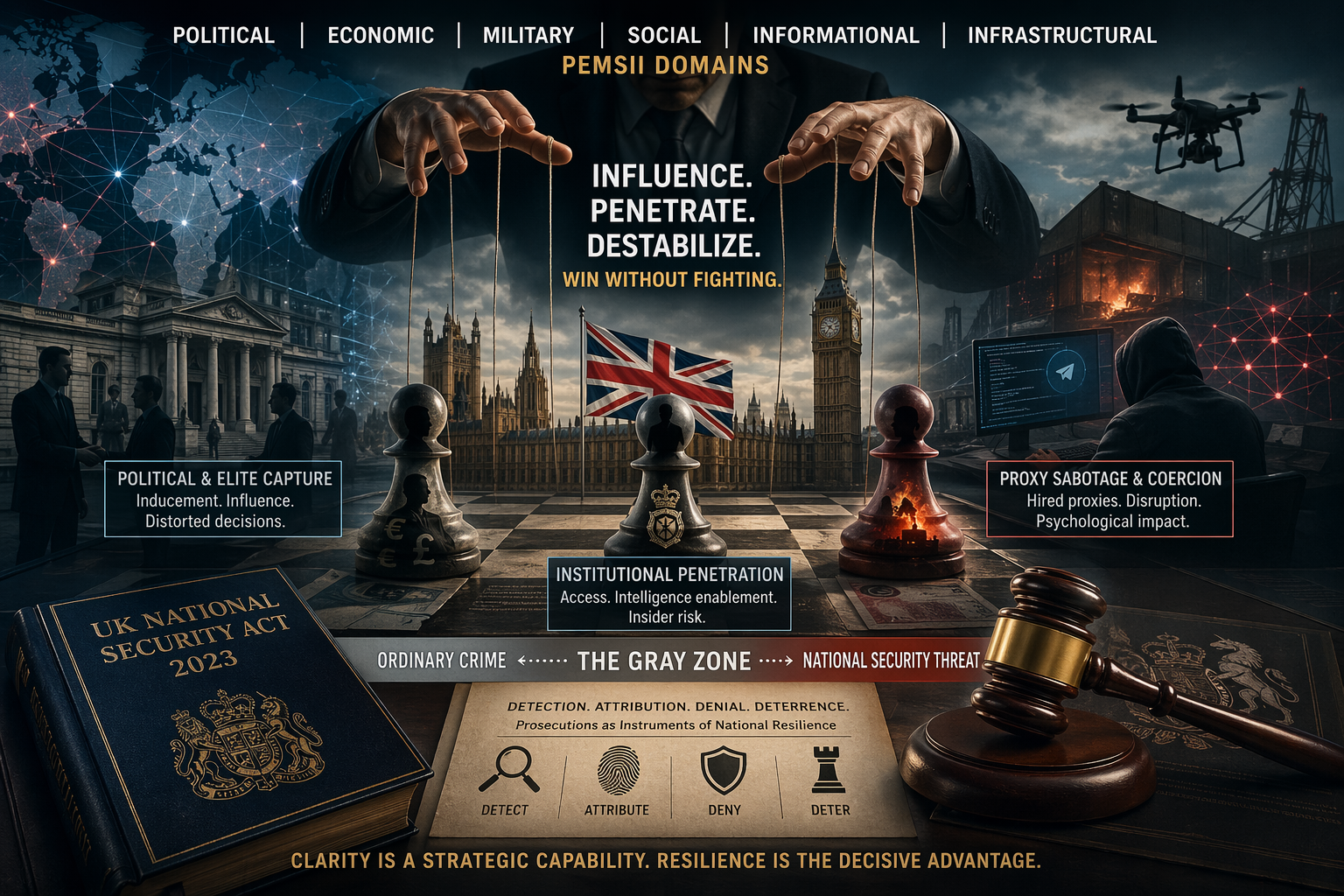

Contemporary security competition increasingly operates below the threshold of armed attack, within the political, economic, military, social, informational, and infrastructural (PEMSII) domains upon which democratic societies and the international community depend for peace and security. In this environment, the cognitive dimension, encompassing values, beliefs, public trust, perception, and decision-making, becomes a decisive terrain for the generation of strategic impact across the competition–conflict spectrum, given its capacity to shape behavior not only within political and military leadership, but also across civilian populations. The UK National Security Act 2023 (NSA) was introduced in response to this challenge, equipping the United Kingdom to prosecute foreign malign interference that exploits cognitive, socio-psychological, and infrastructural vulnerabilities without crossing traditional legal thresholds relating to armed attack or armed conflict.
Early prosecutions indicate that the United Kingdom is willing to use the criminal justice system to respond to foreign-linked malign influence operations as national security threats rather than ordinary crimes. However, the case of former Member of the European Parliament (MEP) Nathan Gill, prosecuted on bribery charges, raises a more difficult question, namely when should such conduct be treated as ordinary crime, and when should it be recognized as part of a wider campaign of foreign-linked malign interference with national security implications?
This article argues that the answer matters not only for legal classification, but for how hybrid threats are perceived, attributed, and countered. Through three recent UK cases, it shows how the criminal justice system, by design, fragments conduct into discrete offenses, while adversaries operate through coordinated strategic influence campaigns across PEMSII domains. The result is a growing gap between legal framing and strategic reality, particularly in the ‘gray zone’ where non-kinetic and kinetic methods may operate in parallel.
The Dilemma of Labeling and Framing
The NSA was intended to strengthen homeland resilience against foreign malign interference operating below the threshold of armed attack. In this context, the criminal justice system becomes a tool of detection, attribution, denial, and deterrence, within the domestic political and social domains that hybrid aggressors deliberately target for their vulnerabilities and strategic impact.
Three recent cases illustrate both how strategic impact can be generated below the threshold of armed attack, and how the criminal justice system, by design, disaggregates what may, in reality, be an overall campaign of malign interference into discrete prosecutions framed around specific offenses. Hybrid campaigns operate through combined and cumulative effects across PEMSII domains. As Sean Monaghan, Piotr Łubiński and Frank Hoffman observe, hybrid threats, understood as ‘non-violent’ efforts to erode societal cohesion and political will, may operate in parallel with hybrid warfare during armed conflict.
High thresholds under the NSA are deliberate safeguards against overreach. However, where sabotage is framed as national security but elite influence as ordinary corruption, our hybrid threat perception and response can be undermined by what Kilcullen aptly describes as this ‘liminal’ or ‘gray’ zone of strategic maneuver.
In R v Phillips, assistance to a foreign intelligence service was charged under the NSA. In R v Earl and others, foreign-directed arson linked to Russia’s war in Ukraine was prosecuted as the national security threat of sabotage. Yet former MEP Nathan Gill was prosecuted for conspiracy to commit bribery, despite judicial findings of foreign-linked inducement and institutional harm that are also indictable under the NSA.
This pattern aligns with wider threat reporting. The UK Intelligence and Security Committee of Parliament reports on Russia, China, and Iran warned of exploitation of political and institutional vulnerabilities. Europol’s EU-SOCTA 2025 highlights convergence between state actors and criminal networks in strategic subversion and destabilization operations. NATO’s research on cognitive warfare underscores how democratic societies can be targeted through undermining trust and collective decision-making without overt armed force.
This pattern is not unique to the United Kingdom. The U.S. Department of Justice cases similarly reveal coordinated foreign malign influence campaigns combining proxy actors, covert funding, and narrative manipulation. Indictments describe multi-year operations in which Russian intelligence services recruited and directed domestic political groups, funded local actors, and sought to “sow discord” and interfere in democratic processes. Parallel prosecutions concerning covert media networks demonstrate how influence narratives can be laundered through ostensibly independent platforms and personalities. As in the context of the UK, these activities are prosecuted through discrete offenses. Yet strategically they form parts of integrated campaigns operating across PEMSII domains, reinforcing the gap between legal fragmentation and operational reality.
The Gill Case as Political and Elite Capture
The judicial findings in Gill indicate that this case is best understood as part of a malign foreign-linked political and elite capture and influence campaign, involving financial inducement in exchange for institutional access to influence political and strategic decision-making.
Nathan Gill accepted payments originating from a foreign adversary linked political actor, delivered scripted parliamentary speeches at their behest, recruited other MEPs without disclosing his financial motive, and used his elected position to advance narratives aligned with Russian interests. The judge concluded that his conduct “fundamentally compromised the integrity of a supra-national legislative body…in its dealings with Russia, a persistently hostile state” and eroded “public confidence in democracy itself”.
Therefore, arguably, there was sufficient evidence to show that this was not simply about a corrupt transaction. It concerns access to decision-making nodes and the ability to undermine strategic resilience and security from within. The strategic effect is not limited to individual wrongdoing. It includes degradation of democratic trust, distortion of policy debate, and, in a wider European security context, the potential for a weakening of alliance cohesion and support for collective security in favor of an adversary.
The narrative manipulation campaign’s logic was also detectable. Gill’s coordinated media appearances, scripted speeches attacking Ukraine, and amplification of Russian supplied talking points demonstrate how institutional access can be used to launder influence narratives through legitimate democratic platforms and social networks. Strategically, this narrative manipulation was enabled by purchased elite penetration and capture.
It is understandable that the UK Crown Prosecution Service (CPS) prosecuted this case as bribery. A UK foreign interference offense under the NSA requires proof of foreign power linkage and intent (or recklessness) as to prejudicing UK interests, which is a higher and more complex evidential threshold. The comparatively lower evidential burden for bribery makes it easier to secure a conviction for the same conduct.
Yet framing has consequences. When prosecuted solely as an individual corruption-based offense, the public, as a soft target for achieving strategic impact, cannot perceive the harmful effects of malign interference. Further, they are less able to recognize, resist, and respond to such interference in ways that contribute to the denial and deterrence of hybrid aggressors.
The judge described bribery as “a malignancy at the heart of public life” that “impoverishes the national interest.” That formulation captures the core concern that non-violent influence methods can corrode democratic will and institutional legitimacy in ways that are strategically significant, even if they do not resemble classic espionage or sabotage.
This is not an argument for overreach. It is an argument for recognizing that elite capture, when linked to foreign actors and geopolitical conflict, sits within a wider national resilience problem. How such cases are framed affects deterrence, attribution, and the ability of society to detect and deny malign interference.
Phillips as Institutional Penetration and Intelligence Enablement
If Gill illustrates foreign-linked influence within democratic institutions, Phillips represents a more overt form of institutional penetration and subversion.
The sentencing findings established that Phillips initiated contact with Russian intelligence, sought employment within the UK Border Force requiring a security clearance, offered logistical and concierge-style assistance, disclosed insider-derived information about the then-Secretary of State for Defense, and expressed a willingness to provide continuing support for financial reward. The judge assessed that he was acting with “the highest culpability” in assisting a foreign intelligence service described as “a determined enemy of the United Kingdom.”
This was not a technical hack or a disinformation campaign. It was human access–based infiltration. Phillips was positioning himself to gain proximity to sensitive systems and decision nodes, including border databases, ministerial information, and logistical facilitation for hostile actors. The strategic logic was enablement, i.e. building access that could later support disruption, coercion, or intelligence exploitation.
Unlike Gill, where the legal framing centered on bribery within a political institution, the NSA charge in the Phillips case aligned directly with the strategic character of the conduct. The law and the threat narrative pointed in the same direction, namely assistance to a hostile intelligence service.
This alignment reinforces the clarity of attribution and signals that institutional access, even before physical harm occurs, constitutes a national security threat. Phillips is therefore the “clean” case, not because the facts were simpler, but because the legal framing captured the strategic logic without ambiguity, which sends an important signal relevant to denial and deterrence.
Earl et al. as Proxy Coercion With a Nexus to Armed Conflict
If Phillips represents institutional penetration and intelligence enablement, the Earl case illustrates something more overt, namely proxy sabotage in the UK embedded in a broader pattern of coercive activity linked to an ongoing armed conflict in Ukraine. While it would be difficult, under the framework articulated by the International Criminal Tribunal for the Former Yugoslavia in Tadić, to characterize such conduct as part of an extraterritorial armed conflict in a strict legal sense, the case nonetheless reveals how hybrid threat activity within a nominal ‘peace’ zone may operate in parallel with, and in functional support of, hybrid or conventional warfare elsewhere. This does not collapse the distinction between armed conflict and non-conflict environments, but rather highlights the strategic integration of coercive measures across legal thresholds, PEMSII domains, and jurisdictions, thus complicating both classification and response.
The sentencing findings describe a foreign-linked criminal enterprise operating on UK soil in support of Russia’s war aims in Ukraine, with broader consequences for European security. The UK warehouse arson was commissioned by the Russian Wagner Group, described as closely connected to the Russian state. It was intended to disrupt aid and equipment bound for Ukraine and to intimidate those supporting it. The court characterized the conduct as “a planned campaign of terrorism and sabotage on UK soil”.
This was not ordinary criminal damage. It involved the use of ‘hired’ local actors and organized crime groups as proxies to generate political and psychological damage including the disruption of logistics, signaling of reach, and intimidating perceived adversaries. The significant economic damage, risk to life, and broader social impact demonstrate how limited acts of violence can serve strategic purposes beyond the immediate offense.
The campaign was digitally initiated and coordinated through Telegram and encrypted communications. The judge referred to the “hidden hand of the internet” enabling cross-border direction and recruitment. The digital infrastructure was not the primary objective; it was the architecture that allowed foreign actors to activate hired proxies at a distance. There were also attempted efforts to widen the reach of the operation, including discussions of recruiting a serving UK soldier and targeting a prominent Russian dissident. These elements point to an ambition extending beyond a single act of arson.
Here, the NSA framing aligned directly with the strategic character of the conduct. The foreign power connection and the war context were named in law and in public explanation. Unlike the Gill case, the legal narrative and the strategic narrative pointed in the same direction and provided strong deterrent and denial signaling.
Isolated Crimes or a Coordinated Strategic Campaign?
Taken together, these cases suggest more than isolated offenses. Gill involved foreign-linked inducement shaping the debates and decision-making of parliamentarians. Phillips involved institutional access-building in support of a hostile intelligence service. Earl involved foreign-directed sabotage using local proxies to generate political and psychological damage. Different methods, including inducement, infiltration, and proxy violence, all serve a common objective, namely weakening social cohesion, distorting decision-making and complicating state response.
Legal framing therefore matters. If sabotage is prosecuted as national security while elite penetration is framed solely as corruption, the cumulative campaign logic risks disappearing in law. That, however, does not justify indiscriminate use of the NSA and high thresholds are valuable deliberate safeguards. But in a liminal threat environment, coherent threat narration and response are both part of strategic signaling and resilience.
In this sense, strategic resilience is not simply a post-incident capacity to respond, but an ongoing ability to anticipate, absorb, and recover from shocks while maintaining core societal functions. As NATO doctrine on resilience through civil preparedness emphasizes, the objective is to sustain continuity of governance, essential services, and societal cohesion in the face of disruption. Legal framing therefore plays a role not only in attribution and deterrence, but in shaping the broader system-level capacity to resist and adapt to hybrid interference.
Hybrid threats may be non-kinetic, but they target popular will, government legitimacy and decision-making capacity, which are the foundations of national security. As recent NATO resilience frameworks recognize, adversaries increasingly seek to destabilize systems by targeting interconnected domains rather than discrete events, exploiting vulnerabilities across PEMSII domains. This reinforces the need to understand individual offenses not in isolation, but as components of wider campaigns designed to erode cohesion and degrade system performance over time. The criminal justice system is therefore not peripheral but central as investigations, prosecutions, and convictions perform detection, attribution and denial functions, reduce ambiguity, and expose foreign linkages. Properly framed, they can strengthen homeland resilience without undermining democracy or the rule of law.
Winning Without Fighting
As Patterson et al. make clear in Winning Without Fighting, contemporary competition is not decided on the battlefield but through the cumulative pursuit of power, influence, and legitimacy across PEMSII domains. The cases examined here show that the UK is already engaged in that contest, but its legal and narrative framing has yet to fully reflect it. When foreign-linked bribery is treated as mere corruption, or influence operations as isolated misconduct, the broader campaign to shape decisions and erode democratic legitimacy slips from view, and with it, the ability to resist. Clarity, therefore, becomes a strategic capability. Prosecutions do more than punish; they signal, attribute, and expose. Framed coherently, they become instruments of competition in their own right, disrupting malign influence operations, denying adversaries the cover of ambiguity, and reinforcing the legitimacy on which democratic resilience ultimately depends.



