Inside the Islamic State Recoilless Gun Program | ARES
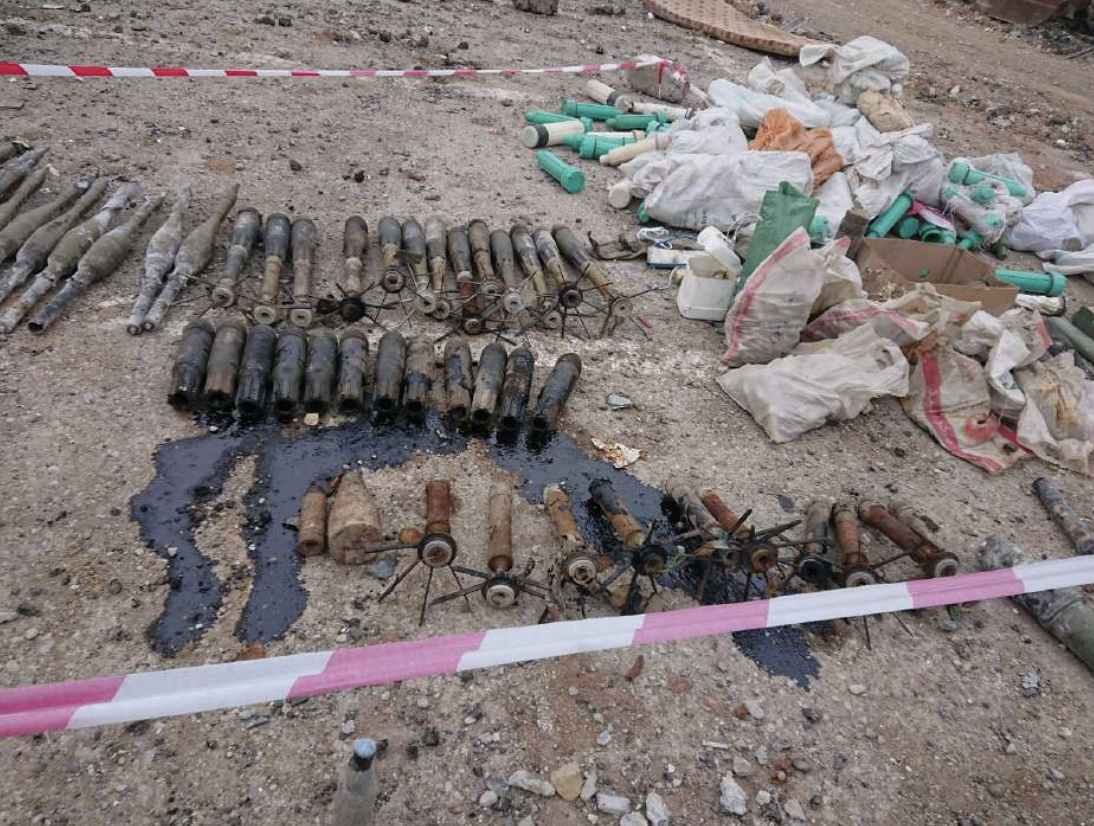

By publishing Special Report 6, “Islamic State Craft-produced Light Recoilless Guns: Conventional & Chemical Variants,” ARES seeks to provide a comprehensive technical understanding of IS craft-produced recoilless guns and their munitions—including a chemical weapons capability—highlighting the implications for threat assessment and force protection.
Islamic State’s Craft-Produced Arsenal: Recoilless Guns and Chemical Variants
A new special report from Armament Research Services (ARES) provides a comprehensive technical examination of Islamic State craft-produced light recoilless guns, including the first documented evidence of a fifth variant designed to deliver a sulphur mustard chemical payload. Authored by a team of explosive ordnance disposal (EOD) veterans and arms analysts with direct field experience in Mosul and Northeast Syria, the report draws a detailed technical picture of a weapons family that proved consequential during IS’s territorial peak.
What IS Built and Why
IS arms production was driven by necessity. The group needed anti-armor that could be fired from confined urban spaces by personnel on foot with reduced backblast. Factory alternatives like the SPG-9 were available only in limited quantities. IS solved the problem by building its own. As a non-state actor without reliable resupply chains, they established craft-production facilities in captured cities.
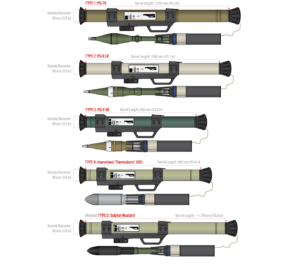
Four conventional variants were publicly advertised by IS in 2017 and subsequently confirmed by EOD teams on the ground.
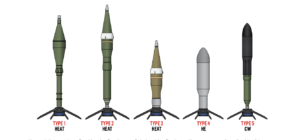
- The Type 1 fires a modified PG-7 HEAT projectile adapted from Soviet-designed anti-tank munitions, with a claimed range of 200 meters.
- The Type 2 fires a modified PG-9 HEAT projectile at ranges up to 700 meters—the longest-range variant in the family.
- The Type 3 uses only the warhead section of the PG-9 projectile in a shorter barrel, offering a compact 50-to-300-meter capability optimized for dense urban combat.
- The Type 4 was marketed by IS as a “thermobaric” weapon. It is not. The report confirms the warhead contains a straightforward ammonium nitrate and aluminium high-explosive fill. IS propaganda either misunderstood what it had built or deliberately misrepresented it.
All four types share an identical barrel diameter (89 mm outside, 84.5 mm inside); the same electrically initiated propelling/expelling charge; the same countermass assembly packed with salt, metal swarf, or sand; and the same IS-developed folding fin assembly. This commonality simplified production, reduced the number of unique components, and allowed an effectively single-use weapon to be assembled from a limited parts inventory.
“Whilst the recoilless principle significantly reduces the muzzle velocity of fired projectiles, this limitation is less significant when such weapons are used in urban areas.”
The weapons’ backblast characteristics appear to have been superior to both the RPG-7 and SPG-9 for confined-space use, IS’s primary operational environment
The Type 5: A Chemical Variant
The report’s most significant contribution is its documentation of a fifth type. In November 2017, an EOD team led by one of the authors discovered a metal tube loaded with what was later confirmed to be a sulphur mustard munition in Mosul. More than 25 similar munitions were recovered the following month. EOD personnel subsequently exhibited symptoms consistent with chemical exposure, and hospital staff reported treating hundreds of civilian cases.
The Type 5 munition uses a PG-7 or PG-9 flight motor mated to a craft-produced body containing sulphur mustard produced through the Levinstein process. This is the same improvised synthesis method IS used across its chemical weapons program. The agent recovered was approximately 35% purity, mixed with petroleum products, and had degraded through improper storage. It remained hazardous. The tube found loaded with the munition shared the same approximate dimensions as the four conventional variants, and a propelling charge consistent with the IS recoilless gun family was found nearby.
“The existence of a ‘Type 5’ recoilless gun, whilst unconfirmed, is implied by the existence of the Type 5 projectile, the fact that one such projectile was found inside of a tube, and the proximity of that tube to an expelling/propelling charge that strongly resembles those used in IS craft-produced conventional recoilless guns.”
Whether the Type 5 was ever fired in combat remains unknown. The fragile plastic warhead likely posed handling risks under field conditions, and none of the recovered munitions were marked to indicate a chemical payload. Iraqi security forces likely destroyed an unknown number assuming they were conventional rounds.
Implications
Here are some takeaways from a threat assessment and force protection perspective:
- The IS recoilless gun program demonstrates that non-state actors with access to captured industrial infrastructure and modest machining capability can develop semi-standardized, tactically effective weapons families in short timeframes. The design iteration from Type 1 to Type 5 reflects a genuine engineering process.
- The integration of chemical payloads into an otherwise conventional weapons platform means that field identification of chemical variants requires close inspection. The only distinguishing external feature of the Type 5 munition was a rounded plastic nose visible from the muzzle end of the tube. EOD teams were ultimately instructed to treat any IS recoilless gun munition with a plastic warhead as a chemical hazard until confirmed otherwise.
- The report also corrects a persistent error in Western commentary. These weapons are recoilless guns, not rocket launchers. The presence of a rocket motor in the munition does not change the classification of the weapon system.
- Finally, the IS chemical weapons program as a whole was neutralized primarily by the recapture of Mosul and coalition airstrikes on Mosul University, which served as the program’s production hub. The report warns, however, that IS would likely seek to restart production if it could.
Find the full report by N.R. Jenzen-Jones, Drew Prater, Tony Salvo, Charles Randall & Mick F. here: “Islamic State Craft-producedLight Recoilless Guns: Conventional & Chemical Variants.”