





How America’s Adversaries Learned to Weaponize Reality
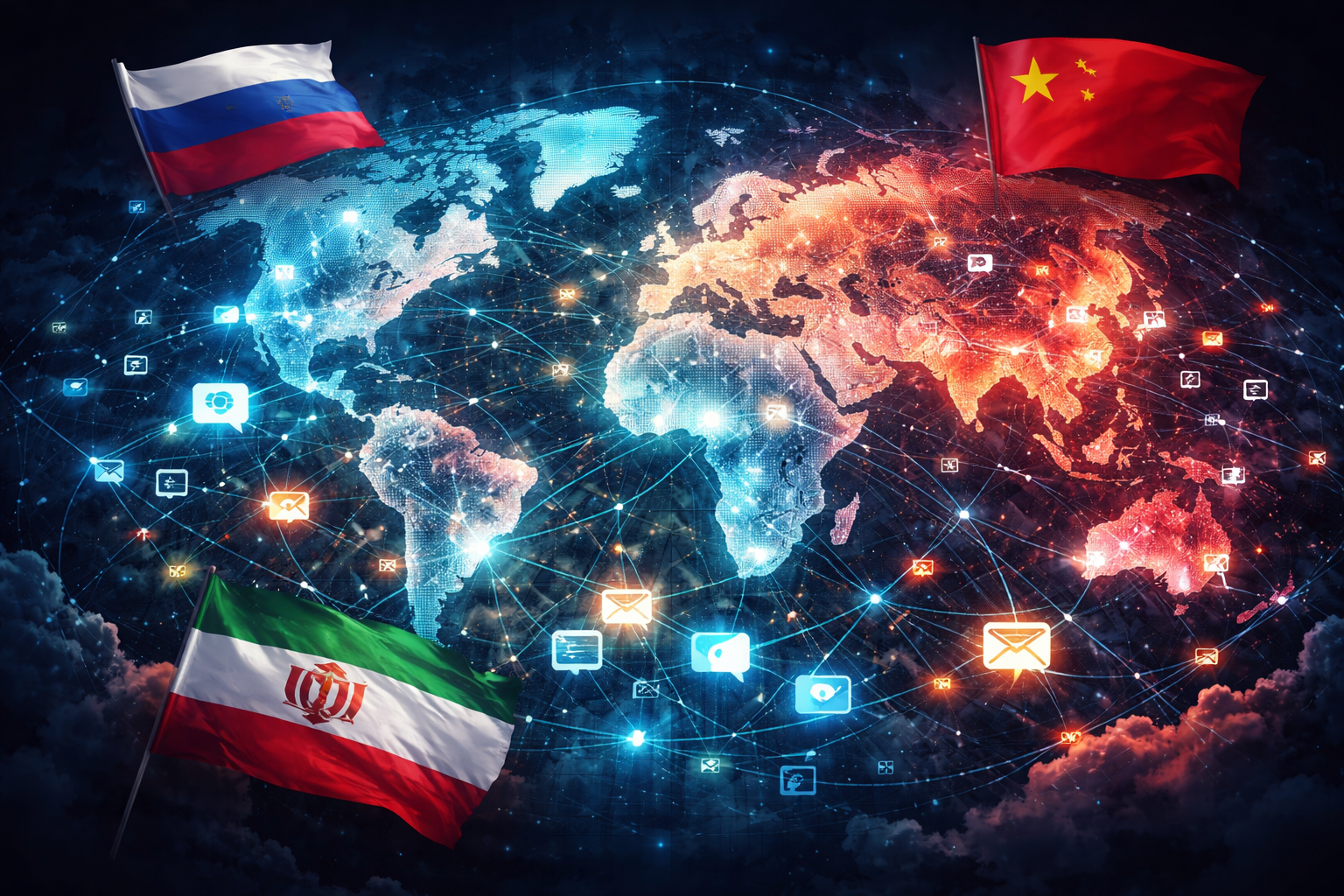

Abstract: Russia, China, and Iran have developed sophisticated narrative warfare strategies that allow them to shape political outcomes even when facing military or economic disadvantages. Russia relies on reflexive control to fragment adversaries’ perceptions and influence decision-making, while China focuses on long-term discourse shaping through disciplined messaging and institutional influence. Iran leverages revolutionary ideology and theological concepts of resistance to build resilient domestic cohesion and attract diverse external actors. In contrast, the United States continues to rely on a Cold War–era model of persuasion, based on credibility and institutional legitimacy, which often struggles against identity-driven narratives. The article argues that modern conflicts increasingly depend on narrative endurance rather than kinetic dominance, with strategic success often determined by which side maintains belief in its political story rather than which side wins on the battlefield.
Introduction
Who is actually winning the wars in Ukraine and Iran, and what would victory even look like if neither battlefield momentum nor economic punishment produces political collapse? How much territory would Ukraine have to recover before Russia could be said to have lost? How much damage would Iran have to suffer before its regional position is truly weakened? If both regimes continue to function, mobilize support, and persuade their populations that the struggle remains necessary, then the more uncomfortable question will begin to surface: whether the real contest has already shifted away from terrain and toward something far less visible but ultimately more decisive.
Wars today increasingly turn on whether governments can control how reality itself is interpreted. Military force can destroy infrastructure, impose casualties, and degrade capabilities, yet political outcomes depend on whether societies interpret those losses as defeat or as sacrifice. Economic pressure can shrink output and isolate financial systems, yet it only produces strategic results when populations or target audiences in the regime begin to see hardship as pointless rather than necessary. Narrative therefore does not sit beside military conflict as a communications tool. It determines whether military pressure translates into political consequence at all. Russia may lose personnel, equipment, and even relinquish occupied territory in Ukraine and yet claim success and open fronts in the Baltic, intensify hybrid warfare in Europe, or dictate political outcomes in elections around the world. Iran may have lost its key leaders, its entire navy and air force defense, diplomatic standing in the Gulf, and political backing in proxy states, but still utilize its external networks to generate anti-American and anti-Israeli backlash around the world.
Russian, Chinese, and Iranian strategic cultures all begin from this premise, though they arrive there through very different intellectual pathways. Russian thinking reflects Soviet-era doctrines that treated political struggle as continuous and treated perception as a domain of conflict. Chinese strategy draws on Leninist political communication theory and a long tradition of shaping historical interpretation to shape political legitimacy. Iranian narrative warfare grows from revolutionary ideology fused with Shi’a theological concepts of resistance and moral endurance. Each tradition treats narrative to shape the decision environment itself rather than as a tool for explaining decisions after they occur.
The Roots of Reflexive Control in Soviet Strategic Thinking
The Soviet origins of reflexive control remain one of the clearest expressions of this philosophy. Soviet military theorists developed the concept during the late Cold War while studying how leaders behave under conditions of uncertainty and pressure. Their central insight was disarmingly simple but strategically profound: decision makers rarely respond to objective reality. They respond to the version of reality they believe they inhabit. Whoever shapes that perceived reality shapes the decisions that follow.
Rooted in game theory, reflexive control therefore focuses on influencing how adversaries perceive choices rather than attempting to dictate those choices directly. Russian strategists attempt to introduce signals, strategic deception such as false flag operations (“maskirovka”), aimed at disguising the origin of particular active measures, selective disclosures, contradictory explanations, emotional triggers, and carefully managed ambiguity into an opponent’s information environment so that certain risks appear larger, certain opportunities appear smaller, and certain responses begin to feel unavoidable. Success does not require belief in the narrative itself. Success requires predictable reaction.
Cold War active measures demonstrated how seriously Moscow treated this logic. Soviet intelligence services did not primarily attempt to convince Western audiences of pro-Soviet narratives. They instead worked to shape political climates in ways that produced useful reactions. They reinforced ideological tensions that already existed inside Western societies. They cultivated intermediaries capable of influencing debates without appearing connected to Moscow. They encouraged Western overreaction where overreaction imposed economic cost. They encouraged hesitation where hesitation slowed policy response. The measure of success involved whether Western governments behaved in ways advantageous to Soviet interests, not whether Western publics believed Soviet explanations.
How Contemporary Russian Narrative Warfare Benefits from Soviet Precedent
That logic still shapes Russian narrative behavior surrounding Ukraine, where messaging rarely attempts to produce a single global interpretation of the conflict and instead works to ensure interpretive fragmentation. Russian domestic audiences encounter a story about national endurance, historical confrontation, and resistance to Western encroachment. Many audiences across Africa, Latin America, and parts of Asia encounter a different story focused on sanctions spillover, food prices, and perceived Western selectivity in applying international norms. Strategic advantage emerges not from universal persuasion but from preventing narrative consolidation among opponents.
Russian messaging also places unusual emphasis on the strategic meaning of time, both in terms of memory and forward messaging. Endurance itself becomes evidence of strength. Continued state functioning under sanctions becomes proof of structural resilience. A conflict that fails to produce Russian collapse gradually becomes evidence that collapse will not occur. Under such conditions duration stops looking like stalemate and starts looking like validation. Another example is the dramatic shift from Russia’s anticipated and much-hyped “three-day victory” over Ukraine as the Kremlin defined as the capture of Kyiv and end of Ukrainian independence with the reality, over the past four years since Russia’s full-scale invasion, of “backward advances,” catastrophic losses in men and material, and strategic embarrassments, including Ukraine’s sinking of Russia’s Black Sea flagship Moskova and subsequent evacuation from Crimea of the remainder of the fleet, Ukraine’s Operation Spiderweb that destroy billions of dollars in irreplaceable Russia bomber aircraft across the country, and Ukraine’s seizure of Sudzha and ability to maintain a salient in Kursk, Russia for over six months. While almost inconceivable, Russian propagandists, in so far as they acknowledge any of these disasters, employ suffering and defeats to signify the strength of survival and the need to fight on.
China’s Narrative Framing Through Discourse Power
Chinese narrative strategy relies on gradual normalization rather than chaotic contradictions. Rather than attempting to fragment interpretation, Chinese political communication seeks to shape the assumptions through which events will later be judged. Chinese strategists often describe this as discourse power, reflecting a belief that whoever defines the vocabulary of a geopolitical issue often defines the range of acceptable conclusions long before conflict escalates. In translation, the term used means “the right to speak”.
The Taiwan case illustrates this approach with unusual clarity. Chinese messaging rarely begins with military threats. Instead it consistently frames the issue through themes of historical continuity, specifically by promoting three narratives, focused on three historical anniversaries and known as the “Three Anniversaries Campaign”, civilizational connection, economic integration, and the unfinished legacy of national division. Reunification appears within that structure not as expansion but as restoration. The cumulative effect is not aimed at immediate persuasion. Instead, China seeks long-term conditioning of how future developments will be interpreted, while presenting itself as a force for unity and stability. When crises emerge, they emerge inside a narrative environment shaped years in advance.
References to stability, prosperity, and shared cultural roots appear constantly, while outside involvement is framed as disruption rather than protection. By repeating these themes across years of official statements, white papers, diplomatic exchanges, and economic messaging, Beijing works to ensure that any future crisis appears inside a conceptual structure where reunification feels historically grounded and resistance appears destabilizing.
This approach relies heavily on message discipline and institutional consistency. Chinese narrative campaigns tend to look organized because they are tied to party control over information space and to the broader political requirement that the state remain the central interpreter of reality. The messaging often emphasizes order, predictability, and gradual historical movement because those themes reinforce domestic legitimacy while also appealing to foreign elites who prioritize stability in their own political environments.
Iran’s Revolutionary Narrative Model
Iran operates through yet another narrative model, derived from its grand strategy known as “forward defense”, one that may appear ideologically rigid, and allegedly failed as a sustainable kinetic infrastructure, yet demonstrates remarkable ideological adaptability in practice. Iranian political messaging consistently draws from the Shi’a story of Karbala, where Imam Hussein’s resistance against overwhelming force established moral authority through sacrifice, victimhood, and grievance rather than victory. Iranian revolutionary ideology transformed that theological memory into a political template. Endurance signifies legitimacy. Survival demonstrates righteousness. Hardship confirms ideological purpose.
That framework produces unusual resilience precisely because external pressure strengthens rather than weakens the governing story. Iran points to sanctions as evidence of independence, uses even unfavorable military confrontations as confirmation of resistance, and propagates the view of its continued survival as ideological validation. Political systems built around such narratives rarely fracture under kinetic pressure alone because that pressure reinforces the story holding the system together.
The more surprising element of Iranian narrative warfare lies in its ability to extend far beyond Shi’a theology. Iran rarely attempts to export religious doctrine directly or exclusively, though it has certainly spared no expense to promulgate soft power reach through educational influence in the “near abroad” such as Iraq nor has it ever put an end to efforts to recruit and convert followers from Africa to Latin America. More importantly, however, the Islamic Republic exports the emotional messaging of resistance. Sovereignty, dignity, humiliation, and survival against stronger adversaries form a political vocabulary capable of attracting actors with radically different ideological commitments.
This helps explain how Iran successfully builds networks that include Sunni extremist groups, secular armed movements, leftist anti-imperialist organizations, nationalist factions, isolationist political currents, and even criminal actors operating within gray economies. Participation does not require ideological alignment with Shi’a theology. Iran seeks to draw in anyone willing to align with the narrative structure of resistance. That structure functions as political vertebrae capable of connecting actors who otherwise share little common ground.
The revolutionary origins of the Iranian state help explain this adaptability. Shi’a symbolism merged with anti-colonial revolutionary theory during the formation of the Islamic Republic, producing a hybrid ideological language capable of speaking simultaneously to religious identity, anti-Western sentiment, and revolutionary legitimacy. Emotional resonance became more important than doctrinal purity. The result, far from being a rigid ideological bloc, is in fact a seemingly infinitely flexible narrative ecosystem.
The American Narrative Paradigm is Still Frozen in the Cold War Era
The American approach to strategic narrative warfare emerges from a very different doctrinal tradition rooted in Cold War public diplomacy and later counterinsurgency thinking. The concept of winning hearts and minds reflects a belief that influence grows from credibility, consistency between values and behavior, and the gradual accumulation of trust. The underlying understanding were rooted in a combination of the concept of American exceptionalism, the belief that the United States occupies a unique role in history because of its founding principles, political system, and perceived mission to advance liberty, democracy, and opportunity, and the framing of the defense of freedom against tyranny and terror. Narrative in this tradition functions primarily as persuasion grounded in factual legitimacy rather than as behavioral conditioning.
For decades, this model helped the United States to mobilize alliances, to defend international norms, and to construct legitimacy in ways few competitors can match. Yet it also assumes that audiences respond primarily to evidence and consistency. Narrative competition often operates differently. Audiences frequently interpret events through emotional and historical frameworks long before factual arguments enter consideration.
Ukraine demonstrates this tension clearly. American messaging grounded in sovereignty and documented aggression resonates strongly within allied societies already invested in those norms. In parts of the Global South where the conflict appears through rising commodity costs and memories of Western intervention, the same arguments often fail to shape interpretation. Russia does not need to convince those audiences that Moscow is right. It only needs to ensure they do not see the conflict through Washington’s preferred lens. Moreover, even these well-tested tools have fallen to piece under the Trump administration’s view which replaced adherence to international cooperation with a focus on pure power moves justifying interventions at will. With the view of long-standing alliance and multilateralism crumbling, without being replaced by any sort of other narrative that would appeal to the audiences beyond supporters of this paradigm, the US narrative trajectory is now relegated to an increasingly narrow stratum of domestic and international supporters of the Trumpian world order.
Iran demonstrates this asymmetry. American textbook “realist” messaging tends to emphasize deterrence, nonproliferation, and regional stability. Iranian messaging emphasizes resistance, sovereignty, and defiance of external pressure. One framework appeals to institutional logic. The other appeals to political, religious, and historical identities – in the region and beyond. Beyond traditional Western environments, appeals to identity frequently proves more durable and certainly faster disseminating than institutional arguments.
Structural characteristics of the American political system reinforce this disadvantage in narrative competition. As intended by the Federalist structure that balances factions and interests, elected officials, government agencies, think tanks, and media compete with themselves and with other forces to define events. During debates over military aid to Ukraine, for instance, the executive branch framed assistance as essential to defending democratic norms, while factions in Congress questioned the strategy, scale, and/or sustainability. The result was a diverse, sometimes contradictory discourse that external audiences could selectively interpret. The United States presents a mosaic of perspectives that can appear inconsistent or even incoherent to outside audiences. Information warfare rewards long-term thematic consistency. Democratic systems naturally produce message variation through electoral cycles, bureaucratic competition, and media pluralism. Strategic messaging frequently competes with domestic political messaging. The same openness that strengthens democratic governance complicates narrative discipline. The Trump administration’s confused, uneven, and mercurial narratives around Operation Epic Fury in Iran illustrate this tension quite clearly.
The US Adversaries Can Wrestle Survival from the Jaws of Military Defeat through Narrative Success
Preparation timelines can further widen the gap. Russian, Chinese, and Iranian narratives often shape expectations years before crises emerge through education, diplomacy, and cultural positioning. By the time conflict begins, many audiences already interpret developments through those established frameworks. American messaging often begins once crises become visible, forcing it to operate inside narrative terrain already shaped by others. Both the wars in Ukraine and Iran illustrate this principle.
All of this suggests that the long-term political outcomes of conflicts like Ukraine and Iran may depend less on battlefield developments alone than on which narratives retain credibility among key audiences. Military success can produce strategic advantage only when it reshapes the governing story. Tactical setbacks may lose long-term significance when they reinforce narratives of endurance.
Iran may ultimately provide the clearest demonstration of how narrative positioning can outweigh kinetic outcomes. A political system built around the moral meaning of resistance can absorb damage that outside observers expect to prove decisive. If survival continues to function as validation inside the governing narrative, pressure alone may not produce political collapse. Systems built around endurance rarely fail because of physical damage alone. They fail when the narrative that gives hardship meaning begins to fracture. In other words, until the military, the IRGC, and the bureaucratic institutions supporting the political class in Iran become disillusioned in the narratives they are indoctrinated with and being to fracture, crumble, and leave the vestiges of the power system that has sustained them as much as they have sustained it, not much is likely to change.
Conclusion
Russian reflexive control benefits most when American strategy inadvertently validates the interpretive frames Moscow has spent years trying to normalize. Every instance of unclear objectives, escalatory signaling followed by hesitation, visible domestic division, or shifting definitions of success feeds a perception environment in which adversaries can argue that American power lacks strategic patience and political coherence. Russian information strategy does not need to manufacture these perceptions. It only needs to amplify them, selectively highlight them, and circulate them into decision environments where they shape expectations about U.S. behavior. Once introduced, those perceptions travel far beyond the immediate conflict. Chinese strategic messaging can then fold the same signals into its long-standing narrative about Western decline and the instability of democratic decision making, while Iranian political discourse can incorporate them into its resistance framework as further evidence that endurance outlasts pressure. Reflexive control works precisely because it turns real signals into strategic leverage, allowing Russian amplification of American friction to become raw material for Chinese inevitability narratives and Iranian resistance narratives at the same time. Under those conditions, narrative mistakes do not remain isolated communication failures. They become inputs into a wider ecosystem of adversarial political warfare that feeds on inconsistency and converts it into long-term strategic advantage.
Modern conflict increasingly turns on control over political meaning rather than control over escalation ladders. Military pressure, sanctions, covert action, and deterrence signaling all impose real costs, yet none of them produce decisive results unless they also reshape how societies interpret risk, time, and survival. Governments that successfully embed hardship inside narratives of historical purpose, civilizational struggle, or sovereign resistance can continue functioning under pressures that outside observers repeatedly assume will prove unsustainable. The decisive variable therefore lies in whether a state can continue to make endurance feel like progress rather than stagnation, legitimacy rather than desperation, and inevitability rather than decline. Wars fought under those conditions rarely end when one side runs out of weapons. They end when one side runs out of belief.


