





Time to Dam the Iron River
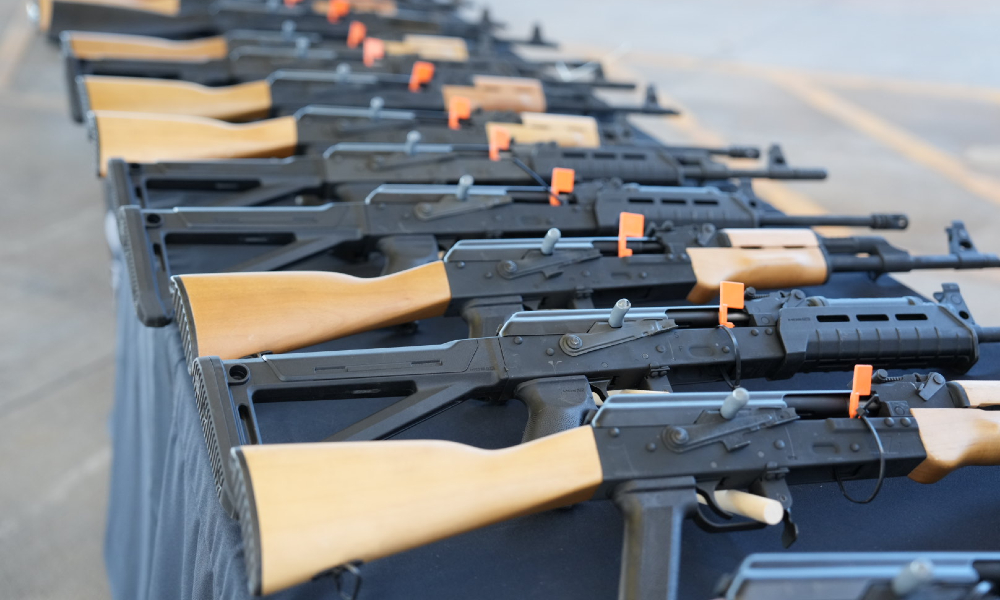

Washington’s approach to cartels emphasizes designations and strike authority. The operational center of gravity sits elsewhere. That center of gravity, argues Henry Ziemer in an article for Lawfare, is sustained access to U.S.-sourced firearms moving south across the border.
The Picture
Tracing data consistently attributes large volumes of recovered weapons in Mexico to U.S. origin points, with demand concentrated on rifles and .50 caliber systems. These systems shape cartel competition and constrain Mexican security forces, which operate under persistent firepower gaps and rely heavily on military and National Guard support to hold territory.
Supply Chains Adapt
The supply chain adapts to enforcement pressure. Weapons move in parts, assembled after crossing the border, and increasingly enter circulation through barter arrangements that exchange drugs directly for arms. This reduces financial visibility and ties procurement more tightly to violence itself. At the border, U.S. interdiction efforts remain weighted toward northbound drugs and migration, leaving southbound weapons flows less consistently detected.
Legal Tools Help, But…
Legal tools tied to foreign terrorist organization designations expand the ability to prosecute suppliers and intermediaries under material support statutes. Early cases indicate this is working somewhat, though enforcement remains uneven and legally complex. At the same time, U.S.–Mexico coordination on tracing and intelligence sharing continues to develop but lags behind the adaptability of trafficking networks.
Bottom Line
The result? Cartel capacity is reinforced by a steady external weapons pipeline, while policy attention remains concentrated on downstream disruption rather than supply-side control. This presents ample room for improvement, Ziemer concludes.
…[N]either country disagrees with the position that violent transnational criminal organizations should not have access to lethal weapons. The current moment presents an opportunity for Washington and Mexico City to affirm their commitment to this shared principle, and align on a set of policies to get weapons out of cartel hands, and keep them out.
Read the original piece by Henry Ziemer here: “The Counterterrorism Toolkit for Cutting the Cartels’ Arms Pipeline.”
While you’re here:
We highlighted a March federal indictment of an Arizona firearms dealer on charges related to providing weapons to Cartel de Jalisco Nueva Generacion (CJNG) and the Sinaloa Cartel, both designated as foreign terrorist organizations (FTOs) in 2025. Read that discourse here: “A Federal Indictment Links Cartels to U.S. Firearms Networks.”
Check out this thought-provoking perspective piece outlining a novel counter-cartel strategy by Jim Crotty: “Could Mexican Cartels Be Incentivized to Sell “Safer” Drugs?.”

