





The Kurds: Realism Over Separatism
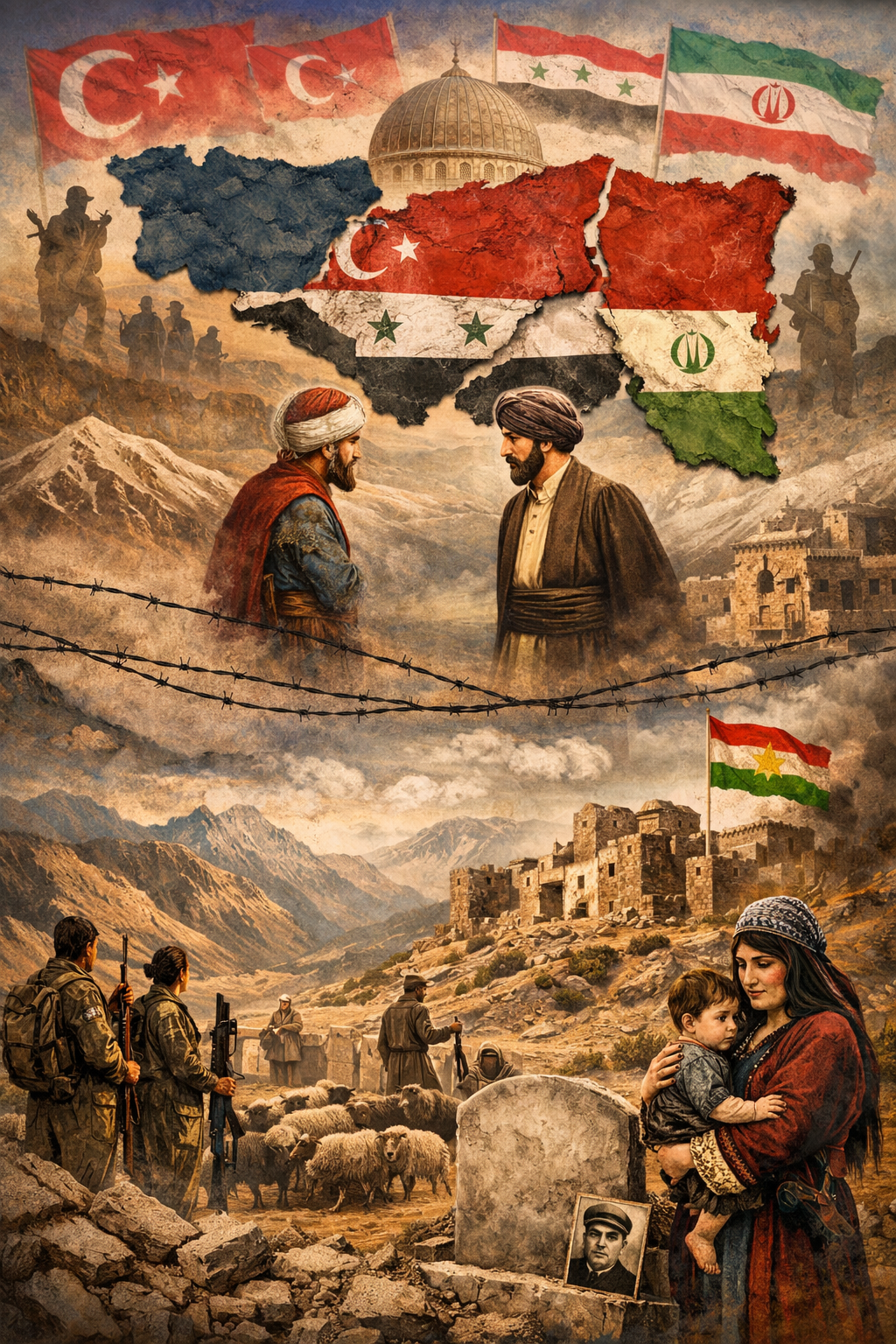

Current and Past Experiences Have Shifted the “Greater Kurdistan” Project from a Political Goal to a Cultural Discourse.
The Kurdish people are the world’s largest stateless nation. The geography of Kurdistan was first partitioned by the Treaty of Amasya (1555) between the Safavid and Ottoman Empires. The region under Iranian control is known as East Kurdistan (Rojhelat).
In the early 20th century, the Sykes-Picot Agreement and the aftermath of World War I further divided Ottoman-held Kurdish lands among Turkey, Iraq, and Syria—creating North (Bakur), South (Bashur), and West (Rojava) Kurdistan, respectively. Together, these parts constitute what is historically known as “Greater Kurdistan.”
A Victim of Geography
The Kurds have long been victims of their own geography. Kurdistan’s mountainous terrain served for centuries as a natural buffer between Persian, Arab, and Turkish empires. While providing a sanctuary, these rugged mountains—with their harsh winters and difficult transport routes—hindered large-scale agriculture, regional connectivity, and the formation of centralized institutions or urban hubs.
The Kurds generally identify as descendants of the Medes, who ruled a vast empire from Central Asia to Anatolia around 700 BCE. From the 11th century to the mid-19th century, Kurds established various principalities and emirates. While these entities enjoyed varying degrees of autonomy, their existence was usually tied to the temporary weakening of central imperial powers, which allowed Kurdish leaders to exert control over the mountainous frontier zones.
The Pursuit of Independence
Some researchers argue that Kurds did not historically seek absolute independence in the modern sense; rather, they preferred a regional autonomy within weak empires. However, this is not a universal truth. The surge of modern Kurdish separatism primarily emerged during the first half of the 20th century, specifically during the World Wars.
The collapse of the Ottoman Empire fueled aspirations for statehood. To persuade Kurds and Arabs to turn against the Sublime Porte—despite its religious legitimacy—the British promised independence.
In South Kurdistan (Iraq), Britain granted governing authority to Sheikh Mahmoud Barzanji, who later declared himself King of the “Kingdom of Kurdistan” (1921–1924). However, the establishment of the Iraqi state and shifting British interests led to the postponement of independence. While the Treaty of Sèvres (1920) suggested a referendum for independence, the Treaty of Lausanne (1923) effectively ignored these claims, incorporating South Kurdistan into the British Mandate of Iraq. Even a century later, Erbil and Baghdad have yet to fully resolve the definition of “independence within the framework of Iraq.”
In North Kurdistan (Turkey), the Ararat Republic was established in 1927 but was suppressed by the Ankara government by 1930. Similarly, during World War II, the Republic of Kurdistan in Mahabad was declared in Iran with Soviet encouragement. It lasted barely a year (1945–1946) before ending with the execution of its president, Qazi Muhammad, by the Iranian government.
The Shift Toward Realism
Learning from the fate of these movements, subsequent Kurdish uprisings moderated their demands. The 1961 “September Revolution” led by the Kurdistan Democratic Party (KDP) eventually settled for autonomy in 1970 for the provinces of Sulaymaniyah, Erbil, and Duhok. This ended in 1975 when the Shah of Iran and Saddam Hussein signed the Algiers Agreement, effectively crushing the revolution.
The Patriotic Union of Kurdistan (PUK) launched a new revolution that same year under the banner of “Self-Determination,” later refining this goal into a demand for a federal system within Iraq.
Following the Gulf War and the 1991 uprising, the Kurds liberated Erbil, Sulaymaniyah, and Duhok. Protected by a Coalition-enforced No-Fly Zone, the Kurds elected a parliament and formed the Kurdistan Regional Government (KRG). By October 1992, the Kurdish parliament officially called for a federal system in Iraq.
After the 2003 U.S.-led invasion ended Ba’athist rule, the Kurds became a cornerstone of the new Iraq. The 2005 Iraqi Constitution formally recognized the KRG as a federal entity. Although an earlier 2005 informal referendum showed 98.8% support for independence, Kurdish politicians remained committed to the constitutional “voluntary union” of Iraq.
The rise of ISIS in 2014 and the collapse of the Iraqi army created a vacuum that the Peshmerga filled, bringing almost all of South Kurdistan under their control. However, this leverage was lost following the 2017 independence referendum. Despite 92% of voters supporting independence, economic and military pressure from neighbors led the KRG—under then-Prime Minister Nechirvan Barzani—to accept a federal court ruling annulling the results.
Regional Perspectives in 2026
In West Kurdistan (Syria/Rojava), the Kurds have not pursued secession despite the fall of Bashar al-Assad’s regime in late 2024. Instead, SDF Commander Mazloum Abdi emphasized Syria’s territorial integrity in agreements with transitional leader Ahmed al-Sharaa. They now seek decentralization and constitutional rights within a unified Syria.
Similarly, imprisoned PKK leader Abdullah Öcalan’s discourse with Ankara focuses on a “Democratic Union” and the brotherhood of peoples within Turkey, rather than the independence of North Kurdistan.
Most recently, amid the U.S.-Israel-Iran conflict in early 2026, Tehran has leveled harsh threats against Kurds, accusing them of separatism. Yet, Iranian Kurds maintain that they seek autonomy or federalism through dialogue within a unified Iran.
Conclusion
While Kurds hold the same right to nationhood as any other people, their geography has dictated a history of subjugation or, at best, semi-independent governance. The brief windows for independence opened by the World Wars were quickly closed by regional powers.
This shift—from the demand for independence and a nation-state toward self-administration within the framework of the nation-states of the Arabs, Persians, and Turks—stems from the fact that great powers have supported Kurdish liberation and independence movements only within a specific scope and agenda, subsequently abandoning them.
The fate of the Kingdom of Kurdistan in the South, the Republic of Kurdistan in the East, and more recently, the SDF’s self-administration in Rojava (West Kurdistan) demonstrates that an independence project cannot be built solely by relying on external powers. This is compounded by the consensus among Arabs, Persians, and Turks to confront and dismantle any Kurdish attempt at independence in any part of Kurdistan. Furthermore, the landlocked geography of Kurdistan has imposed a significant strategic vulnerability on the Kurdish people.
Having learned from history and recognizing that the international community remains committed to Sykes-Picot borders, the Kurds have pivoted. Their goal has shifted from absolute independence to semi-autonomy within federal or decentralized systems across Iraq, Syria, Iran, and Turkey. Today, any state rhetoric labeling Kurds as “separatists” is largely a manufactured threat, used to galvanize domestic nationalist support and legitimize state violence.


