





Zero Tolerance Under Prohibition: Argentina and the Adaptation of Criminal Networks
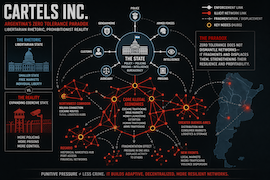

Argentina’s current security strategy under President Javier Milei represents not a rupture, but an intensification of prohibitionist logics that have long shaped Latin America’s approach to illicit economies. Framed as “Zero Tolerance,” this model relies on militarized enforcement, expanded punitive frameworks, and deeper international security cooperation. Yet Zero Tolerance strategies within prohibitionist regimes are less effective at dismantling illicit markets than at transforming them. What emerges is not the disappearance of criminality, but its reorganization into more adaptive, decentralized, and resilient networked systems.
A revealing entry point into this dynamic lies not in traditional drug trafficking corridors, but within Argentina’s institutional core. In early 2026, the death of a young anesthesiologist in Buenos Aires—linked to the unsupervised use of hospital-grade fentanyl and propofol—exposed micro-markets embedded within the healthcare system. This episode followed the 2025 fentanyl contamination crisis, which caused dozens of deaths and revealed systemic failures in pharmaceutical traceability and regulatory oversight. Together, these cases illustrate a broader pattern: prohibition does not eliminate access to controlled substances, even in highly regulated environments. It incentivizes diversion, fragmentation, and informal redistribution—often under more dangerous conditions.
From a systems perspective, this outcome is predictable. Prohibition creates artificial scarcity within high-demand markets. That scarcity generates rents, and those rents attract actors who organize to capture them. Over time, these actors evolve into complex adaptive networks—flexible, decentralized, and capable of operating across legal and illegal domains. In Argentina, these dynamics are increasingly visible across sectors, from healthcare supply chains to territorial criminal governance.
The Milei administration’s approach—initially under Security Minister Patricia Bullrich and continued by Alejandra Monteoliva—mirrors earlier militarized campaigns in the region. It emphasizes tactical gains: increased seizures, high-profile arrests, and localized reductions in homicide rates, particularly in Rosario. Yet these indicators obscure deeper structural transformations. As pressure is applied within prohibitionist regimes, activity is displaced across nodes of the system. Markets fragment, diversify, and professionalize. Violence, rather than disappearing, is redistributed.
This pattern reflects network adaptation under constraint. Criminal organizations no longer resemble hierarchical “cartels,” but paramilitarized corporate structures with diversified portfolios: extortion, human smuggling, resource theft, and territorial governance. They operate through subcontracting, franchising, and fluid alliances that blur the boundaries between legality and illegality. Zero Tolerance strategies within prohibitionist regimes do not dismantle these networks; they accelerate their evolution.
Empirical trends in Argentina reinforce this interpretation. While homicides in Rosario declined significantly under Plan Bandera, violence has shifted geographically to the peripheral districts of Greater Buenos Aires, where territorial disputes and armed confrontations have intensified. Recruitment patterns have also changed, with younger participants entering criminal circuits. At the same time, record drug seizures have not reduced availability. Consumption—particularly of synthetic substances—continues to expand, suggesting that supply chains are not being dismantled, but reconfigured.
These dynamics extend into the political sphere. Prohibitionist regimes generate large volumes of illicit capital, which in turn seek channels of influence and protection. This creates structural vulnerabilities in campaign financing and governance. Allegations surrounding figures such as José Luis Espert—a libertarian economist closely aligned with the political project of Javier Milei—and their reported links to individuals implicated in transnational drug trafficking networks expose a deeper structural vulnerability. Under prohibitionist regimes, illicit capital does not remain at the margins; it seeks entry into formal political arenas. The result is a troubling convergence: political movements that denounce the state while operating within, and potentially benefiting from, the illicit financial circuits that prohibition itself generates.
In this context, the contradictions of Argentina’s approach become particularly stark. President Javier Milei has consistently portrayed himself as a libertarian committed to individual freedom, limited government, and the reduction of state intervention. Yet his Zero Tolerance approach requires precisely the opposite: expanded surveillance, harsher penalties, broader police powers, and deeper state penetration into social and economic life. This is not a marginal inconsistency but a structural contradiction. Nicolás Morás, founder of Los Liberales,a libertarian, anti-establishment platform critical of state overreach, has highlighted this tension. From a libertarian perspective that rejects coercive state intervention, Morás argues that prohibitionist strategies reproduce the illicit incentives and shadow economies they claim to suppress. The contrast is revealing: libertarian rhetoric coexists with enforcement practices that expand the state and reinforce the very systems of control and illicit market formation they purport to eliminate.
At the regional level, Argentina’s alignment with US.-led counternarcotics initiatives, including cooperation with the Drug Enforcement Administration, further embeds these dynamics within a hemispheric framework. Historically, such approaches produce well-known “balloon” and “cockroach” effects: pressure in one area displaces activity to another, while fragmentation multiplies actors and increases volatility.
Under these conditions, the Argentine state has not regained a monopoly on violence; rather, it has facilitated its erosion through the very markets it refuses to liberalize. Sebastián A. Cutrona and Nilda M. García, in their 2025 comparative study Drug Policy Revolutions: Trajectories in Argentina, Portugal, and Uruguay, show how Argentina’s persistent reliance on punitive frameworks contrasts with alternative policy trajectories in the region and shapes outcomes in both security and public health. Building on this comparative insight, Argentina can be understood as a “full-cycle” actor in the political economy of illicit drugs—where the state is not external to illicit markets, but increasingly embedded in the conditions that sustain their reproduction.
What is ultimately at stake is the state’s relationship to violence. Under prohibition, the state does not reestablish a monopoly on force; it co-produces a fragmented landscape in which multiple actors exercise coercion across overlapping jurisdictions. Criminal networks, far from being external to the system, become embedded within it—interacting with formal institutions, exploiting regulatory gaps, and adapting to enforcement strategies in real time.
For policymakers and security practitioners, the implications are clear. Zero Tolerance strategies within prohibitionist regimes can deliver short-term, localized gains, but they do not dismantle the underlying systems that sustain illicit markets. On the contrary, they intensify network adaptation, redistribute violence, and deepen the entanglement between state structures and criminal economies. Absent a shift toward approaches that reduce illicit rents and strengthen institutional governance capacity, Argentina risks consolidating a model in which enforcement not only fails to resolve the problem—but actively reproduces it.


