From Ceasefire to Settlement? The Prospects of a U.S.–Iran Deal
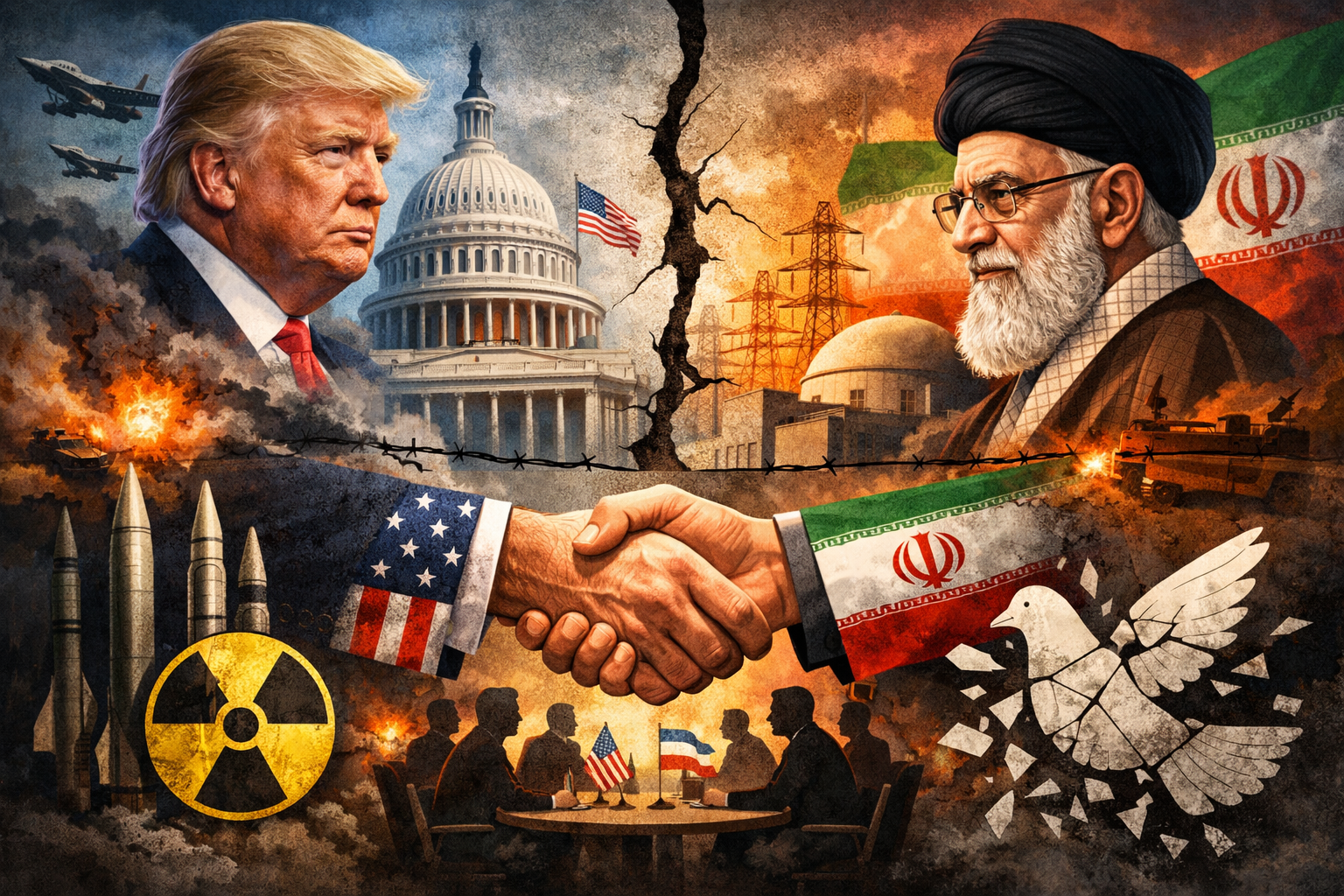

U.S. President Donald Trump has indicated that he might travel to Islamabad soon if Washington and Tehran succeed in reaching a peace deal. His remarks come after the marathon negotiations between top-level delegations from the two countries in Islamabad, amid a ceasefire that paused an intense weeks-long regional war. While those negotiations failed to deliver a breakthrough, can renewed diplomacy translate into a durable peace?
I argue that both sides have strong incentives to seek a deal despite their shared mistrust, but certain structural hurdles and unaddressed questions complicate the prospects for a truce that offers long-term dividends. Between pressures for de-escalation and impediments to compromise, regional and global stability hangs in the balance.
Iran’s Incentives for a Deal
Despite its belligerent rhetoric towards the U.S., Iran seems to be taking the possibility of a negotiated settlement seriously. The Iranian ambassador to the United Nations says that Tehran is “cautiously optimistic” about the diplomatic engagement with Washington, expressing hope for a “meaningful outcome.”
Iran has compelling reasons to seek a deal. The war with the U.S. and Israel has proved to be staggeringly costly for Tehran, which has suffered extensive leadership and material losses. For a country that remains economically in shambles due to international sanctions and politically fragmented by rifts over governance, enduring such losses for an extended period is unrealistic. Iran says the initial losses from the war with the U.S. and Israel amount to $270 billion. The actual cost could be much higher, and Iranian officials believe recovery could take more than a decade.
Beyond the tangible costs, Iran is now regionally more isolated than ever before. During the war, Iranian missiles and drones struck key energy facilities as well as civilian infrastructure in the Gulf states, among other targets. These actions will have far-reaching repercussions – key Gulf states, given the long institutional memory of their leadership, will have a deep sense of distrust towards Iran for many years to come.
A return to war with the U.S. and Israel, with the potential of drawing in the Gulf countries, can prove to be strategically fatal for Iran. Iranian decision-makers seem to recognize that while they hold strategic leverage to impose costs on their adversaries, such leverage cannot offset their own mounting losses amid continued economic strangulation and political isolation. A negotiated settlement is thus not only desirable but also becoming increasingly imperative for Tehran.
U.S. Calculus: Politics and Leverage
Washington, too, has strong incentives to bring the conflict to a close. Domestically, the war with Iran has deepened the fractures within the conservative base, particularly among supporters who believe in the “America First” doctrine and thus oppose foreign entanglements. Influential MAGA figures like Tucker Carlson and Megyn Kelly have scathingly criticized the administration’s decision to go to war with Iran, a reflection of the chasms within the conservative coalition that got Trump elected. At the same time, reports suggest some unease within the administration. Even Vice President J.D. Vance was reportedly opposed to a full-scale war with Iran.
The divisions within the MAGA camp over the Iran conflict coincide with Trump’s declining popularity at home, especially regarding the handling of the economy. A CNN poll suggests that about two-thirds of Americans say the economy has worsened under Trump’s policies.
With midterm elections in the U.S. approaching, the continuation or intensification of the Iran war could carry significant electoral costs for President Trump and the Republican Party. Not only does the war bring public frustration, even among Republicans, over “endless wars” to the fore, but it also exacerbates inflationary pressures or broader economic uncertainty.
Strategically, the U.S. is interested in moving toward an agreement with Iran as it views the current moment as advantageous. Iran has borne the brunt of the war, and the U.S. partial blockade of the Strait of Hormuz could not only mitigate the effects of Iran’s own geographical leverage but also squeeze the Iranian economy even further. If the blockage reduces Iran’s oil exports, the country’s economic lifeline, its survival will be jeopardized to a greater extent, raising its costs of fighting a war. From Washington’s perspective, this creates an opportunity to translate battlefield and economic pressure into diplomatic leverage, potentially securing a deal on favorable terms.
An Uncertain Path Forward
Notwithstanding converging incentives to end the war, turning a ceasefire into a broader peace deal is replete with challenges.
For the Trump administration, a possible agreement will need to be framed in a way that there is domestic buy-in. The Trump administration will need to explain to the MAGA constituency why it engaged and settled the issue with the same regime it denounced and wanted to topple. Also, if the final deal resembles the 2015 Joint Comprehensive Plan of Action (JCPOA) agreement on the Iranian nuclear issue that Trump deemed a strategic blunder, the political burden of justification will be even greater for the White House.
Iran confronts its own legitimacy dilemmas at the domestic level. The regime has projected itself as the winner, rejecting not only ceasefire proposals but also negotiations with the U.S. If Iran agrees to a deal now, contradictions in the country’s narrative will be exposed. Also, such a deal can reignite fault lines between the hardline and pragmatic factions within the Iranian regime, with hardliners likely framing it as a sign of weakness in a bid to undermine moderates and consolidate their influence. More fundamentally, an agreement will pose an uncomfortable question to the Iranian regime: if Iran ultimately accepts tighter limits on its nuclear program, were the enormous investments in the nuclear program, and the costs incurred to defend it, justified?
Decision-making dynamics within Iran add to the complexity at hand. One must bear in mind that Iran is dominated by clerics, who remain at the helm of affairs. Political clerics have overwhelming clout, but their decision-making is often incongruent with conventional models of strategic statecraft, so expecting them to act rationally might be questionable.
Moreover, even if there is political will on both sides, the technical facets of a potential settlement foreground a multitude of daunting challenges. Critical questions arise regarding guarantees, verification, and enforcement mechanisms in the nuclear context. Who will be the guarantor of the agreement? How will the deal be executed and cheating prevented? If enriched uranium is to be transferred or diluted, how will this be done? How will compliance be ensured in case of future disagreements or disputes?
These are not trivial issues that can be resolved quickly. Yet, both sides appear to be seeking a relatively rapid resolution – such an ambition may collide with the intrinsic complexity of the issues at stake.
To sum up, while both Washington and Tehran have real incentives to de-escalate, the durability of any settlement will depend on the extent to which short-term pressures can be channeled into sustained mutual restraint. Without this, any ceasefire or agreement might not prevent the recurrence of conflict in the long run.