





Back to Basics: What Russia’s Donbas Campaign Reveals About the Character of Modern War


In his latest article at War on the Rocks, “Winning in the Donbas: What Russia’s 2014–2015 Campaign Reveals About Modern War,” Dr. Amos Fox argues that Russia’s Donbas campaign in 2014 and 2015 stands as a masterclass in politically decisive ground combat. Fox is clear that his purpose is not to celebrate Russian military power or validate Putin’s conduct. Rather, he uses the campaign to pull observers of other conflicts, such as the 2026 Iran War, back to a ground truth that techno-optimists have worked hard to obscure: modern war still turns on land forces seizing and holding territory. He writes:
Hope, best intentions, and current U.S. military thought suggest that any ground combat by U.S. forces would be quick, led by robotics and new technology, and be less deadly and destructive than preceding eras of American ground combat. Despite those rosy views of technology’s impact on ground fighting, realistic assessments and relevant case studies portend a much darker future.
Fox examines three major sieges—Ilovaisk, Donetsk Airport, and Debal’tseve—to demonstrate that coherent and sequenced land campaigns produce strategic outcomes that airpower, cyber operations, and precision strike cannot replicate. Territorial control remains the primary driver of political authority in war, and robust land forces are irreplaceable because they deliver surprise, concentration, audacity, and tempo to achieve breakthroughs and sustain momentum in ways no other domain can match.
Russian Ground Forces in Ukraine, Tactical situation, August 29, 2014
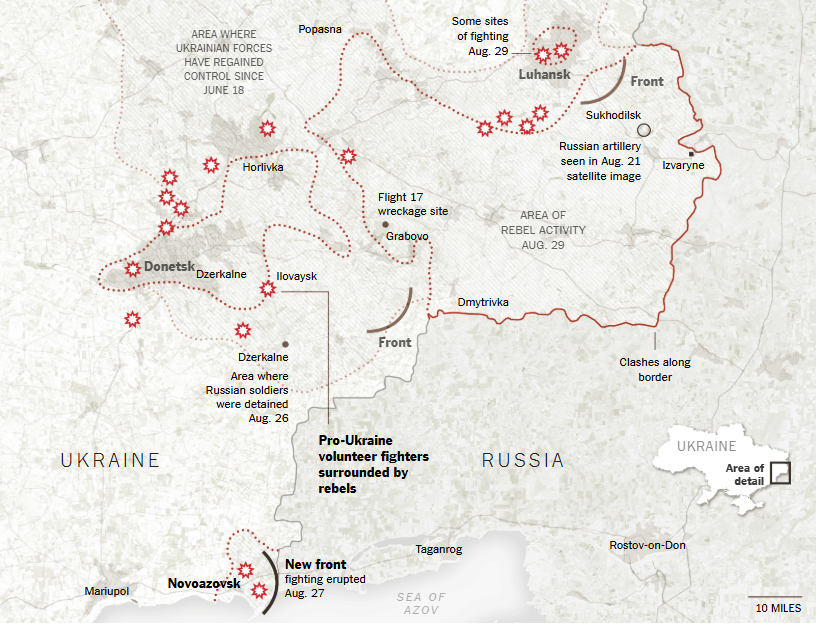
Ultimately, Russian commanders capitalized on each tactical victory to compound Ukraine’s losses and drive Kyiv back to the negotiating table on terms favorable to Moscow. For U.S. planners considering ground operations in Iran, these lessons must be internalized: technologically advanced, airpower-centric strategies alone are unlikely to achieve decisive outcomes against a resilient and capable adversary.
Fox provides an exacting account of how each siege unfolded—the encirclements, the grinding attrition, the cascading Ukrainian collapses—and from that operational detail draws several key insights about the conduct of land wars:
Insight 1 – Control of the situation is paramount: “Control of the situation in warfare remains paramount. Control is generated by taking possession of terrain and remaining engaged with an opponent. Terrain impacts the physical factors of winning and losing in war, but it is also a psychological factor. Territorial control in land wars like the Russo-Ukraine War is a physical representation of a political actor’s sovereignty and authority. If an actor is incapable of retaining or retaking its territory from a hostile actor, then that actor loses a degree of legitimacy.”
Insight 2 – It takes a land force to defeat a land force: “Control results from possessing the capacity to overwhelm an adversary with firepower and manpower at the place and time of need… Land forces exploit emerging opportunities created by multidomain and joint force capabilities. Correspondingly, land forces consolidate the gains afforded by those opportunities… Large, powerful, and mobile land forces are critical to exploit success, prevent defeat, and contribute to controlling the situation. In short, it takes a land force to defeat a land force. Other services and cross-domain capabilities enable and enhance—but do not replace—a land force and the critical functions it provides.”
Insight 3 – Coherent campaigns produce strategically decisive outcomes: “Campaigns are the purposeful sequence of battles and operations in time and space anchored to strategic objectives… Russian commanders likely recognized the impact of their success at Ilovaisk and understood the seriousness of Ukraine’s strategic situation and its ability to continue with major combat operations. Russian military leaders sought to heighten the negative impact on Ukraine’s government and military, while compounding the positive impact for Russia by taking Donetsk Airport. As Russia’s success at the airport became clear, the pattern of situational recognition and exploitation repeated. Consequently, Russian forces moved on to Debal’tseve. Degraded by the losses at Ilovaisk and Donetsk Airport, the siege of Debal’tseve finally broke Kyiv’s ability to continue resisting.”
Insight 4 – Strategic gain often comes through destruction: “The concept of gaining through destruction, though deplorable to a normative perspective, cannot be ignored or forgotten because of its moral repugnance. This oversight often leads to serious strategic, operational, and tactical missteps in crisis, conflict, and war… By destroying Donetsk Airport, Russian forces and the Donetsk People’s Army rendered a valuable aerial node worthless. Thus, aside from the symbolic value of the airport, its destruction made it pointless to try and retake it in any subsequent operation… By defeating the Ukrainians at the airport, destroying the facility, advancing their front lines to that location, and further reinforcing those lines, Russia improved its strategic position relative to its policy goals and those of Ukraine.”
The CSIS report summarized by SWJ’s Discourse, “Russia’s Grinding War in Ukraine: Massive Losses and Tiny Gains for a Declining Power,” provides a useful counterpoint to Fox’s argument, though the two pieces ultimately reinforce the same underlying truth. Where Fox spotlights the 2014–2015 Donbas campaign as a model of decisive land warfare, the CSIS report documents how that same Russian military has since descended into grinding attrition, advancing at an average rate of between 15 and 70 meters per day in its most prominent offensives while suffering nearly 1.2 million casualties (more losses than any major power in any war since World War II).
This contrast does not undercut Fox so much as it illustrates what happens when the fundamentals of offensive operations collapse. Without coherent sequencing, persistent firepower, and purposeful exploitation of tactical gains, land power becomes an instrument of exhaustion rather than decisive action. Fox’s assessment of Russia’s 2014–2015 campaign shows what decisive land warfare looks like when executed well; the CSIS report shows the cost of getting it wrong.

