





Weaponized Hesitation: Authority and Tempo in Gray-Zone Competition

Introduction
Western military thought often assumes that faster sensors and better data lead to faster action. In gray-zone competition, however, ambiguity over escalation thresholds creates a gap between recognition and authorization, allowing decisional authority to lag behind situational awareness. When that gap becomes predictable, hesitation itself transfers tempo to adversaries operating comfortably between peace and conflict.
The Ambiguous Encounter
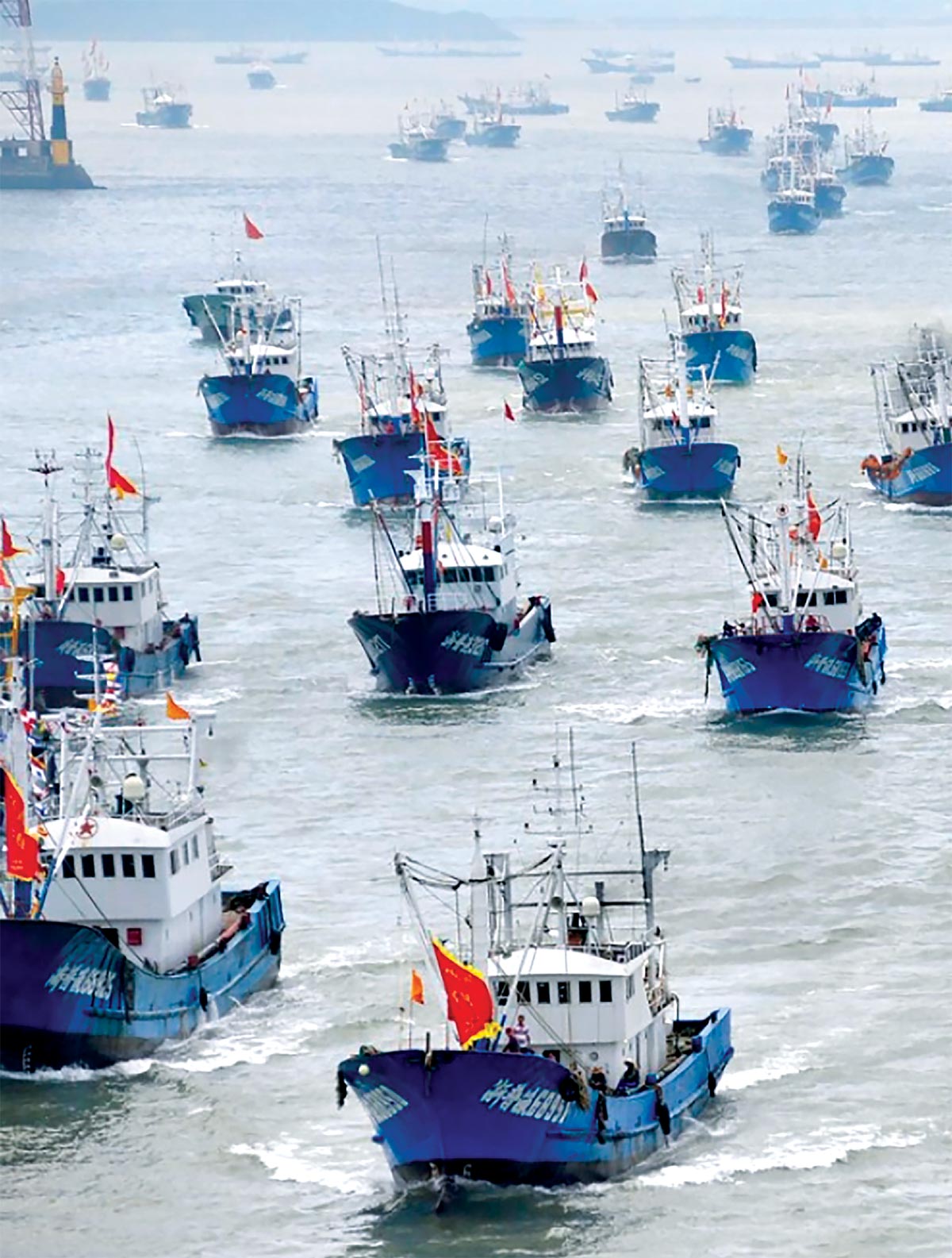
Civilian vessels are historically treated with great respect and caution in contested maritime regions. However, civilian vessels are increasingly being coordinated to apply military pressure without crossing formal escalation thresholds. At first glance, these civilian encounters may appear legitimate but become militarily ambiguous when their deliberate movements impose obvious and severe military consequences.
One Such Encounter Might Begin Like This:
A sudden screen of fishing vessels does not show chaos. It shows a pattern. A cluster of civilian-flagged vessels adjusted course in coordinated fashion, narrowing the space around a partner nation patrol craft operating in contested waters. The maneuver was gradual, deliberate, and familiar. No weapons were visible. No collision occurred. But the intent was clear enough to anyone who had watched similar encounters unfold. Inside the watch floor, the maritime picture was stable. The vessels were tracked. The communications feed was live. Reporting from earlier in the week had warned of activity designed to pressure without provoking open conflict. Nothing about the situation was technically confusing.
What was unclear was who, exactly, should change it.
The rules governing peacetime maritime engagement were written for clarity. A declared hostile warship triggers a procedural response. A confirmed weapons release triggers defensive action. A vessel in distress triggers assistance. These categories assume visible alignment between identity and behavior.
The cluster on the screen did not fit those assumptions.
The vessels carried civilian registry numbers. They broadcast commercial identification signals. Their hull forms matched those of the region’s fishing trawlers. Yet their maneuvering was synchronized, their spacing deliberate, and their movement consistent with prior incidents documented as coercive pressure rather than commercial transit.
Had the approaching vessels flown naval ensigns, the response would have been routine. A radio challenge. A maneuver order. A clear report upward. The classification would have aligned with existing escalation thresholds. No such clarity existed here.
The watch officer understood the diplomatic sensitivity of misclassification. Treating a civilian vessel as hostile without higher validation risked disproportionate strategic consequences for the immediate maneuver. Treating it as routine navigation risked ceding physical space in contested waters. Both options carried a cost. Only one required unilateral reinterpretation of the situation.
Clarification requests moved upward.
While those requests circulated, the patrol craft adjusted course again.
The watch officer was not inexperienced. He understood escalation and the thresholds that governed response.
No sensor failed. No intelligence was missing. The delay occurred in the space between recognition and authorization. Acting would have required someone to reinterpret the situation as something more than maritime harassment. That authority existed, but it did not sit comfortably at the watch floor level.
While clarification moved up and back down the chain, the maneuver achieved its purpose.
The exchange illustrates a recurring feature of gray-zone competition. Advantage does not always depend on superior firepower or degraded networks. It can hinge on whether authority to act keeps pace with what operators already see. When ambiguity forces decision-makers to pause while thresholds are reconsidered, tempo shifts. Understanding how and why that pause occurs is essential to understanding modern competition.
When Authority and Tempo Diverge
The promise of mission command is straightforward. Clear intent and delegated authority allow subordinates to act without waiting for detailed instructions. In conventional conflict, the model functions as designed. An enemy formation crosses a boundary. A weapon system acquires a target. The classification is clear. Initiative and recognition align.
Gray-zone competition complicates that alignment.
Ambiguous maritime encounters rarely meet the traditional definitions of armed attack or hostile intent. Civilian vessels maneuver in coordinated fashion. Airspace incursions occur without weapons release. Cyber intrusions probe without visible destruction. The behavior is observable. Its classification is contested.
Under these conditions, initiative becomes harder to interpret. Acting quickly may preserve tempo. Acting prematurely may exceed guidance. The authority to redefine harassment as aggression does not always reside at the tactical node observing the activity.
The result is not confusion about what is happening. It is uncertainty over how it should be treated.
When awareness outpaces authorization, tempo stretches. The watch floor recognizes the maneuver, but the decision to treat it as actionable requires confirmation beyond the immediate encounter. That confirmation may arrive in minutes or hours. In either case, time passes.
Mission command presumes shared understanding and clear intent. Gray-zone competition operates precisely where clarity is strained. The more ambiguous the actor, the more likely that authority and tempo diverge.
This divergence does not reflect weakness or poor training. It reflects structural tension between decentralized initiative and centralized escalation thresholds. In that tension, hesitation becomes predictable. And when hesitation is predictable, it becomes exploitable: evident in the fishing trawler case.
The pull toward centralization in ambiguous encounters is not irrational. Escalatory missteps in contested environments carry strategic consequences beyond the tactical moment. A misinterpreted maneuver can trigger diplomatic protest, economic retaliation, or alliance strain. For this reason, gray-zone incidents often attract scrutiny from several sources beyond the immediate theater.
This scrutiny alters the responses leaders can make.
In conventional combat, authority is distributed because the identity of the adversary is undisputed. In ambiguous competition, classification itself becomes the decisive act. Declaring an action hostile is not merely tactical but interpretive. It signals intent and assigns responsibility in a context where neither is fully understood. As ambiguity increases, real and perceived risks of misinterpretation rise.
Authority, therefore, migrates upward. Yet the decision is no easier.
Tactical nodes continue to observe, report, and recommend. But the threshold for redefining behavior as aggression becomes layered with legal, political, and reputational considerations. Each layer introduces time. None of the layers are individually unreasonable. Collectively, they elongate response cycles in environments specifically engineered to test, record, and exploit them.
Mission command presumes that shared understanding reduces friction. Gray-zone competition introduces friction precisely by contesting that shared understanding. The doctrine does not fail. It encounters conditions for which its assumptions were not designed.
Ambiguity as Competitive Terrain
Gray-zone competition is frequently defined by activity that falls below the threshold of armed conflict while still producing strategic effects. Intelligence community assessments describe this environment as one shaped by ambiguity, proxy actors, and actions that are difficult to categorize within traditional war and peace distinctions. The ambiguity is not incidental. It structures how responses are considered.
Maritime activity in contested waters illustrates the pattern. Civilian-flagged vessels conduct coordinated maneuvers that apply pressure without crossing into overt hostilities. Analyses of maritime militia operations document repeated use of commercial platforms to obstruct, encircle, or displace opposing forces while retaining the outward appearance of lawful navigation. The vessels are tracked. Their coordination is observable. What remains contested is how they should be classified.
This uncertainty matters.
When a vessel appears civilian but behaves strategically, decision-makers must determine whether the activity constitutes routine maritime presence, coercive signaling, or preparatory action. Each classification carries different escalation implications. The first question is often not what the vessel is doing, but what the vessel is.
Intelligence community definitions of gray-zone activity emphasize actions designed to remain difficult to attribute or interpret as clear aggression. That difficulty shapes response tempo. When classification requires reconsideration at higher echelons, authority and awareness diverge.
In such environments, networks can remain intact and sensors fully functional. The operational picture may be clear. Yet if the actor cannot be confidently placed within existing categories, response slows. Ambiguity becomes more than context. It becomes terrain that influences movement, decision, and initiative.
The side more comfortable operating within blurred categories often retains momentum.
Hesitation as a Tempo Transfer
Recent discussions of cognitive warfare often focus on shaping perceptions or manipulating information flows. That focus captures part of the problem, but not all of it. In gray-zone competition, advantage often comes from exploiting the speed of action against the slower pace of interpretation and authorization. Actors operating at the edge of classification can act quickly while their opponents deliberate over thresholds, authorities, and escalation risks. Actions may be recognized immediately yet still require extended deliberation before they are treated as aggression. During that pause, time accumulates in favor of the initial actor pressing the boundary. Awareness may remain intact, but when authority lags behind recognition, initiative shifts. In gray-zone competition, hesitation is not merely delay. It is a transfer of tempo.
Is Hesitation Sometimes Strategic?
Not every pause is a failure. Deliberation can prevent miscalculation. Restraint can signal stability. In contested environments where escalation carries national consequences, slowing a response may preserve broader strategic interests. Rapid reaction is not inherently virtuous if it produces irreversible error.
Gray-zone competition exploits this truth.
The issue is not hesitation itself. It is patterned hesitation. When adversaries can reliably anticipate that ambiguous maneuvers will trigger extended reconsideration cycles, delay ceases to be prudent and becomes vulnerability. A single instance of caution may be wise. Repeated cycles of predictable delay create maneuver space for incremental advantage.
Strategic patience differs from structural latency.
In healthy decision systems, restraint is selective. In vulnerable systems, restraint becomes reflexive whenever classification is uncertain. The distinction lies not in tempo alone, but in whether tempo is chosen or imposed.
When ambiguity consistently forces upward validation before tactical action, hesitation shifts from intentional prudence to structural condition. At that point, the pause no longer serves a strategy. It serves the adversary.
Tempo Is Governed by Authority
The institutional response to gray-zone hesitation is often predictable: more information, more sensors, more analytics. The assumption is that clearer visibility will compress the decision cycle. Yet hesitation in these environments is rarely due to obscured data. It is a product of uncertain authority, or even the overabundance of information.
Tempo is not governed solely by how quickly a force can see. It is governed by the extent to which it is authorized to act on what it sees.
Certain units operate with pre-delegated authority calibrated for uncertainty. Special operations elements, maritime interception forces, and air defense crews often function under authorities that anticipate compressed timelines. Their thresholds are rehearsed, their response conditions codified in advance.
Gray-zone competition tests whether similar clarity exists across broader formations.
If ambiguous actors repeatedly generate encounters that require upward reinterpretation, tempo becomes contingent upon headquarters availability rather than tactical awareness. The network accelerates recognition but cannot accelerate legitimacy. In such cases, the force becomes highly informed yet operationally cautious.
This caution is not incompetence. It is structural alignment with peacetime norms. The question is whether those norms match the environment.
Authority structures developed for a clear war or a clear peace struggle when actors intentionally inhabit the space between. If decisional ownership remains concentrated at levels designed for strategic escalation control, tactical tempo will continue to elongate in precisely the scenarios that favor the adversary.
Sensors can compress observation cycles, but they cannot compress institutional hesitation.
In contested spaces where incremental gains accumulate through repetition rather than decisive battle, the side that aligns authority with ambiguity retains the initiative. The side that must repeatedly reinterpret classification before acting relinquishes minutes that compound into strategic positioning.
A tactical leader may possess a comprehensive operational picture and recognize threats in real time. Still, if the actor’s status remains contested or the threshold for response requires upward clarification, the decision cycle elongates. The friction lies not only in perception, but in legitimate authority to act on it.
Mission command assumes that intent enables initiative. In clearly defined combat, this holds. In environments structured around ambiguity, however, initiative competes with institutional caution. Authority centralizes not because leaders lack competence, but because the situation resists categorization.
When hesitation becomes patterned rather than exceptional, it ceases to be accidental. It becomes predictable. And when it is predictable, it becomes usable terrain.
An adversary operating comfortably within blurred legal and operational categories does not need to overwhelm a force that sees clearly. It needs only to operate at the edge of that force’s authorization comfort. In contemporary small wars, tempo often belongs not to the side with superior sensors, but to the side whose authority structures align most closely with the environment’s ambiguity.
Conclusions: Authority in the Gray-Zone
Weaponized hesitation does not rely on deception in the traditional sense. The operational picture can remain clear. What is contested is not what is happening, but what the situation is.
By operating across categories of peace and war, civilian and combatants, competitors and belligerents, adversaries induce repeated pauses in systems built to seek formal clarity before action. Each pause transfers momentum. Each reconsideration extends the opponent’s maneuver space.
Information dominance may shorten the time required to observe. It does not automatically shorten the time required to authorize. In gray-zone competition, the decisive variable is often not visibility, but the alignment between authority and ambiguity.
In environments where ambiguity is deliberate rather than accidental, authority cannot remain calibrated solely for clear war or clear peace. Forces that routinely operate in contested spaces must align delegation thresholds with the realities of structured uncertainty. This does not require abandoning restraint. It requires anticipating the conditions under which defining the situation becomes the decisive act. In gray-zone competition, the side that pre-calibrates authority for ambiguity will retain tempo against those that must rediscover it in each encounter.


