CSIS Report | How Russia Is Building a Sovereign Drone Ecosystem for AI-Driven Autonomy


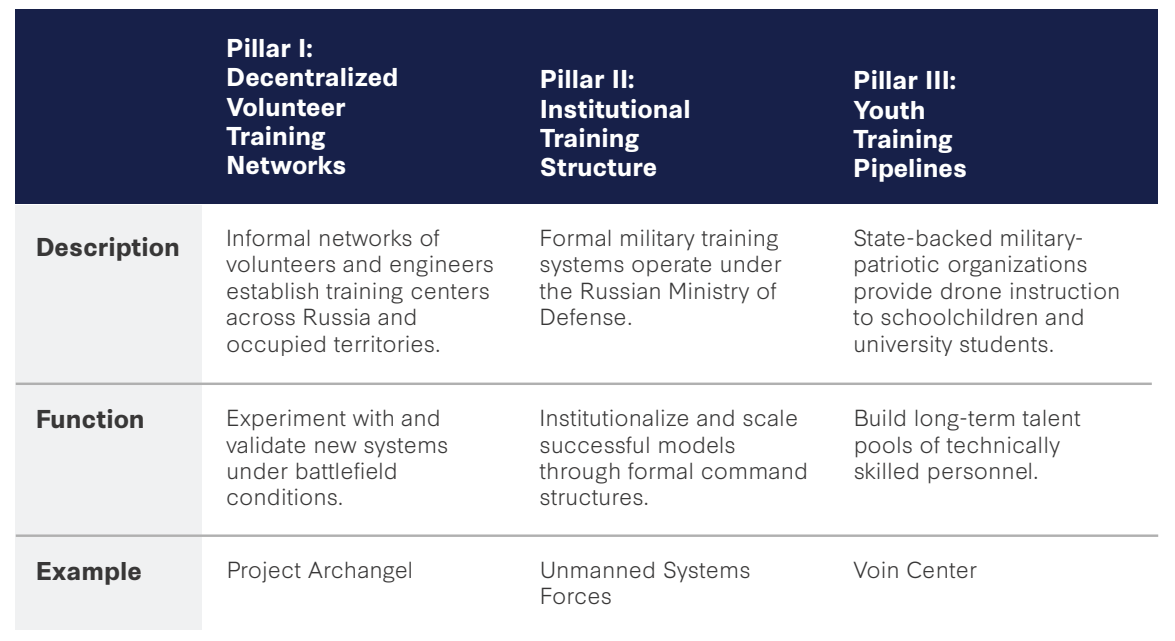
Check out this new report from the Center for Strategic and International Studies, “How Russia Is Building a Sovereign Drone Ecosystem for AI-Driven Autonomy,” by Kateryna Bondar. The report takes a deep dive into how Russia builds military advantage by integrating AI into unmanned systems through a coordinated ecosystem that links state policy, civilian innovation, and battlefield lessons learned. Russia applies available AI tools, tests them in combat, and then scales what works across its force. This innovation cycle is further enhanced by its three-pillar training architecture, highlighted below.
The Russian approach shows that even limited AI capabilities can produce real battlefield effects when units test them in combat, refine them through training, and push them back into the fight at scale. This dynamic compresses the gap between innovation and operational use, allowing faster adaptation under wartime pressure. NATO and partner states will need to accelerate training, streamline procurement, and tighten links between industry and frontline units to keep pace.
Russia’s Three-Pillar Training Architecture
Report Roadmap
This report examines how Russia is integrating AI into its unmanned systems and what this process reveals about the evolving character of Russian military power. The central question is not whether Russia has achieved autonomy in a doctrinal sense, but how effectively it deploys limited AI capabilities that deliver operational advantage at scale.
The analysis is structured in three parts. The first section examines Russia’s policy architecture for AI and unmanned systems, showing how presidential-level priorities translate into national programs, regulatory approaches, and sectoral initiatives. It highlights how a civilian innovation ecosystem— spanning regulation, industry, and workforce development—supports the expansion of military capabilities.
The second section presents a set of case studies that illustrate different models of AI development and deployment, ranging from centralized, state-led programs to commercially driven systems that scale through battlefield validation.
The third section analyzes three key factors enabling Russia to maintain speed and scale in innovation: (1) training as the primary channel for integration and force wide adoption, (2) the origin of the hardware backbone underpinning AI-enabled systems, and (3) the role of international partnerships in sustaining access to critical technologies.
Download the Report HERE.