





Book Review | West Asia: A New American Grand Strategy in the Middle East
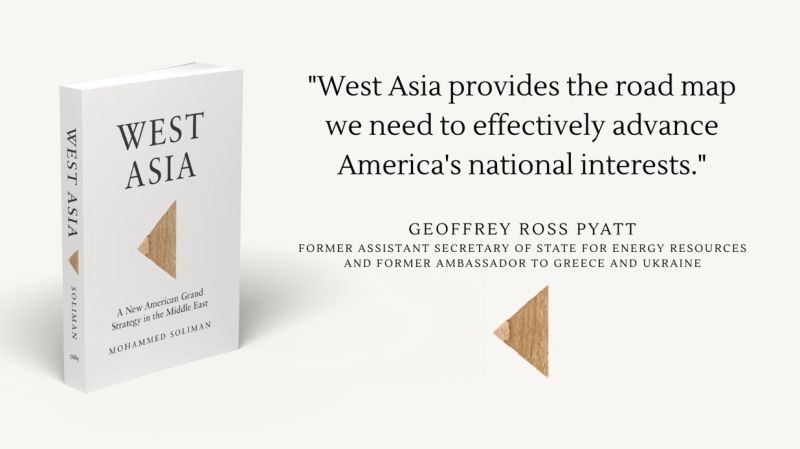

West Asia: A New American Grand Strategy in the Middle East. By Mohammed Soliman. Polity Press, 2026. ISBN: 978-1-5095-6837-6.
There is a particular kind of strategic thinker whose most important work arrives not as a sudden insight but as the slow materialization of a decade-long argument, one that was right when it was made, was largely ignored, and has now been vindicated by events too large to overlook. Mohammed Soliman, senior fellow at the Middle East Institute, is that kind of strategic thinker, and his recently launched book West Asia is that kind of volume. What distinguishes Soliman from a generation of American foreign policy strategists is that he is, at his core, an Asianist, a strategic thinker who evaluates every theater, every coalition, and every hard-power commitment through a single organizing question: does this serve or dilute America’s position in the Indo-Pacific? The Middle East, in his framework, is not a region to be managed for its own sake but a load-bearing corridor in the larger contest with China, a space whose stability, maritime chokepoints, and techno-economic coalitions either reinforce or undermine the Indo-Pacific order that American grand strategy is ultimately trying to secure. That orientation, Asia first, every other theater assessed in its light, is precisely the cognitive discipline Washington has historically lacked and precisely what marks the kind of thinker the country needs during moments of transition.
West Asia arrives at a moment of profound strategic transition for the United States and the broader international system. As Washington recalibrates toward great power competition with China while attempting to limit overextension in the Middle East, Soliman offers a sweeping reconceptualization of the region as a central geostrategic corridor linking Europe and the Indo-Pacific. No volume could have been timelier for understanding the current war in Iran, the support France, Italy, and South Korea offered to the United Arab Emirates, the solidarities among the Arab Gulf states vis-à-vis Tehran, and above all, the vexing question of Turkey.

Rejecting the term “Middle East,” he reframes the region as “West Asia,” an interconnected geopolitical space stretching from the Mediterranean to the Indian Ocean, and grounds a proposed American grand strategy in offshore balancing, a realist strategic concept in which the United States avoids large, permanent ground deployments and instead preserves regional stability by supporting local partners, maintaining naval and air dominance, and intervening directly only when a hostile power threatens to dominate a critical region. Soliman combines this approach with interlinked coalitions, deterrence architecture, and hard-power partnerships designed to restore a favorable balance of power after the post-Iraq War vacuum enabled Iran and Turkey’s transregional rise. That vacuum is now approaching a second inflection point, as the prospect of war with Iran casts a long shadow over the regional order he proposes to rebuild. At its core, West Asia is about order-building through power: showing how the United States can sustain its global strategic position by empowering regional militaries, maritime chokepoints, and security coalitions rather than costly, manpower-intensive interventions.
Summary
The central move of the book is straightforward, and Soliman is frontal about it: the “Middle East” conceptual framework has to go. Not because the label is offensive, but because it is strategically wrong, and wrong maps produce wrong strategies with a reliability that no amount of tactical brilliance can overcome. The term first appeared in 1902 in Alfred Thayer Mahan’s article “The Persian Gulf and International Relations” in the National Review, where the American naval strategist used it to describe the strategic corridor between Arabia and India while analyzing Britain’s need to secure the Persian Gulf against Russian expansion toward India, framing the region primarily through the lens of imperial maritime strategy centered on British power.That perspective became embedded in the institutional architecture of American foreign policy, the desks, the doctrines, and the deployment postures, and it systematically blinded U.S. strategy to what was actually happening. The region’s eastward economic tilt, its deepening integration with Asian trade networks, and its function as the maritime corridor connecting the Mediterranean to the Indian Ocean: none of this was visible on a map drawn from London. The result was strategies organized around a single Euro-Atlantic axis that the underlying geography had already rendered obsolete.
West Asia does the opposite. It places the region within the Eurasian supercontinent, makes visible its connections to India, Southeast Asia, and East Asia, and critically for the argument of this book, integrates it into the strategic logic of the Indo-Pacific competition that now dominates American grand strategy.
From this geographic reframing, Soliman advances three interlocking arguments. The first is that contemporary instability is fundamentally a balance-of-power failure. The collapse of Iraq and Syria fractured the regional order, creating space for Iran to emerge as a transregional power projecting influence across multiple theaters. Rather than framing disorder primarily through the struggle against terrorism or the attempt for regime change and democracy promotion, Soliman situates it firmly within the realist framework of classical geopolitics and power projection, a deliberate return to the analytical vocabulary that American strategy largely abandoned after the Cold War and has been paying for ever since.
The second argument is that American strategy must zoom out geographically. Washington can reconceive the region as a continuous operational space connecting NATO’s southern flank to the Indo-Pacific, one that draws European, Arab, and South Asian partners into a distributed network of force multipliers rather than treating them as discrete bilateral relationships to be managed separately.
The third is that this expanded conception requires a coalition-based order structured around a geostrategic maritime coalition, a security and deterrence architecture, and a techno-economic alignment designed to reinforce long-term strategic convergence. Together, these aim to contain revisionist powers while preserving American influence with a lighter, more sustainable direct footprint, doing more with less by doing it smarter and with better partners.
Operational Realities and Strategic Credibility
One of West Asia‘s greatest strengths is how closely its strategic logic aligns with realities already visible across modern military force structures and how little patience it has for the comfortable fiction that the United States can sustain its current posture indefinitely.
The overstretch Soliman identifies as “America’s scale problem,” in his own words is far from abstraction. Persistent personnel shortfalls heightened operational tempo, the Navy’s maintenance backlogs, the Air Force’s mission-capability rates, the Army’s recruiting shortfalls: these are not isolated institutional failures but the accumulated consequence of a strategic posture that has consistently asked more of the force than it can sustainably deliver. Military professionals asked to implement any West Asian strategy will recognize the diagnosis immediately.
His coalition-centric approach is built for exactly this kind of scarcity, taking the resource constraint not as a problem to be solved but as the starting condition from which any serious strategy must begin. The coalition architecture he proposes is an overlapping set of geostrategic, hard-power, and techno-economic partnerships designed to distribute the burden of regional order across partners with the capacity, proximity, and incentive to carry it. Rather than a single alliance centered on Washington, the model relies on interlinked arrangements such as the Abraham Accords normalization track, the I2U2 grouping linking India, Israel, the United Arab Emirates, and the United States, and emerging Gulf-Asian defense cooperation networks. This is burden-sharing not as a diplomatic talking point but as an operational requirement.
The book also surfaces an often-overlooked truth that will resonate with anyone who has served in a multinational environment: coalition effectiveness hinges not just on political alignment but on operational design. Friction in combined operations routinely emerges from unclear authority structures, overlapping oversight, and divergent national constraints on the use of force. Soliman’s argument that coalition architecture must be deliberately structured rather than improvised is correct and important. What the book would benefit from is a more granular treatment of how that structuring happens, how command relationships are established, how rules of engagement are harmonized across partners with different legal frameworks, and how alliance management burdens are distributed without reproducing the coordination overhead they were designed to avoid.
Soliman’s implicit case for a reduced direct footprint runs against the institutional grain of a defense establishment that has historically equated presence with influence. But the operational logic is sound. Large footprints generate their own strategic costs: they become targets, create dependencies, and produce nation-building commitments that consume resources intended for competition elsewhere, mainly in Asia. A more focused presence, backed by credible over-the-horizon capability, can deter more effectively precisely because it is not hostage to the political vulnerabilities that large garrisons inevitably accumulate.
Analysis
West Asia stands firmly in the tradition of successful twentieth-century grand strategy, prioritizing balance of power over ideological alignment. Soliman’s treatment of strategic corridors and chokepoints is particularly strong, presenting the Strait of Hormuz, the Bab el-Mandeb, the Suez Canal, and the Eastern Mediterranean not as discrete geographic features but as nodes in a unified operational system whose control determines the terms of Indo-Pacific competition with Beijing. This gives the book an operational concreteness that much grand strategy writing lacks.
Where it is more aspirational than operational is in managing partner friction. Aligning actors as diverse as India, Israel, Egypt, the UAE, Saudi Arabia, and the European Mediterranean states, each with distinct threat perceptions and histories of mutual suspicion, will remain the most demanding challenge of any West Asian order. The gap between the coalition Soliman describes and the operational reality of building and sustaining it under pressure is where the framework will face its severest tests, and where the hardest work remains.
Conclusion
What makes West Asia distinctive is the prior act of clarification it performs: before debating force posture or coalition architecture, you need to agree on what space you are operating in and what competition you are trying to win. Soliman makes that argument with unusual rigor, connecting Middle Eastern stability directly to Indo-Pacific competition and demonstrating how regional coalitions, properly structured, can preserve order without exhausting American resources.
The central question the book leaves open, how to operationalize these insights across environments as varied as the Strait of Hormuz and the Indian Ocean littoral, is not a weakness but an honest acknowledgement of where grand strategy ends and the harder work begins. Grand strategy has always been better at establishing the logic of a position than at specifying the precise instruments of its execution. Soliman’s contribution is to have reestablished that logic at a moment when Washington had lost sight of it entirely.
There is a reason the subtitle retains the word “Middle East” even as the text works to retire it: the grand strategy he is proposing must be built on the institutions, relationships, and bureaucratic habits that the old framework produced. You cannot simply declare the old order obsolete and begin again. You must work through it. That tension between the strategy of the moment and the apparatus inherited from a different moment is the one Soliman leaves his readers to resolve. It is, in the end, the tension at the heart of all serious strategic thought.


