El Centro Annotated Subject Bibliography: Criminal Insurgencies in Mexico and Latin America
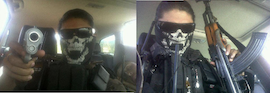

The post-Cold War security environment has existed for over three decades. During this time, the world has witnessed major upheavals in traditional patterns of competition, conflict, and war with a marked shift from a bi-polar to a multipolar world and the rise of military-like power and wealth accumulation by non-sovereign violent non-state actors (VNSAs) and transnational criminal organizations (TOCs). Increasingly, we are seeing transactional relations between states, with a concurrent global assault on liberal-democratic values by authoritarian rulers and ideologues.
Prior to the full emergence of this new security environment, US Army War College Research Professor Steven Metz theorized in 1993 that new insurgency forms would develop that were ‘likely to dominate the post-cold war world’: spiritual (justice/meaning seeking) and commercial (wealth seeking) insurgencies.[1] The latter form served as the conceptual basis of and inspiration for two follow-on constructs that were economically bifurcated: the criminal insurgency sub form—articulated in 2008—that is illicit (criminal) economy motivated and the plutocratic insurgency sub form—articulated in 2011—that is sovereign free (plutocratic) economy motivated.[2] Prior to the development of the criminal insurgency construct, other US Army linked researchers, such as Ralph Peters and Max Manwaring, were also beginning to identify the criminal insurgent-like behaviors beginning to manifest themselves.[3]
Between 2008–2010, the pioneering efforts of Los Angeles Sheriff’s Department (LASD) lieutenant John P. Sullivan, with research support provided by Adam Elkus, took place across four articles which then initially defined and bounded the parameters of criminal insurgency thinking.[4] In many respects, criminal insurgents are simply impunity- seeking actors, striving to engage in illicit activities to acquire riches without state interference. Due to their own successes, however, they may become de facto (politicized) insurgents as they acquire economic and coercive (military-like) power in the regions that they control. The primary focus of the construct initially homed in on Mexico and Central America, given the illicit and coercive-corruptive activities the cartels and gangs, respectively, inflicted on those low political capacity states, but it was readily applicable to other regions of Latin America and beyond. The increasing severity of this form of insurgency as it challenges state sovereignty, per Sullivan, is as follows:
- Local Insurgencies (gangs dominate local turf and political, economic, and social life in criminal enclaves or other governed zones).
- Battle for the Parallel State (battles for control of the ‘parallel state.’ These occur within the parallel state’s governance space, but also spill over to affect the public at large and the police and military forces that seek to contain the violence and curb the erosion of governmental legitimacy and solvency).
- Combating the State (criminal enterprise directly engages the state itself to secure or sustain its independent range of action; cartels are active belligerents against the state).
- The State Implodes (high intensity criminal violence spirals out of control; the cumulative effect of sustained, unchecked criminal violence, and criminal subversion of state legitimacy through endemic corruption and co-option. Here, the state simply loses the capacity to respond).[5]
By 2011, John Sullivan then teamed up with Robert J. Bunker—again with US Army links—to publish additional works on the construct and establish El Centro at Small Wars Journal (SWJ) which functions as a networked hemispheric security think-tank. It draws upon the construct as a core component of its mission statement in that “The elephant in the hemispheric room is clearly the epidemic criminal, cartel and gang threat, fueled by a drug and migration economy, rising to the level of local and national criminal insurgencies and a significant US national security risk.”[6] In so doing, criminal insurgency thinking was increasingly integrated with (and influenced) other national security constructs related to epochal change—third generation gangs, third phase cartels, plutocratic and spiritual (dark) insurgencies, and feral (criminal) cities—which were helping to characterize the post-Cold War security environment taking shape. By this time and moving forward, additional US Army linked researchers, including Hal Brands and Bob Killebrew, were writing about this insurgency construct with it also now appearing in US Congressional testimony focused on the growing threat represented by the evolving Mexican cartels.[7]
More recently, the criminal insurgency construct has been gaining influence in academic/research, practitioner, and national security circles as the reality on the ground in parts of Latin America (and other regions of the world) have become clearly better addressed by this insurgency form (which is post-modern in nature; with state co-option and successor forms emerging ) vis-à-vis traditional perceptions of organized crime (which is modern and legacy in orientation; with a more symbiotic view of organized criminality). Further, the construct is increasingly being utilized to describe the growing gang threat in Brazil and is being written on by Latin American researchers in their respective languages to discuss the changing domestic security environments now challenging their home countries.
The following works, written mostly in English along with some Spanish and Portuguese language pieces, provide a good introduction and overview related to the criminal insurgency literature that has emerged over the last eighteen years:
Esteban Arratia Sandoval, “¿Insurgencia Criminal?: La Cambiante Naturaleza del Crimen Organizado Transnacional en México y Centroamérica” (Criminal Insurgency? The Changing Nature of Transnational Organized Crime in Mexico and Central America). ESD: Estudios de Seguridad y Defensa. No. 5. June 2015: pp. 39–82, https://anepe.cl/wp-content/uploads/2024/05/ESD_5.pdf:
Abstract: This Spanish language article critically examines whether organized crime within Mexico qualifies as a “criminal insurgency,” with Sandoval advocating that it does not meet the defining requirements. Sandoval reviews modernist and postmodernist perspectives on organized crime groups’ ability to pose threats to the state, the formation of gangs (pandillas), and the varying motivations of organized crime groups (which he argues do not stem from a desire to alter the current political system). This article considers different perspectives in the academic realm, arguing that criminal organizations have not replaced profit motives with political ones.
Robert J. Bunker, “Introduction: The Mexican Cartels—Organized Crime vs. Criminal Insurgency.” Trends in Organized Crime. Vol. 16. 28 March 2013: pp. 129–137, https://link.springer.com/article/10.1007/s12117-013-9194-4:
Abstract: This introductory piece was published in a special journal issue on the ‘Mexican Cartels’ which was edited by the author. It delivers a concise overview of Mexican cartels and how they have morphed from mere drug trafficking groups into powerful illicit transnational organizations due to a variety of political and economic factors—including the transition of the Mexican government from an autocracy to a democracy wherein it lost institutional controls over the then evolving cartels. The article provides an overview of the theoretical debate between the competing constructs of organized crime (a modernist perspective) and criminal insurgency (a post-modernist perspective) and which construct better defines the conflict environment which now exists in Mexico.
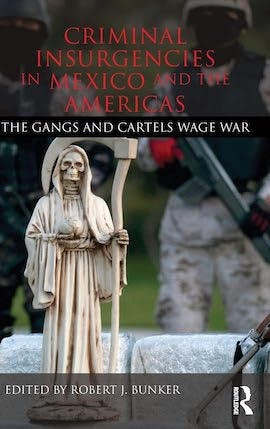
Robert J. Bunker, Ed., Criminal Insurgencies in Mexico and the Americas: The Gangs and Cartels Wage War. London: Routledge, 2013: pp 1–224.
Abstract: The work contains introductory essays and sections with multiple chapters focusing on theory, Mexico, and the Americas. It provides analyses pertaining to narco-insurgents who have no allegiance to any nation and are engaging in asymmetrical warfare against sovereign states in Latin America. Within such states, de facto political control is shifting to the cartels in the ‘areas of impunity’ that have emerged. The book addresses these concerns and highlights the criminal insurgencies being waged by the gangs and cartels. Contributors include Paul Rich, Thomas Durell-Young, Samuel Logan, Steven S. Dudley, Malcolm Beith, Graham H. Turbiville, Jr., David Kuhn, Max G. Manwaring, and John P. Sullivan.
Robert J. Bunker, Old and New Insurgency Forms. Carlisle Barracks: United States Army War College, Strategic Studies Institute, 1 March 2016: pp. 1–106, https://press.armywarcollege.edu/monographs/426/:
Abstract: This monograph, published by the US Army War College in 2016, provides a robust overview of insurgency forms—legacy, new, and projected. The criminal insurgency form is discussed, along with the linked plutocratic form and the earlier commercial insurgency form from which they both developed. This report provides an essential baselining of post-Cold War insurgency constructs, offers innovative terrorism and insurgency cross-modal analysis, and discusses the US National Security implications of emerging forms with suggested response recommendations.
Adán I. Bustamante, “Insurgencias criminales y guerra urbana en Latinoamérica: Una aproximación al proceso de urbanización regional y su impacto en la evolución táctica y operativa de las organizaciones criminales trasnacionales” (Criminal Insurgencies and Urban Warfare in Latin America: An Approach to the Regional Urbanization Process and Its Impact on the Tactical and Operational Evolution of Transnational Criminal Organizations). EntreTextos. Vol. 12, no. 35. August 2020: pp. 1–17, https://doi.org/10.59057/iberoleon.20075316.20203556.
Abstract: This article, written in Spanish, examines the emergence of megacities in Latin America and how criminal groups have leveraged growth patterns, vulnerabilities, and wealth disparities to increase their economic power/influence in areas where the state has eroded, establishing parallel governments. Bustamante describes how criminal actors have strategically established control over key areas (e.g., trading ports, airports, etc.) to aid their maintenance of transnational illicit markets, while also using violent tactics to establish feral cities/fiefdoms. As criminal actors seek to maintain control over areas the have seized, they may evolve into criminal insurgents as they combat the state through irregular tactics.
Claudio Cruz and David H. Ucko, “Beyond the Unidades de Polícia Pacificadora: Countering Comando Vermelho’s Criminal Insurgency.” Small Wars & Insurgencies. Vol. 29, no. 1. 22 December 2017: pp. 38–67, https://doi.org/10.1080/09592318.2018.1404772:
Abstract: This article advocates for recognizing Red Command (Commando Vermelho; CV) as a criminal insurgency so that Brazilian security services may better reassert control over the favelas (urban slums) controlled by this violent armed gang. The authors scrutinize previous state responses (i.e., the establishment of the Unidades de Polícia Pacificadora; UPP), highlighting how they failed to address the CV’s functioning as a parallel state and the underlying conditions that have enabled this criminal organization’s success. This article thoroughly reviews the history, strategies, and operating environment of CV within the favelas and provides a strategy for how the state can effectively counter the group’s insurgent-like tactics.
Lieutenant Alexander Elfes, “Militarised Criminal Networks in Mexico and the Challenges They Present to the Military and Police.” Small Wars Journal. 10 July 2020: pp. 1–5, https://smallwarsjournal.com/2020/07/10/militarised-criminal-networks-mexico-and-challenges-they-present-military-and-police/:
Abstract: This piece by Lt. Alexander Elfes examines the conflict environment within Mexico as that of a criminal insurgency. The article argues that criminal groups within the region (notably gangs and cartels) have developed complex, fluid relationships with the state due to factors including corruption, violence, and competing interests. As “surrogate governments” are established by certain criminal groups through the use of multifaceted violence and strategies aimed at producing a “Narco State,” the author explains why Mexico’s example is integral for national governments to understand how criminal insurgents can pose threats to state security and solvency.
Flávio César Montebello Fabri, “Insurgência e Insurgência Criminal: A Última Linha de Defesa” (Insurgency and Criminal Insurgency – The Last Line of Defense). VELHO GENERAL. 29 February 2024: pp. 1–24, https://velhogeneral.com.br/2024/02/29/insurgencia-e-insurgencia-criminal-a-ultima-linha-de-defesa/:
Abstract: Published in early 2024, this in-depth article explains why the Brazilian Ministry of Justice and Public Security (MJSP) promoted lectures on criminal insurgency, largely in connection to the feral border region and domestic public security concerns. The author thoroughly reviews Brazil’s history of insurgencies/revolts, legal code, and rampant corruption, and further details other neighboring states facing similar threats from organized crime groups. The important piece is written in Portuguese. Note—Dr. John Sullivan has provided a series of in person criminal insurgency lectures to Brazilian security agency audiences for some years now which supports this threat perceptional change in the security forces of that state.
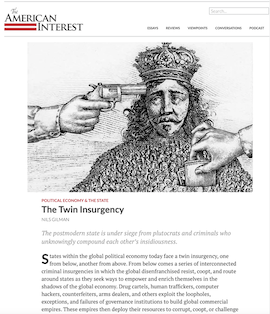
Nils Gilman, “The Twin Insurgency.” The National Interest. Vol. 9, no. 6. 15 June 2014, https://www.the-american-interest.com/2014/06/15/the-twin-insurgency/:
Abstract: This highly influential essay discusses the interaction of criminal and plutocratic insurgencies and their detrimental impacts on sovereign states—primarily liberal-democratic ones. This combination is known as ‘the twin insurgency’ and draws its strength from the sovereign free and illicit economies. Additionally, concern exists as to how these insurgency forms, when used in tandem, can empower authoritarian (kleptocratic) regimes. It was initially written as the foreword for the edited collection Global Criminal and Sovereign Free Economies and the Demise of the Western Democracies (Routledge, 2014) and then republished as a stand-alone web accessible piece.
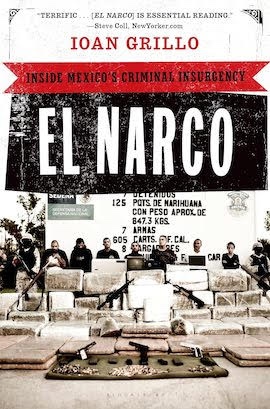
Ioan Grillo, El Narco: Inside Mexico’s Criminal Insurgency. New York: Bloomsbury Press, 2012: pp. 1–336:
Abstract: Ioan Grillo’s journalistic non-fiction novel “El Narco” is a captivating work that details the staggering evolution of the cartels in Mexico from local drug smugglers to transnational criminal insurgents. Featuring Grillo’s wild first-person reporting, interviews, and research, the work explores the vast influence of cartels, extending into economics, politics, social life, and security. Overall, this book is a great read and offers readers a unique understanding of how cartels exercise power in Mexico to achieve relevant objectives. Conceptually, it draws directly from the criminal insurgency construct initially developed by John Sullivan and allied to later El Centro scholarship.
Jorge Francisco Girón Mendizábal, “La Insurgencia Criminal, un reto a la Seguridad de la Nación para Guatemala” (The Criminal Insurgency, a Challenge to National Security for Guatemala). Revista Científica del Sistema de Estudios de Postgrado. Vol. 6, no. 2. 11 October 2023: pp. 85–99, https://revistasep.usac.edu.gt/index.php/RevistaSEP/article/view/180/192:
Abstract: This article, written in Spanish by retired Colonel Mendizabal, examines the ongoing situation in Guatemala, where various criminal groups have fought to expand their territory, resources, and presence, impacting regional security and the broader Northern Triangle. Following ideological struggles and the signing of the Peace Accords in 1997, military infrastructure and personnel have diminished while the National Civil Police have failed to fill the gaps, leaving areas where criminal actors (i.e., the Sinaloa Cartel) have been able to step in and advance their economic objectives and criminal activities. Utilizing mixed methods research and descriptive research approaches, Francisco advocates that a criminal insurgency has been and is continuing to take place as criminal gangs take on security forces/authorities to gain control and advance their interests.
Robert Killebrew, “Criminal Insurgency in the Americas and Beyond.” Prism. Vol. 2, No. 3. June 2011: pp. 33≠52, https://ciaotest.cc.columbia.edu/journals/prism%20/v2i3/f_0024141_19688.pdf:
Abstract: This article examines illegal groups within Latin America that the Department of Justice has recognized as “posing the most significant organized criminal threat to U.S. security.” Killebrew deems such groups to represent a security threat, as they may evolve into criminal insurgencies, and an international threat, as they further the formation of the “black economy.” Attention in the work is paid to criminal networks, areas of influence, illicit markets, political connections, and operational methods and their impact on the rest of the world.
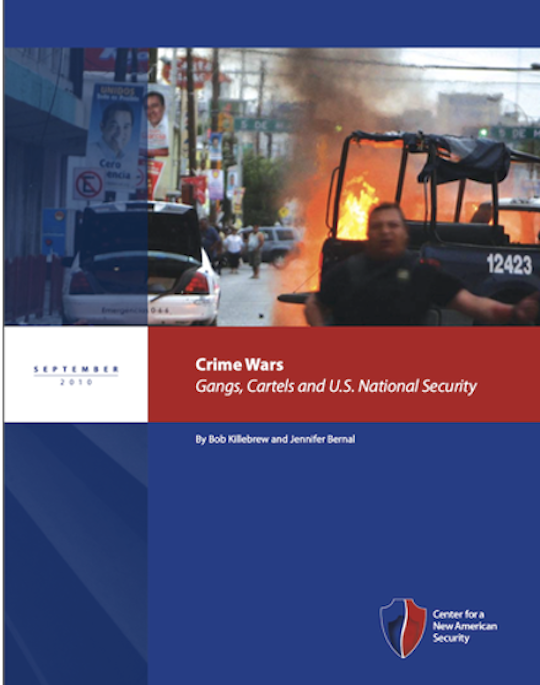
Bob Killebrew and Jennifer Bernal, Crime Wars: Gangs, Cartels and U.S. National Security. Washington, DC: Center for a New American Security, September 2010: pp. 1–84, https://www.files.ethz.ch/isn/121926/2010-09_CrimeWars_KillebrewBernal.pdf.
Abstract: This research monograph serves as a comprehensive resource as it examines “the scale of organized crime in key countries in the Western Hemisphere and provide[s] elements of such a strategy.” Findings from the study conclude that drug cartels do not constitute just a criminal threat, but also a potential transnational insurgent threat, with cartels operating in more than a dozen sovereign countries (each with its own systems in place) as they seek to obtain power and influence to further their illicit activities and agendas. The study found in the monograph is invaluable to readers seeking a more robust publication on criminal insurgency from the early 2010s.
Max G. Manwaring, Street Gangs: The New Urban Insurgency. Carlise Barracks: United States Army War College, 1 March 2005: pp. 1–54, https://press.armywarcollege.edu/cgi/viewcontent.cgi?article=1752&context=monographs:
Abstract: This early (pre-criminal insurgency construct) monograph examines third-generation gang traits and their connection to insurgency. Dr. Manwaring argues that select gangs have evolved into a mutation of urban insurgency. Despite gangs and insurgents having different origins, they share the objective of ridding and/or controlling the government of select states in order “…to guarantee the freedom of action and the commercial environment they want.” As third-generation gangs generate instability for reigning governments (via “a mix of complicity, indifference, corruption, and violent intimidation”), they ultimately act as insurgents, leading to regional, national, and international security threats and concerns.
Steven Metz, The Future of Insurgency. Carlisle Barracks: United States Army War College. 1 December 1993: pp. 1–30, https://press.armywarcollege.edu/cgi/viewcontent.cgi?article=1274&context=monographs:
Abstract: This foundational US Army War College paper from professor Dr. Steven Metz advocates that post-Cold War forms of insurgency will evolve and accordingly should be monitored so that they can be prevented and controlled. Dr. Metz establishes that the psychological component of these emerging insurgency forms is critical and produces two distinct typologies of insurgencies—spiritually and commercially focused ones. These emerging insurgency types are discussed in detail, including regions prone to them, driving factors, their attributes and capabilities, and other relevant factors. The reading of this paper is critical in building an understanding of the theoretical context underlying the criminal insurgency construct.
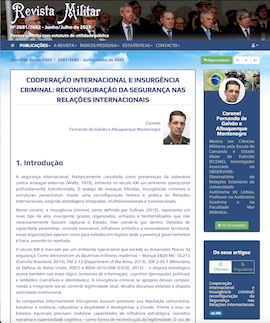
Colonel Fernando de Galvão e Albuquerque Montenegro, “Cooperação Internacional e Insurgência Criminal: Reconfiguração da Segurança nas Relações Internacionais” (International Cooperation and Criminal Insurgency: Reshaping Security in International Relations). Revista Militar. No. 2681/2682. June/July 2025: pp. 1–7, https://www.revistamilitar.pt/artigo/1886:
Abstract: This focused online article, written in Portuguese by Associate Researcher and Professor Col. Fernando de Galvão e Albuquerque Montenegro argues that criminal insurgencies pose a new threat which ‘corrode the state internally’ by acting in ‘physical, logical, and cognitive’ domains. Through hybrid methods and “paramilitary capacity, normative control, symbolic influence, and territorial rationality”, criminal insurgents pursue various objectives while strategically challenging state legitimacy. Suggestions for combating criminal insurgents are also proposed (emphasizing the importance of international cooperation) with consideration to the multifaceted/transnational threat they exhibit.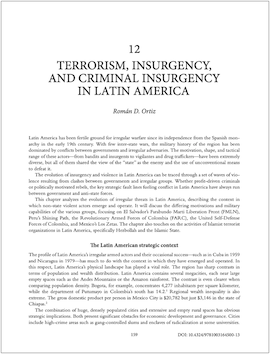 Román D. Ortiz, “Terrorism, Insurgency, and Criminal Insurgency in Latin America,” in Michael A. Sheehan, Erich Marquardt, and Liam Collins, Eds., Routledge Handbook of U.S. Counterterrorism and Irregular Warfare Operations. London: Routledge, 2021: pp. 159–172, https://www.taylorfrancis.com/chapters/oa-edit/10.4324/9781003164500-14/terrorism-insurgency-criminal-insurgency-latin-america-rom%C3%A1n-ortiz:
Abstract: This chapter initially examines irregular threats that emerged in Latin America following independence from the Spanish monarchy in the 19th century and provides an overview of 20th century threats. It then discusses early 21st century criminal insurgencies including those being waged by the PCC (Primeiro Comando da Capital), CJNG (Cártel de Jalisco Nueva Generación), and the Colombian Gulf Gang (Clan del Golfo). Ortiz discusses historical contributing factors to insurrection, including inadequate state services and the marginalization (social, economic, etc.) of various populations. This results in ‘ideological zeal that has now been replaced by hunger for profit’ (derived from illicit economies). Moreover, this chapter delves into ‘social spaces’, the movement of insurgent groups from rural areas to urban centers, and their developing use of hybrid tactics.
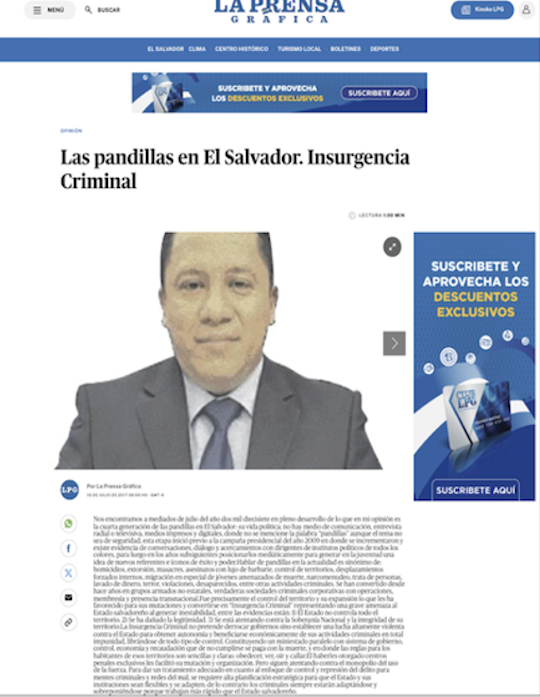
“Las pandillas en El Salvador. Insurgencia Criminal” (Gangs in El Salvador. Criminal Insurgency). La Prensa Gráfica. 15 July 2017: pp. 1–2, https://www.laprensagrafica.com/opinion/Las-pandillas-en-El-Salvador.-Insurgencia-Criminal-20170715-0066.html:
Abstract: This short opinion piece from an El Salvador daily newspaper advocates that the “fourth generation” of gangs has arisen in El Salvador with gangs having constructed a robust political life. The influence of gangs among younger populations is visible through their perceived success and territorial expansion, accomplished via criminal activities including murder, extortion, forced displacement, and drug trafficking. Accordingly, the opinion holds that criminal insurgency tied to more sophisticated gangs (MS-13 and Barrio 18) has occurred, as the State no longer possesses complete control over its territory, legitimacy, or national sovereignty.
Ralph Peters, “The Culture of Future Conflict.” Parameters. Vol. 25, no. 1. Winter 1995-96: pp. 18–27, https://press.armywarcollege.edu/cgi/viewcontent.cgi?article=1749&context=parameters:
Abstract: In this 1990s Parameters article from the US Army War College, Ralph Peters advocates that future conflict will arise from state incompetence, cultural breakdowns, and increasing economic inequality. Peters further contends that future conflicts will not be between previous “winner-states” but will instead be increasingly waged by “loser” populations (the anti-state), resulting in asymmetric warfare becoming prominent. Peters promotes the view that “Massive criminal insurgencies are a new method of challenging the state through violence,” with anticipated insurgents being criminal enterprises or even top-down (kleptocratic) governments.
Julia Pulido, “La Amenaza de la Insurgencia Criminal en Colombia: El Concepto de Inteligencia Híbrida Como Nueva Forma de Adaptación de las Estrategias Tradicionales Contrainsurgentes” (The Threat of Criminal Insurgency in Colombia: The Concept of Hybrid Intelligence as a New Way of Adjustment to Traditional Counterinsurgency Strategies). UNISCI Journal. No 44. May 2017: pp. 55–72, https://www.ucm.es/data/cont/media/www/pag-72408/UNISCIDP44-NUMEROENTERO.pdf:
Abstract: This article, written in Spanish, by international relations professor Julia Pulida, a specialist in strategic intelligence, promotes the application of ‘hybrid intelligence’ by Colombia’s Intelligence Community and armed forces in response to the territorial expansion of criminal organizations. Dr. Pulido outlines the benefits of strengthening international policies, strategies, and security measures to counter BACRIM (bandas criminales)/guerrilla groups that may evolve into criminal insurgencies. As various cartels have migrated to Colombia [while guerrilla groups such as FARC (Fuerzas Armadas Revolucionarias de Colombia) have simultaneously demobilized], this article highlights the importance of updating procedures, threat assessments, and intelligence operations for greater state security needs.
John P. Sullivan, “Outside View: Mexico’s criminal insurgency.” UPI. 18 December 2008, https://www.upi.com/Top_News/Special/2008/12/18/Outside-View-Mexicos-criminal-insurgency/34061229613633/:
Abstract: In this Op-Ed, Sullivan argued that Mexico’s escalating drug violence has evolved into a “criminal insurgency” in which networked cartels, allied with transnational gangs, use extreme violence and corruption to secure territory and challenge state authority. Sullivan warned the cartels’ reach is increasingly transnational and that the convergence of cartels and third-generation gangs creates ungoverned zones vulnerable to further criminal and extremist exploitation. He endorsed the Mérida Initiative as a useful initial response but stated that US-Mexico efforts should prioritize rooting out corruption, policing reform and cross-border cooperation, improved information sharing, and community economic and social programs to restore government legitimacy and resist cartel penetration.
John P. Sullivan, From Drug Wars to Criminal Insurgency: Mexican Cartels, Criminal Enclaves and Criminal Insurgency in Mexico and Central America. Implications for Global Security. Working Papers Series. Paris: Fondation Maison des Sciences de l’Homme. No. 9. April 2012: pp. 1–20, https://shs.hal.science/halshs-00694083v1/document:
Abstract: This short monograph by Dr. Sullivan was produced for a seminar on “Netwars and PeaceNets” on the framework of “Interdisciplinary analysis of the society in webs,” and assesses the ongoing drug war in Mexico (and greater Latin America) and how it is related to transnational crime. As illicit actors such as gangs and cartels conflict with one another and, more relevantly, state/sub-state polities, they are increasing their role as political actors. The author recognizes this threat as a ‘criminal insurgency’ which will likely lead to “profound global security consequences” as criminal networks have infiltrated economic, social, and political domains.
John P. Sullivan, “Crime Wars: Operational Perspectives on Criminal Armed Groups in Mexico and Brazil.” International Review of the Red Cross. Vol. 105, no. 923. June 2023: pp. 849–875, https://international-review.icrc.org/articles/crime-wars-operational-perspectives-923:
Abstract: This piece, published by the International Review of the Red Cross, features the work of SWJassociate editor John P. Sullivan. Dr. Sullivan utilizes two case studies (Brazil and Mexico), which are regions featuring high levels of criminal violence. These case studies clarify how violent non-state actors (i.e., criminal enterprises, cartels, gangs, etc.) challenge and/or influence state actors, with criminal insurgencies being the focal example. The latter part of the paper also delves into the complexities of crime wars, which may or may not evolve into varying levels of criminal insurgency, and discusses how they may be addressed.
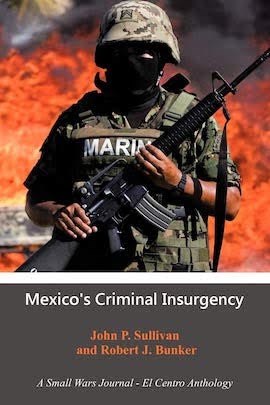
John P. Sullivan and Robert J. Bunker, Mexico’s Criminal Insurgency: A Small Wars Journal-El Centro Anthology. Bloomington: iUniverse, 2012: pp. 1–208:
Abstract: This anthology from Small Wars Journal El Centro associate editors John P. Sullivan and Robert J. Bunker provides insights into Mexico’s ongoing security environment and the growing criminal insurgent threat posed by violent non-state actors. Moreover, this anthology examines into how states may be impacted by emerging forms of warfare waged by criminal actors. The work provides a curated collection of the first year of El Centro writings published along with supporting matter placing it in context.
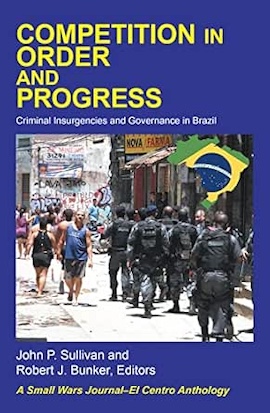
John P. Sullivan and Robert J. Bunker, Eds., Competition in Order and Progress: Criminal Insurgencies and Governance in Brazil. Bloomington: Xlibris, 2022: pp. 1–606:
Abstract: Dr. Sullivan and Dr. Bunker dissect Brazil’s evolving security environment in this extensive anthology, as the government has been attempting to counter criminal actors (armed groups, gangs, militias) who are engaging in criminal state making through various means. Criminal actors have created thriving shadow states in areas such as prisons and favelas and the editors (along with a large group of contributing authors) examine contributing factors to the way these criminal actors have evolved into criminal insurgents and the overall negative impact on the Brazilian state.
John P. Sullivan and Robert J. Bunker, “Rethinking Insurgency: Criminality, Spirituality, and Societal Warfare in the Americas.” Small Wars & Insurgencies. Vol. 22, no. 5. 29 November 2011: pp. 742–763, https://www.tandfonline.com/doi/abs/10.1080/09592318.2011.625720:
Abstract: This in-depth article, building on Steven Metz’s construct of commercial insurgency and written by SWJ associate editors Dr. Sullivan and Dr. Bunker, explores the growing influence and power of criminal insurgent groups. The rise of insurgent groups, challenges they present to state sovereignty and integrity, and usage of “social/environmental modification” (i.e., narcocultura) against the state, are thoroughly examined. Moreover, it is established that criminal insurgents “…are the result of criminal enterprises competing with the state,” with further information provided on their interests in escaping state control/state influence to create their own para-state for impunity purposes.
John P. Sullivan and Adam Elkus, “State of Siege: Mexico’s Criminal Insurgency.” Small Wars Journal. 19 August 2008: pp. 1–12, https://smallwarsjournal.com/2008/08/19/state-siege-mexicos-criminal-insurgency/ (Mirrored at: https://www.academia.edu/927365/State_of_Siege_Mexicos_Criminal_Insurgency):
Abstract: This pioneering SWJ article describes how Mexican drug cartels act as criminal insurgents posing a threat to the public and the state (with the potential to spread to the US, specifically along its southern border). Given that countless Mexican civilians and law enforcement agents have been killed due to cartel conflicts, cartel influence has expanded to “…Substantial chunks of Mexican infrastructure—police, judiciary, and public administration”, exacerbating already existing corruption due to Mexico’s historically weak political capacity. Other topics discussed in the article include “black globalization,” cartel strategy, and possible solutions to combating this emerging insurgency form
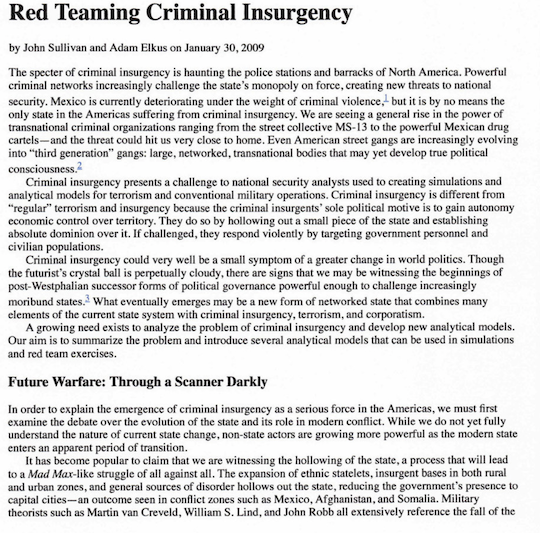
John Sullivan and Adam Elkus, “Red Teaming Criminal Insurgency.” Red Team Journal. 30 January 2009: pp. 1–11 (Mirrored at: https://www.academia.edu/1339071/Red_Teaming_Criminal_Insurgency):
Abstract: This article from Small Wars Journal associate editor Dr. John P. Sullivan and analyst Adam Elkus applies red teaming to criminal insurgency, as illicit non-state actors are recognized as amassing power while modern states are simultaneously being hollowed out. Sullivan and Elkus argue that combining red teaming with operational knowledge can help predict which criminal actors may evolve into criminal insurgents and identify potential measures to prevent such an evolution. This article also provides valuable details on the tactical operations of criminal insurgents, such as assassination/attrition and criminal entities engaging in widespread uprisings.
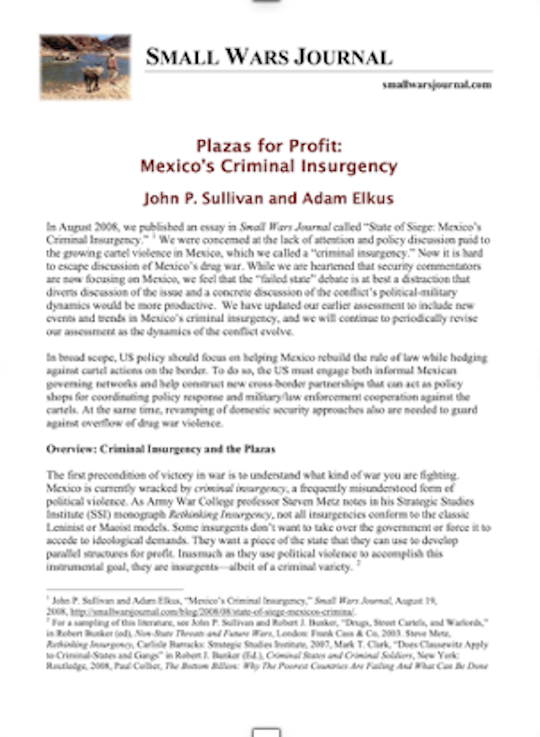 John P. Sullivan and Adam Elkus, “Plazas for Profit: Mexico’s Criminal Insurgency.” Small Wars Journal. 26 April 2009: pp. 1–9, http://smallwarsjournal.com/blog/2009/04/plazas-for-profit-mexicos-crim/ (Mirrored at: https://www.academia.edu/1113524/Plazas_for_Profit_Mexico_s_Criminal_Insurgency):
Abstract: Building upon ideas presented initially in SWJ article “State of Siege: Mexico’s Criminal Insurgency,” Sullivan and Elkus reassess the security situation that evolved from a drug war into what they argue to be a criminal insurgency. Criminal actors are said to have implemented violent tactics, PSYOPS, and corruption methods against the state and amongst themselves to gain control over ‘plazas’ (which are “the corridors for shipment of drugs into the United States”), increase influence, and acquire resources. This essay also discusses military responses, radicalization amongst youth populations, and response strategies as criminal actors have established parallel states, which threaten the Mexican state and possibly the greater Western hemisphere.
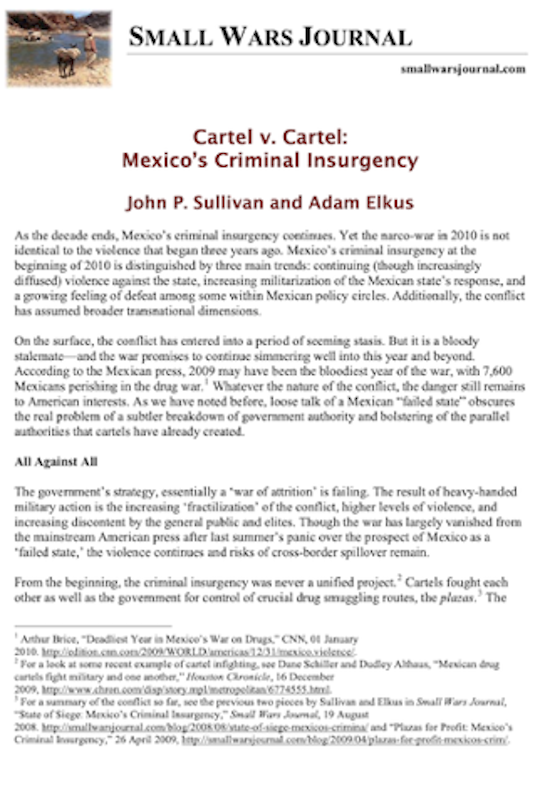 John P. Sullivan and Adam Elkus, “Cartel v. Cartel: Mexico’s Criminal Insurgency.” Small Wars Journal. 2 February 2010: pp. 1–11, https://smallwarsjournal.com/2010/02/02/cartel-v-cartel-mexicos-criminal-insurgency/(Mirrored at https://www.academia.edu/1113545/Cartel_v_Cartel_Mexicos_Criminal_Insurgency):
Abstract: This is “the third in an ongoing open-source effort by Sullivan and Elkus to track the strategic and operational dynamics of the Mexican criminal insurgency.” It describes the Hobbesian ‘all against all’ environment that exists, the counter cartel-surges taking place utilizing federal police and increasingly military units, and the rise of what are known as mega cartels (megacarteles) tied to the CDS (Cártel de Sinaloa) and the CDG (Cártel del Golfo)/Los Zetas alliance, one however that is fragmenting. The essay ends with a discussion of futures conflict potentials for Mexico and US policy recommendations. The influential series of essays it is linked to helped promote the establishment of El Centro at SWJ during the following year.
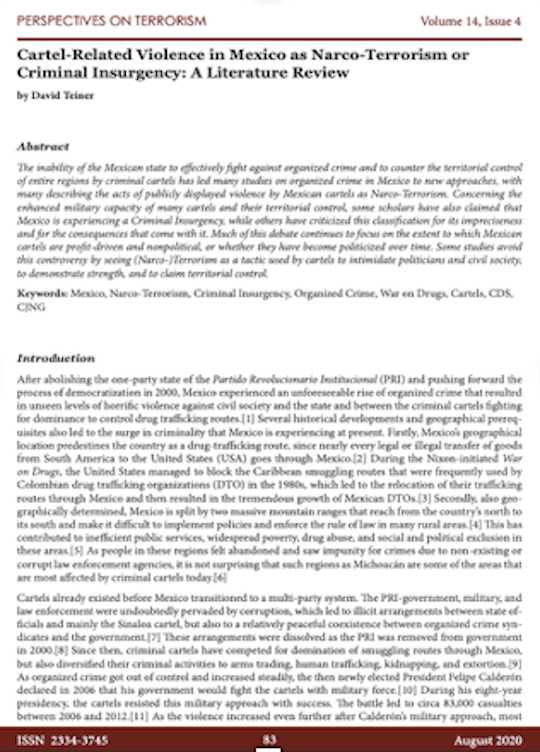
David Teiner, “Cartel-Related Violence in Mexico as Narco-Terrorism or Criminal Insurgency: A Literature Review.” Perspectives on Terrorism. Vol. 14, no. 4. August 2020: pp. 83–98,https://www.jstor.org/stable/26927665?seq=1:
Abstract: This well-crafted literature review examines the ongoing discourse on Mexican cartel violence since the late 20th century, as scholars and practitioners’ debate whether the actions of cartels should be identified as narco-terrorism, criminal insurgency, or neither construct (due to the motivations, ideologies, and actions of the cartel actors). In this academic work, Teiner provides an assessment related to the strengths and weaknesses of these typologies while thoroughly reviewing them vis-a-vis contemporary examples as they relate to the activities of the cartels.
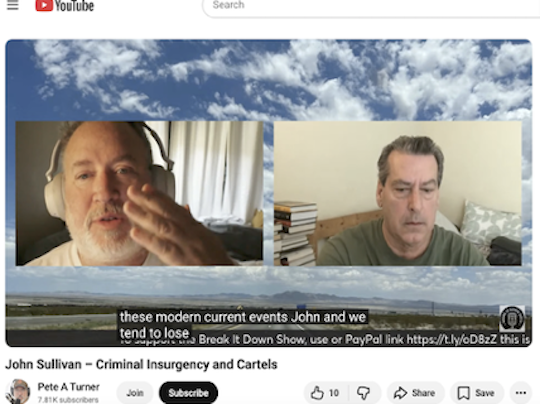
Pete A. Turner, “John P. Sullivan – Criminal Insurgency and Cartels.” Break it Down Show (YouTube). 19 March 2024: 1:08:42 Hour Video, https://www.youtube.com/watch?v=avOjyBv7Cr8:
Abstract: This YouTube video—with host Pete A. Turner and guest John P. Sullivan— delves into the definitions, levels, and strategies surrounding criminal insurgencies. Additional topics discussed include the interconnectedness of domestic and international criminal enterprises brought together through an “ecosystem…of global illicit network of flows [money, contraband, goods] …,” corruption, and strategies for combating criminal groups (i.e., transnational intelligence, police/police reform, et al.). Dr. Sullivan also highlights improvements that must be made in national and transnational intelligence sharing due to weaknesses exploited by illicit actors.
Endnotes
[1] Steven Metz, The Future of Insurgency. Carlisle Barracks: United States Army War College. 1 December 1993: pp. 1-30, https://press.armywarcollege.edu/cgi/viewcontent.cgi?article=1274&context=monographs.
[2] For information on the plutocratic insurgency construct, see Robert J. Bunker and Pamela Ligouri Bunker, Eds., Plutocratic Insurgency Reader: A Small Wars Journal Book. Bloomington: Xlibris, 2019: pp. 1-376. Collectively, criminal and plutocratic insurgencies working in tandem against a liberal-democratic state are known as ‘the twin insurgency.’ See Nils Gilman, “The Twin Insurgency.” The National Interest. Vol. 9, no. 6. 15 June 2014, https://www.the-american-interest.com/2014/06/15/the-twin-insurgency/.
[3] Ralph Peters, “The Culture of Future Conflict.” Parameters. Vol. 25, no. 1. Winter 1995-96: pp. 18-27, https://press.armywarcollege.edu/cgi/viewcontent.cgi?article=1749&context=parameters and Max G. Manwaring, Street Gangs: The New Urban Insurgency. Carlise Barracks: United States Army War College, 1 March 2005: pp. 1-54, https://press.armywarcollege.edu/cgi/viewcontent.cgi?article=1752&context=monographs.
[4] These original four Small Wars Journal articles are: John P. Sullivan and Adam Elkus, “State of Siege: Mexico’s Criminal Insurgency.” Small Wars Journal. 19 August 2008: pp. 1-12, https://smallwarsjournal.com/2008/08/19/state-siege-mexicos-criminal-insurgency/ (Mirrored at: https://www.academia.edu/927365/State_of_Siege_Mexicos_Criminal_Insurgency), John Sullivan and Adam Elkus, “Red Teaming Criminal Insurgency.” Red Team Journal. 30 January 2009: pp. 1-11, https://www.academia.edu/1339071/Red_Teaming_Criminal_Insurgency (Mirrored), John P. Sullivan and Adam Elkus, “Plazas for Profit: Mexico’s Criminal Insurgency.” Small Wars Journal. 26 April 2009: pp. 1-9, http://smallwarsjournal.com/blog/2009/04/plazas-for-profit-mexicos-crim/ (Mirrored at: https://www.academia.edu/1113524/Plazas_for_Profit_Mexico_s_Criminal_Insurgency), and John P. Sullivan and Adam Elkus, “Cartel v. Cartel: Mexico’s Criminal Insurgency.” Small Wars Journal. 2 February 2010: pp. 1-11, https://smallwarsjournal.com/2010/02/02/cartel-v-cartel-mexicos-criminal-insurgency/ (Mirrored at https://www.academia.edu/1113545/Cartel_v_Cartel_Mexicos_Criminal_Insurgency).
[5] John P. Sullivan, “States of Change: Power and Counterpower Expressions in Latin America’s Criminal Insurgencies.” Vol. 2, No. 1. Spring 2014: p. 65, https://www.criminologyjournal.org/uploads/1/3/6/5/136597491/states_of_change.pdf. The preceding article paraphrased the process discussed in John P. Sullivan, From Drug Wars to Criminal Insurgency: Mexican Cartels, Criminal Enclaves and Criminal Insurgency in Mexico and Central America. Implications for Global Security. Working Papers Series. Paris: Fondation Maison des Sciences de l’Homme. No. 9. April 2012: pp. 7-8, https://shs.hal.science/halshs-00694083v1/document.
[6] “El Centro: Exploring the Small Wars of Latin America and Beyond.” Small Wars Journal. 20 February 2020 (Accessed), https://smallwarsjournal.com/el-centro-about/. The original El Centro mission statement when established in 2011 at Small Wars Journal and under the auspices of the Small Wars Foundation is the same. It can be accessed in the archives via https://archive.smallwarsjournal.com/node/11323. The original El Centro logo has the motto “Criminal Insurgencies Analysis” on it and can be viewed at the above URL in the SWJarchives.
[7] Hal Brands, “Third-Generation Gangs and Criminal Insurgency in Latin America.” Small Wars Journal. 4 July 2009, https://smallwarsjournal.com/2009/07/04/third-generation-gangs-and-criminal-insurgency-in-latin-america/, Robert Killebrew, “Criminal Insurgency in the Americas and Beyond.” Prism. Vol. 2, No. 3. June 2011: pp. 33-52, https://ciaotest.cc.columbia.edu/journals/prism%20/v2i3/f_0024141_19688.pdf, and Robert J. Bunker, Criminal (Cartel & Gang) Insurgencies in Mexico and the Americas: What You Need to Know, Not What You Want to Hear. “Has Merida Evolved? Part One: The Evolution of Drug Cartels and the Threat to Mexico’s Governance.” Congressional Testimony Before the House Foreign Affairs Subcommittee on the Western Hemisphere. Washington, DC, 13 September 2011: pp. 1-25,https://foreignaffairs.house.gov/112/bun091311.pdf (Mirrored at: https://scholarship.claremont.edu/cgi/viewcontent.cgi?article=1154&context=cgu_fac_pub).