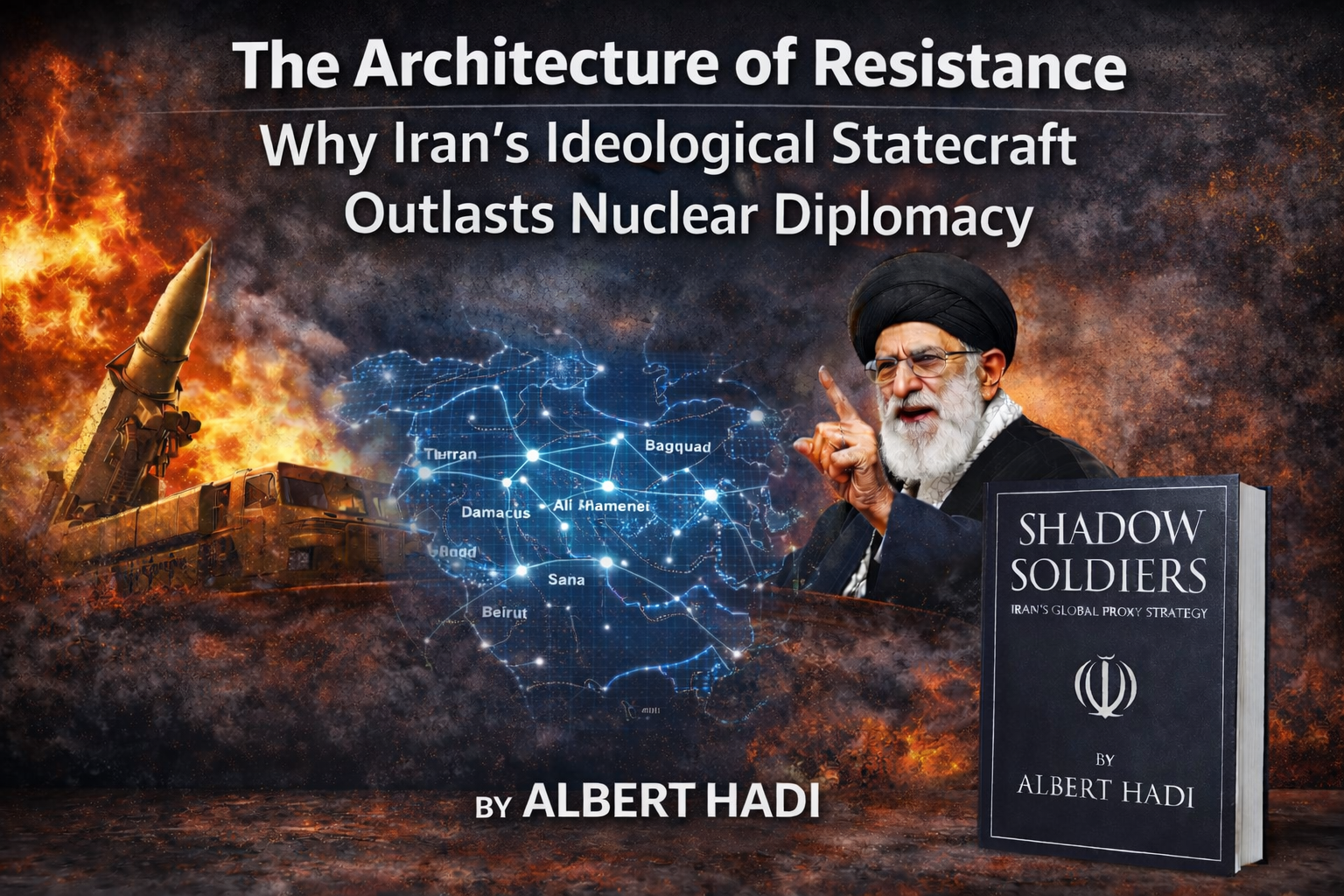
The Architecture of Resistance: Why Iran’s Ideological Statecraft Outlasts Nuclear Diplomacy

Abstract
Contemporary U.S.–Iran diplomacy remains centered on uranium enrichment levels, stockpile thresholds, centrifuge cascades, and inspection protocols. These technical variables are measurable and verifiable, and therefore negotiable. Yet the persistent instability surrounding nuclear negotiations suggests that the central issue may not be technical compliance alone, but strategic intent. The nuclear file addresses capability. Iran’s ideological statecraft address’s purpose.
Introduction
The 2015 Joint Comprehensive Plan of Action, endorsed by United Nations Security Council Resolution 2231, was constructed as a verification-driven arms control framework. Implementation Day, January 16, 2016, followed the International Atomic Energy Agency’s confirmation that Iran had completed required nuclear steps. The agreement institutionalized inspection architecture and monitoring mechanisms, privileging technical transparency over political trust.
However, during the period in which the IAEA repeatedly verified Iran’s nuclear compliance, Iran’s broader strategic posture remained active. Between July 2015 and early 2018, Iran conducted approximately thirty ballistic missile tests, including systems assessed as nuclear-capable under U.S. definitions. These tests included variants of the Shahab-3 and other medium-range systems. At the same time, Iran publicly maintained a self-declared 2,000 kilometer range limit on its ballistic missiles, a ceiling sufficient to cover Israel, U.S. regional bases, and parts of Europe, while avoiding explicit pursuit of longer-range systems that would clearly violate international red lines. This calibrated posture allowed Tehran to preserve regional deterrence while arguing technical compliance with the nuclear agreement.
In parallel, Iran accelerated development of its space launch vehicles and satellite program. U.S. assessments have long noted that space launch technologies share core components with intercontinental ballistic missile development, including multi-stage propulsion and guidance systems. Satellite launches conducted during and after the JCPOA period demonstrated continued investment in long-range missile-relevant technologies, even while nuclear enrichment remained constrained.
Revolutionary Constitutionalism and External Activism
Iran’s 1979 Constitution does not merely describe state authority; it encodes a transnational revolutionary mandate. Article 154 commits the Islamic Republic to support “the just struggles of the oppressed against the arrogant in every corner of the globe”. Article 150 establishes the Islamic Revolutionary Guard Corps (IRGC) as guardian of the revolution and its achievements. These provisions are structural, not rhetorical. They embed ideological activism within the legal architecture of the state and create a constitutional basis for organized engagement beyond territorial defense.
This interpretation is reinforced in the scholarly literature. Said Amir Arjomand, Professor of Sociology at Stony Brook University and one of the leading academic authorities on the Iranian Revolution and Shia political thought, argues that the Islamic Republic fused charismatic clerical authority with institutionalized revolutionary guardianship, producing a political order in which regime preservation and ideological projection are mutually reinforcing. In his analysis, the post-1979 system did not transition from revolutionary movement to conventional statehood; rather, it codified revolutionary mission within constitutional structure. Under this framework, external activism is not a temporary policy choice but a legally embedded dimension of state identity.
The Islamic Revolutionary Guard Corps, particularly through its external operations branch, operationalizes this constitutional mandate. The Qods Force serves as the institutional mechanism through which Articles 150 and 154 are translated into training networks, advisory missions, and militia partnerships across the region. U.S. policy designations reflect recognition of this integration between doctrine and action. In 2007, the U.S. Department of the Treasury designated the IRGC-Qods Force under Executive Order 13224 for its support of militant groups. In 2019, the U.S. Department of State designated the Islamic Revolutionary Guard Corps as a Foreign Terrorist Organization, marking the first time the United States applied that designation to an official branch of another state’s military. These actions were grounded in assessments that the IRGC’s external operations were institutional expressions of state policy rather than independent militia activity.
The diplomatic implications are structural. Nuclear negotiations operate within an arms control paradigm focused on material capability. Iran’s constitutional architecture defines strategic orientation through revolutionary continuity and clerical guardianship. As long as Articles 150 and 154 remain operative, external activism retains constitutional legitimacy irrespective of enrichment limits or inspection regimes. Enrichment levels can be negotiated. Constitutional identity cannot be amended through verification mechanisms.
A sustainable diplomatic approach must therefore account for the embedded nature of revolutionary constitutionalism within Iran’s governing framework. Without addressing this legal and ideological foundation, agreements may constrain fissile material while leaving intact the institutional drivers of regional projection.
Proxy Networks as Strategic Infrastructure
Iran’s proxy system functions as a resilient, deniable, and cost-efficient mechanism of power projection. Unlike nuclear infrastructure, which requires extensive industrial investment and is subject to inspection, proxy networks regenerate through ideology, patronage, and comparatively modest financial support.
Lebanon: Hybrid Deterrence
Hezbollah represents the most developed example of this model. Established with IRGC assistance in the early 1980s, it evolved into a dual political and military actor embedded in Lebanese institutions while maintaining a substantial missile arsenal. Afshon Ostovar, Associate Professor of National Security Affairs at the U.S. Naval Postgraduate School and author of Vanguard of the Imam, describes Hezbollah as both a forward defense arm and a deterrent extension of Iranian strategy. In this framework, Hezbollah functions as a strategic asset integrated into Iran’s layered deterrence posture.
Even after significant military operations targeting Hezbollah leadership and infrastructure, the organization retains institutional durability. It participates in Lebanese governance and maintains socio-economic networks in southern Lebanon. Augustus Richard Norton, Professor Emeritus of International Relations at Boston University and a leading scholar on Hezbollah’s political development, emphasizes that the group’s resilience stems from its embedded political and social functions as well as its military capacity. The hybrid structure complicates external dismantlement. Military degradation does not equate to political elimination. Reconstruction is incremental, not instantaneous, but the model is renewable.
Iraq: Institutionalized Militia Integration
Following the 2003 U.S. invasion, Iran cultivated Shia militias that later consolidated under the Popular Mobilization Forces. Groups such as Kata’ib Hezbollah and Asa’ib Ahl al-Haq maintain operational and ideological alignment with Tehran. U.S. Treasury sanctions have repeatedly targeted these entities.
Their integration into Iraqi political and security institutions enhances durability. They are embedded actors within state frameworks, not external insurgent formations. Sanctions may constrain funding, but structural entrenchment complicates removal.
Syria and Yemen: Strategic Depth and Asymmetric Leverage
In Syria and Yemen, Iran’s proxy model reflects a calibrated strategy that blends expeditionary mobilization with cost-efficient asymmetric pressure. In Syria, Tehran deployed Islamic Revolutionary Guard Corps personnel and mobilized foreign Shia formations, including the Fatemiyoun and Zaynabiyoun brigades. This mobilization demonstrated Iran’s capacity to transform transnational sectarian networks into sustained force projection.
Professor Ostovar argues that Syria became central to Iran’s forward defense doctrine, providing operational depth beyond its borders and reinforcing deterrence through layered regional positioning. Even substantial battlefield reversals did not dismantle the demographic engineering, militia infrastructure, and advisory networks established over years of engagement. These embedded structures reflect institutional planning rather than temporary intervention.
In Yemen, Iranian support to Ansar Allah illustrates a parallel but economically distinct model of asymmetric leverage. On June 10, 2021, the U.S. Department of the Treasury’s Office of Foreign Assets Control designated members of a smuggling network that funded Iran’s IRGC-Qods Force and the Houthis in Yemen. Led by Iran-based financier Sa’id al-Jamal, the network generated tens of millions of dollars through petroleum sales and other commodities. These funds were transferred through a shadow banking system involving international intermediaries, exchange houses, and gold smuggling operations to support Houthi activities.
Across both theaters, the strategic pattern is consistent: relatively constrained expenditures yield durable influence and disproportionate leverage. Syria provides depth and territorial entrenchment; Yemen offers cost-effective disruption and escalation flexibility. Together, these cases illustrate how Iran’s regional architecture operates independently of nuclear negotiation cycles, embedding asymmetric capability within long-term strategic design.
Recruitment, Media, and Regenerative Capacity
The durability of Iran’s proxy architecture rests on sustained ideological reproduction. Recruitment and propaganda operate as force multipliers, enabling Tehran to project influence at relatively low financial cost compared to conventional military programs. Although Iran reportedly spent approximately 30 billion dollars sustaining the Assad regime and allied militias in Syria, support to Palestinian factions remains comparatively inexpensive relative to the leverage generated. U.S. officials have estimated that Iran provides tens of millions of dollars annually to Hamas and Palestinian Islamic Jihad, with support in some years assessed between 70 and 100 million dollars. These sums are modest compared to regional defense budgets, yet they sustain persistent asymmetric pressure against Israel and complicate regional stability.
Recruitment pipelines, educational outreach, religious networks, and digital media campaigns operate at low cost and can regenerate after sanctions or diplomatic breakdowns. Unlike centrifuges, they are diffuse and transnational. Nuclear infrastructure is finite and inspectable. Ideological infrastructure is renewable, adaptive, and resilient.
Taqiyya and Strategic Deniability
The doctrine of taqiyya historically permitted the concealment of belief under persecution. Encyclopaedia Iranica traces its foundations to Qur’anic exegesis and early Shia vulnerability, defining the practice as self-protective concealment under threat.
Two clarifications are necessary. First, taqiyya is not unique to Shiaism. Second, theological permission for concealment does not constitute doctrinal endorsement of treaty deception. However, the broader relevance lies in the normalization of survival through ambiguity. When a political system already relies on proxy warfare and deniability, rhetorical traditions of concealment can intersect with operational practice.
The IRGC-Qods Force’s reliance on partners to maintain plausible deniability is well documented in U.S. assessments. The issue is not religious doctrine per se. It is structural ambiguity as a strategic instrument. Verification architecture must therefore address not only declared capabilities but also deniable networks.
The Hidden Imam and Sacralized Sovereignty
The doctrine of the Hidden Imam remains central to Twelver Shia theology. Twelver Shiaism refers to the line of twelve Imams regarded as divinely guided successors to the Prophet Muhammad; the twelfth Imam, Muhammad al-Mahdi, is believed to have entered occultation and will ultimately return as a messianic figure to establish justice. During the greater occultation, jurists historically exercised custodial religious authority while awaiting the Imam’s return. Ruhollah Khomeini, founder of the Islamic Republic and principal theorist of its governing model, reinterpreted this framework, arguing that juristic authority extends to comprehensive political governance during occultation.
This reinterpretation was institutionalized through wilayat al-faqih in the Constitution of the Islamic Republic. Articles 5 and 110 embed supreme juristic authority within the state’s legal structure. Professor Arjomand explains that this structure sacralizes sovereignty by locating ultimate authority in a jurist who acts as guardian in the Imam’s absence. The regime’s conception of authority produces strategic patience and ideological continuity that outlast treaty cycles. Political authority is framed as divine trusteeship exercised within sacred temporality.
This framework does not preclude negotiation. It situates policy within a theological horizon extending beyond electoral cycles and sanction timelines. Agreements operate as tactical instruments within a broader ideological narrative.
The Nuclear File as Diplomatic Compartment
Iran has repeatedly signaled willingness to negotiate nuclear parameters while resisting linkage to missiles and proxy networks. Compartmentalization is strategically rational. Nuclear negotiations yield sanctions relief and economic stabilization while preserving asymmetric instruments of influence.
Historical precedent demonstrates that arms control between ideological adversaries is possible. The 1972 ABM Treaty and subsequent Cold War agreements illustrate that verification and enforcement can mitigate distrust. However, those agreements were embedded within broader containment strategies.
The Iranian case presents a tighter fusion between ideology and state structure. Revolutionary rhetoric, including references to the United States as the “Great Satan,” reinforces adversarial identity within official discourse. Even when framed as opposition to policy rather than people, such language sustains a narrative of resistance.
The policy question is structural: can verification architectures alone compensate for enduring ideological hostility? Or must durable agreements incorporate constraints on missile programs, proxy networks, and the political narratives that sustain them?
Counterargument: Rational Actor or Ideological State?
Many analysts argue that Iran behaves as a rational actor pursuing regime survival and deterrence. From this perspective, revolutionary rhetoric functions instrumentally. Proxy warfare is cost-effective realism. Ideology provides legitimacy but does not dictate strategy.
There is merit in recognizing Iran’s pragmatic calculations. Tehran calibrates escalation. It negotiates when pressured. It leverages sanctions for concessions. Yet rationality does not negate ideology. In Iran’s system, ideological doctrine shapes institutional architecture. Constitutional mandates, sacralized authority, and proxy networks are not episodic tools. They are structural features.
The issue is not whether Iran calculates costs. It is whether its ideological infrastructure persists regardless of nuclear agreements.
Conclusion: Ideological Doctrine, Enemy Construction, and the Limits of Diplomatic Settlement
The principal vulnerability in current U.S.–Iran diplomacy is not technical insufficiency but conceptual constriction. Nuclear negotiations regulate measurable variables such as enrichment thresholds, stockpile limits, and inspection regimes. These are quantifiable and enforceable. Yet Iran’s broader strategic posture is anchored in an ideological doctrine that operates beyond arms control mechanisms and shapes long-term strategic orientation.
Within the Islamic Republic’s political lexicon, the United States has long been described as the “Great Satan.” This terminology has appeared in official speeches, state media, educational materials, and cultural programming. Supreme Leader Ayatollah Ali Khamenei has repeatedly employed the designation in public remarks, framing the United States as a structural adversary rather than a temporary competitor. Even when framed as opposition to particular American policies, the language constructs an enduring antagonistic identity embedded in political culture and transmitted across generations.
The analytical significance of this framing lies in signaling theory. In international politics, official rhetoric functions as strategic communication. When adversarial language is consistently reproduced at the highest level of authority, it signals to domestic and international audiences that hostility is structural rather than contingent. In a system governed by wilayat al-faqih, the Supreme Leader acts as juristic guardian during the occultation of the Twelfth Imam. Authority is sacralized, and political guidance acquires theological weight. Rhetorical positioning therefore carries doctrinal resonance and shapes expectations of legitimacy, resistance, and endurance.
Historical precedent demonstrates that arms control between ideological rivals is possible, but it requires more than technical verification. During the Cold War, the United States and the Soviet Union negotiated multiple agreements prior to 1972, including the Limited Test Ban Treaty of 1963 and the Nuclear Non-Proliferation Treaty of 1968. The 1972 Anti-Ballistic Missile Treaty emerged within this broader pattern of gradual accommodation embedded in containment strategy. While ideological rivalry persisted, the two powers institutionalized structured crisis-management mechanisms and strategic signaling norms. The Helsinki Accords of 1975 provide an additional illustration. Through sustained diplomatic pressure, the United States and its partners secured Soviet agreement to legally binding human rights commitments. Although framed as confidence-building measures, these provisions created normative benchmarks that later constrained Moscow’s ability to contest internal reform movements and ultimately influenced the political environment surrounding the Soviet Union’s dissolution. Arms control thus functioned within a wider architecture that linked verification, political signaling, and normative leverage.
The Iranian case presents a different structural challenge. The fusion of constitutional ideology and state authority complicates signaling equilibrium. When adversarial imagery is embedded in constitutional identity and reinforced through official discourse, it shapes expectations of enduring enmity. Verification regimes can reduce risks of technical non-compliance, but they cannot alone recalibrate narratives that sustain hostility. Enforcement mechanisms deter overt violations. Stability, however, also depends on credible signals of restraint, reciprocity, and bounded competition.
If negotiations remain confined to nuclear parameters while adversarial identity continues to be reproduced institutionally, agreements risk functioning as temporary de-escalatory instruments rather than foundations of normalization. The structural question therefore extends beyond enrichment limits: can technical compliance compensate for persistent ideological signaling of hostility?
Policy implications follow from this distinction. The objective need not be regime transformation, which would presume alteration of constitutional identity, nor rhetorical capitulation. Rather, a more realistic approach emphasizes behavioral modification anchored in enforceable compliance and calibrated signaling. The United States and partner nations can pursue layered deterrence, sustained verification, and incremental confidence-building measures while simultaneously testing whether adversarial rhetoric moderates in official diplomatic channels. Conditional economic engagement tied to verifiable conduct, expanded crisis communication mechanisms, and multilateral frameworks that reinforce norms of non-escalation may gradually adjust signaling environments without demanding ideological renunciation.
Diplomacy that regulates capability without addressing signaling dynamics may postpone confrontation without transforming it. Diplomacy that integrates verification, deterrence, normative pressure, and calibrated communication offers a more durable equilibrium. Whether nuclear agreements remain tactical pauses or evolve into components of sustained strategic stability will depend on the alignment between technical compliance and credible signaling of restraint across political, military, and rhetorical domains.