Afghanistan’s Political Stalemate: Risks to Regional and Global Security
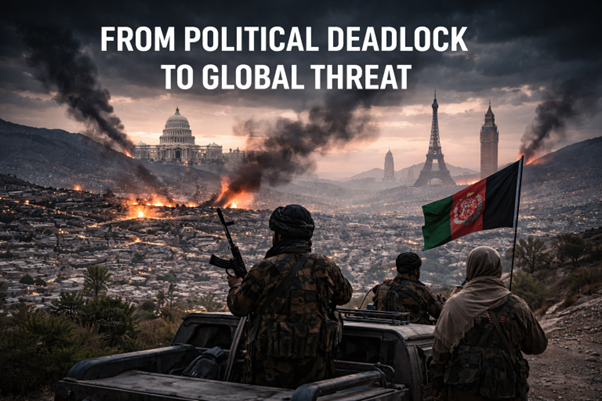

From Political Deadlock to Global Threat
Afghanistan is no longer a distant crisis or a chapter closed in Western policy. It has become a strategic pressure point, where political paralysis, ideological rigidity, and years of international disengagement collide, creating risks that reverberate far beyond its borders. Left unchecked, Afghanistan is poised to become a persistent source of regional instability, shaping security dynamics across Eurasia and challenging policymakers to confront consequences that are already unfolding.
Longstanding structural vulnerabilities—fragile institutions, deep economic contraction, and widespread social exclusion—have amplified humanitarian need and heightened instability. Recent analysis by ACAPS on Afghanistan’s humanitarian, economic, and governance landscape shows that nearly half of the population requires urgent assistance, driven by economic collapse, restricted access to basic services, and exclusionary governance practices.
Humanitarian relief without a parallel political strategy has increasingly substituted for policy rather than complemented it. This approach delays accountability, obscures long‑term security risks, and enables both state and non‑state actors to consolidate influence within a widening strategic vacuum. In security terms, apolitical compassion is not neutrality; it is abdication.
The Core Strategic Challenge
A politically isolated Afghanistan does not remain contained. Prolonged exclusion entrenches ideological rigidity and narrows governance capacity, creating spaces where extremist narratives and criminal networks thrive. According to the United Nations High Commissioner for Refugees (UNHCR’s) operational situation data for Afghanistan, mass returns from neighboring states and internal displacement continue to strain already overstretched services and resources, compounding the country’s vulnerability to further instability.
The marginalization of women—through restrictions on education and employment—accelerates institutional decay and erodes human capital, compounding fragility and reducing the country’s ability to govern and recover.
Migration as a Critical Security Variable
Large-scale displacement driven by repression, economic collapse, and social exclusion is not merely a humanitarian issue; it is a security variable. As documented in UNHCR regional displacement assessments, unmanaged migration flows strain neighboring states, destabilize border regions, and create exploitable pathways for criminal and extremist networks.
Timing is decisive. Once displacement shifts from episodic to structural, containment becomes exponentially more difficult. Afghanistan’s prolonged political stagnation risks transforming population movement into a permanent destabilizing force rather than a temporary crisis.
Why Past Strategies Failed
Western approaches to Afghanistan have been defined by oscillation rather than strategy—first by overreach, then by abrupt disengagement. Large-scale interventions underestimated social and ideological complexity; withdrawal overestimated the stabilizing power of neglect. Both failed for the same reason: they did not address Afghanistan’s ideological silos in phased, sequenced ways. This is a shortcoming documented in The International Crisis Group’s analysis of Afghanistan’s insurgency and governance challenges, which highlights how exclusionary political dynamics and lack of inclusive governance undercut stabilization efforts.
Ideological Silos
Afghanistan’s most persistent vulnerability is ideological siloing. Rigid political and religious belief systems were neither systematically engaged nor incrementally integrated. They were confronted abruptly—provoking backlash—or ignored altogether, allowing them to harden into closed systems resistant to compromise.
Comparative conflict research demonstrates that ideological rigidity intensifies under prolonged political isolation, particularly when governing authorities face no calibrated incentives to moderate behavior. Studies by The International Crisis Group’s analysis of Afghanistan’s political exclusion and rights deterioration show that exclusionary governance reinforces absolutist narratives, narrows elite bargaining space, and increases reliance on coercion over legitimacy.
Political inclusion cannot be treated as an end-state concession. It must be pursued as a sequenced process that gradually widens participation, restructures incentives, and reduces the perceived costs of moderation while increasing the costs of repression. Sustainable stability emerges not from forced ideological collapse, but from engineered incentive environments that make accommodation strategically rational.
Why Timing Is Critical
Afghanistan is approaching a structural inflection point. Economic exhaustion, governance deficits, and social repression are now mutually reinforcing. If current conditions persist, the country risks entrenched stagnation, accelerated human-capital erosion, and intensified migration flows that magnify regional and global security risks.
Historical evidence shows that forcibly toppling regimes absent viable political alternatives does not restore stability; it regionalizes conflict, increases civilian harm, and multiplies spillover effects. This is documented in post‑conflict stabilization and reconstruction lessons from Afghanistan and Iraq that highlight how military solutions without political sequencing often deepen instability.
The Strategic Cost of “Wait and See”
A Western wait-and-see posture carries consequences well beyond Afghanistan. Strategic competitors are actively expanding diplomatic leverage, securing access to critical resources, and consolidating structural influence. These trends are increasingly noted in International Energy Agency assessments of critical mineral competition.
Control over Afghanistan offers positional power over transit corridors, regional connectivity, intelligence access, and strategic depth linking South Asia, Central Asia, and the Middle East. Strategic absence today risks strategic irrelevance tomorrow.
Preventing Spillover: Inclusive Governance and Regional Deconfliction
Future security threats rarely emerge through open conflict; they develop when governance vacuums harden into permanent features of the strategic landscape. A functional, inclusive, and accountable governing framework in Afghanistan—one that integrates marginalized groups, including women—is the first line of defense against regional spillover.
Inclusive governance must be paired with structured regional deconfliction mechanisms. Joint regional deconfliction cells enabling intelligence sharing, border incident management, counterterrorism coordination, and migration monitoring are a good start. These align with what the Global Counterterrorism Forum and related United Nations frameworks that support cross‑border cooperation refer to as “good practices on border security and management in the context of counterterrorism.”
A New Strategic Posture: Innovation, Not Intervention
The alternative to paralysis is neither military intervention nor premature normalization. It is policy innovation grounded in incrementalism. Gradual political integration reduces shock, limits disruption, and minimizes incentives for violent resistance.
A viable framework must expand political participation verifiably, protect women’s rights as binding benchmarks, reduce ideological silos through sequencing rather than coercion, align regional stakeholders around predictability, and tie engagement to measurable outcomes. This is influence without occupation—shaping behavior through incentives, legitimacy, and calibrated pressure rather than force.
What the International Community Must Do
Engagement by the international community must be operational, measurable, and enforceable. Dialogue without leverage is performative. Afghanistan requires an “inclusion-for-concessions” framework based on three non-negotiable principles:
- No symbolic recognition or reputational laundering: Technical engagement must remain conditional and reversible; no interaction should confer political legitimacy.
- Women’s rights as binding benchmarks: Girls’ education and women’s employment, particularly in health, education, and governance, must be explicit, verifiable conditions. Failure halts engagement, consistent with UN Women reports on Afghanistan.
- Independent verification with automatic snapback: Compliance must be independently monitored, with suspension or rollback for violations as recommended in UN Department of Peace Operations monitoring protocols.
A phased operational framework should follow:
- Phase 1: Expanded humanitarian and technical access following verified baseline compliance.
- Phase 2: Reversible, targeted incentives tied to verified progress.
- Phase 3: Limited technical or diplomatic dialogue contingent on sustained compliance.
A transparent dashboard, managed by the UN and independent observers, should track a small set of measurable indicators, including girls’ schooling, women’s employment, access to aid, and arbitrary detentions.
The Choice Ahead
Afghanistan is no longer a future concern; it is already embedded in current and future global security calculations. The structural drivers of risk—political exclusion, ideological rigidity, demographic pressure, and regional competition—are now mutually reinforcing.
The only remaining question is whether the international community manages this reality proactively through calibrated engagement and enforceable conditionality, or confronts its consequences reactively through intensified extremism, destabilizing migration flows, and diminished strategic relevance. Delayed engagement does not preserve neutrality; it raises downstream security costs and forfeits influence.