





Text Without Context is Pretext – Ukraine today, Taiwan tomorrow?
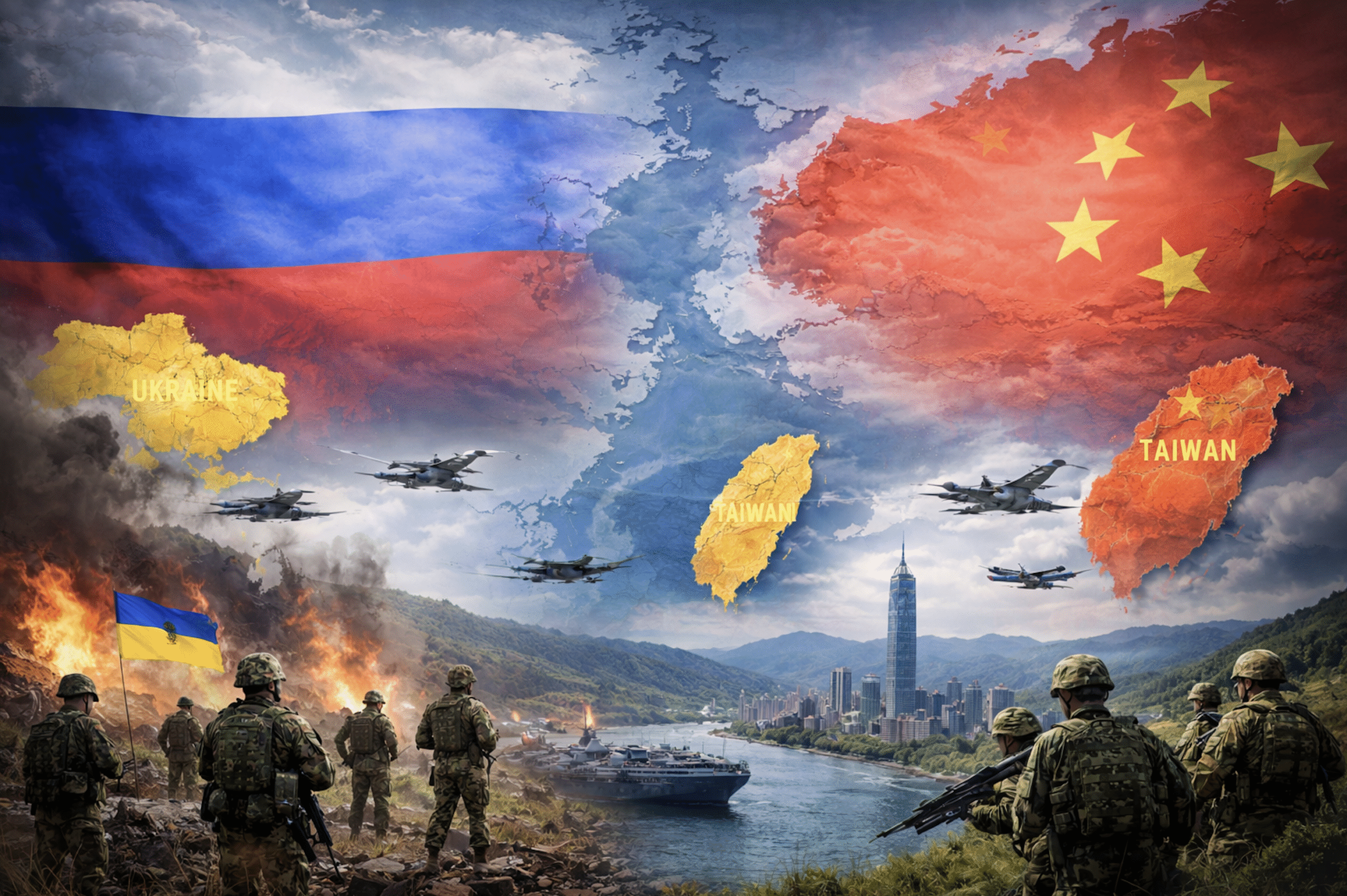

Russia and Ukraine; China and Taiwan. Can we predict an irridentist comparison between two similar yet different contexts?
“Ukraine today; Taiwan tomorrow”. “Taiwan 2027”. We hear the parallels and implications of a Russian-esque invasion of Taiwan repeatedly, and the textual statement makes sense. But how legitimate is the parallel when context is provided? There is some level of justification to highlight an advertised interest in the Peoples’ Republic of China (PRC) acquiring the island of Taiwan, also called Formosa from Portuguese, more formally known as the Republic of China (ROC). Both Ukraine and Taiwan experienced social revolutions in 2014. Both Ukraine and Taiwan have strong ties to larger states in governance and culture. And both states, while they do have populations closely tied to the larger state, have large swaths of the population with unique cultural heritages and social values.
Without nuanced context, our perception of the parallel between Russia invading Ukraine and China invading Taiwan is merely pretext. This overview is a summary of key points of a complex and much broader understanding: there are many details omitted or bypassed for space and time.
History and identity have carried into both situations’ narratives. Just listen to the current Russian president pontificate about how his interpretation of history justifies irridentism to understand that understanding context is imperative to understanding that contest.
So, what are some of the parallels between the Russia/Ukraine and China/Taiwan situations? And what are some of the significant differences? Let’s look at both Ukraine and Taiwan through some societal lenses (inclusive of but not exclusive to corruption, economies, natural resources, historical relationships, and cultural variables) to highlight potential similarities and some potentially significant differences. We will be targeting “pre-invasion” time frames for both: Ukraine will be addressed as prior to 2022, and Taiwan as of 2025 is being considered, also, as this would be aligned to “pre-invasion” time frame.
Ukraine and Taiwan: Similarities
There are some incredibly interesting parallels between Ukraine and Taiwan in their relationships with both Russia and Communist China, outside the assertion of nationalistic possession of the larger state to the smaller. These similarities could illustrate structural vulnerabilities to incursion and acceptance of outside influence or control. Whereas in this situation, the catchy phrase “Ukraine today, Taiwan tomorrow” emphasizes these similarities with either a direct or subconscious surface-level alignment with rationalized irridentism.
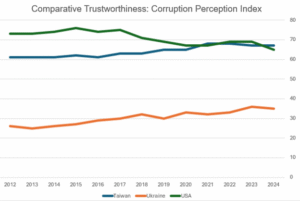
Corruption. Both Taiwan and Ukraine have political systems that are seen, by their people in varying levels, as corrupt. However, it could be argued that there are differences – be they regional, contextual, or cultural – in what constitutes acceptable corruption versus that about which the people consider “too much”. Considering the Corruption Perception Index from which the graph below has been extracted (using the USA as the control), within which country’s score is the perceived level of public sector corruption on a scale of 0-100 where 0 means highly corrupt and 100 means very clean, one can see that Ukraine has been considered highly corrupt, and Taiwan has remained comparable to the USA. However, both Ukraine and Taiwan have used corruption charges as a weapon, even using questionable legal actions to undermine opposition.
In 2011 Ukraine, President Victor Yanukovych brought abuse of power corruption charges against his political opponent, former Prime Minister Yulia Tymoshenko for signing a 2009 gas deal with Russia that resolved a supply crisis. Yanukovych claimed that caused significant losses for Ukraine’s state-owned gas company. The European Court of Human Rights later ruled that Tymoshenko’s politically motivated jailing violated her rights.
In addition to politically motivated corruption, Ukrainian has a history of physical violence. In the years preceding the 2014 revolution, increased transparency in Ukraine revealed escalating patterns of government violence, frequently involving police operating under political protection or hired thugs whose actions authorities failed to investigate. The 2010 presidential election attracted widespread criticism for thuggery and corruption. One particularly revealing indication of the normalization of corruption emerged in the fictional 2010 presidential candidate Lupan, who openly stated his intent to rig the election and, upon assuming office, embezzle state funds. “When you see my villas, you’ll understand why,” he claimed.
The Corruption Perception Index ranks Taiwan as less corrupt and not tied to overt violence like Ukraine. However, corruption issues surrounded multiple politicians such as Ko Wen-je, head of the Taiwan People Party aka the White Party (the one that aspired to bridge the gap between Democratic Progressive Party aka the Green and the China Kuomintang aka the Blue through catering to the middle). In 2024, after a strong showing in the presidential election, prosecutors arrested him on corruption charges even though he came in third place. He denied charges of accepting bribes and has, since, been released on bail with residential restrictions lifted. This seems to be an example of investigation and subsequent corruption charges to remove a powerful adversary – or potential adversary – from the playing field. Although corruption plays out differently in the countries, in both in Ukraine and Taiwan, leaders have used corruption charges to invalidate an opponent. Corruption is not reason enough for the larger neighbors to invade the countries.
Historical Imposition by Larger Neighbors. Ukraine experienced multiple “Russian” settlements within Ukrainian territory through both the Roman Empire and the USSR, especially in the industrialized eastern areas and southern ports. Russian language and culture were dominant; Ukrainian language and culture were seen as “base”. After Ukraine separated from the USSR, many Russians remained in Ukraine. In 2001 29.6% of the population identified as culturally Russian.
In Taiwan, after the Chinese Revolution, the ousted upper class lead by Chiang Kai-shek’s Kuomintang (KMT) party (more on this later) rapidly became the ruling class and implemented mandatory Sinicization which enforced Chinese culture, rewrote history to be Chinese-focused, and renamed street and public spaces to reflect Chinese culture while suppressing indigenous and Japanese influence. Efforts to resist were met with martial law enforcement, resulting in estimated 10,000-20,000 Taiwanese killed.
History of imposition is not compelling enough reason to invade.
Language Integration. The Soviet Union and Russian Empire spoke Russian and considered the Ukrainian language as a “lesser” and “back woods” dialect of Russian. Yet the Ukrainian language survived in rural, agrarian, and domestic settings.
The USSR permitted this use of native minority languages but forced Russian as the language of government and commerce.
Just as Russia forced Russian language and usage, in Taiwan the KMT’s Mandarinization forced people to learn and speak Mandarin and follow traditional Chinese customs. KMT leadership wanted Taiwan to be a unified Island with a clear Chinese identity. Taiwan’s population prior to KMT rule consisted of indigenous tribal groups, many culturally closer to Indonesians and Peloponnesians. These Taiwanese spoke a multitude of Austronesian languages such as Atayalic, Paiwanic, Tsonic and Tao (among others) now considered endangered languages. In addition, many Han Chinese migrants spoke Hakka and Hokkien, other Chinese dialects. And in certain areas where Japan’s rule left influence, people spoke Japanese.
Whereas both countries did learn and adopt the language, resistance to control by their larger neighbors continued through language. For example, the different meanings for “Ukraine” in both Ukrainian and Russian, created a tension of legitimacy. In Russian, окраина (transliteration: “okraina”) means “the outskirts” from the main cities, a rural frontier. The Russians even use a preposition for Ukraine that is not used for any other countries: Ha (transliterated: “nah” and literally translated as “on” is used for Ukraine and no other country) versus B (transliterated: “vuh” and literally translated as “in” and the article used for every other country), implying that Ukraine is a region with no borders rather than a distinct entity. This is the reason Ukrainians have strongly backlashed against official documentation or statements referring to them as “The” Ukraine. Contrastingly, in Ukrainian language, країна (transliteration: “kraina”) means country or land; the preposition y (transliteration: “oo”) means “in”, creating the combination Україна meaning “inside the country”. In short, Russian interpretations of even Ukraine’s name implies diminutization and marginalization. And name interpretation also explains why Russia sees Ukraine as part of its “outskirts” and Ukraine sees their country as an independent state. This simple illustration of interpretations of Ukraine’s name illustrates two diametrically opposed perspectives of Ukrainian legitimacy.
And, in Taiwan, the continued use of Traditional Chinese characters for the written language opposed to the adoption of Simplified Chinese used in China means that written communications between the countries are dramatically different and not understood.
In both Ukraine and Taiwan, their native tongue and cultural identities were considered “less”. While not “mainland China”, the KMT Chinese imposed alignment with their neighbors with the unfulfilled intention of becoming the ruling party of China again. Instead, the alignment in culture and language left China considering Taiwan part of China. Even though Ukraine existed as a unique entity within the USSR, Russian language was required for success in the USSR, and accents were a rapidly identified – and judged – differentiator. In sum, native speech was marginalized and repressed, and language enforced labels of societal value and legitimacy. Language may be a way to force culture and communication but again is not reason enough to want to invade and control a country.
Religious Adaptation. Religious affiliations and commitments have been seen as affecting behavior, both directly and indirectly. Anthropology has often been the primary field for analyzing effects of religion on society. Clyde Kay Maben Kluckhohn defined culture as “the total way of life of a people, the social legacy the individual acquires from his group” which is inclusive of religion, especially when viewed in the total cultural matrix. Clifford Geertz emphasized that religion affects culture; culture affects values. And values affect action. Religion that is not controlled by the state creates a prospective check on state autocracy: religious values and priorities create another, and often very strong, avenue for social action. When considering the actions of both prospective irridentist states, neither have substantive societal “moral compasses” outside the state itself. Those states with active religious practices among the population provide complimentary and sometimes challenging perspectives to state action.
Both Ukraine and Taiwan are more religious than their larger neighbors who embraced communism and suppressed religious practices. Following separation from the USSR, Ukrainian experienced an overt increase in religious practices. The Ukrainian orthodox church continues to grow alongside smaller religious practices of varying affiliations, including ancient goddess worship. The Russian Orthodox Church, which claims 71% of Russia’s population, has a long history of being entwined with the KGB/FSB and has used to advance the ideas of “Russkiy Mir” (Русский Mир, translated as Russian World/Peace) to advance Russian National Identity. Regardless, 20.2% of Russia’s population is religiously unaffiliated. In Taiwan, 93% of the population identify themselves as Buddhists, Taoists, or practitioners of folk religion. This is in stark contrast to Communist China’s 89.3% of religiously unaffiliated population. In both Communist China and Russia, the state-sponsored belief structure is dominant whereas in both Taiwan and Ukraine, the population has “voted with their feet” regarding their religious affiliation.
Ukraine and Taiwan: Differences
Regardless of the many surface level similarities between Ukraine and Taiwan, significant economic, resource, physical, historical and cultural variances paint a different picture for each region. The differences in these deeper structural areas create important reasons as to why Russia invades Ukraine, yet China does not invade Taiwan. While considering the differences, it is good to emphasize a simple business priority: cost benefit analysis. What is the anticipated “return on investment” (ROI) for committing military force for economic, social, or resource returns?
Economies. The economies between the two regions vary significantly. Ukraine’s economy struggled to grow coming out of the USSR’s dissolution, and even into the late 2010’s, educated and skilled laborers actively sought employment outside Ukraine. The pensioners and military veterans wrestled with absurdly low pensions. Corruption and rampant criminality enabled abundant illicit wealth while the hard-working masses struggled. On the Economic Freedom Index which measures the impact of liberty and free markets around the globe, Ukraine scored in the low 50’s in the 5 years leading up to the 2022 invasion, often scoring right next to Pakistan. Russia’s score was a small level higher but not by much.
Taiwan, on the other hand, experienced an explosion of economic growth with their computer chip industry. Taiwan’s population is economically comfortable, values their comfort, and scores in the high 70’s and low 80’s over the past 5 years on the Economic Freedom Index: this is ensconced within the Nordic states’ evaluations. Taiwanese live comfortably and stable. They have what they need and are not struggling to make ends meet. For a comparative scoring, China has been consistently in the high 50’s, scoring comparably to various African states.
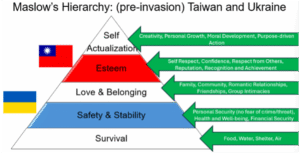
Maslow’s hierarchy is an easy snapshot of human needs from basic survival to growth, and it emphasizes how humans build up when their more basic needs are met. While not an absolute or predictive model, Maslow’s Hierarchy is a general framework for understanding human motivation. The placement of both Ukraine and Taiwan were templated based off the Economic Freedom Index. Ukraine’s years of economic instability enabled rampant criminality: Ukraine, prior to Russia’s 2022 irridentist invasion, was pushing between the 2nd and up to the 3rd level of Maslow’s pyramid. Research has shown clear correlations between levels of desperation and action with how stable a community feels. Taiwan may experience corruption, but the levels of criminality, threat, and financial instability are nowhere near comparable to Ukraine. Taiwanese are content on the 4th level and push towards the pinnacle.
Maslow argued that behavior is goal-oriented, with unsatisfied needs driving actions. No one wants to go down the pyramid: only up. In the case of some parts of Ukraine, memories from the USSR provided a higher level on the pyramid with stability of expectations, opportunities, and provisions. For other parts of Ukraine, the USSR bottomed out the pyramid through sponsoring incidents like the Holodomor (great famine). As for Taiwan, China does not offer a step up on this pyramid but rather a step down. If China actually threatened invasion, thus causing a step down from esteem and self-actualization to safety and stability on the pyramid, we predict that survival instincts would encourage Taiwanese to relocate thus decreasing both the value of resources on the island and any legitimacy of the take-over.
Considering the ROI, while Russia’s attack made sense, a kinetic Chinese attack on Taiwan in the conventional sense does not make sense. The Chinese prospective ROI for an invasion is comparatively low. Taiwan’s valuable economy would be devastated, the population upset, and Taiwan’s incredible infrastructure damaged. Russia’s ROI, especially if she gains control of Ukraine’s East (Donbas through Crimea), is exceptionally high. She doesn’t need the people or most of the buildings: she needs the land, the port, and what is beneath the land. If there is ultimately a stalemate, economically, and the Donbas becomes an independent area or free trade zone, Russia’s patronage networks and businesses could have an exceptional ready access to the European Union markets.
Cultural variables of the larger state. Culture symbolizes the shared behaviors, beliefs, values, and customs passed down through generations. The Chinese and Russian cultures lend to very different approaches in asserting dominance, a key indicator for understanding how they would ultimately seek to control another state.
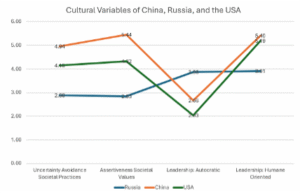
Four cultural indicators, extracted from the Globe Project research in 2004, highlight insightful differences between China and Russia (using the USA as a comparison). These are general trends across societies and should be seen as such.
First, Uncertainty Avoidance, defined as “The extent to which a society, organization, or group relies (and should rely) on social norms, rules, and procedures to alleviate unpredictability of future events. The greater the desire to avoid uncertainty, the more people seek orderliness, consistency, structure, formal procedures, and laws to cover situations in their daily lives.” Chinese people actively avoid uncertainty whereas Russians exist in a world of uncertainty; Chinese are less likely to take a risk than Russians. Practically speaking, Chinese are more likely to methodically plan. They will work out options and engage when they are quite confident of success: they’re patient and will take generations to build that confidence. Russians, on the other hand, will more often charge. Uncertainty may be a threat; being assertive in the face of a threat is strength.
Second, Assertiveness, defined as, “The degree to which individuals are (and should be) assertive, confrontational, and aggressive in their relationship with others.” On this scale, where the higher number is less assertive, Russians are exceptionally assertive in comparison with the Chinese mindset that is, quite definitely, not. Assertiveness lends itself to a more aggressive assertion of dominance, such as a physical invasion. Russians are more likely to attack and invade; the Chinese are more likely to work an arrangement and build leverage for control.
Third, Participative Leadership, defined as, “The degree to which managers involve others in making and implementing decisions. It includes two primary leadership dimensions labeled (a) nonparticipative and (b) autocratic (both reverse scored).” While considering Russian and Chinese scoring, Russia demonstrates centralized control that drives subordinate action. In contrast, Chinese decision making is more reflective of a collectivist value: while we might call the PRC “authoritarian”, it is collectivist. This mentality lends itself to casualty aversion for kinetic planning: when casualties are expected to mount, the collectivist leader backs off. Looking through this lens, the Russians do not consider input from subordinates: it’s a very top-down system of decision making where the top pushes subordinates to complete the higher up’s objectives, regardless of cost. Meanwhile, the Chinese are more likely to consider input from subordinates and, when the subordinates push back regarding an operation, the Chinese are more likely to listen.
Fourth, and finally, Humane Oriented Leadership, otherwise understood as “considering your people” or, more formally defined as, “supportive and considerate leadership and includes compassion and generosity. This leadership dimension includes two primary leadership dimensions labeled (a) modesty and (b) humane orientation.” As one can see, Russians are notably below both Chinese and the USA: Russia will roll through things with far less of a concern for their people. Chinese, on the other hand, are conscientious regarding Chinese loss. A high casualty creating operation is inherently counter to Chinese leadership values: this has direct impact on kinetic invasion plans versus control by other means.
Natural Resources. Ukraine is exceptionally rich in natural resources, boasting vast reserves of fertile soil, making it a global breadbasket. The mining industry of the east houses incredible mineral wealth, including significant deposits of iron ore, titanium, manganese, uranium, graphite, lithium. On the other hand, Taiwan’s resources are not in the earth: they’re incredibly advanced technical capabilities and access to an educated population.
Killing residents, destroying research operations, and manufacturing plants would destroy the economic value of controlling Taiwan. Whereas Ukrainian assets can be seized and occupied by those familiar with their use, without need to retain civilians: many of those same Ukrainian power facilities, mines, and ports were built by the USSR. Again, returning to the ROI assessment, one can see that the natural resources of Ukraine, at least those of value to the Russians, do not need Ukrainians. The minerals can be extracted by other miners. As for the technical research and nuclear facilities – well, much of this was Soviet in the first place. Russia could source alternative staffing.
Physical Territory. Ukraine is comparatively flat and adjoins the Russian border with regular cross-border travel by road, rail, and foot. The official and internationally acknowledged borders have been “porous” with the historical USSR patronage system (those “under the umbrella”) continuing supply chain operations between the USSR and Ukraine. Soviet Rail systems, with USSR gauged width, in Ukraine have enabled rapid supply and movements between Ukraine and Russia; however, Ukraine is not so thoroughly linked with European rail networks and only opened its first standard gauge rail line in 2025.
Taiwan would be very challenging to invade Normandy style. The mountainous island, covered in dense jungle, has a handful of assaultable beaches, some accessible airports, and a few other open areas: and the Taiwanese military is quite aware of which vulnerable spaces can be targeted. An actual invasion would likely have high casualties from the defenders and natural barriers. If the Chinese military launched a full-scale invasion, the very infrastructure China desired would be damaged.
A physical invasion of Ukraine is a logical extension of Russian capability, especially into the eastern areas where even the old railroads maintained Soviet gauges. An uninvited physical invasion of Taiwan would not likely have a positive ROI.
Ukraine and Taiwan: Traditions and History
If we wish to understand what someone is likely to do, we assess their previous actions with contextual variables. Historiographical understanding of a conflict’s origin creates a more nuanced understanding of the present, enabling more realistic predictive analysis. We understand the culture as it is, integrating knowledge of what is done within the context of what we perceive. However, the origin of this mindset helps create a trajectory for more effective predictive analysis.
Responses to uprisings, acceptance of military involvement by the ruling party, acceptance of differences, and games give us insights. A culture’s sporting events, especially events simulating military planning, explain a lot about how that culture engages in combat. These games create a mindset for how one works and structures their competitive engagements. While not perfectly parallel, especially in the day of cyber and space domains increasingly affecting the operational environment, the use of games can be a strategic logic metaphor. How does one win? What does it take to win? And how does one see “loss”? Through these following discussions, we will see the Russian penchant for dominating their board through conquest and defeating opponents whereas the Chinese emphasize domination through controlling the space. The mindset for conquest versus control affects prioritization of means: might one default to military might or economic coercion?
Ukraine and Russia
Ukraine and Russia both are exceptionally proud of their proficiency at chess. It is a common pastime and a prestigious, competitive game in both countries. Chess is a game of strategy, of planning multiple steps ahead, wherein different pieces have different values, can make different moves, and, ultimately, are protected or sacrificed. When you take a piece, you land on its square: that piece is now removed from the board. Pawns typically are sacrificial; however, if they survive the gauntlet, they can be promoted. The game concludes when the winner places an opponent’s king in checkmate.
This aligns with Russia’s approach of physically occupying a space, sacrificing conscripts, and pawns rewarded with a promotion into queens after working their way through the gauntlet. While some of the Russian techniques use “soft power”, Russia’s primary approach uses physical occupation by way of force as a justification of ownership.
This idea of justified ownership has a long history. The populations of both Russia and Ukraine have a shared history traced back to Vikings, Rus steppe warriors using force to invade. Some argue that Russia is an offshoot of Ukraine or Ukraine of Russia… or even that either language could be a dialect of the other. Yet witnesses to the early overlapping histories died many generations ago.
But living memory is more likely to affect action: many Ukrainians remember the stability of the USSR, and both Russians and Ukrainians have often spoken of close similarities between their societies. However, over the last 30 years, many of the horrors of the USSR have surfaced. An example is the Holodomor, or great famine, forced starvation and killing of the Ukrainian poor caused by the Russia elite to grab more food, resources, and comfort. Many of those who suffered during the USSR rule are still alive or are a single generation removed. And the youth are increasingly finding more records of previously archived horrors committed against their parents, grandparents, and great-grandparents.
Ukraine sought to create its own identity after the USSR dissolved. The 1990’s brought difficulties as the USSR suffered an economic decline leading up to its dissolution that further broke down trade routes, organizations, and established connections organic to the USSR. This left a need for stability and resource movement that was efficiently filled by criminality and thuggery. In the early 2000’s, this led to growing tension in the political sector between power-breaking factions. Ukraine’s politics swung from the East and Russia to the West and NATO like a clock pendulum powered by drunken bulls. This was a zero-sum political climate. In this period, Ukraine’s government handled dissent in a repressive manner rather than through conciliation or negotiations. Whether you were pro-East or pro-West, if you were in power, you aimed to squash the opposition by removing them from the board. In 2014, protesting in the Kyiv Maidan grew: the national guard beat, shot, and killed to attempt pacification. The initial several months of conflict at the Maidan (and elsewhere) was not a time of understanding or conciliation but rather lethal assertions of power that brought broader contention through the fleeing of ousted government leaders and Russia’s invasion. Winners survived, and losers died or ran away. This power struggle with the use of force presents a key difference between Taiwan and Ukraine.
Following the Maidan riot, Ukraine focused on building toward internal unity. But actualization of their policies, especially their language and education policies, appeared to result in a sense of compelling a Ukrainian shared identity through threat and marginalization rather than on drawing the population together. In this case, it is very important to note that Ukraine came out of the 2014 revolution with a growing drive to focus on the non-Russian aspect of its heritage, intentionally compelling Ukrainian language, culture, customs, and values over Russian, often at both social and official levels.
Taiwan and China (PRC)
China and Taiwan are another, quite different, situation. First, let us consider how one dominates and wins contests. The Chinese game of “Go” is far more indicative of Chinese mindset and approach to warfare than Chess. In the game of Go, all pieces – or stones – have the same value, capabilities, and appearance. It is a more community centric approach where all the pieces collectively affect controlling space rather than one piece dominating another at sequenced intervals. Yes, there is sacrifice. But the sacrifice is not an individual being sacrificed to draw out the enemy or create a trap or kill an opponent – it’s a collective sacrifice for control of greater space. Also interesting is that the Go pieces, once controlled, are not necessarily removed from the board like in chess. The stones still occupy their space but become part of the dominant group: black stones surrounded by white are considered white, regardless of the stone’s actual color.
The focus of Go is not domination: it is a methodical establishment of control to win. This is far more in alignment with Chinese warfare methods and doctrine than Chess.
As Taiwan sits in a strategic position only 100 miles off the coast of China, they have a long-intertwined history. Many of the dynasties incorporated Taiwan as a province or peripheral territory. Merchants, farmers, and fisherman interacted for centuries. During the Sino-Japanese war of 1895, China ceded rule of Taiwan to Japan. Japanese control of Taiwan lasted for about 50 years, until 1945 when the Japanese surrendered after World War 2 when they granted jurisdiction of Taiwan to China.
Shortly, thereafter, in 1949, Chiang Kai-shek, the general and president of China and his KMT lost to the communists. With this defeat, the KMT government, still internationally acknowledged as the legitimate government of China, at that time known as the “Republic of China” (ROC), withdrew to Taiwan taking their upper-class attitudes, expectations of privilege, and self-proclaimed authority of China with them – and the seat on the United Nations Security Council. Chiang Kai-shek swore to re-unify China under his and the KMT’s authority, retaining the name “Republic of China” while ruling in Taiwan. Meanwhile, mainland Communist Chinese leadership called their country the “People’s Republic of China” (PRC) to align with the communist vision.
From 1949 until the 1970’s, the PRC “sealed” its borders to outside influences and focused on China’s self-reliance, national security, and ideological purity. Mao Tse Tung, leader of the PRC instituted policies such as the “Great Leap Forward” of 1958-1969 and the “Chinese Cultural Revolution” of 1966-1969 to bring his vision to China as a country organized into self-sufficient communes where the collective spirit encourages individuals to give effort for the good of the group. Many of Mao Tse Tung’s philosophies and quotes exemplify the culture of unification through assimilation rather than initiating force: “I shall not attack unless I am attacked; if I am attacked, I will certainly counterattack; I counterattack only after I am attacked. Up to now I have not given up this principle.”
Much of the political tensions in Taiwan from the 1970’s to the 2000’s centered around whether Taiwan (ROC) would seek closer ties with the PRC or whether Taiwan would seek to refine its own separate identity, outside of being seen as the “ROC”. Many watched the 1997 reunification of Hong Kong to China to see how much control China would assert there. Hong Kong served as China’s “window to the world” for global trade when its borders remained closed. By leaving Hong Kong rule with more flexibility, Taiwan would not feel as threatened. We saw history play out that China regained control over Hong Kong without force and integrated the region into Chinese rule almost seamlessly. The “Green” party emerged in the late 1990’s as a democratic counterbalance against the KMT. It was primarily composed of academics, students, and people from the non-governmental organization sector of Taiwanese society.
Fast forwarding several years to 2014: Taiwan, like Ukraine, had a protest movement that was student driven. This movement, though, had a very different outcome. The Sunflower Student Movement was short-lived and non-violent. Protestors occupied government spaces and, within a comparatively short time, entered negotiations with the government to address their concerns. There was no bludgeoning. No shooting. No death. This was nothing like what happened in Ukraine.
Since 2014, there have been several other protests, as one can expect in a changing democratic society. These have generally been met with reason, logic, and consideration. There were peaceful transitions between the Green and Blue parties through the 2000’s, unlike in Ukraine when party transitions, especially in the early 2000’s, were faced with tools such as assassinations and thuggery. Tensions in Taiwan began to rise in the late 2010’s with concern of PRC incursion. The KMT party was advocating increased economic interdependence with the PRC. But, in the light of this and soon after the time of Russia’s Ukrainian invasion, Taiwan experienced another presidential election in 2024. The Green party, not the old KMT and pro-Chinese Unification Blue party, won. And the transition was peaceful.
Taiwanese might have voted against the Blue party out of concerns that if Russia was not held accountable in their invasion of Ukraine, the PRC may not be held accountable in an invasion of Taiwan. Taiwan might have voted Green to retain greater economic opportunity provided by independence from China. Or they might have voted Green to keep democracy. The point is that Taiwan’s dominant political party and a majority of citizens supported a separate, non-communist, Taiwan.
Conclusion
China and Russia have significantly different approaches to expansion and growth, and drawing a parallel between them with minimal nuanced context is far less likely to enable effective predictive analytics. China aspires to be capable of invading Taiwan by 2027: this is text. The context of culture is a key variable needed to differentiate between a pretextual assumption of a kinetic invasion and text which asserts capacity goals. Diplomatic, Information, Military, and Economic means (DIME) are the four ways within which a state traditionally asserts its influence. Russia’s cultural analysis, much abbreviated in this consolidated assessment, illustrates a penchant for kinetic assertion of power, complimented by information, thus appears to be “IM” dominant, with information shaping the environment and military kinetically asserting itself, in the DIME model. If Russian legitimacy is at all threatened or perceived as threatened by senior leadership, then Russia would be more likely to use Military force. China appears different. China looks to be more DE – Diplomatic by Economic means. The military gathers information for backing up the economic legitimacy rather than building it. Text without context truly is pretext.
Remember the difference between Chess and Go. China’s military strategy emphasizes “active defense” and “systems confrontation” through a “whole of nation” approach to conflict. Chinese military collectively aims for control rather than a kinetic invasion. The PRC does not seek a hot war. Rather with an approach to conflict like in the game Go, China seeks to control opponents through controlling systems (“systems” being understood as communications, logistics, command/control, information) in both the civilian and military sector, the Taiwan Relationship Act becomes less threatening.
There are many purported arguments rumbling online or in discussion as to why Russia actually invaded Ukraine: port access, reversing Putin’s plummeting approval ratings, Ukraine’s advertised interest in joining the EU and NATO, to clean out the prisons, to battle harden their troops, to increase their Slavic population through reallocation of Ukrainian born children, or even to justify cracking down on those who were starting to encourage alternative paths for Russia’s future. One could build and present statistical support for each of these arguments as there is a clear correlation. However, during the long-winded whiny speech regarding why he invaded, Mr. Putin finally came to his legal justification for invasion: according to the official statement from the Russian president, he lawfully invaded Ukraine in an act of collective Russian self-defense to protect Russians living within Ukraine from genocide. While it was challenging to listen to the long-winded Presidential speech, he clearly stated that Russia’s invasion was necessary to stop genocide of Russians through enacting self-defense authorization in accordance with Article 51 (Chapter VII) of the UN Charter.
Regardless of the reason for Russia’s invasion of Ukraine and the surface level parallels between Ukraine and Taiwan, after considering deeper historical and cultural insights, context discourages such a parallel. A situationally enabled economic or social influence in Taiwan seems more likely and beneficial to China. While President Xi Jinping is working towards a military modernization campaign to be completed by 2027, this does not mean that there will be an invasion. The “2027 goal” marks the 100th anniversary of the founding of the People’s Liberation Army (PLA) on August 1, 1927. Further, an actual invasion is counter to historical and modern principles and Chinese social behavior in general. It is also in direct conflict with the current Chinese military doctrine which emphasizes active defense and system control rather than active conflict.
This article did not create a comprehensive comparison between the Ukrainian and Taiwanese situations; it introduced a more culturally nuanced approach to framing geopolitical predictive analysis. First, violence and the physical removal of opposition is not the standard Chinese approach: violence is more often a counterattack, as happened in Korea. Second, China is likely considering a more wholistic control that will bring the Taiwanese “into the fold”, like controlling the area on the “Go” board. A destructive invasion would be culturally illogical and not aligned with traditional behaviors or military thought processes. Third, if the objective is unification, this would need to be done legitimately to “save face”. In the case of Taiwan, re-unification may be advertised, but it will most likely remain in limbo until there is either a direct threat justifying retaliation (like Korea) or a means where the Taiwanese welcome Communist Chinese (like a natural disaster and need for assistance). The Russian invasion of Ukraine did not endear Russian speaking Ukrainians to the Russians; rather, it appears to have caused the opposite effect. The PRC would take notice.
Does this mean that Taiwan should just stop setting up defenses? No. Or that there is no threat of a Chinese invasion by Diplomatic, Information, Military, or Economic (DIME) means? No. This simply emphasizes that the likelihood of a Normandy-style invasion is far less likely, especially considering culture, than other means of gaining control of Taiwan. If the purported threat was Mongolia or portions of Siberia, with the abundance of natural resources from the earth, low levels of public observation, easy and open access, and Russia’s military predominantly focused on Europe in defense, that might be a different comparison for a kinetic jurisdiction assumption.
Text without context is pretext. While “Ukraine today, Taiwan tomorrow” sounds disconcerting, and the highlighted capacity to invade as of 2027 puts an actual date to the concern, this is text. Context is more nuanced. Culture affects behavior, and perception of parallels through one lens may not show parallels as much as we realize. As 2027 is the PLA centennial, it makes sense to set an august measurable capacity in alignment with their 100-year birthday. The physical invasion of Taiwan across water through kinetic military action, Normandy style, is increasingly improbable when considering the context of Chinese culture and social values, especially when also compounded with Taiwan’s defendable terrain.



