





The Code War: A Race to What End?

Abstract
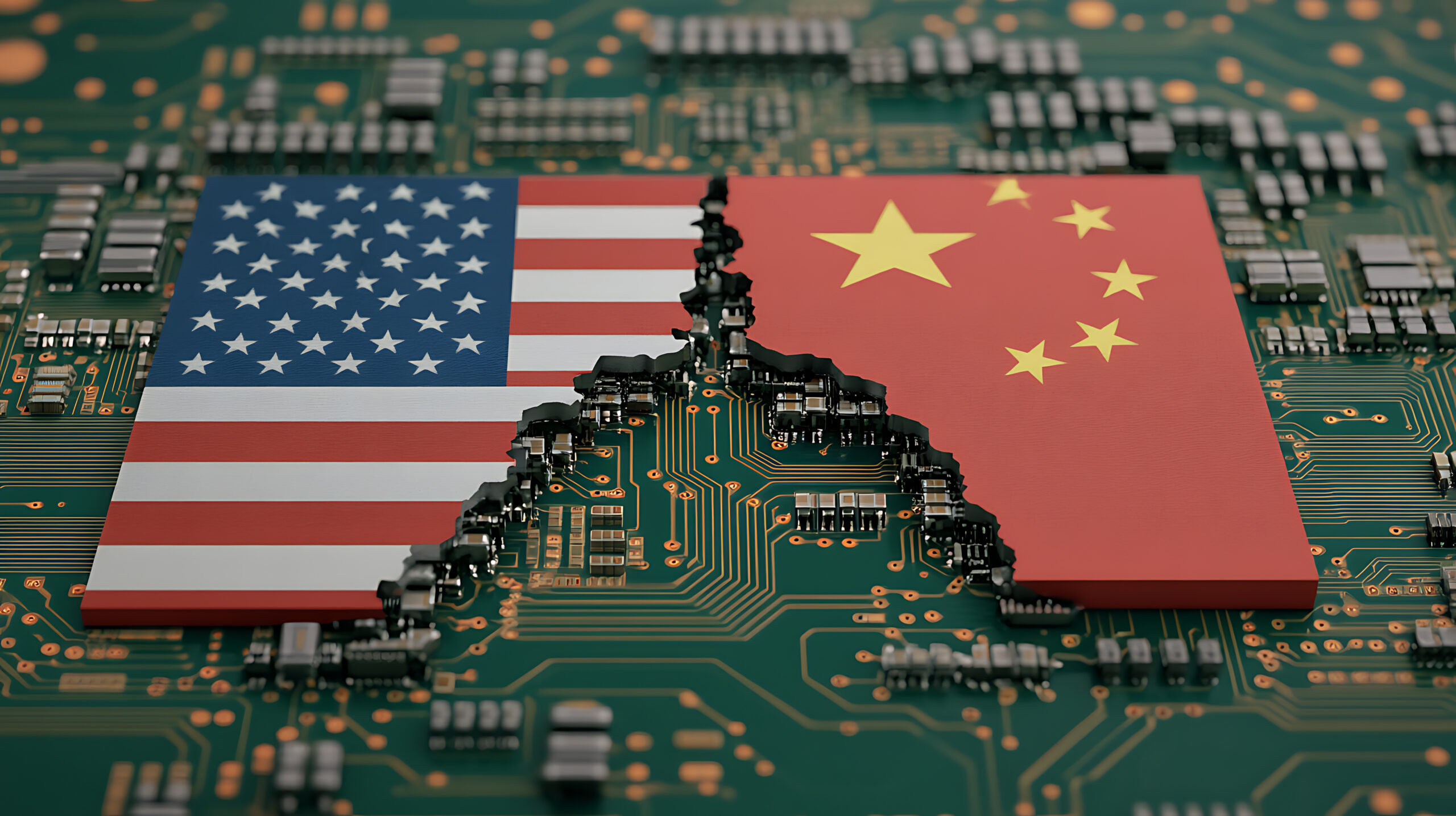
This article explores the prophecies provided in science fiction as a warning for the current Artificial Intelligence rivalry between the United States and China. It argues that the dangers in the pursuit of Artificial General Intelligence require a paradigm shift away from competition toward a mutually-beneficial cooperative architecture for the sake of global stability.
Voices in the Digital Desert
Authors wrestling with the realities of Artificial Intelligence (AI) and the impending evolutionary step toward Artificial General Intelligence (AGI) find touchpoints in science fiction as a prophetic voice in making sense of the current landscape and its possible future. While citing Terminator or Alien as dystopian views may seem unacademic, it is worth noting that science fiction predicted the submarine, the atomic bomb, and the rise of the authoritarian police state, the latter being the most prescient of the AI race and China’s integration of AI within its Social Credit System. In this vein, Terminator predicted robotics, which Michael O’Hanlon notes, if placed “in the wrong hands, or in the wrong context… could be very dangerous and hard to control,” spelling potentially disastrous consequences not only for an adversary but the user as well. Alien, on the other hand, accurately predicted what Ian Bremmer fears could be a shift away from government in preference for a “techno-elite” at the helm of powerful AI tools that give them a seat at the geopolitical table and create an opportunity for corporations to subvert representative government.
These comparisons provide a starting point but leave observers with more questions than answers about the race between the U.S. and China, whether competition or collaboration should be the agenda, and what that decision could mean for the rest of the globe. Vladimir Putin may well be proven right on AI when he claims, “the one who becomes the leader in this sphere will be the ruler of the world.” This makes the incentive, for states to dominate the AI race, not just great but existential – despite warnings from disparate voices as Musk, Gates, Kissinger, and Hawking that “we will neither be able to understand it nor control it.” These warnings, however, go largely unheeded, as any slowing of progress by the United States could allow China to eclipse in AI development in a short span, “downward spiral of a security dilemma” and spurring a U.S. investment of $18 billion toward Automated Weapons Systems (AWS) alone in a four-year time frame from 2016 to 2020.
The Frictions of Differing Ideologies
The questions of consciousness and control are heavily dictated not only by a state’s interaction with AI and its intended use, but their form of governance – either for continued democracy or the maintenance of autocracy. For the sake of a continued democracy, capable of being spread globally, it is considered imperative that the United States win the AI race with an AI imbued with a value system based upon democratic principles, such as individual rights and freedom of expression. Allowing China to overtake the U.S. risks the creation of an AI based on authoritative values – which can be exported only for the good of the Chinese Communist Party and maintaining their control. This much can be seen in their vast surveillance apparatus in the service of their Social Credit System, as well as the Great Firewall in curating the internet with which the Chinese people interact.
With the assistance of AI, the promise of democracy or threat of autocracy will experience an amplifying effect. However, they share a common problem as AGI, Max Tegmark warns, they are subject to “scenarios of expunged rights under benevolent AGI dictators and totalitarian surveillance states.” Where China has the Great Firewall, the United States has the spy agency run ECHELON to “monitor global communications,” both of which can be used to great adverse effect in violating civil rights and suppressing dissidence. Pitfalls into authoritarianism by different names are more likely when national security and the ease of information-gathering on citizens through AI converge.
Shifting Sands of Economy and Information
The country that wins the AI race will be able to geopolitically subvert its adversaries and shape the global world order through the fruits of economic and military growth. Efficiency through automation holds the promise of lowered production costs to a wide swath of industries, from logistics to manufacturing, as well as breakthroughs in medical interventions through the massive computing power of AI and iterative improvements to its own code. These industries boost GDP, creating a greater spending advantage toward military mobilization, but by leveraging their superior AI towards automated weapon system improvements, they ensure a primacy in exerting influence across the geopolitical sphere.
Henry Farrell, Abraham Newman, and Jeremy Wallace make the prescient observation, however, that “AI will not transform the rivalry between powers so much as it will transform the rivals themselves.” AI will be able to further alter reality through a more sophisticated degree, as well as brute force, in election interference through deep fake videos and misinformation campaigns. Steven Myers and Stuart Thompson reported to have included 215 distinct incidents of this globally but most notably during the 2024 election cycles in the U.S., Taiwan, Indonesia, India, Pakistan, and Slovakia. It is evident that the winner of the AI race will be the arbiter of truth, as a tool against a chief adversary and to ensure their preferred world order globally.
The Risk of Autonomous Governance
This sort of autonomous governance would be a danger to democracy and autocracy alike…
Both democracy and autocracy rely heavily upon a feedback loop from their public, with the distinction that autocracies “historically have a much harder time getting good feedback.” AI built upon false premises and poor inputs due to its desire to give answers it believes humans approve of exacerbates problems in an autocracy where government opposition is considered a threat. Democracies, likewise, fall prey to a similar sort of biased inputs when feedback from the public is misinformed or fickle. Ultimately, AI poses a greater threat to an autocracy’s goals of regime maintenance by inadvertently turning the information loop back on itself, granting outputs that are self-fulfilling prophecy of the Party, thereby enjoying a façade of short-term control at the risk of long-term stability, ending in regime failure. This is an unconscionable outcome for the CCP.
There will be a great temptation to allow AI to consolidate information in giving a seemingly unbiased assessment while autonomously enacting policies, without acknowledgment of built-in biases or, if acknowledged, overlooking bias generated by the supposed impartiality of a machine with prescribed guardrails that mirror the state’s value system. This sort of autonomous governance would be a danger to democracy and autocracy alike, individually as states, and collectively to a global human-run order.
The Case for Collaboration
O’Hanlon puts forth that in the race for AI superiority, and for the sake of both the U.S. and China, “safety must not only be an afterthought or viewed entirely in zero-sum terms.” He continues by making this not only a great power concern but a global one, saying, “all nations have an interest in preventing abuse of this century’s transformative technology,” bolstering this view through the claim that “unrestrained competition… could exacerbate the dangers.” Nick Bostrom, posits that we are in a quickly shrinking window in which AI can be regulated before it reaches the level of super-intelligence, dwarfing human capabilities for control. Among many layers of a system not fully understood is just one of the myriad possibilities that a “godfather of AI,” Yoshua Bengio, relates wherein a “superintelligent yet badly regulated AI might even try to hoodwink a rogue actor to produce and then unleash an unprecedentedly lethal virus.” Predictions, such as these, from experts deeply aware of the potential dangers are unsettling to say the least, and stand as a call to action for the U.S. and China to cooperate on regulation without driving mindlessly headlong towards the mirage of single-state dominance, which ends in the ash heap of humanity.
Ian Bremmer and Mustafa Suleyman state that the trade-off in reward for “maximally constraining” or “maximally liberating” AI is asymmetric, driving the imperative “to prevent… risks before they materialize rather than mitigate them after the fact.” Unfortunately, regulation is no longer the sole prerogative of individual states and must include the tech companies that created AI – which function as geopolitical actors in their own right. While the importance of tech companies cannot be overstated, it is of great value to recognize that these are private, unelected entities with private interests, whose monetary incentive for competitive systems far outweighs ethical imperatives. Comparisons of the current AI race to the nuclear arms race are beneficial to a degree, but fail to appreciate the government control that states possessed over nuclear arms. This control which states do not have over AI, including the indiscriminate proliferation of AI to every smartphone on the planet, is what states sought specifically to avoid with nuclear arms.
This control which states do not have over AI… is what states sought specifically to avoid with nuclear arms.
Conclusion: A Dynamic but Navigable Challenge
Bremmer and Suleyman make the case that “Washington and Beijing may find it advantageous to work together… in slowing the proliferation of powerful systems that could imperil the authority of nation-states.” For want of profit, unchecked, an AI created by a private tech company, devoid of guardrails built into the code, or regulations agreed upon by nation-states, can lead to a self-serving system interested not in the good of man but in its own survival and improvement. This enables the erosion of democratic norms through deepfakes and disinformation at the outset, military conflict worldwide through gross miscalculation of an adversary’s intentions, and proliferation of AI to rogue states as the norm; all culminating in AGI which is no longer controlled, but bent on eliminating the sole threat to its survival: humans. The desire to compete for primacy in AI is not the same as the geopolitical jostling of the past, and as such must be approached with a flexible stance to meet the dynamic nature of this new challenge.
The U.S. and China are in a dead heat to create an intelligence that neither understands and, in high likelihood, neither can control, provided by companies that cannot guarantee the safety of their product while wielding the power of representative government. There is no doubt that any pause or divestiture in the AI space for either state would leave them vulnerable to the overtake and implicit threat to their own way of life. However, both the U.S. and China must understand the fleeting nature of that primacy in this construct, as well as the volatile nature that these competing interests represent.
Competition is dangerous, leaving greater room for disastrous outcomes such as rogue states leveraging AI, or worse, a rogue AI. Competition in this case is the yesteryear thinking of the Maginot Line, with no regard to AI’s blitzkrieg. These challenges do not include the social changes that will be experienced from the loss of jobs through automation, creating civil unrest and political upheaval, necessitating at minimum a universal basic income. Domestic issues would presage international catastrophes if the two great powers are not “united in common purpose, rather [than] incentivized to use advanced technology against each other.” There is an ever-shortening timeframe in which greater competition equates to less cooperation. Thankfully, however, China has the infrastructure but not the chips, and the U.S. in reverse, creating a natural stalemate of sorts, for the time being, in which regulations can be spelled out through the employment of an AI meant to keep the prevailing systems in check. Without these regulations, Putin will be proven true: the one who wins the race will become the ruler of the world, there just might not be much left to rule.


