Who Consolidates Gains? The Enduring Requirement for Manpower in Army Formations
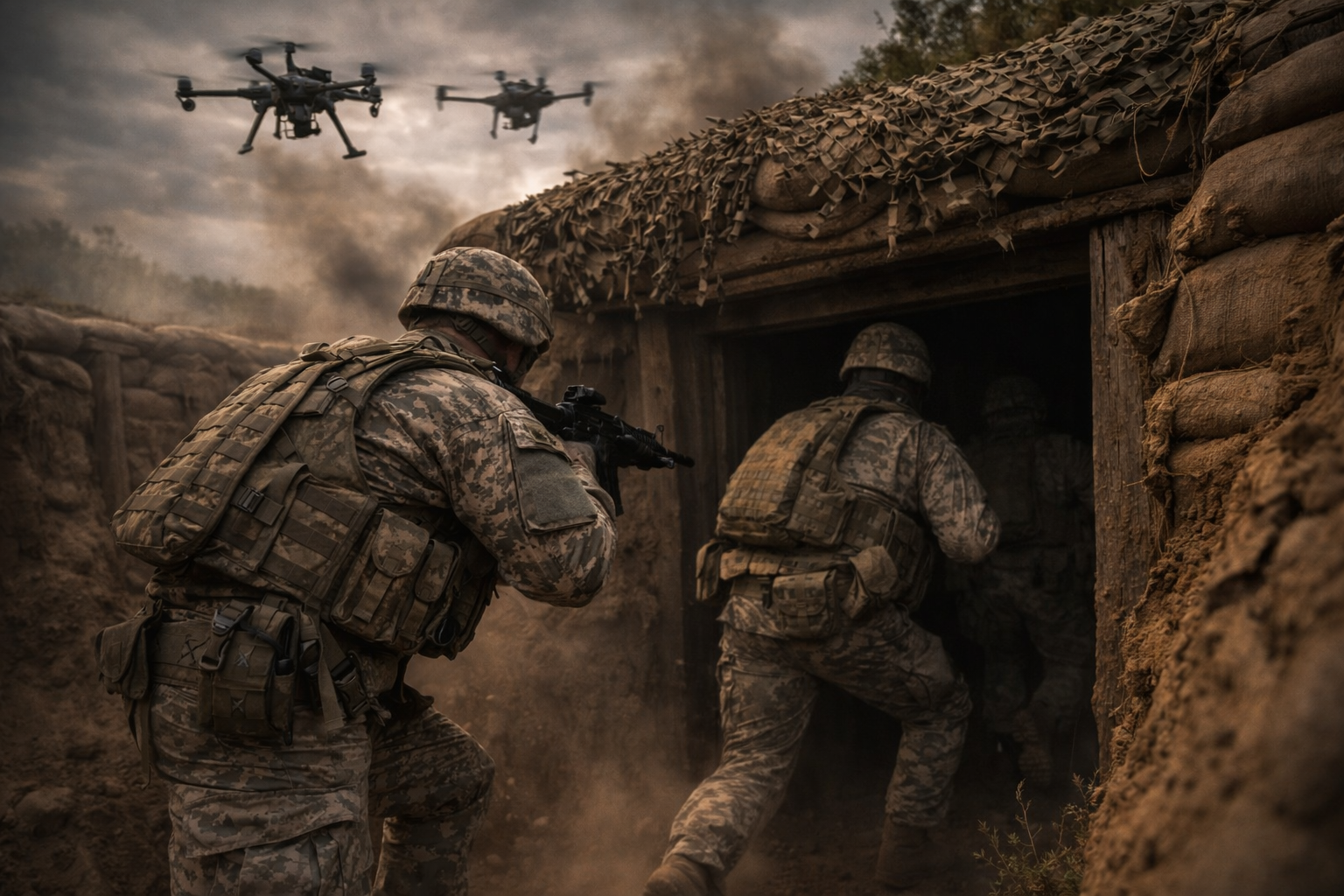

The late Colin Gray offers prophetic advice to those thinking about innovation, technology, and the future of war. In Gray’s Strategy for Chaos, his research “Shows clearly the limited value of advanced technology as a source of strategic effectiveness…Military advantages and disadvantages will tend to even out over a period, and leave the contest to be decided by the issue of quantity rather than quality.”
When developing war-fighting concepts and military doctrine, Robert Citino also provides prudent counsel. Citino posits that, “There is something incomplete about a way of war that relies on the shock value of small, highly mobile forces and airpower, that stresses rapid victory over all, and that then has a difficult time putting the country it has conquered back together again.” Considering both Gray and Citino’s caution, it is important to examine the U.S. Army’s move to transform most of its Infantry Brigade Combat Teams (IBCTs) into Mobile Brigade Combat Teams, or MBCTs.
The MBCT is the product of the U.S. Army’s desire to support a technology-centric Department of Defense innovation narrative to “accelerate like hell,” and to move beyond what the department calls a “peacetime science fair.” This “peacetime science fair” is what many others might call rigorously examined and empirically informed concept and capabilities development.
In a stark tradeoff of quantity for quality, the MBCT sheds significant amounts of manpower for technological updates. To be sure, the IBCT consists of approximately 4,500 personnel, whereas the MBCT shrinks to only 1,900 soldiers – a 58% decrease in manpower in each converted brigade combat team. Technology along the lines of drones and sensors makes up the difference. Yet, modern conflicts and wars are often won or lost by manpower, and not technological superiority. The MBCT reflects an incorrect rendering of winning and losing in war that posits that things (e.g., drones, sensors, and artificial intelligence), not functional requirements, like controlling territory and defeating threat forces, fuels success and failure.
In this article, I assert that the MBCT is a Potemkin force – it looks great on paper, sounds spectacular when discussed amongst likeminded institutionalists, technocrats, and futurists, and appeals to government officials seeking to minimize boots on the ground in conflict and war. But the MBCT, and its placement within existing Multidomain Operations doctrine and future military strategy, lacks the quantity of manpower that the continuities of war indicate are necessary to weather the rigors of combat and win.
Furthermore, the MBCT reflects the Army’s application of confirmation bias and systematically excludes disconfirming evidence from the Russia-Ukraine War and other conflicts to “transform in contact.” In doing so, the MBCT does not truly reflect the causal challenges associated with winning and losing in war. Rather, the MBCT, continuous transformation, and accelerating innovation “like hell” all position innovation as a goal in and of itself.
A detailed examination of continuous transformation and innovation exceeds the scope of this article; however, it must be noted that innovating for the sake of innovation should never be the goal. Innovation must answer to the questions, “why are we innovating,” and “to what goal does that purpose fulfill?” Consequently, innovation should never be the bedrock of force design and force structure development. Rather, force design and force structure should be based on the “science fair” of rigorously examined empirical evidence regarding the causality of winning and losing in war.
Similarly, force design and force structure should never be based on the “fear of missing out,” or FOMO. For instance, the U.S. Army embraces FOMO as a transformation imperative each time it points to what Ukraine, Russia, China, Israel, and others are doing and then, without contextual self-reflection, point to itself, and passionately asserts that the U.S. military doesn’t look enough like the others, that it doesn’t possess the same military capabilities as those other actors, nor that it matches their operations and tactics. That is, the Army has selectively focused on its looks and its perception, but not on requirements and the causality to generate positive outcomes in war. Just flash, glitz, and narratives.
Considering those points, the MBCT lacks the capabilities and capacity to fight and win 21st century conflict and wars. This is because the MBCT possesses three fatal flaws. First, the MBCT’s small manpower base means that it is uniquely prone to culmination if drawn into close combat or identified and targeted from afar. Second, the MBCT’s limited manpower negatively impacts the formation’s potential to exploit opportunities that are created by shaping and enabling operations. The MBCT itself is little more than a shaping-enabling force. Third, if exploitation is successful, and assuming the MBCT hasn’t culminated, it lacks the capabilities and capacity to consolidate the gains generated during the shape-enable and exploit portions of an operation. Thus, the MBCT leaves the Army with a bedrock formation that is (1) highly sensitive to culmination, (2) unable to exploit the benefits of shaping-enabling activities, and (3) is unable to consolidate gains.
Regarding the Army’s contribution to a joint task force or land component command, the MBCT makes the Army the joint service’s weakest link. Whereas the other services will continue to conduct their core functions, an MBCT-laden Army won’t be able to exploit the opportunities created by joint shaping-enabling operations, nor will it be able to consolidate battlefield gains into meaningful outcomes.
In this article, I provide a basic logic of operations to explain why the MBCT is not the right solution to problems of warfare that the U.S. Army – or any likeminded armies – will experience in the future. First, the MBCT does not provide the Army and the joint force with the capability to exploit positive changes to the battlefield situation and accompanying conditions. Second, as case studies illustrate, the MBCT will not provide the Army with the manpower it needs to overcome negative situations and conditions on the battlefield. Third, in being slightly larger in manpower than most traditional infantry battalions, once committed to ground combat or identified on the battlefield, the MBCT will be hyper-sensitive to rapid culmination and piecemeal destruction. Fourth, if the MBCT survives long enough to make it through exploitation operations, the formation will not possess sufficient manpower to consolidate the gains made through the preceding phases of operations. Thus, the Army will have to commit more brigades to consolidate the positive outcomes they’ve been able to generate. Furthermore, as the recent past warns, the Army will have to commit additional brigades to control the situation on the ground. In both instances, the requirement to compensate for the MBCT’s limited manpower means that the formation will be able to do little more than shape and enable for a fight in which it culminates before arriving to, or not possess the strength to do anything meaningful once it arrives.
Keeping in spirit with Gray and Citino’s cautions, I examine a set of case studies from 21st century conflicts and wars. In doing so, I find that the need for manpower in the land forces is more important to a conflict and wars outcome than innovative military technology.
To that end, I find that the winners and losers in most 21st century conflicts were those with manpower asymmetry, not just technological advantages. This is because manpower asymmetry provides militaries with the ability to create situationally relevant ground combat lopsidedness that positively changes the conditions on the battlefield to their favor. For instance, drones, long-range precision strike, cyber, and land forces can all destroy and neutralize threats. Yet, it is only the manpower within a land force that can (1) take, retake, hold, and control terrain, (2) protect populations, (3) seal borders and boundaries, and (4) provide the human-to-human interface so often needed during security operations and small wars. In short, when considering the continuities of war, the MBCT is a liability, not an upgrade. The MBCT increases the Army’s inability to generate tactical, operational, and strategically relevant battlefield outcomes and instead contributes to futile battlefield muddling.
Following the case studies, I conclude this article with a set of recommendations. First, when innovating for the future of war, recent history and the continuities of land warfare must be placed ahead of preferred futures and unproven technology. Second, when innovating for the future, the exploit and consolidate gains phase must be at the fore of development. And third, the structural dynamics of competition, survival, and the pursuit of self-interest must be placed ahead of fantastical ideas like cognitive paralysis, decapitation, and other wishful goals.
Case Studies
The Army’s confirmation bias and exclusion of disconfirming evidence is quite easy to see (see Table 1). If one sets aside the Second Nagorno-Karabakh War because it is a small-theater outlier, and the 2025 Iran-Israel Conflict because it wasn’t fought on land, it is apparent that being the most technologically advanced side in medium- to large-theater conflicts in the 21st century does not equate to strategic victory. In fact, the evidence indicates that manpower advantage is a leading factor in generating positive strategic outcomes in war.
For this study, manpower advantage is classified in two ways. The first method is the most basic – quantitative asymmetry; or having more soldiers or fighters on the ground than the other side. The second method is employing a Fabian strategy and operating via positional warfare to overcome an opposing force’s manpower asymmetry. Third, and closely related to the second method, includes operating from sanctuaries outside of combat zones that prevent unnecessary losses. These three categories are not mutually exclusive either. A combatant might use one method or any combination of the three methods. For instance, in Ukraine, Russia possesses a quantitative advantage in forces on the ground, but they also operate from relative safety within Russia to protect their forces and generate combat power.
Table 1: 21st Century Medium- to Large-Theater Conflicts
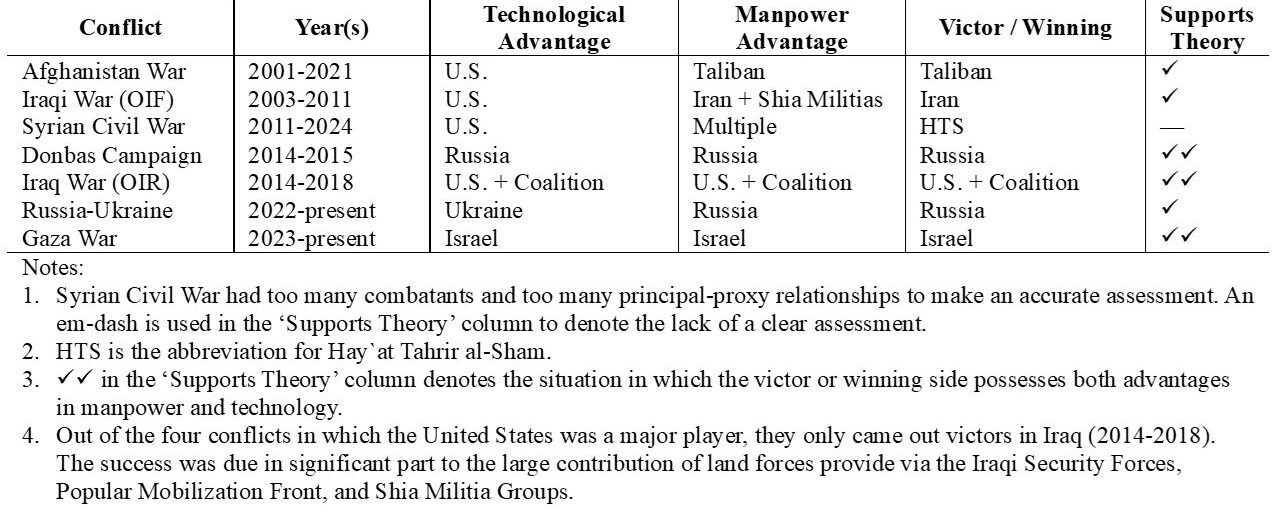
In the U.S.’s conflicts listed within Table 1, American strategy tended to use technology as the preferred replacement for manpower. In those cases, the lack of land forces proved the critical vulnerability that unraveled American military strategy. As the selected case studies will highlight, this caused U.S. military commanders to continually pine for additional land forces to help address the security issues that remained unresolved and beyond the reach of drones, long-range precision strike, and cyber capabilities.
In the other conflicts, success was determined by two primary factors. First, strategic success was decided by the side who could either control territory, or at a minimum deny their adversary from controlling the disputed ground. Second, strategic success was decided by the side who could disrupt the security situation such that their adversary could not generate the forces and force density at the point and time of need required to prevail.
The following case studies, simplified for the sake of brevity, explain this in more detail. Regarding case study selection, Afghanistan and Iraq are used because they are the best examples of large-scale U.S. military operations in the 21st century. Both phases of Russia’s war against Ukraine are used because they are the die upon which the Army casts the MBCT.
Afghanistan War (2001-2021)
There is no single cause of failure for the U.S.’s 20-year war in Afghanistan. Nevertheless, the U.S.’s insufficient number of troops, from the planning of the invasion in 2001 to the fall of Kabul in 2021, is an unmistakable trendline that contributed to the U.S.’s strategic defeat in Afghanistan.
The Afghanistan War ended in the Taliban regaining control of the country after two decades of U.S. political and military floundering. Under the leadership of Secretary of Defense Donald Rumsfeld, the U.S. naïvely judged that transformative technology would obviate the causal logic and historical precedent for manpower needs in Afghanistan.
Instead, Rumsfeld opted for a small, light force focused on eliminating Al Qaeda and the Taliban. Rumsfeld disregarded the potential need to control terrain, secure the population, and partner with the instruments of governance and security. Rubber-stamped by the excessively deferential generalship of U.S. Central Command’s commander, General Tommy Franks, the U.S. invaded Afghanistan outmanned and critically underprepared for the continuities of warfare that routinely surface in land wars.
The true impact of Rumsfeld and Franks’ misguided decisions on the mission, and the forces required to accomplish the task, was not immediately felt because of early success. The U.S. military quickly upended Al Qaeda and the Taliban’s control of the government and key population centers. Consequently, a vast number of Al Qaeda and Taliban political and military leaders fled to Pakistan to wait-out the Americans. In the place of Taliban political leadership, a resilient and well-provisioned insurgency rapidly materialized.
Perhaps believing the hype about their own superiority, not strategizing sufficiently, or discrediting and discarding unwanted information, the U.S. military was seemingly surprised and caught off guard when their troop levels proved insufficient for occupation and security duties in the face of the Afghan insurgency. Moreover, the insufficient number of U.S. (and partner) troops on the ground facilitated the Taliban fighters’ ability to lurk in the background, terrorize the population, and gradually wrest back control of large portions of the country.
Despite the overwhelming amount of high-tech sensors and lethal weaponry, U.S. commanders from General David McKernan and Stanley McChrystal to David Petraeus all petitioned the White House for more troops to address the causal logic of the war in which they were engaged – they needed land forces to take, retake, and hold the territory. They needed land forces to clear hostile threats from difficult terrain like the mountains and urban areas. They needed land forces to seal borders and to protect local populations. Drones, long-range precision strike, and high-tech cyber capabilities did not disavow the continuity of these requirements, nor were they even slightly capable of accomplishing these tasks.
The White House authorized various troop increases in Afghanistan over the years, but none of the surges provided strategically relevant impacts. The Taliban played hide-and-seek, while the U.S. military used a high-tech whack-a-mole strategy that served as little more than pinpricks against the weight of the strategic, operational, and tactical problems at hand. As a result of that mix of bad strategy and tactics, large portions of the country remained beyond the U.S. and the Afghan government’s control.
What’s more, the U.S. and its strategic security partners spent twenty years and $88 billion training, advising, and equipping the Afghan security forces, but the Afghans never metastasized into a credible security force. As a Congressional Research Service report highlights, by 2018 the Taliban controlled 40% of Afghanistan. The lack of U.S.-coalition manpower, coupled with the void in security and control provided by the Afghan security forces facilitated the Taliban’s incremental reassertion of political power and physical control in Afghanistan.
The U.S. military’s technological asymmetry lacked the complimentary and compounding impact that manpower unlocks when applied within the framework of combined arms and joint operations. As a result, the U.S. military could not exploit success nor consolidate gains beyond the most tactical situations. The lack of sufficient forces on the ground to control terrain, defeat security threats, exploit opportunities, and consolidate military gains into strategically relevant outcomes was the fountainhead from which the U.S. lost the war in Afghanistan. All other strategic failures in the war rolled downhill from the decision to place faith in technology ahead of humans. That deficiency, not the lack of a coherent counterinsurgency strategy, nor more high-tech sensors and kinetic strike capability, unraveled U.S. military strategy and the White House’s policy for Afghanistan.
Iraq (2003-2011)
As with Afghanistan, there is no single cause for the U.S.’s sputtering in Iraq, but sufficient manpower is without question one of the major causes of failure. Moreover, as with the invasion of Afghanistan, Rumsfeld’s preference for transformation, at the expense of resourcing the U.S. military for the long-standing continuities of land wars, doomed the U.S. invasion from its earliest days of planning. Rumsfeld rejected plans that included large troop deployments. For instance, when Chief of Staff of the Army (CSA) Eric Shinseki stated that the U.S. Army would need several hundred thousand soldiers to effectively defeat the Iraqi military, replace the Saddam Hussein regime, and conduct occupation and security operations during the transition period before a new Iraqi government could be on its feet, Shinseki was pushed into retirement.
Rumsfeld shunned the reality that toppling and replacing Saddam’s government would necessitate that the U.S. military would have to control Iraq’s territory, political structures, populations, and borders for a conditional period of time. Instead of embracing the reality of conflict, he favored a preferred future that included quickly transitioning control to Iraqi authorities and returning U.S. forces home after rapidly defeating the Iraqi armed forces, toppling Saddam Hussein, and replacing Hussein’s Ba’ath party regime with a pro-U.S. government. Thus, he approved a meager plan, that settled on a 190,000-man force, which Michael O’Hanlon ironically called a “smart plan.” After tremendous success defeating Iraq’s military, however, Rumsfeld’s “smart plan” quickly fell apart.
In the spring of 2003, insurgent networks sprouted, Iranian proxies were activated and infiltrated west, and a host of outside influence generated complete chaos in Iraq. By 2004, a full-blown insurgency was underway. Because of the relatively small size of the U.S. land forces, and their partners, in relation to the emerging problems on the ground, they were quickly overwhelmed by a host of security challenges. Consequently, these challenges became requirements.
As reporting from RAND highlights, the U.S.’s land forces were required to take, retake, and hold territory from insurgent and proxy threats. Furthermore, U.S. land forces had to clear threats from difficult terrain, like in Fallujah, Ramadi, Tal Afar, and Sadr City. Likewise, U.S. land forces had to seal boundaries in areas of substantial sectarianism like Tal Afar and Sadr City. Moreover, U.S. land forces had to control borders in places like Al Qa’im and Al Faw. And perhaps most importantly, U.S. land forces had to protect the Iraqi population, to include civilians, political leaders, law enforcement, and civilian objects. In addition to that, U.S. land forces had to protect their bases, provide liaisons throughout the theater, and at any given time, a large number of personnel were unavailable due to injury, leave, or other reasons.
Manpower was in high demand, but supply remained low. This caused the U.S. military to contract many non-combat requirements, enact stop-loss, overtax the reserve component, and give soldiers little time at home between deployments to Iraq (or Afghanistan). Suffice it to say, Rumsfeld’s “smart plan” was quite possibly the most inappropriate strategy for the situation – U.S. land forces were overstretched, undermanned, and short on time. To make matters worse, many people had advised against Rumsfeld’s “smart plan,” but their caution was dismissed, while the prophets of transformation and technology rubber stamped Rumsfeld’s transformation strategy.
Between 2005-2006, the security situation completely collapsed. As Ben Connable notes, the insurgency overwhelmed U.S. land forces and it largely dictated the war’s terms and conditions, from the strategic level to the most tactical elements. At best, security and the control of territory, politics, and the population was contested. At worst, it resided with the insurgency – in many places the U.S. land forces and the dysfunctional Iraqi Security Forces (ISF) lacked the numbers and the associated footprint to effectively gain control and provide security. Instead, both the U.S. land forces and the ISF muddled their way through incipient counterinsurgency efforts. Under General David Petraeus, and subsequently General Ray Odierno, the U.S. military conducted a ‘surge’ – an increase in the number of land forces to help gain control of the situation on the ground and improve security throughout the country.
The surge, which added eight U.S. brigade combat teams, plus other additional capabilities, in conjunction with negotiations with a host of competing strategic actors, eventually calmed things to the point that the U.S. passed control and security to the Iraqi government and the ISF. This precipitated the conditions required for the Americans to humbly exit the conflict in December 2011.
In hindsight, Shinseki was right. The U.S. military needed a large land force, not for the invasion, but for the meaty middle segment of the war that connected the U.S.’s initial military activity with its policy goals for Iraq. Much like Colin Gray writes that strategy serves as the bridge to connect tactical action with political goals, so land forces serve as the bridge in land wars between initial intervention and generating the desired political outcome.
Thus, a key takeaway from the Iraq War (2003-2011) is that policymakers must understand that a light, quick moving, high-tech military might rapidly and decisively defeat a hostile armed force. However, threat and terrain-driven requirements in armed conflict tend to not care about their adversary’s transformation initiatives and technology-driven warfighting doctrine. More germane, the threat forces in Iraq illustrated that once they have identified how an aggressor operates, they will do nearly everything in their power to offset those preferences and seek their own self-interested path to strategic victory. Manpower-rich land forces provide strategic leaders and operational and tactical commanders a buffer against the “unknown unknowns,” and war’s long-standing continuities, in ways for which transformative technology cannot.
Russo-Ukrainian War (2014-2015)
Gudren Persson, and many others, state that Russia’s significant reliance on land forces in eastern Ukraine between 2014-2015 is lost in the hoopla surrounding Moscow’s use of little green men, the reconnaissance-strike complex, battlefield transparency, and hybrid warfare. To be sure, despite the glitz and glitter, Russia fought a war of attrition, anchored by stout land forces. These robust forces included a proxy army built to somewhat mirror Russian mechanized battalions.
Between April and August 2014, Russia and their proxy forces deftly wrested control of significant portions of Luhansk and Donetsk oblasts from Ukraine’s national and local security forces. Between August and September 2014, Kyiv’s forces effectively countered Russia and their proxy forces’ territorial control in many contested areas in the Donbas. Nonetheless, as Ukrainian security forces took the upper hand at places like Ilovaisk, Donetsk airport, and Debal’tseve, Russia doubled down on their initial investment in advisors and proxy forces. In place of additional advisors and proxies, the Kremlin opted for conventional land force deployments. As a result, proxies, mechanized forces, artillery, multiple launch rocket systems (MLRS), drones, and cyber effects converged in the Donbas to thwart Kyiv’s efforts at reasserting physical, political, and domestic control in many parts of the region.
Through November 2014 and February 2015, the quantity of Russian land forces increased in Ukraine. Consequently, Russia’s ability to control occupied terrain, defeat prostrate Ukrainian security forces, and consolidate the Kremlin’s policy aims in the region increased in stride. Russian counterattacks at Ilovaisk, Donetsk Airport, and Debal’tseve gradually broke Kyiv’s military capacity and political will to reassert control over Russia’s territorial gains in the Donbas and Crimea. Ukraine’s defeat at Ilovaisk directly fueled the Minsk Protocol, a failed ceasefire which never truly materialized. Likewise, Russia compounded the operational and strategic impact of the Ilovaisk victory via sequencing significant tactical victories at Donetsk Airport (January 2015) and Debal’tseve (February 2015). These string of victories facilitated the Minsk II Agreement in March 2015 which formally terminated the conflict, despite many breaches in the ceasefire up to February 2022.
Policymakers must appreciate that the Donbas campaign highlights the importance of land forces, despite the presence of new technologies and new ways of warfare. For Russia, their land forces were the critical capable that accomplished the waypoint objectives which gradually advanced the Kremlin toward its policy aims in Ukraine, even if they fell short of maximalist goals. Likewise, the persistent presence of Russian proxies and their advisors in the region provided the springboard for Russia’s February 2022 invasion.
On the other hand, policymakers must also understand that Ukraine’s lack of manpower in their land forces was the critical vulnerability that contributed to Kyiv’s strategic defeat during the Donbas campaign. Kyiv lacked the numbers required to address immediate military situations, much less react to emerging security situations elsewhere with more than a token force. Setting aside the contested 3:1 attack-to-defend heuristic, Ukraine’s force structure lacked the depth and redundancy to take, retake, or hold its territory, and simultaneously clear threats from difficult terrain, protect its population, and seal its borders.
To conclude, policymakers must understand that the glitz and glitter of emerging technology didn’t win or lose the 2014-2015 war in Ukraine. Russia won the Donbas campaign because they used land forces to gain and maintain control in the region. Likewise, Russia consolidated their gains with manpower – they possessed the capacity to reinforce the occupied regions of the Donbas with significant numbers and capabilities to deter future attempts on the part of Ukraine to retake that land. Ukraine, on the other hand, lost because their land forces didn’t possess the sufficient depth in manpower to endure a war of attrition predicated on territorial control. When success did occur – early in the battles at Ilovaisk, Donetsk airport, and Debal’tseve, for instance – they lacked the capacity to consolidate their gains and exploit their successes.
As a result, Ukraine’s lack of land force capacity boxed policymakers into bad strategic situations. This occurred because they lacked tactical and operational options to positively change the situation and conditions on the battlefield in their favor. Because Ukraine’s force was unable to evict Russian land forces from the region, Russia prevailed in the preamble to their 2022 reinvasion.
Russo-Ukraine War (2022-present)
Many commenters point to the current iteration of the Russo-Ukrainian War as the paradigmatic example for how 21st century technology has transformed war. Yet, none of the technology – drones, long-range precision strike, cyber, and sensor technology – has delivered strategic victory to either side. Why? Because Russia consolidated their territorial gains in Ukraine with manpower and fortifications, and thus flipped the script on Ukraine.
By establishing a defensive belt from Luhansk in the north to Crimea in the south, and running through most of Donetsk, Zaporizhzhia, and Kherson oblasts—and Russifying everything behind that line—Russia created a problem which exceeds Ukraine’s ways and means. As a result, the Kremlin has obtained their policy aims, even if it is the minimal limit of Russian President Vladimir Putin’s wider policy ambition for Ukraine. Nonetheless, for Ukraine to achieve President Volodymyr Zelenskyy’s policy goals, Kyiv’s forces must find a way to remove Russian forces from the contested territory. Considering the on-going negotiations to end the conflict, however, this remains to be seen.
When physical control of territory is nine-tenths of the law in international affairs, international law is of little help – it possesses no army divisions, which tend to be the key driver of change against states and non-state actors that aren’t interested in adhering to the norms and laws of global politics. As a result, by digging in and building an interconnected defensive line that meshes reconnaissance outposts, infantry positions and other traditional land force capabilities, with their sensors, cyber, drones, and long-range precision strike, Russia’s control of Ukrainian territory provides the Kremlin with strategic options that outweigh Ukraine’s ability to overturn. Thus, Russia finds itself at a very advantageous position regarding its policy aims and negotiations with Kyiv to end the war.
Ukraine, on the other hand, must regain control of the territory, politics, and population in the areas Russian forces occupy. Ukraine’s strategic problem is that despite their bevy of glitzy technology and innovative tactics, their land forces lack the strategic depth to positively change the tactical and operational situation on the ground. To make matters worse, morale in front line units is quite low. Reports illustrate a severe morale problem, specifically amongst infantry formations. To be sure, reporting states that prosecutors in Ukraine opened 250,000 cases regarding absence without leave (AWOL) and desertion since February 2022. The problems of morale only complicate an already perplexing manpower challenge for Kyiv.
As a result, Ukrainian military operations are incapable of providing their senior military leaders and policymakers with strategically relevant battlefield outcomes. Offensive operations that liberate and hold Zaporizhzhia and Kherson oblasts, for instance, would cause significant concern in Moscow, while positively changing the strategic situation for Kyiv. Moreover, these types of operations would further endear international support for Ukraine’s war effort, and likely boost domestic support and morale in Ukraine’s front-line units. Yet, Ukraine lacks the manpower and land force to bring about this sort of positive strategic change.
Drones, long-range precision strike, cyber, and sensing technology helped Ukraine not lose the war, but none of those considerations have generated operational or strategic victory. The Ukrainian land forces lack of manpower has proven the missing component – their critical vulnerability. This situation inhibits Kyiv’s ability to flip the operational and tactical situation on the battlefield and consequently create strategic options for their policymakers. To state it another way, Kyiv’s lack of manpower in their land forces has prevented their military from being capable of both (1) exploiting the micro-tactical success of drone and long-range precision strike missions, and (2) being capable of consolidating the gains generated from the stand-off and exploitation phase of their operations.
At the outset of the conflict, Kyiv’s reliance on light, small, and dispersed land forces operating with a clear technological and innovative advantage, allowed Ukraine to avoid being quickly and entirely overrun by Russian land forces. That is, Ukraine’s technology and innovation advantage allowed Ukraine to not lose the war.
Yet, those tools did not enable operational and strategic victory. In the intervening period, several constraints hampered the Ukrainian way of warfare. First, Kyiv is unable to generate sufficient land forces. Second, because of those manning and force structure shortfalls, Ukraine’s armed forces are unable to consolidate the gains made by its innovative tactics and technologically sophisticated force. Third, because Ukraine’s forces cannot exploit the success of their innovative tactics and technology – that is, consolidate gains – they cannot create strategically important battlefield outcomes. Fourth, the lack of strategic progress on the battlefield, despite the amazing displays of technological ingenuity, hampers Ukraine’s negotiating position regarding war termination with Russia.
Conclusion
At the risk of over-simplifying the chaotic dynamics of warfare, the case studies examined above find that innovative technology and tactics, especially when not coupled with sufficient manpower in an actor’s land force, proved to be ineffectual. A host of variables impact winning and losing wars. However, within the military element of national power, few considerations are more germane than possessing the manpower in one’s land forces to successfully address the historical continuities of war. As Robert Citino reminds the reader, light, small, technology-oriented land forces, which sacrifice manpower for tech-power tend to come up short in the long run because they cannot exploit initial success and consolidate those gains into lasting, substantial success. This is a concept that the case studies examined herein support.
The MBCT fits this bill and, if history and the reality of modern conflict provide any true insight to how to prepare for the future of war, then the U.S. Army’s forces and commanders will yet again find themselves struggling to provide credible military outcomes to the state’s strategic outcomes in war. A simple logic helps illustrate why.
In A x B = C, A is the independent variable, B is the intervening variable (and causal mechanism), and C is the dependent variable, or desired outcome. If A is shaping and enabling activities, B is exploitation and consolidating gains, and C is desired battlefield outcomes, then: shaping and enabling activities multiplied by exploitation and consolidating gains equals desired battlefield outcome. Flipping the equation to begin with the goal, then the desired battlefield outcome (C) materializes from the multiplicative interaction between an actor’s shaping and enabling activities (A) and their exploitation and consolidation capacity (B).
It must also be noted that the logic expressed in this equation is theoretical insofar as there has yet to be an empirically identified activation threshold (i.e., a ‘magic’ force ratio) that causes the opportunities created at A to generate C when acted upon in B. Likewise, this theoretical model does not account for all the variables that contribute to success and victory in war and warfare. This theory is a heuristic to help simplify understanding one (of many) cause of victory and failure in land war.
Continuing with the examination, in simple terms, drones, long-range precision strike, and cyber and sensing operations conduct the shaping and enabling activities of 21st century conflict. In A x B = C, these tools and activities are A.
Mobile land forces – infantry, tanks, engineers, artillery, and others – exploit the situationally relevant conditions created by shaping and enabling forces and activities. They do so by using their mobility and flexibility to capitalize on providential situations created by shaping and enabling activities (i.e., exploit) and then use mobility and flexibility to consolidate the beneficial conditions on the ground. In A x B = C, these tools and activities are represented as B. Manpower is the critical component that facilitate activities within B (See Figure 1).
C is the effect and the outcome created by the amplifying factor of A and B’s interrelated capabilities and activities. The effect is C’s physical component; that is, the effect is either the destruction of a force, taking of territory, protection of local population, or any other number of measurable impacts of military operations. The outcome is C’s cognitive component. That is, successful effects, like retaking an oblast, reshaping the policymakers’ understanding of the situation. In doing so, successful effects provide policymakers with a new range of options because of the change in the physical conditions and the situation. Though not a linear process, nor as simple as explained, each actor in war iterates through A and B until (1) they generate C, (2) they are defeated in pursuit of C, or (3) they must withdraw from the process because they lack the resources and will to continue.
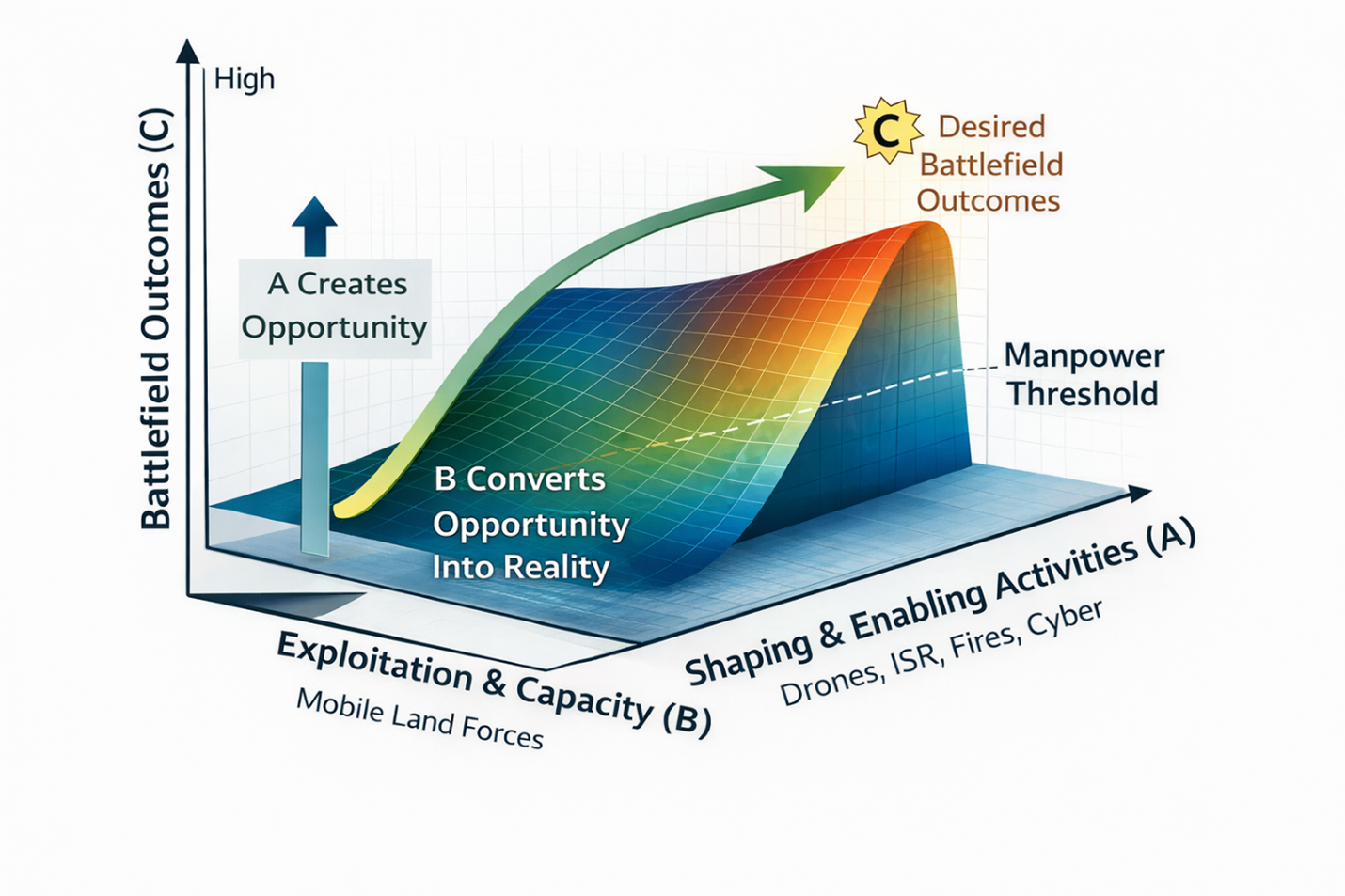
Figure 1: Logic of Land Warfare. Source: Author (author’s note: image create using ChatGPT. Not to scale. For visual representation of a concept, only).
The MBCT, which lacks much manpower, does not possess the key variable that facilitates a land force’s ability to exploit shaping and enabling activities and consolidate the associated gains throughout the iterative process of A x B. Those using different formations, each case study highlights this situation – a lack of sufficient manpower in the land forces prevented the associated army from being able to accomplish their required tasks, whether those were protecting the population, taking or retaking territory, holding terrain, or sealing borders and boundaries. Or in the case of Russia in Ukraine, the advantage in manpower across their land forces, throughout the theater of conflict, allowed Moscow to parry the innovating and technologically sophisticated Ukrainian forces.
Moving forward, the U.S. Army should re-evaluate its embrace of the MBCT. It should do so void of fanciful visions of the future which placed preferred outcomes ahead of empirically informed continuities of war. In addition, it should emphasize the enduring character of land wars in which manpower in the land forces are a recurring driver of victory and failure. The Army’s forces should be built to thrive in close combat.
To conclude, The MBCT is a Potemkin force. The MBCT, which possess 58% less manpower than the IBCT, increases Army forces’ stand-off striking power. This will turn the Army into a shaping and enabling force, but one that won’t possess the manpower to win close combat. Without manpower, the MBCT cannot consolidate gains. As the Army sells off its manpower and IBCTs for MBCTs, it is ceding the U.S. military’s ability to consolidate tactical and operational opportunities on the battlefield. Though there are many historical examples, the looming lesson for the U.S. Army is that modern military technology should enhance manpower, not replace it.