





CSIS Report | Russia’s Grinding War in Ukraine: Massive Losses and Tiny Gains for a Declining Power

In Russia’s Grinding War in Ukraine: Massive Losses and Tiny Gains for a Declining Power, published by the Center for Strategic and International Studies, Seth G. Jones and Riley McCabe argue that Russian claims of battlefield momentum mask severe military and economic strain. The authors report that Russian forces have suffered roughly 1.2 million casualties since 2022 while advancing only meters per day in major offensives and capturing limited territory.
They find that Russia’s war economy shows mounting stress, with slowing growth, declining manufacturing, and weak technological capacity. The brief concludes that Moscow sustains the war through attrition and disinformation rather than decisive gains, creating vulnerabilities that the United States and Europe can exploit.
THE ISSUE
Despite claims of battlefield momentum in Ukraine, the data shows that Russia is paying an extraordinary price for minimal gains and is in decline as a major power. Since February 2022, Russian forces have suffered nearly 1.2 million casualties, more losses than any major power in any war since World War II. At current rates, combined Russian and Ukrainian casualties could reach 2 million by the spring of 2026. After seizing the initiative in 2024, Russian forces have advanced at an average rate of between 15 and 70 meters per day in their most prominent offensives, slower than almost any major offensive campaign in any war in the last century. Meanwhile, Russia’s war economy is under mounting strain, with manufacturing declining, slowing growth of 0.6 percent in 2025, and no globally competitive technology firms to help drive long-term productivity
RUSSIAN ENDS AND MEANS
Putin’s primary objective is to bring Ukraine back into Russia’s sphere of influence, either directly by militarily conquering and annexing Ukraine…or indirectly by installing a Russian ally in Kyiv.
Ukraine Battlefield Map, January 2026
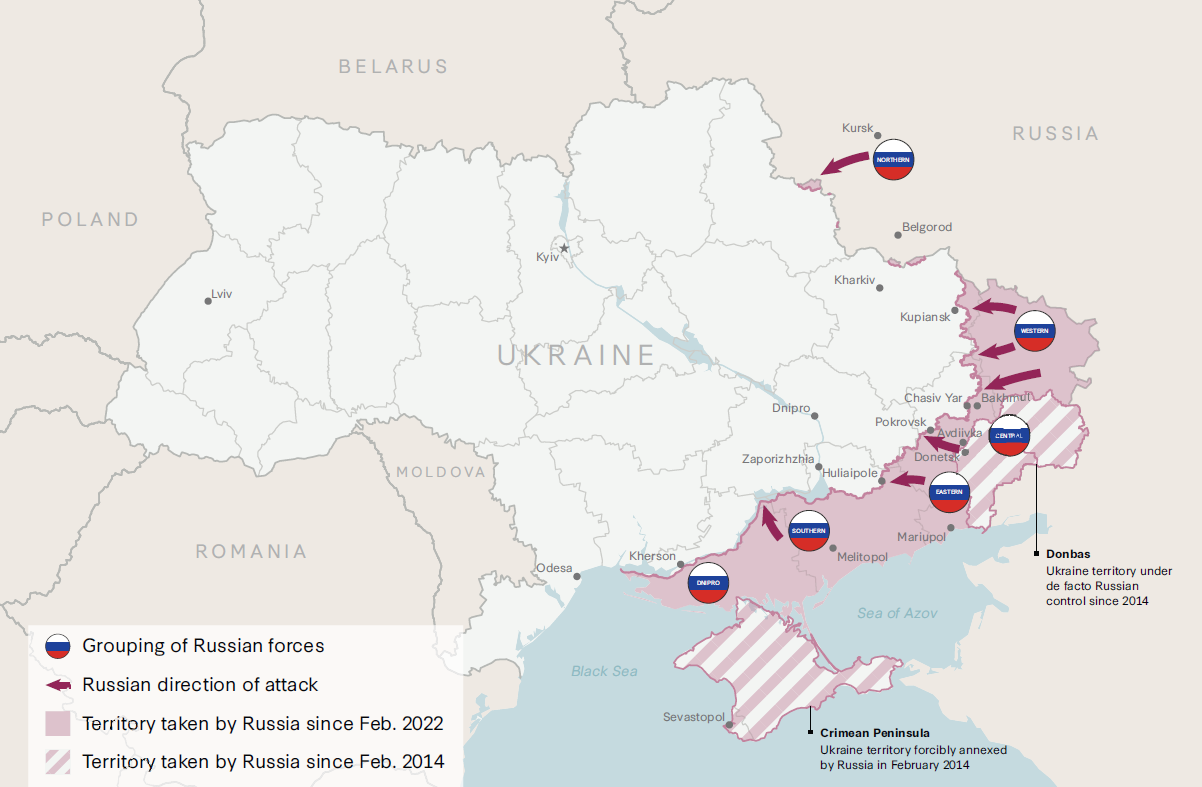
After failing to bring Ukraine back into Russia’s orbit by seizing Crimea in 2014 and then using a combination of regular and irregular military units in eastern Ukraine over the next several years, Putin resorted to a conventional invasion in February 2022. But the Russian military was unable to swiftly defeat Ukrainian forces through a blitzkrieg campaign and has resorted to a strategy of attrition warfare.
RUSSIAN CASUALTIES AND FATALITIES
According to CSIS estimates, Russian forces suffered nearly 1.2 million battlefield casualties, which include killed, wounded, and missing, between February 2022 and December 2025…There were roughly 415,000 Russian casualties in 2025 alone… In addition, there were roughly 275,000 to 325,000 Russian battlefield fatalities.
These numbers are extraordinary. No major power has suffered anywhere near these numbers of casualties or fatalities in any war since World War II…Russian battlefield fatalities in Ukraine are more than 17 times greater than Soviet fatalities in Afghanistan during the 1980s, 11 times greater than during Russia’s First and Second Chechen Wars in the 1990s and 2000s, respectively, and over five times greater than all Russian and Soviet wars combined since World War II.
RUSSIAN AVERAGE RATE OF ADVANCE
Russia’s slow rate of advance in multiple offensives over the last two years underscores the attritional nature of the war in Ukraine and the difficulty of breaking through fortified defensive positions.
[Pokrovsk offensive] From late February 2024 to early January 2026, Russian forces advanced just under 50 kilometers, at an average pace of only about 70 meters per day.
[Chasiv Yar offensive] From late February 2024 to early January 2026, Russian forces advanced roughly 10 kilometers, at an average pace of approximately just 15 meters per day.
[Kupiansk offensive] From mid-November 2024 to early January 2026, Russian forces advanced approximately 9.5 kilometers, at an average pace of about 23 meters per day.
[Huliaipole offensive] Between early November 2025 and early January 2026, Russian forces advanced roughly 18.5 kilometers, at an average pace of 297 meters per day.
Average Daily Rates of Advance for Selected Combined Arms Offensives, 1914-2026
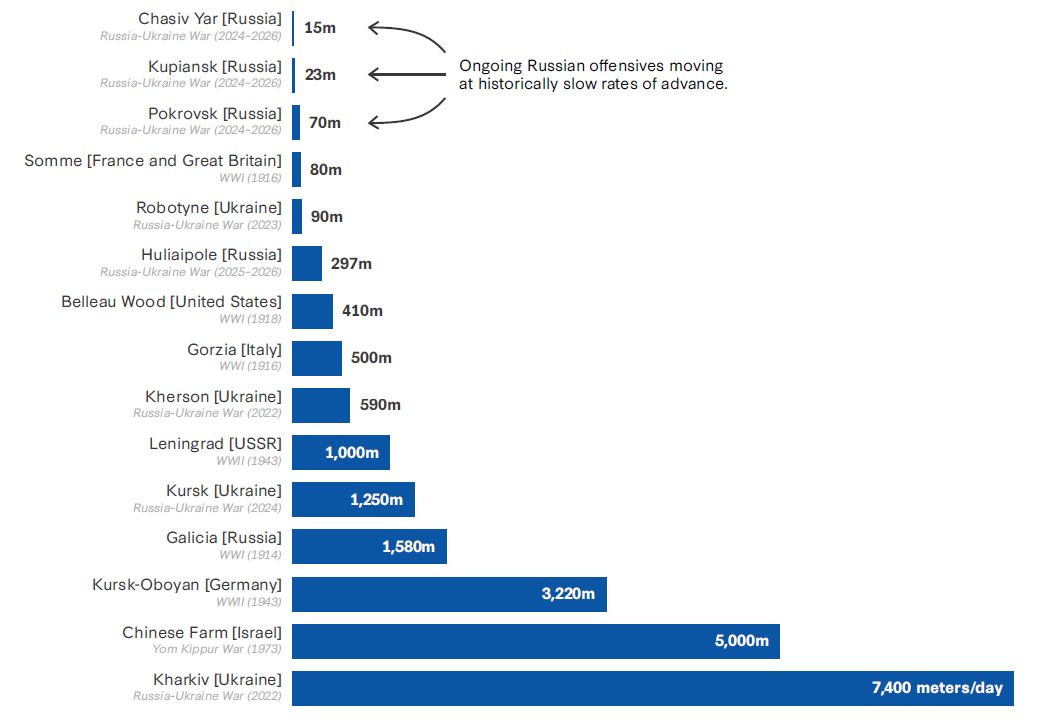 In all of its offensives over the last two years, Russia has failed to generate rapid breakthroughs to collapse the Ukrainian front line and allow for sweeping territorial gains.
TERRITORY SEIZED BY RUSSIA
In 2024, Russian forces seized approximately 3,604 square kilometers of Ukrainian territory, or about 0.6 percent of Ukraine… In 2025, Russian forces made marginally larger gains, seizing approximately 4,831 square kilometers…In total, Russian forces have seized around 75,000 square kilometers…since the 2022 invasion and control about 120,000 square kilometers…including territory seized before 2022 such as Crimea and parts of Donbas.
RUSSIA’S WAR ECONOMY
Russia’s economy is showing signs of strain, and long-term productivity looks bleak…Russian manufacturing declined at its fastest rate since March 2022…Economic growth slowed to 0.6 percent in 2025.
Tank factories are working overtime, but automobile producers have cut shifts. Overall, Russia’s nominal GDP is closer to Canada or Italy… Russia today is a bottom-tier AI power…Russia had zero companies in the top 100 list of technology companies in the world by market capitalization.
A DECLINING POWER
While Russia still possesses nuclear weapons and a large military, it does not measure up as a great power in virtually any category…[with] historically slow rates of advance and little new territory to show for its efforts over the last two years…President Putin remains undeterred by the high casualty and fatality rates…[and] the Russian government have been adept in conducting an aggressive disinformation campaign…Yet as this analysis highlights, Russia has several vulnerabilities that the United States and Europe can exploit.

