A War Without Headlines: Mozambique’s Insurgency and the Global Security Blind Spot

The Islamic State (IS) in Mozambique mirrors the rise of ISIS in Syria and Iraq, perpetrating atrocities including public beheadings, child recruitment, exploiting women with sexual abuse, massacring Christians, and displacing nearly a million people.
For nearly a decade, poverty and neglect in the volatile Cabo Delgado province cultivated fertile ground for extremist ideology, proliferating armed insurgents. Mozambique faces a “triple crisis,” that includes armed conflict, extreme weather events, and a deteriorating socio-economic situation. These overlapping shocks form a complex emergency, in which conflict and climate disasters compound and magnify one another, stretching fragile governmental structures and overwhelming limited humanitarian response mechanisms.
Despite the gravity of the situation, Mozambique remains one of the most underreported and understudied conflicts. This lack of global attention to the evolving IS threat exposes a blind spot to a dire situation that could easily worsen and unravel with international consequences, similar to the resurgence of ISIS.
Resource-Rich Mozambique
Northern provinces such as Cabo Delgado remained marginalized from economic investment, receiving fewer government services and weaker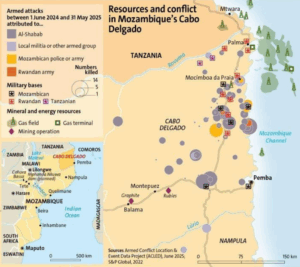 infrastructure. The disparity compounded as Mozambique experienced rapid economic change. Between 2010 and 2013, the discovery of offshore natural gas reserves promised billions in foreign investment and state revenue, further accentuated by the discovery of the world’s largest graphite deposits in 2014. The supposed benefits from these resources barely reached the impoverished communities of Cabo Delgado. Instead, political elites and foreign corporations profited from the extraction of these natural resources. Financial flowdown failed to translate into broad-based economic participation, as political elites and foreign corporate investors retained control of capital and opportunities. This dynamic effectively excluded large segments of the youth population from employment, entrepreneurship, and upward mobility.
Conflict converted Cabo Delgado’s rich natural resources, once Mozambique’s ticket to prosperity, into a disadvantage. At the core of this challenge is TotalEnergies’ $20 billion LNG project in Afungi, with its project deadline being postponed from 2024 to at least 2030 due to continuous insurgent attacks. This insecurity stalled construction, increased costs, and forced lenders like the U.S. Export-Import Bank to restructure financing. The close intertwining of the energy sector and insurgency was starkly demonstrated in 2021, when militants stormed Palma, kidnapping dozens of gas workers and shutting down operations. Moreover, Cabo Delgado’s mineral wealth draws its own dangers; the Balama graphite mine, backed by a $150 million U.S. loan, briefly halted 0perations during protests following Mozambique’s disputed 2024 elections, demonstrating how political unrest and upheaval can shake even hallmark projects. Mega projects, such as the Rovuma LNG project, specifically cite the ongoing insurgency as a major risk to sustainable growth and investment.
ISIS in Mozambique
Islamic State in Mozambique, also known locally as “al-Shabab.” – separate from the terrorist group in the Horn of Africa – operates an insurgency that exploits the crisis in Mozambique. In 2019, this jihadist organization pledged fealty to ISIS to gain increased funding, improved recruitment, larger recognition, and greater popularity in its territory. The insurgency grew from structural neglect, historical inequality, and broken promises, with many recruits driven by survival, dignity, and belonging rather than ideology.
Beginning in 2017, the insurgency escalated in intensity and sophistication. Armed groups conducted coordinated assaults, burning homes, looting, and abducting civilians. The momentary seizure of Mocímboa da Praia, a strategic port city, demonstrated the insurgents’ growing military capability and the Mozambican state’s inability to defend.
ISIS formalized the movement’s transformation by recognizing it as part of its global network, unified with affiliates in the DRC, under the name “Islamic State Central Africa Province” (ISCAP). This elevated the conflict’s strategic importance, folding a localized insurgency into a global jihad movement. International recognition created substantial challenges for counterinsurgency operations by enhancing ISIS’s perceived legitimacy, broadening its funding and propaganda reach, and accelerating the influx of foreign fighters. These dynamics highlight the urgent need for expanded and adaptive countermeasures. Some regional fighters, often from Tanzania, Uganda, and Somalia, speak a common language and easily integrate into local communities. Hardened fighters are also drawn from distant battlefields, including Syria, Iran, and Afghanistan. Women actively recruit for the insurgency within refugee camps and serve as spies. Insurgents employ social media to coordinate, fundraise, recruit, and message, mirroring tactics used by ISIS from Mosul, Iraq in 2017. Mozambique’s conflict transformed into an issue interwoven with global networks of ideology, recruitment, and resources.
Humanitarian Catastrophe
The conflict in Cabo Delgado has produced one of Africa’s worst current humanitarian emergencies. Recent offensives exacerbated trends of displacement; for example, nearly 60,000 people fled violence in July–August 2025. Aid agencies report that nearly 90% of internally displaced people (IDPs) are women, elderly, or people with disabilities. Displaced families live in makeshift shelters, camps or host communities under dire conditions with insufficient food, clean water, sanitation or medical care. Over half of Cabo Delgado’s health facilities are destroyed or damaged by conflict.
Public health and food security issues compound the crisis. A modest nationwide cholera outbreak recorded 3,840 cases between October 2024 and May 2025, exposing vulnerabilities in the fragile water and sanitation systems. Concurrently, nearly 2 million Mozambicans suffer from severe food insecurity and malnutrition.
Counterinsurgency Challenges
The Defense Armed Forces of Mozambique (FADM) – undertrained, under-equipped, and corrupt – recognized its limitations and requested external military assistance in 2020 to contain the insurgency. Foreign troops conducted costly, overstretched operations and a weakened Mozambican government failed to address worsening civil vulnerabilities. The complicated nature of adaptive insurgency, irregular tactics, a burgeoning humanitarian catastrophe, and an increasingly resistant population, expose the limits of traditional military campaigns and a need for an irregular approach.
Since mid-2024, roughly 2,500 Rwandan troops continue the foreign military role first shaped by the Southern African Development Community (SADC) Mission in Mozambique (SAMIM) of counterterrorism and stability operations. SADC operations continued until mid-2024, when Tanzanian and most South African troops withdrew, with a small contingent remaining until March 2025. Their exit exposed the FADM to renewed strain, forcing a reliance on bilateral partners. Even SADC acknowledged that FADM faced “serious institutional capacity challenges” in the absence of regional support.
The insurgency’s resilience complicated these foreign deployments. Battle-tested from the Levant and Afghanistan, IS militants demonstrate considerable adaptability and avoid direct confrontation in favor of asymmetric tactics. Their operations rely on ambushes, improvised explosive devices, and opportunistic raids against villages, schools, churches, and travelers. In some areas, they have turned highways into revenue streams by demanding informal “tolls” from motorists. Maritime insecurity also deteriorates with fishing vessels seized and crews kidnapped for ransom as insurgents exploit offshore islands and coastal sanctuaries. Beyond violence, ISIS-Mozambique exerts ideological pressure through enforcement of sharia law and required Islamic curricula in schools. These methods spread fear and disrupt daily life, eroding any sense of safety even in areas nominally under government control.
Mozambique and its partners struggle to confront such tactics, producing mixed operational outcomes. Multinational offensive operations have succeeded in retaking some villages, yet often at a heavy price. In March 2025, for example, FADM units suffered severe losses in ambushes using improvised explosive devices (IEDs). Local militias, mobilized by the government to supplement state forces, frequently lack oversight with reports of abuse against civilians, undermining their legitimacy. Foreign contingents faced credibility issues, especially when recorded videos emerged of South African SAMIM soldiers mishandling corpses in 2023, that drew condemnation and triggered investigations. Supply chain difficulties and intelligence gaps further weaken operational momentum, leaving government troops vulnerable despite external support. Analysts note that while the insurgent force decreased from thousands of fighters to only a few hundred, “the insurgency is not near its end”.
The government also received military assistance from private military contractors, including the Wagner Group, in counterinsurgency operations. With a lack of understanding in local dynamics and the inability to collect intelligence on the insurgents, their operational support ended in mutual distrust and failure. Such arrangements underscore the risks of outsourcing security to non-state actors with little investment in long-term stability.
Governance Breakdown
The ongoing insurgency in Cabo Delgado represents a symptom of weak governance across Mozambique. The government increasingly fails to provide basic infrastructure and public services. Fearing the appearance of weakness, the government downplayed ongoing violence and instability rather than declare a national emergency. Aid and reconstruction efforts remain slow or fragmented, prolonging gaps in civil necessities. Public trust erodes due to corruption, repression, and political mismanagement. Mozambique’s 2024 elections, widely criticized for fraud and violent crackdowns, reinforced the belief that leaders prioritize power over people. In Cabo Delgado, the government is unable or unwilling to hold members of its security forces accountable for abuses like extrajudicial killings, sexual violence, arbitrary detention, and ill-treatment of detainees. By only establishing military checkpoints and emergency camps, the government reinforced the perception of being a detached, repressive and authoritarian regime.
Why the World Looks Away
Despite the gravity of this polycrisis, Cabo Delgado rarely gains international headlines, eclipsed by higher-profile conflicts like those in in Ukraine or the Middle East. Foreign investments from the U.K., U.S. and China have become deprioritized in foreign policy. Policymakers and media perceive Mozambique as a distant, complex, and inconspicuous crisis.
This neglect is dangerous. Similar neglect marked the early years of Boko Haram in Nigeria, which metastasized from a localized insurgency and into a regional security threat. This conflict destabilized the Lake Chad Basin, resulting in an estimated 34,000-37,000 fatalities from 2011 to 2018, 2.9 million IDPs, and lost economic output of $2.3 billion USD. In the Philippines, decades of neglect let small insurgent groups grow into ISIS-linked networks, triggering the 2017 Marawi siege — the country’s biggest urban battle since World War II. While militant numbers are low, groups like Abu Sayyaf remain active and could resurge like ISIS, demonstrating the risk of inaction and potential for wider escalation; Cabo Delgado risks following the same trajectory if ignored.
Conclusion
Mozambique’s crisis is a compounding catastrophe with a clear cost for delay. Current de-prioritization by investors, partners, and policymakers risks economic costs, external terrorism, humanitarian crisis, weakened institutions, and threats to global critical mineral supply chains. The humanitarian toll surpassed nearly 6 million with severe famine, 700 thousand displaced, and $326 million in mounting aid costs. U.S. and allied strategies focus on building partner capacity and preventing ungoverned spaces, as local insurgencies can evolve into regional crises that threaten investment, governance, and stability.
Inaction invites geopolitical challenges. China dominates globally approximately 60% of global critical mineral production and controls nearly 85% of processing capacity. Mozambique’s extensive graphite reserves, an essential component in lithium batteries, mobile phones, and electric vehicles, remain strategically important to the US. This region’s strategic value as a LNG production hub emphasizes its global economic and energy implications. Without persistent engagement, Mozambique could cozy to Chinese influence, mirroring Beijing’s swift expansion of mining agreements in Afghanistan following the U.S. withdrawal in 2021.
Ultimately, counterinsurgency cannot succeed by force alone. Rebuilding trust between citizens and the state is essential. The Personal Envoy of the UN Secretary-General for Mozambique, Mirko Manzoni, tasked to lead the Disarmament, Demobilization, Rehabilitation and Reintegration (DDRR) process, notes four elements that contributed to its success: establishing national ownership from the outset, building trust, remaining flexible, and ensuring a human-centered process throughout. Unless corruption, poverty, and exclusion are addressed, counterinsurgency will remain a revolving door of temporary solutions.
Neither an expansive military deployment nor hefty foreign aid package will fix this problem. Cabo Delgado’s history shows that force without governance and stability buys only weeks of calm, not years of peace. U.S. Army Civil Affairs and PSYOPs teams could play a pivotal role by implementing low-cost, low-footprint initiatives – such as community engagement, information campaigns, and infrastructure support – to stabilize local populations and strengthen trust in legitimate governance before the situation hardens into a far greater challenge. Acting now requires three simultaneous threads:
- Protecting civilians and humanitarian access
- Investing in accountable local security forces, improving justice mechanisms
- Funding developmental programming through jobs, schools, and infrastructure.
Each thread reduces short-term suffering and chips away at the conditions fueling violence. It is cheaper, safer, and more moral to prevent the next wave of collapse than to pay for the aftermath.
Check out all of Small Wars Journal’s great content.