Power Without Illusion: Global Signals from the U.S. Operation in Venezuela

Abstract
The U.S. capture of Venezuelan president Nicolás Maduro marks a rare instance of decisive American intervention in a contested international order. This article assesses early global reactions across East Asia, Europe, the Middle East, and Latin America, while situating the operation within established strategic theory. Drawing on insights from leading political scientists and classic thinkers on deterrence, realism, and escalation, it argues that Venezuela functions less as a template than as a signal—clarifying U.S. resolve while exposing risks of misperception. The central lesson is that deterrence without clarity invites miscalculation.
Introduction
The U.S. capture of Venezuelan president Nicolás Maduro marked a watershed moment not only for Latin America, but for the international system as a whole. While Washington framed the operation as a targeted action against a criminalized regime, the reverberations extend far beyond Caracas. Allies and adversaries alike are reassessing what the intervention reveals about American resolve, precedent, and the evolving use of force in a post-normative world.
This analysis, written in the immediate aftermath of Operation Absolute Resolve offers an initial assessment of the operation’s potential global reverberations. Perceptions and responses from key actors remain in flux; the interpretations here draw on established strategic frameworks but will undoubtedly evolve as events unfold.
The 3 January 2026 operation that captured Maduro and his wife, Cilia Flores, ended decades of authoritarian rule intertwined with narcotics trafficking and international sanctions. What followed was immediate and intense global reaction: condemnation on grounds of sovereignty and international law, praise from democratic governments, calls for negotiated transitions, and debate within institutions such as the United Nations Security Council. For some, the operation represented overdue enforcement against a criminalized state. For others, it raised unsettling questions about precedent and escalation.
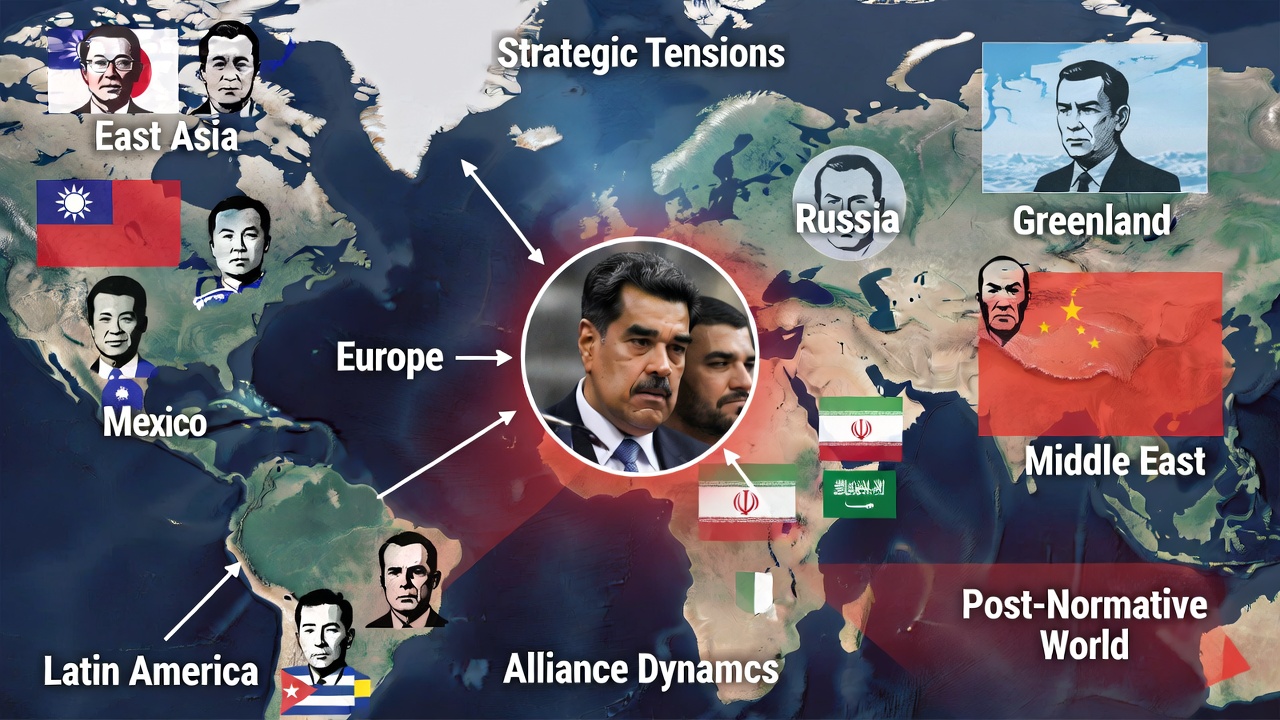
For allies such as Japan, the concern is precedent and escalation. For Taiwan, the operation signals resolve. For China, Russia, and Iran, it provides data—on U.S. willingness to act, alliance cohesion, and escalation tolerance. And for Latin America, it forces a reckoning long deferred: whether sovereignty alone can justify tolerance of regimes that export instability.
Japan and Taiwan: Deterrence, Precedent, and Alliance Tension
Japanese unease following the Venezuelan operation is not rooted in sympathy for Caracas but in concern over precedent. As the United States’ most important ally in East Asia, Japan depends on American military power for deterrence while living in close proximity to an increasingly assertive China. Any perceived erosion of norms governing the use of force is therefore not abstract. It directly shapes Japan’s security environment.
Tokyo’s anxiety is that Beijing could selectively cite U.S. action in Venezuela as rhetorical cover for coercive moves against Taiwan—even if the analogy is legally and strategically flawed. Geography sharpens this concern. Any Taiwan contingency would immediately implicate Japanese territory, U.S. bases in Okinawa, and vital sea lanes that carry most of Japan’s energy imports. Japan’s 2022 National Security Strategy explicitly identifies a Taiwan emergency as an existential threat, underscoring how closely these issues are linked in Japanese strategic thinking.
At the same time, Japanese policymakers are realistic. Few believe that Chinese restraint on Taiwan rests on legal consistency or respect for Western precedent. Beijing has already demonstrated a willingness to reinterpret international norms when core interests are at stake, from the South China Sea to the dismantling of Hong Kong’s autonomy. The concern in Tokyo is therefore less about legality than about perception—how actions elsewhere may reshape escalation dynamics closer to home.
In Taipei, the interpretation is markedly different. Taiwanese officials have largely read the seizure of Maduro as reassurance rather than destabilization. The lesson drawn was not ambiguity, but American operational capability and political will. For a society long accustomed to doubts about U.S. staying power, the operation strengthened deterrence rather than undermined it. This divergence highlights a central challenge in alliance management: an action that reassures one ally may unsettle another, even when both depend on the same guarantor.
China, Russia, and Strategic Observation
For Beijing and Moscow, Venezuela was less provocation than observation.
China has invested tens of billions of dollars in Venezuela through loans-for-oil arrangements and infrastructure projects designed to secure long-term access to energy resources. Despite this material stake, Beijing’s response has been notably restrained. Chinese officials condemned the U.S. action as a violation of international law but avoided direct confrontation. Venezuelan oil remains important to China, but not at the cost of escalation with the United States.
This response reflects a broader realist logic. As scholars such as John J. Mearsheimer have argued, great powers prioritize core interests and avoid unnecessary overextension. From this perspective, Beijing’s posture represents calculated pragmatism: protect economic equities where possible, absorb diplomatic loss where necessary, and allow Washington to bear the political cost of action.
Russia’s reaction has been even more subdued. Despite longstanding ties to the Maduro regime, Moscow appears focused on higher-priority theaters, particularly Ukraine. Recent reporting underscores that Kremlin decision-makers view Venezuela as expendable compared to negotiations over Ukraine’s future and sanctions relief. From a realist standpoint, this restraint reflects hierarchy of interests rather than weakness of will. Venezuela matters; Ukraine matters far more.
Iran, the Middle East, and Escalation Control
In the Middle East, the Venezuelan intervention intersects with rising internal unrest in Iran and Tehran’s increasingly explicit framing of confrontation as “full-scale” against Israel, the United States, and the West. Domestic pressures—marked by protests, economic strain, and legitimacy erosion—constrain Iran’s freedom of maneuver even as its external rhetoric grows more belligerent.
This aligns closely with deterrence theory. As Thomas Schelling observed, the most dangerous moments in international politics occur when states feel both threatened and constrained. Regimes under internal stress are more prone to misinterpret signals and take risks others might avoid. Applied to Iran, this suggests that Western pressure must be calibrated carefully: credible enough to deter, restrained enough to avoid unintended escalation.
Recent public commentary by senior U.S. military leaders, including former Iraq and Afghanistan commanders, underscores that American power today operates along a spectrum—from informational and economic measures to precision strikes designed to avoid occupation or regime collapse. This calibrated approach reflects a conscious effort to retain coercive leverage while managing escalation.
Gaza and the Israel–Hamas conflict further shape this environment. For Tehran, Gaza functions as both pressure valve and proxy arena, allowing indirect confrontation with Israel while avoiding direct war with the United States. Washington’s posture—robust support for Israel combined with restraint aimed at preventing regional spillover—reinforces a broader pattern visible in Venezuela: selective, asymmetric application of power rather than open-ended intervention.
Saudi Arabia and the Gulf states act as additional stabilizers and constraints. The Trump administration’s close relationship with Riyadh and other Gulf partners underwrites a regional balance that deters Iran while seeking to avoid energy shocks or broader war. Gulf states benefit from U.S. credibility but remain acutely sensitive to escalation risks that could threaten infrastructure, shipping lanes, or regime stability.
Latin America: Sovereignty Under Strain
Nowhere are the implications more immediate than in Latin America. For decades, regional diplomacy rested on the assumption that internal repression and state collapse were insulated by sovereignty norms. Venezuela’s implosion rendered that assumption increasingly untenable.
The Maduro regime functioned for years as a hub of regional instability—exporting narcotics, enabling transnational criminal networks, and sustaining allied authoritarian regimes, most notably Cuba. Its removal forces uncomfortable questions across the region.
Cuba is the most exposed. The island relied heavily on subsidized Venezuelan oil to sustain an already collapsing economy. With Caracas no longer able to guarantee that lifeline, Havana faces intensifying internal pressure marked by blackouts, shortages, and mass emigration. Recent reporting in the Wall Street Journal highlights how the loss of Venezuelan oil threatens to push Cuba toward a crisis rivaling the post-Soviet “special period.” The regime’s response—heightened repression and nationalist mobilization—reflects survival instincts rather than confidence.
Colombia and Mexico present different challenges. Colombia, despite enduring years of migration pressure, cross-border criminality, and armed-group spillover from Venezuela, has publicly criticized the U.S. operation on sovereignty grounds. Mexico has likewise condemned the intervention rhetorically while quietly adapting to the economic and security consequences. Both cases illustrate hedging behavior: normative resistance paired with pragmatic adjustment.
As Robert D. Kaplan has long argued, geography and material reality reassert themselves when norms falter. Migration flows, energy networks, and criminal economies do not respect diplomatic abstractions. They shape strategy whether governments acknowledge it or not.
Hemispheric Signaling, Greenland, and Alliance Friction
The Venezuelan operation coincides with renewed U.S. attention to Greenland, another case where strategic interests are clear but signaling has proven destabilizing. Greenland’s importance—missile defense, Arctic access, rare-earth minerals, and emerging sea lanes—is widely recognized. The Arctic is rapidly becoming a theater of strategic competition involving the United States, Russia, and China.
Yet rhetoric suggesting the possible use of force, even as negotiating leverage, has unsettled allies. Danish and Greenlandic leaders have rejected any notion of acquisition or coercion, while European partners—including France and Norway—have criticized the Venezuela operation on legal grounds. Their concern is less about outcomes than about process and predictability.
This friction illustrates a recurring dilemma. Deterrence built on shock and dominance can succeed tactically while complicating alliance politics strategically. In a system where alliance cohesion underpins deterrence itself, reassurance matters as much as resolve.
Conclusion: Power, Perception, and Discipline
The U.S. intervention in Venezuela will not rewrite international law, nor does it confer license for aggression by adversaries elsewhere. What it does clarify is the operating environment of the early twenty-first century: norms are contested, deterrence rests on perception as much as capability, and sovereignty without governance is increasingly untenable.
This assessment reflects an early snapshot of how key global actors have interpreted the U.S. intervention in Venezuela, based on initial reactions in the days immediately following the operation. Time will tell whether this snapshot holds or whether subsequent actions provide greater clarity.
George Kennan warned that the greatest danger in foreign policy is not action itself, but confusion about interests and limits. In this case, deterrence without clarity means a powerful signal from the United States—credible and costly—but one whose thresholds and boundaries remain undefined, inviting allies and adversaries alike to draw their own, potentially dangerous conclusions.
Venezuela was not a template.
It was a warning.