It’s Time – Recognizing The Taiwanese Nation State

Abstract
For decades, the international community has maintained a diplomatic fiction: pretending Taiwan is not a sovereign state despite overwhelming evidence to the contrary. This essay argues it is time to break this taboo through incremental, grassroots recognition of Taiwan as an independent nation-state.
Five arguments support this shift. First, the Taiwanese people constitute a distinct nation—longitudinal polling shows over 60 percent identify as “Taiwanese only” with only 2-3 percent as “Chinese”—and the Republic of China governs a de facto independent state. Second, while U.S. strategic ambiguity was brilliant Cold War statecraft, Washington failed to adapt as Taiwan and China diverged fundamentally between 2005-2015. Third, Beijing’s deterrence by punishment has been so effective that democratic governments now police their own speech. Fourth, decentralized recognition by individuals, municipalities, universities, and civil society can overwhelm Beijing’s coercive apparatus by distributing resistance across actors too numerous to suppress. Fifth, this strategy may force Beijing to reconsider whether absorbing Taiwan serves the CCP’s only true core interest: regime survival.
Incremental recognition is not merely confrontation but a pathway toward sustainable coexistence. The current trajectory leads toward military catastrophe. The essay concludes with the author’s formal declaration recognizing Taiwan’s sovereignty.
Introduction
Breaking the Delusion
For decades, the international system has entertained a diplomatic fiction worthy of The Emperor’s New Clothes. Everyone can see that Taiwan functions as a sovereign, democratic nation-state, yet governments pretend otherwise primarily because Beijing insists on maintaining the illusion. The world nods along, applauding the procession, even as Emperor Xi-Jinping and the Chinese Communist Party (CCP) march naked and humorless down the geopolitical runway.
This strange ritual persists despite the facts. Twenty-three and a half million Taiwanese citizens elect their own leaders, speak their own dialects, defend their own borders, trade globally, operate a competent military, and most importantly, maintain their own collective identity as a Taiwanese people. Yet, the world speaks of their statehood and their identity as a nation in hushed tones, as if acknowledging it aloud might summon a security crisis into being. The result is one of the worst-kept secrets in modern statecraft: everyone privately recognizes Taiwanese de facto statehood while accommodating Beijing’s tortured naming conventions, but few are willing to say so publicly. Not because the truth is complicated, but because the consequences of honesty feel politically inconvenient at best and downright dangerous at worst. The taboo persists through coercion from Beijing and misplaced nostalgia among small factions in Taiwan. Beijing built it. The United States accommodated it. The world internalized it. And the longer we perform this self-imposed silence, the more we mistake fear for prudence.
As this essay goes to press, Beijing has provided fresh evidence of its coercive intent. Xi Jinping’s New Year address declared Taiwan’s reunification ‘unstoppable’. The week prior, PLA forces conducted Justice Mission 2025, simulating a comprehensive blockade of Taiwan with live-fire exercises. These drills explicitly targeted ‘deterrence outside the island chain,’ a direct warning to would-be American and allied intervention. The message is clear: Beijing is rehearsing the tools of coercion while the world maintains its polite fiction. The question is whether we will continue performing our assigned roles in this charade.
This essay argues that it is time to break that taboo and, incrementally and responsibly, move toward full international recognition of Taiwan as an independent nation-state. To be clear, the arguments in this essay should not be construed as a universal endorsement of secessionist claims, nor a template for revisiting settled internal borders within consolidated democratic states. It applies narrowly to a case where a self-governing, democratic polity faces existential absorption by an external authoritarian power that has never exercised legitimate sovereign control over it. Conflating Taiwan with domestic minority politics inside democratic states collapses a critical distinction between internal constitutional pluralism and external imperial conquest.
Five conceptual arguments underpin this claim and point to a necessary strategic shift for the United States and its allies.
First, three basic facts demand acknowledgment: (a) the Taiwanese people constitute a nation, despite decades of CCP propaganda; (b) the political entity known as the Republic of China (ROC) is the legitimate government of a de facto independent state of Taiwan, and (c) there is only one China and Taiwan is NOT part of it.
Second, although often criticized for short-termism, the United States executed a remarkable grand-strategic balancing act during the late Cold War and early post-Cold War period by marginalizing Taiwan to achieve broader geopolitical gains. What Washington failed to do was adapt that posture as the strategic environment shifted between 2001 and the 2010s, when Beijing adopted a far more coercive national strategy.
Third, the only remaining reasons that these fundamental facts are not globally acknowledged are (a) the CCP’s sustained and highly effective coercion, and (b) the degree to which that coercion has deterred U.S. and allied leaders into silence. In this respect, the PRC’s “deterrence by punishment” has succeeded beyond anything the PLA could achieve with missiles or ships: it has coerced democratic governments into policing their own speech.
Fourth, a strategy of grassroots, incremental recognition conducted by individuals, organizations, municipalities, professional associations, and civil society may erode this artificially imposed narrative and help build the connective tissue of legitimacy that Taiwan and its would-be supporters will need in the coming future confrontation.
Fifth and finally, if such a strategy gains momentum, it may force Beijing to reconsider the premise that national rejuvenation requires the unprecedented absorption of Taiwan and its distinct people. That premise is historically dubious, strategically unnecessary, and politically constructed. It is also the root cause of what could be the defining geostrategic disaster of this century.
1- THE FACTS OF TAIWANESE IDENTITY
The Taiwanese Nation
Understanding Taiwan requires first disentangling two foundational concepts—nation and state—that are often blurred in popular discourse but analytically indispensable. Borders, armies, or bureaucracies do not define a nation. A nation is defined by people who share a socially constructed sense of collective identity; what Benedict Anderson famously called an ‘imagined community’. Such communities are imagined because their members will never know most of their compatriots; they are communities because they share symbols, narratives, values, and expectations; they are limited because they define in-groups and out-groups; and they are sovereign because they aspire to (or in this case, already have) self-rule. Measured against these criteria, the Taiwanese people today are unmistakably a nation.
Identity Data: The Empirical Line That Will Not Recede
No amount of CCP propaganda or wishful thinking in certain Western capitals can obscure the blunt, longitudinal reality: Taiwanese identity has diverged sharply and irreversibly from Chinese identity over the past four decades. National Chengchi University’s Election Study Center (ESC) time series, the gold standard for identity polling, shows a profound transformation. In the early 1990s, “Taiwanese only” hovered in the single digits. By the mid-2010s, it had surged above 60 percent, with roughly 30 percent identifying as “both” and only 2–3 percent identifying as “Chinese.” These numbers are not statistical noise. They are confirmed in numerous other studies. These are the sociological expressions of a national community that has consolidated itself through shared experience, democratic participation, and generational change. The Taiwanese nation is not emerging; it has always existed to some degree, it has recently matured, and it continues to grow stronger in the public consciousness of the island’s people. Each act of saber-rattling and subversive activity only makes the Taiwanese identity stronger in the minds of its people.
The Taiwanese nation is not emerging; it has always existed to some degree, it has recently matured, and it continues to grow stronger in the public consciousness of the island’s people. Each act of saber-rattling and subversive activity only makes the Taiwanese identity stronger in the minds of its people.
History as the Crucible of the Taiwanese Nation
History is used here to explain how collective identity and political legitimacy emerge over time, rather than to establish primordial claims or revive antiquated borders. Modern sovereignty rests not on medieval inheritance, but on present consent and governance. Unlike revisionist historical claims used to justify conquest, Taiwan’s case rests on contemporary democratic self-rule and the expressed will of its population.
The persistent misunderstanding, especially among Western observers, is the belief that Taiwan’s “Chineseness” is a timeless historical inheritance. It is not. Taiwan’s past is the story of repeated encounters with foreign rule, migration, occupation, resistance, and assimilation, producing a distinct society that, only under the CCP’s narrative lens, is flattened into an extension of “China.”
When the Dutch East India Company established control over parts of the island in 1624, the population was overwhelmingly indigenous. Han settlers were imported largely as labor, beginning a pattern of migration to Taiwan rather than Taiwan’s subordination to China. The Zheng regime (1662–1683), while linked to the Ming, governed Taiwan as a separate base of power. Qing rule, often invoked by Beijing as historical “proof,” was neither deep nor consistent; it was colonial suzerainty, not integrated nationhood. The Qing voluntarily ceded its claim over Taiwan to Japan in the Treaty of Shimonoseki. Hardly the behavior of a state guarding an inseparable part of its national territory, though the people of Taiwan mounted a concerted resistance to the subsequent Japanese invasion and occupation.
Japanese rule (1895-1945), which is often characterized as oppressive, extractive, and transformative, left deep administrative, educational, cultural, and infrastructural imprints. Taiwanese (including descendants of Han settlers) resisted their subordinate status, but they also assimilated elements of Japanese modernity, identity, and governance. By 1945, Taiwan was not “returning” to a Chinese political community; it was entering yet another round of foreign rule.
The KMT’s arrival in 1945 sparked a period of occupation, political violence, and resistance. When Chiang Kai-shek’s Nationalist forces occupied Taiwan after Japan’s defeat, they were stunned by how Japanese—in language, custom, and habit—the population had become. The KMT responded by attempting to erase Japanese and native Taiwanese influence and impose its own version of Chinese nationalism. From 1945 to 1949, Taiwan was governed not as a fellow Chinese province but as a conquered territory. The February 28, 1947, violent crackdown on uprisings, known as the 228 Massacre, initiateddecades of political repression. Known as the White Terror, this repressive response was meant to eliminate both Taiwanese identity and prevent communist subversion from the mainland. It also prepared the KMT for the pipe dream of reclaiming the mainland from the CCP. Ironically, the decades-long struggle against authoritarianism only fertilized the sense of common identity that bound the people of the island together. This was just the latest chapter in Taiwan’s history of occupation, resistance, and assimilation. In the long arc of Taiwan’s history, foreign occupiers are eventually absorbed into the island’s evolving identity—and the same happened to the KMT. What began as a military occupation slowly mutated, under internal pressure, into a shared political community.
The Sovereign State of Taiwan
If the Taiwanese nation is the product of history, the Taiwanese state is the product of political transformation. The two are related but distinct. A nation is a matter of identity; a state is a matter of institutions, governance, and sovereignty.
Taiwan’s transition from a KMT-run authoritarian regime to a vibrant democracy was the foundational shift that tied the Taiwanese nation to the state that governs it. The democratization process, beginning haltingly in the 1970s and accelerating after Chiang Ching-kuo’s reforms in the 1980s, fundamentally reshaped political legitimacy on the island. The KMT lifted martial law in 1987, opposition parties emerged openly, and by the mid-1990s, Taiwan held its first direct presidential election. Democratization liberalized the ROC system, but it also re-rooted that system in Taiwanese identity, which was further strengthened by the contrast with the mainland. The authoritarian “Republic of China on Taiwan” slowly became the democratic “Taiwan under the ROC constitutional framework.” Schools began teaching Taiwanese history, rather than the KMT-mandated history of China. The distinction matters: the state did not create the nation; the nation remade the state through a long-term, multi-generation resistance movement that turned the occupiers into natives.
One of East Asia’s least appreciated transformations was how the post-1949 mainlanders (外省人) assimilated into Taiwanese identity. The KMT arrived as occupiers, not compatriots, imposing repression and cultural control. Yet by the second and third generations, these communities became Taiwanese in culture, democratic practice, and political preference. This inverts Beijing’s narrative: the Taiwanese population did not assimilate into China; the Chinese who arrived in 1949 assimilated into Taiwan.
A Contested State, but a State Nonetheless
Taiwan today is a “contested state”—a term political scientists use for entities that possess the full attributes of statehood but lack universal diplomatic recognition. Yet analytically, Taiwan meets every criterion of the modern state, including a defined territory, a permanent population, a functioning government (democratically elected), and the capacity for external relations (which it exercises even under constraints). Taiwan fields armed forces, collects taxes, passes laws, maintains its own currency, controls its borders, signs trade agreements, and operates foreign missions. Remarkably, Taiwan hosts the world’s most indispensable business: Taiwan Semiconductor Manufacturing Company. In practice, the ROC governs the island as the undisputed sovereign authority. In theory, only coercion by the PRC prevents other states from acknowledging this reality.
Taiwan is not a nation seeking a state; it is a state whose nation has been denied recognition. This distinguishes it categorically from cases such as the Kurds, whose claims, however legitimate, involve the redrawing of existing sovereign borders across multiple states. Recognizing Taiwan acknowledges an existing political reality without revising borders.
2-US POLICY: FROM MASTER-STROKE TO FAILURE TO ADAPT
American policy toward Taiwan from the 1970s through the 1990s deserves recognition as one of the more elegant exercises in Cold War statecraft. The opening to China, with Taiwan as the necessary concession, allowed the United States to take advantage of the emerging split in the Sino-Soviet bloc, accelerate Soviet encirclement, and ultimately help bring the Cold War to a favorable conclusion. The marginalization of Taiwan was strategic triage, not a moral failure. When survival is at stake, great powers make hard choices. Nixon and Kissinger made theirs, and history largely vindicated them.
Students of US-China relations today learn that the Three Communiqués, the Taiwan Relations Act, and the Six Assurances inform US policy towards China and Taiwan. The genius of the arrangement is in its studied ambiguity. The Shanghai Communiqué and subsequent agreements did not recognize PRC sovereignty over Taiwan. They merely agreed that Taiwan was part of China and “acknowledged” Beijing’s claim. This linguistic sleight of hand created space for the United States to maintain unofficial relations with Taiwan, continue arms sales, and preserve the island’s de facto independence while pursuing normalized relations with Beijing. The result was a deliberately constructed hedge rather than a permanent settlement: if China liberalized, unification might eventually become acceptable to the Taiwanese people. If China collapsed or fractured, the ROC framework might prove helpful. If neither occurred, the arrangement at least bought time.
Through the 1980s and into the 1990s, this hedging logic remained defensible. The Tiananmen Square massacre in 1989 revealed the CCP’s willingness to use mass violence to preserve its rule. Still, it also confirmed that the regime was brittle and potentially reformable under sufficient external pressure. The Clinton administration doubled down on engagement, operating under the widely shared theory among Western elites that integrating China into the global economy would generate middle-class demands for political liberalization. Strategic ambiguity served this theory perfectly: it avoided forcing a crisis over Taiwan while leaving open the possibility that cross-strait tensions would eventually dissipate as both societies converged toward liberal-democratic norms.
But the theory did not hold. More importantly, the conditions that made strategic ambiguity a rational hedge began to erode between 2005 and 2015; a decade during which the wars in Iraq and Afghanistan consumed American attention while policymakers missed or downplayed the tectonic shifts occurring across the Taiwan Strait.
The Decade of Divergence
On the mainland, the CCP did not liberalize. It adapted. Under Hu Jintao, and especially after Xi Jinping’s rise to power in 2012, the Party systematically dismantled the fragile legal and civil society reforms of the 1990s and early 2000s. Rather than evolving toward political pluralism, the regime invested in surveillance technologies, social control mechanisms, and ideological discipline. While the United States was preoccupied with counterterrorism, Beijing leveraged global concerns over Islamic extremism to justify the systematic repression and cultural genocide of the Uyghur population in Xinjiang. That campaign revealed not a regime in crisis but one confident in its coercive capacity.
Simultaneously, Taiwan moved in the opposite direction. The island’s democracy deepened through successive peaceful transfers of power, and Taiwanese civil society demonstrated remarkable resilience. The 2014 Sunflower Movement crystallized what polling showed: Taiwanese identity was a consolidated national consciousness, not a phase.
By 2015, the divergence was complete, as Taiwan had become one of Asia’s most vibrant democracies and one of its most prosperous economies. The PRC, on the other hand, had become the world’s most technologically sophisticated authoritarian state. The idea that these two political communities might peacefully converge—the theoretical foundation of engagement and strategic ambiguity—was empirically dead. Yet American policy did not adapt and stubbornly still refuses to budge.
The Status Quo Trap
The failure is one of strategic imagination. U.S. policymakers continue to speak of “preserving the status quo” and “maintaining stability” as if these were coherent goals. They are not, at least not when one party to the arrangement has openly committed to overturning it.
Strategic ambiguity was designed as a hedging strategy, not an equilibrium. It was assumed that China’s future political character was uncertain and that time might favor a peaceful resolution or transition. But hedging strategies have a shelf life. When uncertainty resolves, and one side states its intention to revise the arrangement by force while systematically building the military, economic, and political means to do so, the hedge collapses into a trap.
Status quo strategies are inherently reactive, setting defensive perimeters and relying on deterrence thresholds to prevent overt aggression. But they are poorly suited to counter revisionist powers that employ incremental coercion, gray-zone operations, and political warfare. Each move of economic pressure, diplomatic isolation, cyberattacks, disinformation, and military exercises falls below response thresholds. Beijing understood this dynamic and ruthlessly exploited it. Rather than trigger a war that might unite the international community, the PRC made recognition of Taiwan so costly and accommodation so attractive that democratic governments police their own behavior. Meanwhile, the military balance shifts, Taiwan’s international space contracts, and the window for intervention narrows. The status quo erodes through a thousand cuts rather than a single big crisis. Deterrence by punishment focused on political speech instead of military action.
The United States and its allies have spent two decades debating how to maintain a status quo that no longer exists. The Taiwanese nation is not emerging; it has always existed to some degree, it has recently matured, and it continues to grow stronger in the public consciousness of the island’s people. Each act of saber-rattling and subversive activity only makes the Taiwanese identity stronger in the minds of its people.
The Taiwanese nation is not emerging; it has always existed to some degree, it has recently matured, and it continues to grow stronger in the public consciousness of the island’s people. Each act of saber-rattling and subversive activity only makes the Taiwanese identity stronger in the minds of its people.
3- DETERRENCE (AND COMPELLANCE) BY PUNISHMENT: HOW BEIJING WON WITHOUT FIGHTING
The national security establishment in Washington loves to debate deterrence. Elbridge Colby, now serving as Under Secretary of Defense for Policy, has built much of his career around the concept of “denial.” The idea that the United States, alongside Taiwan and regional allies, can develop military capabilities that make a PRC invasion of Taiwan prohibitively costly or outright impossible. Deterrence by denial, the theory goes, is superior to deterrence by punishment because it removes the adversary’s confidence that aggression can succeed, rather than merely threatening retaliation after the fact.
It is a sound strategic concept, and its manifestation in policy, posture, and capability is long overdue. There is only one problem. While American strategists have been absorbed in debates over how to deter Beijing militarily, they have failed to notice that Beijing has already cognitively deterred Washington.
The PRC’s most effective weapon against Taiwan has not been its amphibious fleet, its missile arsenal, or its cyber capabilities. It has been the systematic use of coercion to silence, isolate, and marginalize Taiwan in the international system and to condition foreign governments, corporations, and institutions into enforcing Beijing’s preferred narratives on its behalf. This is deterrence by punishment in its most refined form: not the threat of military retaliation, but the certainty of economic, diplomatic, and reputational costs imposed on any actor that acknowledges Taiwan’s reality.
While American strategists have been absorbed in debates over how to deter Beijing militarily, they have failed to notice that Beijing has already cognitively deterred Washington.
The Three Warfares and the Erosion of Recognition
Beijing’s strategy rests on what PLA doctrine calls the “Three Warfares” (三战): psychological warfare, media warfare, and legal warfare. These are the primary instruments through which the PRC has reshaped international behavior without firing a shot. The evidence is exhaustively documented in policy reports, academic studies, and diplomatic case files. Since 2016, the PRC has aggressively poached Taiwan’s remaining diplomatic allies, particularly in Latin America, Africa, and the Pacific. Numerous analyses of China’s “anaconda strategy” capture the method: Beijing combines economic inducements (infrastructure investments, debt relief, trade access) with implicit threats (withdrawal of aid, exclusion from Chinese markets) to pressure small states into switching recognition from Taipei to Beijing. The result has been a steady contraction of Taiwan’s formal diplomatic space from over 20 countries in 2016 to fewer than a dozen today. Additionally, Beijing systematically polices informal recognition: airlines list Taiwan as ‘Taiwan, China’ or face market exclusion; universities avoid hosting Taiwanese officials; international organizations from the WHO to INTERPOL exclude Taiwan even when cooperation serves public interest.
This is a deliberate, globally coordinated campaign to enforce a political fiction and to punish any deviation from it. It works not because Beijing’s arguments are persuasive, but because the costs of resistance are immediate and the benefits of compliance are tangible.
The Deterrence That Dare Not Speak Its Name
What makes this strategy so effective is that it operates primarily beneath the threshold of what Western governments recognize as “deterrence.” When policymakers in Washington, Brussels, or Tokyo think about deterrence, they think about missiles, naval blockades, and invasion scenarios. They do not think about the quiet pressure on a trade ministry, the revenue projections that shift when a CEO considers offending Beijing, or the cultural event that gets canceled because a Taiwanese representative was invited.
Yet this is precisely where the PRC has achieved its most significant victories. Democratic governments have internalized Beijing’s red lines and begun enforcing them preemptively. Officials avoid using the word “country” when referring to Taiwan. Diplomatic invitations are quietly rescinded. Trade delegations are renamed. Political leaders rehearse verbal gymnastics to avoid “provoking” Beijing, as if acknowledging observable reality were itself an act of aggression.
This is not prudence. It is capitulation. And it is precisely what deterrence by punishment is designed to achieve: behavior modification through the internalization of threatened costs. Beijing does not need to punish every transgression if governments learn to punish themselves.
The Uncomfortable Truth
American strategists debate force structures, missile inventories, and alliance coordination as if these are the decisive factors in cross-strait stability. They are not wrong to focus on military readiness—deterrence by denial will matter when (not if) Beijing attempts an invasion, coercive blockade, or any other combination of strategic approaches. Building better capabiities and even forming a stronger Pacific Defense Pact can have real effect. But American strategists are fighting the second war. The PRC has already won the first one. It secured victory over whether Taiwan’s existence can be acknowledged in polite company.
The assumption that recognition “accelerates” conflict rests on a misreading of Chinese behavior. Beijing’s military modernization, legal preparation, and gray-zone coercion have proceeded independently of Western recognition debates. The relevant variable shaping conflict risk is not declaratory policy, but perceived trends in relative power, legitimacy, and time. The CCP will invade, subvert, or aggressively coerce when it is ready. Paradoxically, indefinite delay may be more destabilizing than incremental recognition, because it reinforces Beijing’s belief that coercion works and that time favors absorption rather than accommodation. Even if Beijing were to achieve rapid military success, recognition remains strategically consequential because the decisive contest would shift immediately from invasion to occupation, legitimacy, and resistance. These are domains where political recognition directly shapes outcomes.
Until democratic governments recognize that they have been deterred and that their silence is not strategic patience but strategic defeat, they will continue to cede ground. The question is not whether Beijing will attempt further coercion, which continues and is now routine. The question is whether the international community will continue to enforce it on Beijing’s behalf.
But American strategists are fighting the second war. The PRC has already won the first one. It secured victory over whether Taiwan’s existence can be acknowledged in polite company.
4 – INCREMENTAL RECOGNITION – WE CAN SALAMI SLICE TOO
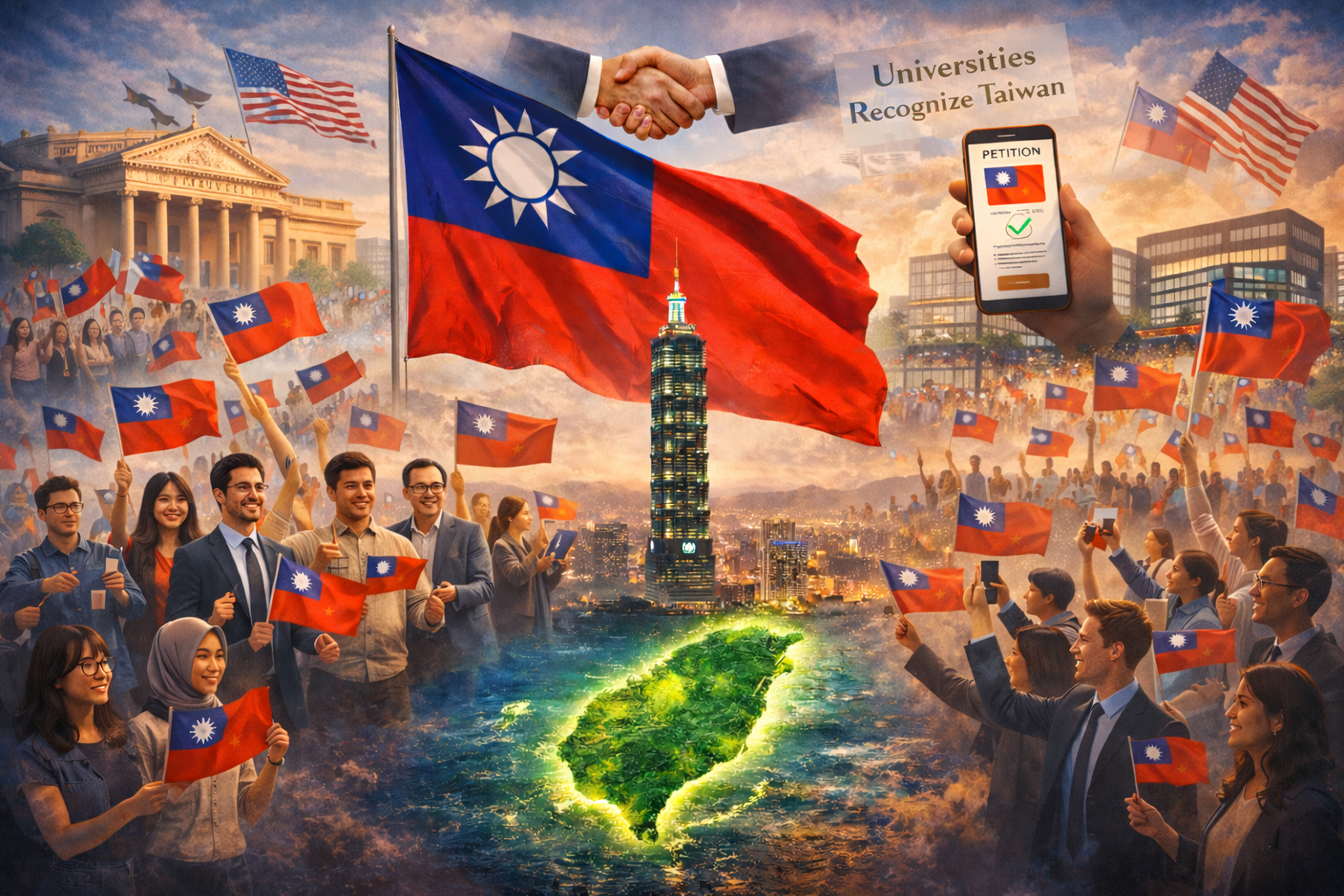
If Beijing’s coercion succeeds through a thousand small cuts, the response must mirror the method. The path to recognizing Taiwan need not, and realistically cannot, begin with a sudden diplomatic reversal by Washington or Brussels, barring a crisis. They have wasted too much credibility by repeating the lie that there is one China and that Taiwan is a part of China…it is NOT. But it can begin with something more diffuse, more resilient, and ultimately more difficult to suppress—grassroots recognition by individuals, institutions, municipalities, universities, civil society organizations, and subnational governments.
One of the significant advantages of living in open societies is that governments can maintain official positions while populations remain free to hold and express different views. This is a defining feature and great strength of democratic governance. And it is precisely this feature that offers a strategic opportunity. If the PRC’s coercion operates by isolating Taiwan through centralized pressure on national governments, the counterstrategy must distribute recognition across a decentralized network of actors too numerous and too dispersed for Beijing to effectively coerce.
If the PRC’s coercion operates by isolating Taiwan through centralized pressure on national governments, the counterstrategy must distribute recognition across a decentralized network of actors too numerous and too dispersed for Beijing to effectively coerce.
The Power of Defiant Speech
The first step is simple, and it costs nothing. Individuals and organizations should publicly recognize Taiwan. Newspapers and media outlets should refer to Taiwan as a country. Municipalities should pass resolutions acknowledging Taiwanese sovereignty. Universities should host Taiwanese officials without apology. State and provincial governments should engage in sister-city relationships and trade delegations with Taiwan, using language that reflects reality rather than Beijing’s preferred euphemisms.
This will provoke resistance not just from Beijing but also from within democratic institutions themselves. The reflexive response will be to hide behind procedural neutrality: “Our organization does not take stands on political issues.” But this framing is dishonest. Refusing to acknowledge Taiwan is itself a political position and, worse yet, one adopted under coercion. When the Taiwanese people overwhelmingly reject the claim that they are part of the PRC, pretending otherwise is not neutrality; it is complicity in Beijing’s narrative engineering.
I know this invites retaliation, but this is precisely why distributed recognition matters. If only a handful of actors break ranks, Beijing can isolate and punish them with precision. If thousands do, the coercion becomes unsustainable. The PRC cannot boycott every university, sanction every city council, or exclude every company that acknowledges Taiwan without exposing the absurdity of its own position. Crucially, if retaliation does occur, it should be met with public exposure and collective defense, not capitulation.
Building a Network of Resilience – Swarming Recognition?
The strategic logic here is straightforward. Decentralized recognition creates resilience. If recognition is concentrated in national governments, Beijing can focus its coercion on a small number of high-value targets. But if recognition is distributed across civil society, municipal governments, professional associations, cultural institutions, and private citizens, the coercive burden becomes prohibitive. If it happens simultaneously, it becomes even stronger and opens the door for future coordinated recognition by national governments.
Consider the mechanics: A state legislature recognizes Taiwan. Beijing threatens to cancel trade or withdraw investment. But if ten states act simultaneously, Beijing faces a dilemma: escalate against all and reveal its retaliation as indiscriminate, or selectively punish and prove its threats are manageable? Either response weakens Beijing’s position. Indiscriminate retaliation exposes the coercion as performative authoritarianism, turning international opinion against the PRC. Selective retaliation suggests the threats are hollow and invites further defections. This is the logic of decentralized resistance: it forces the coercer to choose between escalation that discredits it and restraint that emboldens opposition. Swarming recognition creates dilemmas that expose Beijing’s position as weak.
The Role of Governments: Plausible Deniability and Strategic Cover
National governments, particularly the United States, need not—and, in the near term, perhaps should not—lead this process. The executive branch can maintain its official policy of strategic ambiguity, thereby providing plausible deniability and avoiding immediate confrontation with Beijing. But this does not mean passivity. The federal government and allied governments must immediately begin a concerted effort to provide strategic cover in several ways:
First, they should immediately begin efforts to reintegrate Taiwan into those key international and intergovernmental organizations from which it has been banned or sidelined. This should start with INTERPOL and the WHO, and also include the use of the name “Taiwan” in international sporting competitions.
Second, they can loudly and publicly defend actors who are targeted by PRC retaliation. If a university is punished for hosting a Taiwanese official, the State Department should issue statements condemning the coercion and signaling support for academic freedom. If a corporation faces exclusion from Chinese markets for recognizing doing business with Taiwan, trade authorities should publicize the incident, consider it in broader economic policy deliberations, and most importantly, retaliate by punishing Beijing and assisting Taiwan in kind.
Third, legislative branches that may be less constrained by diplomatic protocol can amplify grassroots recognition. Members of Congress, parliamentarians, and regional legislators can pass resolutions, host delegations, and issue statements that incrementally normalize Taiwan’s status without requiring executive action. This creates political space for civil society while signaling to Beijing that democratic institutions are not monolithic.
Fourth, governments can refrain from disciplining their own actors. When a city council recognizes Taiwan, the federal government need not endorse the resolution—but it should neither endorse nor discourage it. The message should be clear: in democracies, subnational and non-governmental actors are free to speak, and attempts to coerce them will be met with resistance, not compliance.
Overwhelming the Coercion Machine
The goal is to build a critical mass of recognition that causes Beijing’s coercion strategy to collapse under its own weight. If hundreds of cities, universities, professional organizations, and media outlets begin openly referring to Taiwan as a country, the PRC faces an impossible choice: accept the erosion of its narrative control or engage in such widespread and indiscriminate retaliation that it alienates the very international community it seeks to dominate.
Let Beijing get angry. Let it issue protests, suspend partnerships, threaten retaliation, and conduct yet another military exercise around Taiwan. Each time Beijing desperately states that its claims on Taiwan are “sealed in seven locks,” it will expose the coercive apparatus that has silenced democratic discourse for decades. Beijing, thou doth protest too much. Each time civil society actors stand firm, they will demonstrate that Beijing’s red lines are not laws of nature. The red lines are political constructs that can be dismantled through collective defiance.
This strategy will not produce immediate diplomatic breakthroughs. But it will do something more important: it will rebuild the connective tissue of resilience that Taiwan and its supporters will need in the confrontation to come. It will normalize the language of Taiwanese sovereignty, making eventual formal recognition less of a shocking provocation and more of a natural extension of reality. Ultimately, it will shift the burden of escalation back onto Beijing, forcing the CCP to confront the limits of coercion and the stark reality when it is applied against open societies that refuse to be silenced.
5 – TOWARD A REAL GRAND BARGAIN
The conventional wisdom holds that the CCP’s commitment to “reunification” with Taiwan is ironclad—a core national interest so profoundly embedded in regime legitimacy that no amount of external pressure or internal calculation could dislodge it. This belief has paralyzed Western strategy for decades, creating a sense of inevitability that forecloses serious consideration of alternatives.
But the conventional wisdom is wrong. More precisely, it mistakes rhetorical rigidity for political immutability. The CCP’s position on Taiwan is not an eternal truth rooted in the profound logic of Chinese civilization. Instead, it is a constructed political commitment that the CCP adopted for specific historical reasons and has reinforced through decades of propaganda. Like all constructed commitments, it can be deconstructed.
The Constructed Nature of “Core Interests”
Mao Zedong did not always believe Taiwan was part of China. In the 1930s and 1940s, CCP rhetoric on self-determination was ambiguous, and Party leaders often treated Taiwan as separate from the Chinese civil war. Only after the KMT’s 1949 retreat did the CCP embrace the reunification narrative. It did so not because Taiwan was integral to Chinese identity, but because a rival government threatened the regime ideologically and politically.
Over the past 75 years, the CCP has embedded this narrative in textbooks, Party doctrine, and nationalist rhetoric. The “core interests” (核心利益) language emerged in the 2000s to signal non-negotiable issues. But here’s the paradox: if Taiwan’s status is a “core interest” only because the CCP declared it so, the CCP can revoke that declaration. The question is whether circumstances can arise in which maintaining the commitment costs more than abandoning it.
The CCP’s Real Core Interest: Survival
The CCP’s only true core interest is its own survival and the perpetuation of its rule over 1.3 billion people in mainland China. Everything else, from territorial claims and ideological narratives to nationalist rhetoric, is instrumental to that goal. When policies threaten the regime’s stability, the CCP has repeatedly demonstrated a willingness to reverse course, often with startling speed and flexibility.
The Party reversed the catastrophic economic policies of the Great Leap Forward when famine threatened social collapse. It dismantled the ideological extremism of the Cultural Revolution when it became clear that chaos was unsustainable. Deng Xiaoping abandoned Maoist economics in favor of market reforms when regime legitimacy required it. More recently, Xi Jinping reversed Zero-COVID policies after widespread protests revealed that public patience had limits.
This is not to say the CCP is inherently pragmatic or benign. It is ruthless, calculating, and willing to impose enormous suffering when it believes doing so serves its interests. But it is also adaptive. And when the regime perceives that a policy has become a liability rather than an asset, it can and does change course. The question is whether the international community can establish conditions that make Taiwan’s absorption seem like the strategic disaster it is likely to be, rather than a national triumph.
Schrodinger’s China: Rising Power or Peak Power?
China exists in a state of strategic ambiguity/ It is simultaneously portrayed as an unstoppable rising power and a brittle regime facing systemic crises. Both narratives contain truth. China’s economy is slowing, demographics are collapsing, the financial system is debt-burdened, and technological innovation is increasingly constrained by Western export controls, all while Xi’s authoritarian turn breeds inefficiency and resentment.
In this context, a contested Taiwan invasion represents an enormous gamble. A cross-strait invasion would be one of history’s most complex amphibious operations, conducted against a well-armed defender with likely external support. Even if successful, the PRC would face insurgency, international sanctions, and economic collapse while its model depends on global market access. The quagmire problem that consumed Russia in Afghanistan and Ukraine, and the U.S. in Vietnam, Iraq, and Afghanistan, awaits.
The CCP leadership is not suicidal. If they conclude that seizing and pacifying Taiwan costs more than quietly abandoning the project, they will reverse course, perhaps incrementally and with face-saving rhetoric that preserves regime legitimacy.
What Incremental Recognition Could Achieve
Grassroots recognition is not just about confrontation but must be part of a pathway toward sustainable coexistence. If successful, it could force both sides to abandon cherished fictions. The PRC would accept that Taiwan is not coming back through persuasion or coercion. The ROC would officially abandon any remaining claim to represent all of China.
Symbolic gestures could ease this transition and provide Beijing with face-saving measures. Taiwan could return some or most of the cultural artifacts taken by the KMT in 1949. These treasures belong to Chinese civilization and remain a source of resentment. The ROC could relinquish claims to Kinmen and Matsu, offshore islands geographically part of the mainland and strategically indefensible. These concessions don’t compromise Taiwan’s core identity or security, but they offer Beijing symbolic victories for domestic consumption.
But none of this becomes possible while the international community treats Beijing’s claims as immutable and Taiwan’s sovereignty as unspeakable. Breaking the silence is the first step. The second is demonstrating, through incremental recognition and collective resistance, that coercion’s costs are rising and Taiwan’s isolation is unsustainable. The third is patience. Let the CCP’s strategic calculus shift as the costs of its Taiwan policy become undeniable.
CONCLUSION
Strategic shifts do not begin with governments. They start with individuals willing to state what they know to be true. And so, let this begin here:
I, Ken Gleiman, Editor-in-Chief of Small Wars Journal, hereby recognize the Taiwanese people as a nation and the government of the Republic of China as the sovereign authority governing Taiwan.
Was that so hard?
Who’s next?