Adapting the Combat Training Centers for the Drone Battlefield
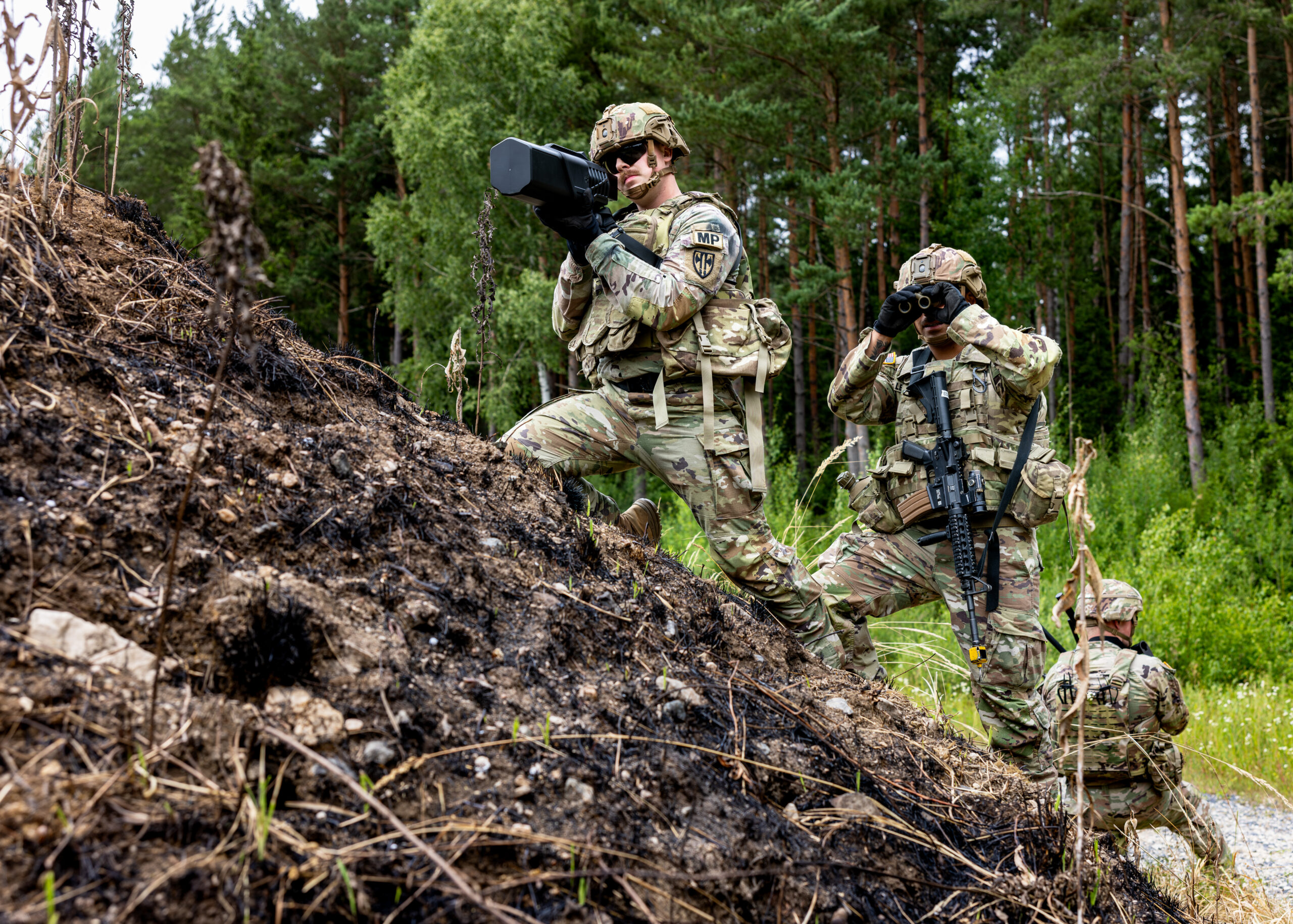

“It felt like you were being hunted versus hunting,” said Col. Scott Wence…I didn’t have any experience talking through how you defeat this,” (CSM) Donaldson said. “None of us did.”
Is the U.S. Army paying attention to the lessons learned in conflict zones around the world? sUAS (small unmanned aerial systems, i.e., drones) have transformed modern warfare, and it is time our training reflects that reality. The Combat Training Centers (CTCs) are uniquely positioned and should lead this evolution by integrating drones into base defense (defense) and call-for-fire / indirect fire training (offense) as a core skill for every leader and soldier in a direct combat specialty and across the entire force.
This technology has been proven, the benefits are clear, and our adversaries are already operating this way. Incorporating drones at the CTCs is not about catching up; it is about staying ahead and ensuring our soldiers are fully prepared for the modern battlefield. To be fair, there is a significant amount of effort taking place in this space, but are we truly leaning into it?
Training at the CTCs focuses heavily on staff processes, but the modern-day battlefield is more dynamic. Our troops will fight in drone-saturated environments like Ukraine, Gaza, or the Pacific; they must train to confront these threats. While CTCs have made strides in threat replication and limited C-UAS exposure, they still fall short of making drones a core element of tactical training.
Current adjudication standards need to be updated. Training rules that require six guns and 100+ rounds to destroy an armored vehicle ignore the capabilities that precision drone observation brings to combat operations. When a drone can see round impacts in real time and adjust immediately, the notion of firing a full battery becomes wasteful. One shot, one kill is not just a slogan for snipers anymore—it is the reality of modern precision-enabled fires.
The CTCs have not yet fully adapted to the modern fight and must adapt quickly. They need to train for the asymmetric realities of today rather than the battlefield of yesterday. To prepare soldiers for the conflicts they will face, CTCs must embed UAS and C-UAS employment into every rotation, every scenario, and every training lane.
The Global Situation of UAS and C-UAS Employment
Across the world, drone warfare is reshaping the fight. From Ukraine to Gaza to the U.S. southern border, unmanned systems are redefining tactics, logistics, and even command decisions.
In Ukraine, small drones have become the primary forward observer for all fires. Ukrainian units routinely locate Russian positions and adjust artillery in real time, striking with precision using a fraction of the ammunition once required. Facing ammunition shortages, they have refined their fire support to deliver decisive effects with far fewer rounds. The Ukrainian integration of commercial drones into traditional artillery missions has completely reshaped the execution of fire missions.
Ukrainian artillerymen say drones make their aim 250% better. — Business Insider, Feb 2024.
What Ukraine has proven is that when soldiers at the lowest levels are empowered to use drones for spotting and adjustment, they become more lethal, more efficient, and far less vulnerable. In one Ukrainian artillery battalion, drone-enabled spotting improved accuracy by over 200 percent. Every successful mission becomes intelligence for the next one, a live feedback loop between sensor and shooter. This kind of adaptation is exactly what our CTCs should be teaching.
Small drones have been spotted tracking U.S. troop movements along the southwest border and mapping out our sensor and observation coverage. That is a homeland example that mirrors what we are seeing in Ukraine and a warning that we are lagging.
The fight in Gaza reinforced what we have now recognized: drones shape every aspect of modern warfare. Israel’s Defense Forces (IDF) used hundreds of small drones for reconnaissance and precision strikes, giving squad leaders the ability to clear buildings and tunnels without exposing their soldiers. Hamas used the same technology to blind Israeli sensors and open lanes for attack. Both sides proved the same point: drones are now integral to combined arms operations. If we expect our soldiers to succeed in that environment, our training must reflect it.
Drones are rewriting the geometry of the battlefield. — War on the Rocks, 2024.
Our adversaries have already accepted that drones are part of every fight. Russia, China, Iran, and even cartel networks along the U.S. southwest border are using drones to surveil, harass, and attack. Small drones have been spotted tracking U.S. troop movements along the southwest border and mapping out our sensor and observation coverage. That is a homeland example that mirrors what we are seeing in Ukraine and a warning that we are lagging.
The good news is that the U.S. Army is beginning to capture these lessons learned. The National Training Center (NTC) in California replicates threat UAS systems using platforms like the TSM 800, capable of swarming up to 150 drones from a single control station. They are also using commercial systems such as the Parrot Anafi and DJI Mavic for ISR and simulated munitions drops. These steps, while limited, demonstrate that the Army recognizes the shift.
We are using drones to locate targets, call for artillery fire, and observe fall of shot—safely and effectively. — SFC Richard Hutnik, 166th RTI, Nov 2024.
Momentum is already building across the force. There are pockets of excellence and leaders taking the initiative. The 82nd Airborne Division stood up Gainey Company to drive drone innovation and training. They have learned directly from Ukraine’s lessons and pushed those insights back into their training pipeline. That kind of thinking needs to reach the CTC system.
Gainey Company isn’t just testing drones—it’s redefining how units fight with them. — DefenseScoop, 2023.
Gainey Company’s work has shown what’s possible when leadership commits. The company’s operators test, fail, and improve weekly. Additional Army efforts like Project Shrike and experiments at the Pennsylvania National Guard’s Regional Training Institute (RTI) prove that drones can be safely used to adjust live artillery fire. Instructors used small quadcopters to observe impacts, make corrections, and assess damage under controlled conditions. That is exactly the kind of pilot program we need at the national level.
How the U.S. Army Should Adjust Its CTCs – Defense
There is an approach gaining momentum in the private sector that is similar to the U.S. Army’s understanding of “base defense” that has proven valuable in the protection of critical infrastructure, mass gathering venues, and sensitive sites in the United States. The author has created a methodology and framework using their own experience and a thought process that starts with an understanding of the sUAS ecosystem. Failure to appreciate this basic understanding is the single biggest reason there is much confusion on how to approach sUAS technology as a potential threat tool.
When planning for an operation, especially with a fixed site for base operations, it is important to set the defense planning and infrastructure improvements in motion as a top-priority and task; in military terms, it is the priority of work. Offensive and defensive postures work synergistically in this type of environment, a trademark of over two decades of conflict in the Middle East. Today, however, the geometry has changed, and leaders must now consider the air domain more deliberately when it comes to physical security. Physical security thought and legacy approaches are outdated. Commanders own this inside their units and must come to the table with a vision. This approach is based on a five-step methodology depicted in the graphic below:
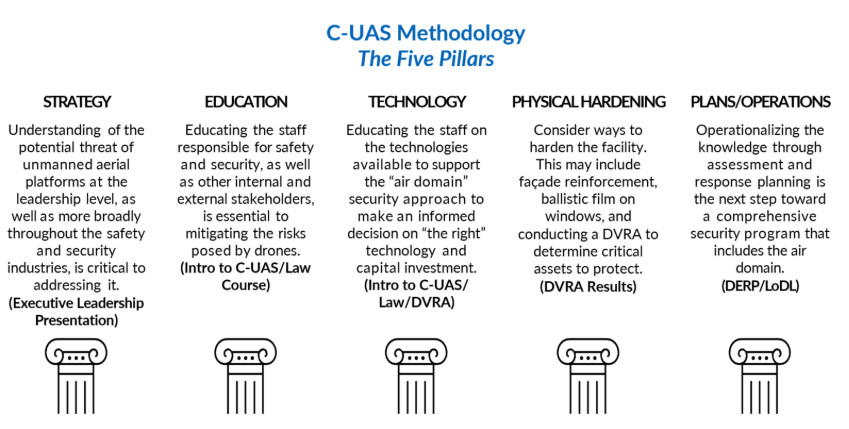
In each of these pillars, there is an associated training course that supports the planning and operational processes. To understand this better, each of the supporting training events is detailed here:
Strategy: The unit Commander and subordinate leaders own this task in coordination with the organization’s senior leadership and leadership two levels up in the chain of command. These steps require that the Commander and leaders understand the different compartments of the sUAS ecosystem. Those include drone manufacturers, component providers, detection sensors, mitigation and defeat tools, and training resources. The importance of this knowledge is to competently support the tactical formations when challenges arise at the lowest levels and require resourcing, a higher headquarters’ primary task.
Education: Holistic and comprehensive organizational training that considers internal and external stakeholders. This is the next step in creating a common operating picture (COP) for all levels of the organization, as sUAS will have impacts across the unit. ENSCO provides C-UAS training courses that fulfill this intent. This education program provides foundations in the following:
- C-UAS technologies, legal considerations inside the United States, status of forces agreements outside the United States, and rules of engagement in conflict zones.
- Drone Vulnerability and Risk Assessments (DVRA) for base defense considerations.
- Drone Emergency Response Planning (DERP) for policy, procedure, and standard operating procedure (SOP) development.
- Left-of-Drone-Launch (LoDL) (i.e., shaping drone launches before they happen) operations and development of operational concepts (CONOP)
Technology: sUAS technological evolution is often intimidating, but simply put, it should not be that way. Technology is the capital investment in this ecosystem and provides tools for drone flight, detection, defeat, and training. Airframes are the foundation of this entire methodology. In the U.S., this technology is developing rapidly but remains far behind the Chinese manufacturing base. As the Ukrainian conflict continues, more countries are moving fast to produce all categories of drones to add to their arsenals. There are four types of C-UAS sensors to consider: radio frequency, radar, optical (camera), and acoustic (microphones). Mitigation is more nuanced, but remains simple to understand: kinetic-projectile and drone-on-drone Directed Energy Weapons (DEWs), high-powered microwave, high-powered lasers, electronic warfare (jamming), Global Navigation Satellite System (GNSS) disruption, and lastly a takeover of the Command-and-Control signal.
Physical Hardening: This consideration is all about basic defensive fortifications: bunkers, barriers, netting, taking lessons learned from Ukraine to harden vehicles, façade reinforcements, as well as ballistic glass and films, or even ground-based versions of naval chaff launchers. Tactically, tools like Kevlar blankets and cloaking camouflage are important to the individual Soldier. Limiting heat emission is a key learning point from Ukraine. Spectrum analysis tools on bases and in frontline positions give awareness of the signal emissions from your position, an essential step to remain undetected in an environment where electromagnetic emissions are easily detectable.
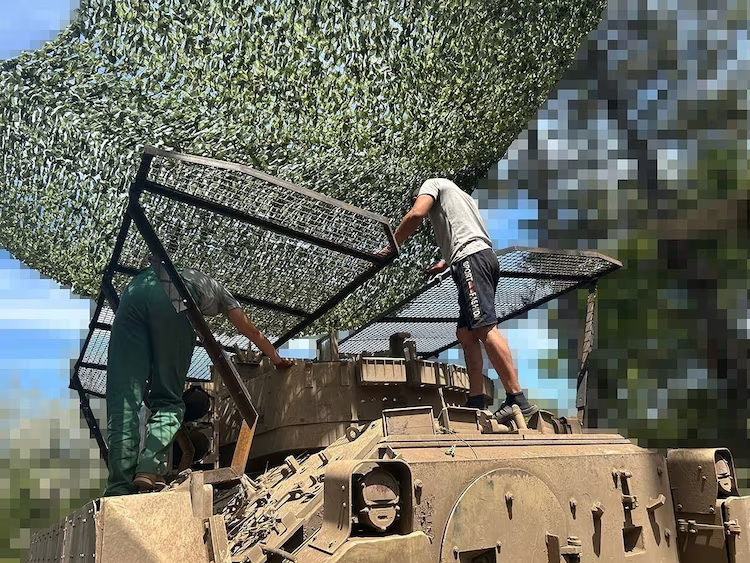
A U.S.-made Bradley armored vehicle fitted with a metal addition (ABC).
Plans and Operations: This consideration requires building operational concepts to support an offensive posture. Concept of Operations (CONOP) development takes shape as the next step in this framework. This is a collaboration between information and intelligence that drives directed operations to formally gain a left-of-drone-launch posture. Based on the author’s experience in the private sector and as an observer of contemporary conflict zones, drone pilots and operators have proven to be high-value targets in current operations in Ukraine.
Historical precedents do exist: live-fire training successfully integrated artillery, electronic warfare, and drones through white cell control, established safe grids, and coordinated observer checks to ensure safety. It can be done; no valid safety or doctrinal barrier prevents us from doing it; it just takes planning and leadership.
Planning the defense is a way to posture the organization for offensive operations. Once the Commander’s approach memorializes a concerted effort on defensive preparations and actions, it is prudent to focus on offensive operations by using the tools in the sUAS tool kit to support ground maneuver.
Every soldier on tomorrow’s battlefield will have access to a drone, just as every soldier today carries a radio. — Gen. Randy George, Chief of Staff of the Army (May 2024).
At the CTCs, risk can be mitigated. Historical precedents do exist: live-fire training successfully integrated artillery, electronic warfare, and drones through white cell control, established safe grids, and coordinated observer checks to ensure safety. It can be done; no valid safety or doctrinal barrier prevents us from doing it; it just takes planning and leadership.
There is a perception that sUAS cannot generate reliable grid locations. Forward observers have long generated coordinates with a greater margin of error than what most drones now achieve. This is no longer a safety issue – it is a resistance-to-change problem. Meanwhile, our adversaries have integrated drones as a routine and essential part of their operations.
Data from Ukraine and other conflicts proves the point. A quadcopter can generate coordinates with less than five meters of error, even less if properly calibrated. Meanwhile, traditional observers using a compass and rangefinder often miss by more. Our doctrine simply has not caught up.
CTCs must update their adjudication rules to reflect accuracy and incorporate multi-domain coordination between artillery, intelligence, and aviation trainers. We already have the processes in place with Restricted Operations Zones (ROZs), white cell control, and safety grids to safely manage drone operations. The only missing piece is the will to institutionalize it.
Train as you fight – or you’ll fight as you trained. — U.S. Army Training Doctrine Command.
How the U.S. Army Should Adjust Its CTCs – Offense
To operationalize offense, we must adopt a structured methodology that builds on defensive foundations, emphasizing sUAS as offensive enablers. The approach builds upon this through a Perception Shift, Training Integration, Technology Calibration, Doctrinal Update, and Operational Coordination.
Perception Shift
- Reframe sUAS from primarily defensive reconnaissance tools to proactive offensive assets.
- Train leaders to view drones as force multipliers for tempo, deception, and precision targeting.
- Encourage units to integrate drones into maneuver planning, treating them as “organic fires” rather than adjunct ISR.
Training Integration
- Embed offensive drone employment into CTC rotations, including red-team adversary use to stress friendly forces.
- Develop scenarios where sUAS enable penetration of enemy defenses, rapid exploitation, and pursuit operations.
- Train soldiers to synchronize drone feeds with fires, maneuver, and electronic warfare in real time.
Technology Calibration
- Standardize offensive drone loadouts (munitions, EW payloads, decoys) to match mission profiles.
- Test and refine drone swarm tactics under contested conditions, including GPS denial and EW interference.
- Ensure interoperability between sUAS platforms and mission command systems for rapid targeting cycles.
Doctrinal Update
- Codify offensive drone employment in FM 3-90 (Offense and Defense) and related doctrine.
- Define offensive drone roles: suppression of enemy air defenses (SEAD), precision strike, deception, and tempo acceleration.
- Establish offensive drone TTPs (tactics, techniques, and procedures) for company (and below)- and battalion-level operations.
Operational Coordination
- Integrate sUAS into combined arms rehearsals at CTCs, ensuring synchronization with artillery, aviation, and maneuver.
- Develop joint and coalition offensive drone playbooks to ensure interoperability in multinational exercises.
- Use CTCs as laboratories for offensive drone innovation, capturing lessons learned and feeding them back into doctrine and acquisition.
This framing makes offensive sUAS employment not just a technical add-on, but a paradigm shift in maneuver warfare—where drones extend reach, accelerate tempo, and impose dilemmas on the adversary.
Here is an accelerated timeline for offensive sUAS integration at CTCs:
Immediate (0–12 Months)
Perception Shift
- Mandate offensive drone injects in every CTC rotation, not just experimental lanes.
- Push leader education modules into PME (Professional Military Education) now.
Training Integration
- Use OPFOR drones offensively in all rotations to force adaptation.
- Train company-level units to employ drones as “organic fires” immediately.
Technology Calibration
- Rapidly field standardized offensive payload kits (munitions, EW, decoys) from existing commercial systems.
- Conduct live-fire offensive drone trials during current rotations.
Doctrinal Update
- Issue interim doctrine annexes and TTPs within one year.
Operational Coordination
- Require drone integration in combined arms rehearsals at brigade-level exercises.
Near-Term (1–3 Years)
Perception Shift
- Institutionalize drones as maneuver enablers in all PME and leader development.
Training Integration
- Build dedicated offensive drone lanes at CTCs within 24 months.
- Train battalion staffs to integrate drone-enabled tempo acceleration.
Technology Calibration
- Field modular offensive kits Army-wide.
- Begin swarm experimentation under contested EW conditions.
Doctrinal Update
- Formalize offensive drone doctrine in FM 3-90 within 3 years.
Operational Coordination
- Develop joint/coalition offensive drone playbooks and integrate into multinational exercises.
Mid-Term (3–5 Years)
Training Integration
- Full-spectrum offensive drone rotations at CTCs (company through brigade).
Technology Calibration
- Field semi-autonomous swarm systems capable of SEAD, deception, and precision strike.
Doctrinal Update
- Codify offensive drone doctrine across Army and Joint publications.
Operational Coordination
- Institutionalize offensive drone innovation cells at each CTC.
Acceleration Levers
- Doctrine Fast-Track: Issue interim annexes and TTPs now, rather than waiting for full doctrinal cycles.
- Commercial Off-the-Shelf (COTS): Leverage existing drone tech and payloads instead of waiting for bespoke Army programs
- CTC Mandates: Require offensive drone injects in every rotation immediately
- Leader Education: Push PME updates now, not in future cycle
- Joint Integration: Use existing multinational exercises to accelerate coalition playbook development.
Conclusion
Get back to the basics, blocking and tackling. The CTCs are the right place to build these skills. Commanders are evaluated on their ability to fight and win in realistic conditions, and integrating drones into that training strengthens every formation. The bottom line is simple: drones are here to stay. They pose a risk to soldiers but are also offensive tools; therefore, practice on shortening the kill chain, and fundamentally reshape how we execute fires. The battlefield is changing, and CTCs can lead that change—ensuring our soldiers are ready, our tactics are current, and our advantage endures.
Check out all Small Wars Journal has to offer.