Next Fight Nigeria: An Introduction to the Central Nigerian Operational Environment

If the US joint force and its allies were directed to conduct operations in any portion of the competition spectrum related to Nigeria it will encounter a complex operating environment. Nigeria is simultaneously Africa’s largest economy, one of the most violence afflicted countries in the world, and a crossroads for great power competition. The following article provides a primer for tactical leaders and operational planners unfamiliar with the operating environment.
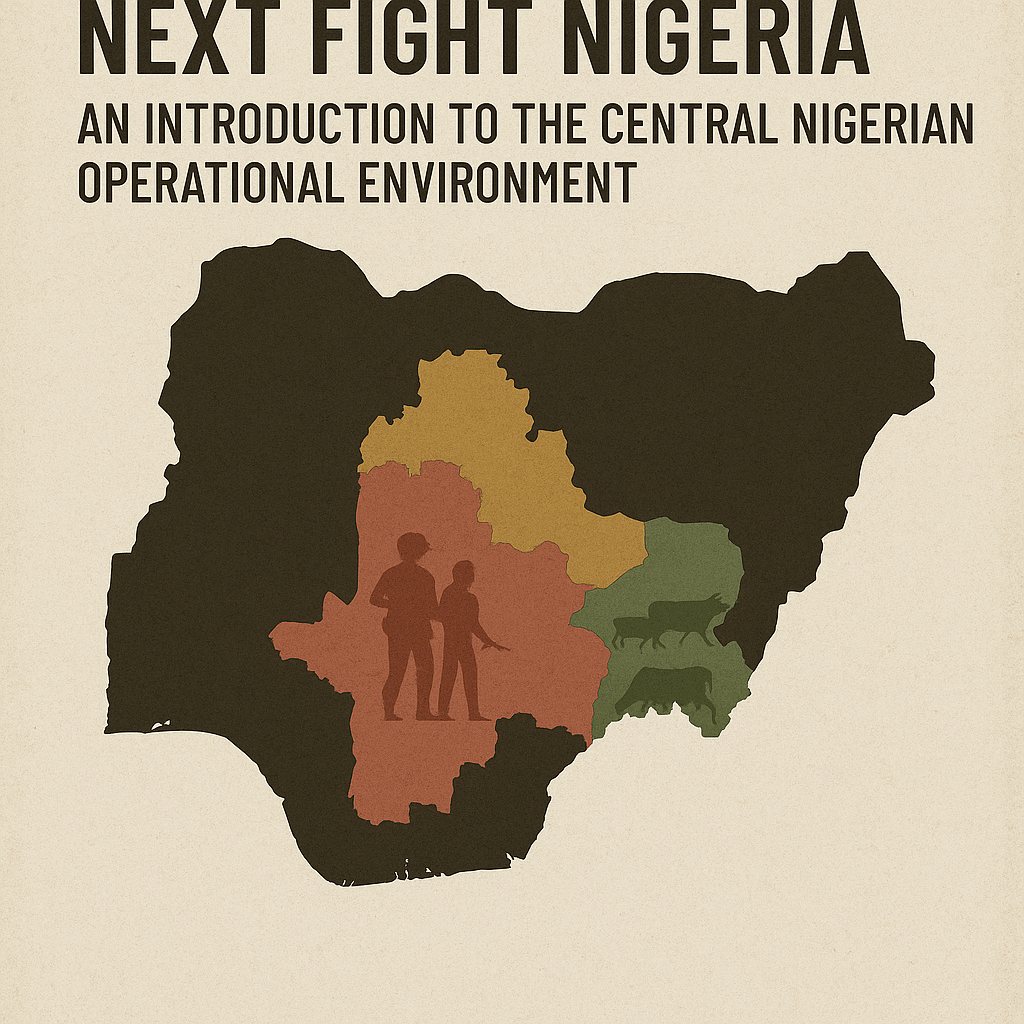
Nigerian farmers and herders have been fighting for years. This is one of several simultaneous conflicts occurring in Nigeria but is the one most often associated with violence against Christians. While many Global War on Terror veterans may be familiar with the Boko Haram/Islamic State West Africa (ISWAP) conflict in Nigeria’s Northeast, the farmer-herder conflict occurs in Central Nigeria in a region known as the Middle Belt. This is the contact area where major ethnic and religious divisions mix, specifically the predominantly Muslim north and Christian south of the country. Escalation in the Middle Belt can have an outsized impact on national identity and political cohesion. Conflict in Africa is exceptionally complex and what follows is intended to aid as a primer on the operational environment that Military Leaders would encounter.
General Context-Overlapping Patterns of Instability
Boko Haram (JAS) and Islamic State West Africa Province (ISWAP) are the threat actors readers may be most familiar with from the Global War on Terror. Although there is some overlap with extremist violence reaching many regions in Nigeria, Boko Haram and ISWAP are concentrated in northeast Nigeria where they pseudo-govern areas. These groups have committed numerous atrocities to include targeted killings of Christians, suicide bombings, and mass hostage taking. Although activity is focused on the northeast, violence spills into central and northwestern Nigeria as well. These groups are trans-national, exploiting a porous border between Nigeria, Chad, Niger, and Cameroon to move freely between sanctuaries established in regions with inconsistent government presence, even in the face of a coordinated, but largely ineffective multi-national JTF effort. Difference in their approach to governance led to a 2016 split between Boko Haram and ISWAP contributing to increasing violence as the two sides often do more damage to each other than government forces are capable of.
In the country’s northwest, secular insurgent groups (known as bandits) have terrorized the country with a reign of abductions. These armed groups also operate in the Middle Belt to rustle cattle and conduct attacks on farming communities to seize resources as kidnapping profitability declines. Further these groups have increasingly turned to mass kidnappings for increased profit and attention. Bandit group have varying levels of capability, ranging from hundreds of fighters backed by active air defense to a common gang, with shifting alliances among themselves and extremist groups (JAS/ISWAP). Many groups are capable enough to represent a credible threat to the Nigerian Armed Forces and overwhelm any local militias they encounter.
At any given time, Nigeria has military operations occurring in 30 of 36 states. There are a multitude of violent actors—Boko Haram, ISWAP, Biafran Secessionists, Bandits—with overlapping operating areas and a variety of conflict drivers from economic to religious to political. Violence has been increasing among these groups, especially in the delta region. It is a core concern of the Nigerian government given its roots in the 1967 Nigerian Civil War and the groups’ coastal location. The government went as far as banning Twitter in 2022 connected to insurgent activity in the southeast. However, the conflict most frequently referenced related to violence against Christians and with the most latent potential to disrupt Africa’s largest economy is not discussed above.
Relevant Actors in the Farmer-Herder Conflict
Separate from all the above conflicts is the farmer-herder conflict occurring in the Middle Belt. This conflict divides Nigeria along national level geographic and religious fault lines and has been ongoing for generations. However, violence has intensified significantly since 2001 due to a multitude of reasons with the states of Benue, Plateau, Nasarawa, and Kaduna being most impacted. This conflict is the one most often cited when discussing violence against Christians in Nigeria. It often consists of raids and reprisals between communities of farmers and herders. There is a massive range of violent acts from outright massacres to gang style individual killings. The conflict is inherently rural, dispersed, and highly localized because of its communal nature tied to opposing agricultural ways of life.
Due to this conflict’s decentralized/overlapping nature, it is critical to separate localized farmer-herder violence from Islamist insurgents or bandit groups. All these attacks are well organized and coordinated. Most farmer-herder attacks are localized and retaliatory occurring during the planting season from May to October. Farm crop damage from livestock or rustling of cattle are common triggers for the cycle of violence between pastoralists and farming communities. Both sides maintain self-defense militias ranging in size based on the community from a dozen up to a few hundred. Herder militias often burn the farms/villages they seize while farmers kill the cattle remaining in the herd. Bandit groups and insurgents by contrast often steal and sell cattle and leave villages damaged but intact. Bandits and insurgents can withdraw further and much faster than farmer/herder groups tied to their pastoral/agricultural lifestyles. Herder-farmer violence occurs in cycles of reprisals that are often openly discussed by the aggrieved parties.
Herders are often seen as aggressors. They are primarily of the Fulani ethnicity and Muslim religion. They are nomadic and transient, giving them a substantial mobility advantage over farming communities. As a result of this advantage they maintain the initiative, often dictating the tempo of the conflict and fighting on their terms. They mass to attack villages at night and then withdraw before dawn to protected forest bases or use motorcycles to quickly move through the raid’s objective area. They maintain ethnic/communal militias to protect themselves from Nigeria’s persistent instability, frequently armed with AK-47s, swords, bows and arrows. Often associations can represent their interests but can’t speak for all such as the Miyetti Allah Cattle Breeders Association of Nigeria.
Farmers bear the brunt of the violence due to their fixed locations and schedules. They comprise numerous ethnic groups such as Berom, Tiv, Irigwe, and Hausa. Although primarily Christian, there are numerous Muslim farming communities as well. They also maintain communal militias for protection, however they are limited by farming requirements. Lightly armed with swords, spears, hunting rifles, bows and arrows they are limited in size based on the men available in a community. Farmers’ immobility and task-saturated routines mean they cannot easily abandon their fields to maneuver or mass forces; instead, they depend on communal early-warning networks and often meet attacks from a defensive, reactionary position. Farmers, with a settled lifestyle, have more formal power structures with governors and traditional ethnic chiefs able to speak for highly localized interests. However, this has not resulted in responsive government security forces with attacks on farming communities lasting multiple hours without intervention.
The Nigerian military and law enforcement maintain a weak presence in the Middle Belt. Few perpetrators are apprehended, and security forces often arrive after attackers have departed. Despite the military being equally unresponsive to both sides, the government has stood up a federal joint task force and sponsored militia—the Forest Guards. It’s unclear how effective this approach has been with the complex multi-actor conflict in Central Nigeria. Forest Guards have been specifically targeted by bandit groups with substantial losses. However, Nigerian military operating alongside local organizations have also inflicted losses on bandit groups.
The core of the farmer-herder conflict is among farmers and herders. It has both ethnic and religious implications as well. In addition to this, the Middle Belt region is subjected to activity from bandits (NW) and extremist organizations (NE). The overlapping presence of violent actors has blurred the lines between communal defense, targeted killings, organized crime, and terrorist activity.
Drivers of Conflict- Complex and Interlocking
Resource scarcity is the central driver pushing farmers and herders into direct competition across the Middle Belt. There is less accessible arable land for both sides with disrupted traditional migration routes and depleted farmland compressing options for both communities. This scarcity is rooted in several environmental factors: Lower rainfall, longer droughts, expanding desertification and unsustainable farming practices depleted once-productive farmland tying farmers’ livelihoods to smaller plots of land. At the same time, the Sahara’s southward advance and stricter border control across Sahelian states have reduced available grazing corridors pushing herders south. Improved veterinary medicine and Tsetse fly control programs had the unintended consequence of enabling herds to move further south in the Middle Belt, where these groups have not historically co-existed. These areas also happen to be weakly governed fuelling conflict potential resulting from anti-grazing laws. Currently, although the violence and resource competition manifests as a larger trend, it may just be a conglomerate of numerous localized disputes.
Weapons—both imported and locally manufactured—are easily obtained despite severe poverty in the Middle Belt. Well-armed actors on all sides create a powder keg for confrontation between communities. Attributing an attack and understanding its context is incredibly challenging. Bandits have leveraged this to obfuscate themselves by imitating Fulani dress to mis-attribute attacks. Further, the scale of violence, access challenges, and variety of actors add additional complexity. A cycle of violence may be spiraling between raids on a community by any actor and a reprisal against the actor most easily attributed. This exacerbates generations old grievances between farmers and herders which often aligns with religious cleavages between Muslims and Christians.
Spectrum of Options & Considerations
The spectrum of options for a Nigerian or third nation intervention range from purely punitive approaches to stabilization operations. Punitive approaches may look like decimating the farm/herds of groups attributed to criminal violence imposing significant communal risk on those using it for economic gain. On the other end of spectrum, stabilization operations may be applying sustainable farming/herding practices and incentivizing job transition pathways to create space between incompatible communities. This could include training combined with buying cattle or farmland at a price aimed at relocating groups. However, other west African nations, and even communities in Nigeria, have demonstrated dispute resolution and symbiotic relationships between herders and farmers. Unfortunately, stabilization-oriented options such as sustainable farming/herding have been recommended by the national government in the past and were turned down by the local power brokers.
Across the entire spectrum, the role Operations in the Information Environment (OIE) should be significant. OIE can engage non-government organizations and grassroots initiatives to maximize effects while minimizing government resources required. Further, this crisis is only covered episodically in the media and local information may be biased by the source. OIE can change this through straight forward media engagements via public affairs and other means providing platforms that promote key narratives. Specifically, OIE can reach across borders into areas that may not be politically accessible in Niger, Chad, and Cameroon that have large Fulani herder populations that migrate between these nations along the porous borders.
If a government where to select a punitive-oriented option it is critical to consider second and third order effects such as the Accidental Guerilla, Kilcullen’s term for insurgents mobilized in response to coercive actions impacting them. The farmer-herder conflict is already a fertile recruiting ground for violent extremist organizations and bandit groups. Punitive measures may nudge farmer groups towards banditry or expand herder networks available to JAS/ISWAP. 70% of Nigeria’s rural population rely on agriculture to survive and the Middle Belt is a corridor from the Lake Chad Basin to the Gulf of Guinea. These communities turning to insurgency in mass may set conditions for a second Nigerian Civil War as hybrid criminal-insurgent organizations may be more willing to cooperate against the central government than current armed groups. Further, from a US and European perspective, Russia exploits Nigerian instability to recruit civilian laborers for its military industrial complex. Increased population vulnerability in Nigeria increases workers available for the Russian plants building Shahed attack drones in Alabuga.
For a US or allied nation to pursue a stabilization-oriented option it is behind the power curve. Just days after Nigeria entered the US news cycle, China announced a $450 million agricultural investment in Kaduna. Deepening dependence on China is not new for Nigeria with substantial economic ties however it is important to note how closely this investment aligns with the farmer-herder areas of greatest concern. Chinese political warfare and competition with the US related to Nigeria goes back almost two decades, despite Nigeria’s unclear strategic value to the PRC. Options should consider how third country competitors may respond given both China and Russia have aggressively competed in West Africa for years.
Conclusion
The farmer-herder conflict in Nigeria cannot be understood in isolation; it is deeply impacted within a broader landscape of overlapping insurgencies, criminal organizations, and instability. This conflict is more complex than the traditional Sahelian focused counter-terrorism fight and closer to great power interests of China, Russia, and the US. The issue at hand spans from Ghana to Chad at varying levels of violence, impacting the most powerful West African nations. In Nigeria’s Middle Belt, localized grievances over land and livelihood are exacerbated by ethnic and religious tensions. Further easy access to weapons and periodic exploitation by powerful non-state actors amplifies the scale of violence. Interventions must recognize the hyper-localized nature of disputes while accounting for regional dynamics, external influence, and the risks of driving communities closer to extremist/criminal organizations. Great power engagement will seek to shape the future balance of power in West Africa, especially in the face of ECOWAS political fractures since coups in Niger, Chad, Guinea, and Burkina Faso.
Please check out all the Small Wars Journal has to offer.