Mexican Cartel Tactical Note #54: Initial Reports on the Vehicle Explosion in Coahuayana, Michoacán: Car Bomb or Premature Detonation?
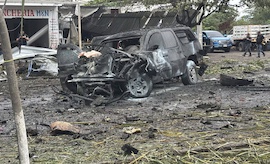

A vehicle exploded in front of a community police/self-defense force facility in Coahuayana, Michoacán on Saturday, 6 December 2025. Two persons inside the vehicle were killed in the blast which appears to have been a premature detonation. Various reports provide conflicting accounts of the blast which is said to have killed six persons. The blast was reportedly initially investigated as a “terrorist” incident, but that characterization was later rejected, demonstrating the political and operational difficulty of categorizing violence by criminal armed groups (CAGs).
Key Information: “Car bomb targeting community police station kills 6 in Michoacán.” Mexico News Daily. 8 December 2025, https://mexiconewsdaily.com/news/car-bomb-police-station-michoacan/:
The explosion of a car bomb outside a community police station in the town of Coahuayana, Michoacán, on Saturday killed six people, including at least three police officers.
Michoacán Attorney General Carlos Torres Piña reported on Sunday that the death toll had risen to six from an earlier report of five fatalities. He reported that seven other people were injured in the powerful blast, although the Coahuayana mayor said on Saturday that as many as 30 people were hurt.
Torres said that the vehicle that exploded was a black Dodge Dakota pickup truck that entered Michoacán via Federal Highway 200 from the neighboring state of Colima. The municipality of Coahuayana borders Colima and the Pacific Ocean.
The detonation of the car bomb occurred at 11:40 a.m. Saturday in the center of Coahuayana, the largest town in a municipality of around 17,000 people. The explosion caused damage to a number of other vehicles as well as nearby buildings, including the Coahuayana Municipal Palace.
Key Information: Dalia Martínez, “Explosión de coche bomba en Coahuayana, Michoacán, deja al menos dos Muertos.” Proceso. 6 December 2025, https://www.proceso.com.mx/nacional/estados/2025/12/6/explosion-de-coche-bomba-en-coahuayana-michoacan-deja-al-menos-dos-muertos-364176.html:
El Gabinete de Seguridad de Michoacán confirmó la explosión de un coche bomba en las inmediaciones de las instalaciones de la Policía Comunitaria del municipio de Coahuayana, que dejó como saldo dos personas muertas y siete heridas.
El ataque fue dirigido contra las autoridades de seguridad comunitaria. La onda expansiva del artefacto explosivo dañó varias viviendas.[1]
Key Information: Dalia Martínez, “Asciende a seis el número de personas muertas por explosión de coche bomba en Coahuayana.” Proceso. 7 December 2025, https://www.proceso.com.mx/nacional/2025/12/7/asciende-seis-el-numero-de-personas-muertas-por-explosion-de-coche-bomba-en-coahuayana-364254.html:
Al menos tres de las víctimas del atentado eran policías comunitarios; la Fiscalía del Estado confirmó que la camioneta cargada de explosivos era una Dakota color negro, que ingresó a Michoacán por la carretera 200 que une a esta entidad con el estado de Colima.[2]
Key Information: Ernesto Martínez, Marco Duarte y Gustavo Castill, “Califica FGR de ‘acto terrorista’ el ataque con coche bomba en Michoacán.” La Jornada. 7 December 2025, https://www.jornada.com.mx/noticia/2025/12/07/estados/califica-fgr-de-acto-terrorista-el-ataque-con-coche-bomba-en-michoacan:
La Fiscalía General de la República (FGR) anunció que investigará como acto de terrorismo el ataque cometido contra una base de la policía comunitaria del municipio de Coahuayana, Michoacán, donde estalló un vehículo con explosivos que dejó un saldo de cinco personas muertas y cinco lesionadas.
El Ministerio Público federal precisó que ayer a las 11:40 horas detonó un automotor sobre la avenida Rayón, colonia Centro, de dicha demarcación, frente a la base policial.
La FGR precisó que “inició carpeta de investigación en contra de quien o quienes resulten responsables del delito de terrorismo (…) derivado de la utilización de explosivos para atentar contra elementos de la policía comunal”. Refirió que en esta indagatoria participan las fiscalías Especializada de Control Regional, la Especializada en Materia de Delincuencia Organizada y la de Investigación de Terrorismo, Acopio y Tráfico de Armas.[3]
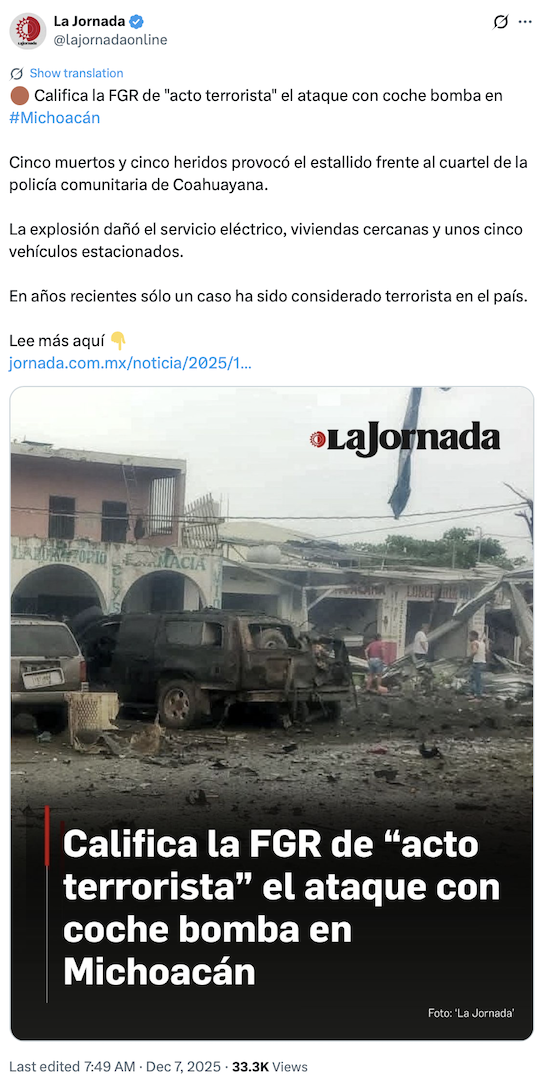
FGR [initially] rates the car bomb attack in #Michoacan as a “terrorist act.”[4]
Key Information: Diego Mendoza López, “‘Se descarta terrorismo en ataque con coche bomba en Coahuayana, Michoacán’, confirma García Harfuch.” Infobae. 9 December 2025, https://www.infobae.com/mexico/2025/12/09/se-descarta-terrorismo-en-ataque-con-coche-bomba-en-coahuayana-michoacan-confirma-garcia-harfuch/:
García Harfuch explicó igualmente que los hechos corresponden a la confrontación entre grupos vinculados al Cártel Jalisco Nueva Generación (CJNG), el Cártel de Tepalcatepec y organizaciones que forman parte de Cárteles Unidos, las cuales buscan ampliar su control territorial y las actividades ilícitas en la zona. Entre estas actividades mencionó el trasiego de droga, el narcomenudeo, la extorsión, el tráfico de armas y la minería ilegal…
… No fue un ataque directo a la policía comunitaria
Harfuch aclaró que, contrario a algunas versiones preliminares, la explosión no estuvo dirigida específicamente contra policías comunitarias que operan en la zona…
Reveló además que el vehículo involucrado en la explosión provenía de Colima y que dentro de la camioneta viajaban dos personas al momento del estallido. “No fue un coche bomba abandonado; había un conductor y un acompañante cuando el vehículo detonó”, precisó…
… Incremento en uso de artefactos improvisados
El secretario también confirmó que, en las últimas horas, autoridades federales aseguraron artefactos explosivos improvisados tanto en Michoacán como en Sinaloa. Recordó que estos dispositivos, algunos instalados en vehículos o acoplados a drones caseros, presentan alta inestabilidad y han provocado detonaciones accidentales dentro de los mismos grupos criminales.[5]
Incident Summary
A car bombing with a vehicle-borne improvised explosive device (VBIED) occurred on Saturday, 6 December 2025, in front of a community police (or policía comunitaria) headquarters. These community police are essentially unofficial autodefensas (self-defense groups).[6] The following provides an incident summary of the publicly available details at time of this report:
Who: Unidentified assailants believed to be affiliated with criminal gangs or criminal armed groups (CAGs) in the area.
What: Car bombing involving a black Dodge Dakota pick-up truck laden with explosives. Possible premature detonation since both the driver and accomplice were reportedly killed in the blast (further assessment needed).[7]
Where: Coahuayana, Michoacán, Mexico, in front of a community police facility.
When: Saturday, 6 December 2025, 1140 Hours.
Why: Believed to be linked to cartel battles for control of the area, i.e., a battle for competitive control. The area is contested by the Cártel Jalisco Nueva Generación (CJNG) and the Carteles Unidos (Cartels United or CU). In addition, the Mexican Navy has noted that there is competition between community police and the CJNG.[8]
Analysis
Car bombings, or vehicle-borne improvised explosive devices (VBIEDs), occur sporadically in Mexico’s criminal conflicts. This research note chronicles the most recent explosive-related incident involving the use of a vehicle. Many past incidents have occurred. The first of the current drug war occurred in Ciudad Juárez on 15 July 2010 and was documented here at Small Wars Journal.[9]
Over the years, several other car bombing-related incidents have been recorded in Mexico. One major assessment of these threat potentials was contained in our 2013 Letort Paper at the US Army War College, “Cartel Car bombings in Mexico.”[10] A later analysis was produced in a Counter IED-Report article in 2021. In addition, a series of research notes here at SWJ–El Centro has continued our attempt to document the use of explosive-related tactic, technique, and procedures (TTPs).[11] In 2023, we documented a car bomb ambush injuring ten Guardia Nacional Agents in Celaya, Guanajuato at C/O Futures.[12] Just a little over a year ago, a report at El País noted that “Car bomb attacks signal escalation of cartel violence in Mexico.”[13] This research note documents the latest known incident in order to continue assessment of the potentials for continued scalation and use of car bombs in Mexico’s criminal insurgency.
To date, the VBIEDs utilized by the Mexican cartels have been low yield devices meant for instrumental violence, PSYOPS (psychological operations; narco terrorism), and anti-personnel targeting rather than for anti-infrastructure purposes as was witnessed in Colombia in the 1980s and 1990s in the bombing campaign undertaken by the Medellín cartel directly against the Colombian state. Cartel car bombings in Mexico are still relatively infrequent (expressed in the low dozens of incidents) in relation to all forms of IED incidents (detonations, demining, and device seizures). The total number of IEDs that have been produced by the cartels in Mexico is typically reported to be in the thousands of devices,[14] however the actual number is likely much higher surpassing the five-figure mark when all the IED seizures (including a more recent rise in drone IED bomblets) are considered. This larger SWJ–El Centro estimate is due to the sheer number of devices which have increasingly been encountered over the last few years.
The incident was initially investigated as a “terrorist attack by Mexico’s attorney general’s office, the Fiscalía General de la República (FGR),[15] but that classification was later rejected by Omar García Harfuch, Mexico’s Secretary of Security and Citizen Protection (Secretario de Seguridad y Protección Ciudadana).[16] Additional research and analysis is required to determine the specific actors involved in this incident and the perpetrators’ specific targets—though Cártel Jalisco Nueva Generación is presently the prime suspect. In addition, further research and policy analysis is needed to accurately characterize this and similar incidents occurring during these criminal conflicts.[17]
Sources
“Califica la FGR de “acto terrorista” el ataque con coche bomba en #Michoacán.” La Jornada(@lajornadoonline) on X. 7 December 2025, https://x.com/lajornadaonline/status/1997695009923944852?s=20.
“Car bomb targeting community police station kills 6 in Michoacán.” Mexico News Daily. 8 December 2025, https://mexiconewsdaily.com/news/car-bomb-police-station-michoacan/.
Dalia Martínez, “Explosión de coche bomba en Coahuayana, Michoacán, deja al menos dos Muertos.” Proceso. 6 December 2025, https://www.proceso.com.mx/nacional/estados/2025/12/6/explosion-de-coche-bomba-en-coahuayana-michoacan-deja-al-menos-dos-muertos-364176.html.
Dalia Martínez, “Asciende a seis el número de personas muertas por explosión de coche bomba en Coahuayana.” Proceso. 7 December 2025, https://www.proceso.com.mx/nacional/2025/12/7/asciende-seis-el-numero-de-personas-muertas-por-explosion-de-coche-bomba-en-coahuayana-364254.html.
Ernesto Martínez, Marco Duarte y Gustavo Castill, “Califica FGR de “acto terrorista” el ataque con coche bomba en Michoacán.” La Jornada. 7 December 2025, https://www.jornada.com.mx/noticia/2025/12/07/estados/califica-fgr-de-acto-terrorista-el-ataque-con-coche-bomba-en-michoacan.
Diego Mendoza López, “‘Se descarta terrorismo en ataque con coche bomba en Coahuayana, Michoacán’, confirma García Harfuch.” Infobae. 9 December 2025, https://www.infobae.com/mexico/2025/12/09/se-descarta-terrorismo-en-ataque-con-coche-bomba-en-coahuayana-michoacan-confirma-garcia-harfuch/.
Significance: Car Bombs, Coches bomba, Crime Wars, Criminal Armed Groups (CAGs), Criminal Insurgency, Michoacán, TTPs, Vehicle-borne Improvised Explosive Device (VBIED)
Endnotes
[1] In English, the title reads: “Car bomb explosion in Coahuayana, Michoacán, leaves at least two dead.” In English, the text reads: “The Security Cabinet of Michoacán confirmed the explosion of a car bomb in the vicinity of the facilities of the Community Police of the municipality of Coahuayana, which left two people dead and seven wounded. […] The attack was directed against the community security authorities. The blast wave of the explosive device damaged several houses.”
[2] In English, the title reads: “The number of people killed by a car bomb explosion in Coahuayana rises to six.” In English, the text reads: “At least three of the victims of the attack were community policemen; the State Prosecutor’s Office confirmed that the van loaded with explosives was a black Dakota, which entered Michoacán through highway 200 that links Michoacán with the state of Colima.”
[3] In English, the title reads, “FGR classifies car bomb attack in Michoacán as a ‘terrorist act.’” The text reads, The Attorney General’s Office (FGR) announced that it will investigate the attack on a community police station in the municipality of Coahuayana, Michoacán, as an act of terrorism. A vehicle loaded with explosives detonated, leaving five people dead and five injured. […] The Federal Public Prosecutor’s Office specified that yesterday at 1140 hours, a vehicle detonated on Rayón Avenue, in the Centro neighborhood of that municipality, in front of the police station. […]The FGR specified that it “has opened an investigation against those responsible for the crime of terrorism […] resulting from the use of explosives to attack members of the community police.” It stated that the Specialized Regional Control Prosecutor’s Office, the Specialized Organized Crime Prosecutor’s Office, and the Terrorism, Weapons Stockpiling, and Trafficking Investigation Prosecutor’s Office are participating in this investigation.”
[4] In the original Spanish, “Califica la FGR de “acto terrorista” el ataque con coche bomba en #Michoacán.” La Jornada (@lajornadoonline) on X. 7 December 2025, https://x.com/lajornadaonline/status/1997695009923944852?s=20.
[5] In English, the title reads, “Terrorism ruled out in car bomb attack in Coahuayana, Michoacán.” The text reads: “García Harfuch also explained that the events correspond to the confrontation between groups linked to the Cartel Jalisco Nueva Generación (CJNG), the Cártel de Tepalcatepec, and organizations that are part of the Cárteles Unidos, which seek to expand their territorial control and illicit activities in the area. Among these activities, he mentioned drug trafficking, small-scale drug dealing, extortion, arms trafficking, and illegal mining […] It was not a direct attack on the community police […] Harfuch clarified that, contrary to some preliminary reports, the explosion was not specifically directed against community police officers operating in the area. […] He also revealed that the vehicle involved in the explosion came from Colima and that two people were traveling in the truck at the time of the blast. “It was not an abandoned car bomb; there was a driver and a passenger when the vehicle detonated,” he said. […] Increase in the use of improvised devices […] The secretary also confirmed that, in recent hours, federal authorities had seized improvised explosive devices in both Michoacán and Sinaloa. He noted that these devices, some of which are installed in vehicles or attached to homemade drones, are highly unstable and have caused accidental detonations within the criminal groups themselves.”
[6] See Max van der Graaf, “Inside Mexico’s New ‘Self-Defense Squads.’” CrashOut by Ioan Grillo. 23 October 2024, https://www.crashoutmedia.com/p/inside-mexicos-new-self-defense-squads; Romain Le Cour Grandmaison, “Becoming a violent broker: Cartels, Autodefensas, and the state in Michoacán, Mexico.” European Review of Latin American and Caribbean Studies. No. 112. July – December 2021: pp. 137–158,https://www.jstor.org/stable/pdf/48658263.pdf for background on autodefensas in Michoacán.
[7] During a press conference held by Mexican President Claudia Sheinbaum, an official said, “No fue un coche bomba que hayan dejado y que después hayan detonado, sino que llegan, se estacionan y es cuando explota” [“It wasn’t a car bomb that they left and then detonated, but rather they arrived, parked, and that’s when it exploded.” Pablo Ferri, “Harfuch confirma que dos personas iban a bordo del coche bomba de Coahuayana.” El País. 9 December 2025, https://elpais.com/mexico/2025-12-09/harfuch-confirma-que-dos-personas-iban-a-bordo-del-coche-bomba-de-coahuayana.html.
[8] “La Secretaría de Marina identificó que en la costa de Michoacán hay una fuerte confrontación entre las Policías Comunitarias de Aquila y Coahuayana con el Cártel Jalisco Nueva Generación (CJNG)” in “FGR investiga explosión en Coahuayana, Michoacán; conductor estaba dentro del auto.” Aristegui Noticias. 6 December 2025, https://aristeguinoticias.com/0612/mexico/fgr-inicia-investigacion-por-explosion-de-auto-en-coahuayana-michoacan/.
[9] John P. Sullivan, “Explosive Escalation? Reflections on the Car Bombing in Ciudad Juarez.” Small Wars Journal. 21 July 2010, https://smallwarsjournal.com/2010/07/21/explosive-escalation/. The original article, which predates the fully online SWJ content, is available at https://www.academia.edu/1113534/Explosive_Escalation_Reflections_on_the_Car_Bombing_in_Ciudad_Juarez. A Spanish language translation, “¿Escalada Explosiva? Reflexiones sobre el ataque con Coche bomba en Ciudad Juárez is available at https://www.academia.edu/7716496/_Escalada_Explosiva_Reflexiones_sobre_el_ataque_con_Coche_bomba_en_Ciudad_Juárez.
[10] John P. Sullivan and Robert Bunker, “Cartel Car Bombings in Mexico.” Letort Paper. Carlisle Barracks. US Army War College, Strategic Studies Institute. 2013, https://press.armywarcollege.edu/cgi/viewcontent.cgi?article=1320&context=monographs.
[11] See, for example, Daniel Weisz Argomedo, Nathan P. Jones, John P. Sullivan, and Robert J. Bunker, “Mexican Cartel Strategic Note No. 33: Pueblos Unidos Launch Sophisticated Prison Break Allegedly Using Coches Bomba (Car Bombs) or IEDs.” Small Wars Journal. 20 December 2021,https://archive.smallwarsjournal.com/jrnl/art/mexican-cartel-strategic-note-no-33-pueblos-unidos-launch-sophisticated-prison-break; Robert J. Bunker, David A. Kuhn and John P. Sullivan, “Mexican Cartel Tactical Note #42: Car Bomb in Apaseo el Alto, Guanajuato with Remote Detonation IED (‘Papa Bomba’) Payload.” Small Wars Journal. 7 January 2020, https://archive.smallwarsjournal.com/jrnl/art/mexican-cartel-tactical-note-42-car-bomb-apaseo-el-alto-guanajuato-remote-detonation-ied.
[12] John P. Sullivan and Robert J. Bunker, “Car Bomb Ambush injures at least Ten Guardia Nacional (GN) Agents in Celaya, Guanajuato.” C/O Future Cartel Research Note Series. 14 July 2023, https://www.cofutures.net/post/car-bomb-ambush-injures-at-least-ten-guardia-nacional-gn-agents-in-celaya-guanajuato.
[13] Elías Camhaji, “Car bomb attacks signal escalation of cartel violence in Mexico.” El País. 25 October 2024, https://english.elpais.com/international/2024-10-25/car-bomb-attacks-signal-escalation-of-cartel-violence-in-mexico.html.
[14] This is derived from SEDENA data. Mariana Fernández, “Criminal Groups Are Ramping Up Explosives in Mexico.” Insight Crime. 3 February 2025, https://insightcrime.org/news/criminal-groups-mexico-improvised-explosive-devices/ – :~:text=Days earlier, in the municipality,1,571 had already been counted.
[15] Op. Cit., “Car bomb attacks signal escalation of cartel violence in Mexico” at Note 13; “Califica FGR de ‘acto terrorista’ el ataque con coche bomba en Michoacán” at Note 3, “FGR rates the car bomb attack in #Michoacan as a “terrorist act” at Note 4. See also, César Arellano, Iván Evair Saldaña, Ernesto Martínez, and Marco Antonio Duarte, “FGR: coche bomba en Michoacán no fue acto terrorista.” La Jornada. 8 December 2025, https://www.jornada.com.mx/noticia/2025/12/08/politica/fgr-coche-bomba-en-michoacan-no-fue-acto-terrorista and “FGR investiga como delincuencia organizada explosión de auto en Michoacán.” Aristegui Noticias. 7 December 2025, https://aristeguinoticias.com/0712/mexico/fgr-investiga-como-delincuencia-organizada-explosion-de-auto-en-michoacan/.
[16] Op. Cit., “‘Se descarta terrorismo en ataque con coche bomba en Coahuayana, Michoacán’” at Note 5. For additional resources on the challenges of classification, see Brian J. Phillips, “Terrorist Tactics by Criminal Organizations: The Mexican Case in Context.” Perspectives on Terrorism. Vol. 12, no. 1. 2018: pp. 46–63, http://www.jstor.org/stable/26343745; David Teiner, “Cartel-Related Violence in Mexico as Narco-Terrorism or Criminal Insurgency: A Literature Review.” Perspectives on Terrorism. Vol. 14, no. 4. 2020: pp. 83–98. JSTOR, https://www.jstor.org/stable/26927665; and David Teiner, “Bibliography: Terrorism and Organized Crime in Latin America.” Perspectives on Terrorism. Vol. 14, no. 4. 2020: pp. 118–54, https://www.jstor.org/stable/26927667.
[17] Incident specifics are starting to be pieced together related to the vehicle utilized in the attack, an accomplice vehicle, and the time frames and movements of the perpetrators prior to the detonation taking place. “FOTOS: Así fue la ruta que siguió el vehículo utilizado como coche bomba en Coahuayana, Michoacán.” El Universal. 9 December 2025, https://www.eluniversal.com.mx/estados/fotos-asi-fue-la-ruta-que-siguio-el-vehiculo-utilizado-como-coche-bomba-en-coahuayana-michoacan/.
Additional Reading
Robert J. Bunker, and John P. Sullivan, Illicit Tactical Progress: Mexican Cartel Tactical Notes 2013–2020. Bloomington: Xlibris, 2021.
Robert J. Bunker, John P. Sullivan, David A. Kuhn, and Alma Keshavarz, “Use of IEDs and VBIEDs in Mexican Crime Wars.” Counter IED-Report. Spring-Summer 2021. pp. 63–73.
John P. Sullivan and Robert J. Bunker, “Cartel Car Bombings in Mexico.” Letort Paper. Carlisle Barracks. US Army War College, Strategic Studies Institute, 2013.