Testing Willpower: How China Might Target Californians’ Resolve During a Quarantine or Blockade of Taiwan

ABSTRACT
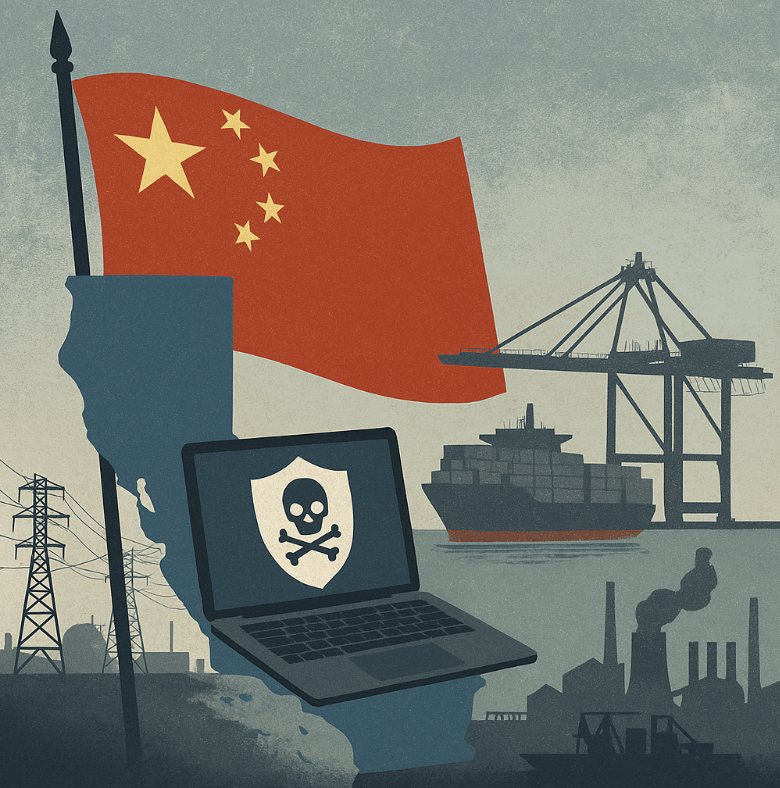
This article examines how China might target California’s public opinion, infrastructure, and economy to weaken the US resolve during a quarantine or blockade of Taiwan. Through gray-zone tactics, disinformation, and cyberattacks, Beijing could exploit societal divisions and economic vulnerabilities to weaken support for intervention. The article highlights the importance of bolstering resilience in California as a critical factor in maintaining US deterrence in the Western Pacific.
US intelligence officials have assessed that President Xi Jinping has instructed the People’s Liberation Army (PLA) to be ready to forcibly ‘reunify’ with Taiwan by 2027. Regardless of the actual intent of this order, Beijing’s increasingly aggressive signaling over Taiwan should be taken seriously. While experts agree that the People’s Republic of China (PRC) is likely to favor a low-intensity encroachment campaign meant to incrementally chip away at Taiwan’s sovereignty, the possibility of a quarantine or blockade is of major concern to US and Taiwanese officials. These actions threaten to upend the status quo in the Western Pacific and test US resolve. With its economic weight, Pacific-facing infrastructure, and concentration of military installations, California would form the American mainland’s front line in a Taiwan crisis—and a strategic target of Beijing’s attempts to weaken US willpower.
Beijing knows that if America came to Taiwan’s aid, it would be far less likely to achieve success—making the threat of US intervention a decisive deterrent. To prevent this, the PRC would reach deep into American society to weaken its resolve. With the PLA’s ‘Three Warfares’ principle—psychological, public opinion, and legal—guiding its operations, the PRC would seek to influence decision-makers, shape narratives, and advance its interests. California is acutely vulnerable across these domains: psychological operations would exploit disruption of infrastructure and economic stability, public opinion campaigns would seek to manipulate narratives and leverage social divisions, and legal justifications would frame aggression as legitimate civilian law-enforcement. Such gray-zone tactics can be obscured in ambiguity and plausible deniability, complicating conventional responses. In this uncertainty lies China’s opportunity. This article will focus on potential PRC actions against California in the opening phase of a crisis, and their implications for US resolve.
Quarantine and Blockade
To understand how Beijing could seek reunification short of invasion, it is important to distinguish between a quarantine and a blockade of Taiwan, as each presents unique challenges for US deterrence and escalation management. A quarantine would be framed by the PRC as a limited law-enforcement operation—using coast guard and militia forces, with the PLA supporting in reserve—to punish Taipei for (likely exaggerated) evidence of a movement towards independence. In reality, the goal would be to exert control over commercial shipping and establish increased sovereignty over the island. A 2024 poll by the Center for Strategic and International Studies found that this hybrid approach could frustrate foreign reactions, highlighting that only 13 percent of US experts and strategists were “completely confident” that there would be a response to a quarantine.
A blockade of Taiwan would mark a step up from a quarantine, with the PLA actively engaged in operations, including mining ports and enforcing strict air and sea exclusion zones. The aim would be to break Taiwan’s will to resist, forcing capitulation without resorting to a costly invasion. To this end, China could also lean on well-rehearsed gray-zone tactics, such as severing Taiwanese undersea fiber-optic communications cables to further isolate the island from the world. A more extreme aim would be to soften up Taiwan for an invasion, which could see kinetic attacks on military sites and critical infrastructure to damage defensive capabilities and wear down the island.
In both scenarios, Taiwan would likely need US intervention to stop Beijing from establishing dangerous norms of denying sovereignty or even staging for an invasion. While Taiwan could hold off a Chinese offensive for a short period, the prevailing consensus among experts remains that US intervention would be decisive in securing Taiwan. However, China’s blurring of civilian, law-enforcement, and military actors makes it more difficult for US policymakers to justify intervention—and the associated costs—to the American public. A quarantine or blockade represents two paths to the same outcome: disruption that puts California in the crossfire.
Targeting Californian Minds
By spreading narratives sympathetic to its cause, Beijing would try to sow doubt, division, and distrust to undermine US intervention efforts. Cognitive control is considered a potent tactic by Chinese military planners, who aim to win without fighting, much of which can be done from afar. Chinese online influence campaigns—which seek to shape opinions in Beijing’s favor and have a history of sowing chaos and division at tumultuous moments—have become increasingly effective in recent years. The intended outcome of such efforts would be to cause hesitation among policymakers and polarization among the public, sapping political will at a moment when time—and unity—is of the essence.
The PRC will likely accompany a quarantine or blockade with disinformation, divisive content, and narratives framing the crisis as a “domestic issue” and US actions as “imperialist aggression,” while using ‘Spamouflage’ tactics—bot-driven disinformation campaigns—to inflame societal disunity by posing as Americans online. Considering only about 34 percent of Americans can find Taiwan on a map—let alone understand the nuances of US strategic interests—China could have effective leverage over some minds. While a majority of Californians support Taiwanese sovereignty, almost one-third are either unsure or unsupportive. These individuals represent potential targets for Chinese influence operations.
Targeting Californians across the political spectrum, Beijing might exploit existing divisions to condition favorable outcomes. Isolationists could be susceptible to pro-China narratives, such as that policy-makers are neglecting domestic issues to defend distant non-Americans. Meanwhile, skeptics of traditional US interventionism could be swayed by portrayals of a Taiwan crisis as just another “war of aggression”.
Chinese cognitive influence campaigns would also play out on social media: US Navy Foreign Area Officer Lieutenant Commander Charles Bell noted that TikTok’s tweaking of its algorithm to align with Beijing’s interests could be used to downplay the severity of a quarantine or blockade. “The messaging,” he said, “would frame it as a normal law enforcement action, not a military one, and suppress opposing views.” Around 43 percent of American adults under 30 regularly get news on the app, presenting a particularly acute threat to California, the most TikTok-engaged state in America.
Beijing could attempt to leverage diaspora communication channels popular among California’s approximately 1.8 million Chinese American community to spin the story and encourage (or even coerce) favorability towards its agenda. The messaging and social media app WeChat—tightly administered and censored by the Chinese Communist Party, and widely used as a Chinese-language news source by Chinese-American communities—has already been used to spread propaganda and disinformation among diaspora audiences, including during recent US election cycles. Furthermore, the PRC’s United Front apparatus has cultivated ethnic-Chinese community organizations abroad and mobilized diaspora networks in the US as part of a broader influence campaign. These precedents suggest a legitimate prospect that Beijing could exploit these networks to influence Chinese-American opinion in a Taiwan crisis, further weakening a unified resolve.
Cyber and Infrastructure Attacks
Beyond information operations, Beijing could also seek to impose real-world disruption, using cyber and infrastructure attacks to gain a military advantage while amplifying confusion and eroding public confidence. The recent Salt Typhoon (targeting telecommunications) and Volt Typhoon (targeting critical infrastructure) cyberattacks exemplify the PLA’s principle of pre-positioning offensive capabilities within critical infrastructure and systems for future use. Lying undetected for years, “sleeper software” embedded in Chinese-made technology within American systems could be activated in a crisis to sabotage crucial civilian and military apparatuses. For instance, Chinese-manufactured commercial and military drones, surveillance cameras, and Ship-to-Shore (STS) cranes across Los Angeles and Long Beach ports could be compromised or controlled from China.
Attacks on California’s critical infrastructure, from cyberattacks or pre-positioned vulnerabilities, could present a domestic distraction at a pivotal global moment. “The goal isn’t to create total chaos,” Mr. Bell explained, “but to cause enough problems at home that it distracts leaders and diverts resources, making it harder to focus on the crisis in Taiwan.” The Department of Defense and the intelligence community have assessed that the PRC could launch cyberattacks on oil and gas pipelines, and transportation systems, such as rail, lasting for weeks. Rep. Mike Gallagher (R-WI), then-chair of the House Select Committee on China, noted that attacks would likely also target water systems (as with the 2021 alleged Chinese hacking of a Southern California water system), the electrical grid, and communications infrastructure.
The psychological effects of everyday life suddenly grinding to a halt are key to China’s cognitive warfare strategy. Former Cybersecurity and Infrastructure Security Agency Director Jen Easterly warned in 2023 that one objective of attacks on critical infrastructure would be to ‘sow panic and chaos’ and divide Americans. Indeed, it’s hard to blame the average person for not prioritizing defending an island thousands of miles away when their phone, lights, and water are not working. Beijing would want Americans to be stunned by its capacity to inflict substantial disruption on their lives, and to believe that things would only get worse should the US become more deeply involved.
Setting back US mobilization efforts would be another priority for Beijing’s cyber operatives. As a central military hub, California—with the most installations of any state, strategic airlift from Travis AFB, fleet logistics from San Diego, cyber protection from NAVWAR, and critical Pacific ports—is a prime target. Mr. Bell highlighted this reality, “From a military standpoint, we need California’s ports to be fully operational to move forces and supplies to the Pacific. China knows this, which is why they might target our critical infrastructure to slow us down.”
On top of compromising transportation infrastructure, attacks against defense and military-contractor networks could damage logistical efforts across the state. Furthermore, prompting US officials to doubt the reliability of their infrastructure—and thus look for alternatives to even uncompromised systems, out of an abundance of caution—would be considered another cognitive success. Through disruption, Beijing would increase its ability to shape American decision-making, or, at the very least, stymie logistical operations. A 2023 annual intelligence threat assessment warned that Chinese actions would aim to deter a US military response by hindering decision-making, instigating societal panic, and obstructing force deployment. These elements of tactical disruption would serve larger strategic goals: complicating US leadership decision-making, delaying mobilization, and eroding public resolve.
An Economic Shock
The global economic meltdown that would follow a quarantine or blockade would amplify Beijing’s disruptive campaign, transforming temporary inconvenience into prolonged economic coercion with profound effects on Californians. Pandemic-era trade and supply-chain slowdowns would pale in comparison to disruptions caused by a Taiwan crisis that would affect commerce with all of America’s Pacific trading partners, including China. Prices would rise as the availability of cheap Chinese-manufactured goods dried up, and supplies of critical materials and products ran low. Gas prices could skyrocket amid cyberattacks on pipelines and import uncertainty. Furthermore, with California’s ports (which handle about 40 percent of all US container traffic) being a focal point of Beijing’s cyber aggression, not to mention the vulnerabilities of STS cranes, paralysis within these ports would create immense economic fallout for the state.
Any disturbance of semiconductor chip imports would have the most drastic economic impact. Taiwanese fabrication facilities (which cannot be quickly on-shored to the US) produce around 90 percent of the most advanced chips in the world, allowing Silicon Valley to keep America at the forefront of technological and AI innovation. Chips are essential to almost every electronic device available, from iPhones to cars to the newest generation of fighter jets. A recent study shows that a disruption to Taiwanese chip production could cost the US economy over $1.6 trillion, causing damage comparable to the 2008 global financial crisis.
Would Americans still care about and support involvement in a conflict with that kind of economic baggage? That’s precisely what Beijing would be gambling on. Mr. Bell warned that Beijing could exploit its connections with California business leaders and trade associations. He said, “These groups would then lobby politicians, arguing that US involvement in a conflict would destroy California’s economy, which is heavily tied to China.” The economic costs of US intervention would weigh heavily on the calculations of politicians, possibly presenting grounds for varying levels of capitulation. By exploiting California’s leading role in trade, tech, and energy, China would be tightening pressure on national willpower. With ships in port unable to load or unload, Silicon Valley grinding to a halt, and prices soaring, the public’s appetite for intervention would be unlikely to grow. Beijing would wager that sustained economic pressure could erode American resolve in a way that military deterrence alone cannot.
California’s Test of Resolve
California will be the proving ground for US resolve during a Taiwan crisis, not by choice but by geography, economy, and infrastructure. As a Pacific-facing state vulnerable to China’s cognitive warfare, cyberattacks, and economic coercion, California’s response to disruption will test whether America can withstand the costs of intervention. If Californians buckle under pressure and push leaders to prioritize domestic stability over distant allies, Beijing will have successfully weaponized the state against the nation’s strategic interests. To mitigate the psychological effects of disruption, disinformation, and doubt, Americans need to understand what they’re up against before, not during, a crisis.
Informing the public of the geostrategic stakes of securing Taiwan—not just human rights and democracy—could strengthen public resilience against a sudden cognitive and cyber offensive. Richard Downie, President and CEO of the Los Angeles World Affairs Council and retired Army Colonel, recalled his experience in military psychological operations, emphasizing the importance of public awareness of Beijing’s attempts to sow doubt and fear over US intervention. He remarked that while advancing public readiness should be a “focus and priority for our government at every level, state, local, federal—it’s not being done.” A 2024 US Army War College symposium on Cognitive Defense stressed that countering such a strategy requires more than technical fixes—it demands civic literacy, public resilience, and trust in institutions. Among other conflicts, the war in Ukraine offers a sobering reminder that adversaries tend to start conflicts when they perceive weakness in America’s resolve. The same lesson applies here in that bolstering resilience at home is just as important as force posturing abroad.
Officials and policy-makers should act now to strengthen resilience at every level and deny Beijing future leverage over US decision-making. Federal and state leaders should better inform the public of Taiwan’s strategic importance to US security and prosperity, emphasizing that deterrence in the Taiwan Strait safeguards both national security and economic stability. Governments should begin to prepare civilians not only for natural disasters, but also for gray-zone conflict: power outages, manipulated narratives, and economic shocks. Drawing from Finland and Sweden’s “Total Defense” models, state governments could educate citizens on crisis-readiness to bolster public confidence and psychological endurance. Mitigating the effects of cognitive warfare could involve publicly exposing PRC influence operations (as Western allies did ahead of Russia’s 2022 invasion of Ukraine), reinvesting in foreign malign influence and disinformation monitoring, and restricting Beijing’s leverage over major information platforms like TikTok. Officials should consider adopting NATO’s proven counter-disinformation playbook: preempt hostile narratives with transparency and coordination.
Infrastructure and economic resilience are equally vital. Chinese-made components should be rapidly phased out from critical infrastructure—especially STS cranes at West Coast ports—and drills should be conducted to test emergency logistics and cyber recovery. To curb Beijing’s economic coercion, the US should diversify supply chains away from China, expand strategic reserves of semiconductors and rare earths, and test financial systems for crisis scenarios. Together, these measures would enhance deterrence by demonstrating that gray-zone tactics are unlikely to shake American resolve.
President Donald Trump’s unpredictable decision-making has unsettled many American allies, particularly Taiwan. Furthermore, countering the unconventional approaches used during a quarantine or blockade would challenge even the most steady-handed leadership. Seth Stodder, former Assistant Secretary at the Department of Homeland Security, voiced his concern on this matter. He stated, “I’m less worried about influence operations altering US policy towards Taiwan in response to a blockade or an invasion. I’m more worried about whether Donald Trump will make the right decision.” For now, however, the administration’s apparent quiet adherence to America’s long-standing Taiwan policy—as well as the leaked Pentagon memo stressing US prioritization of defending Taiwan—appears to demonstrate a continued strategic focus on deterrence.
Yet leadership alone cannot secure deterrence if the society it represents proves unwilling to bear the costs. Beijing’s strategy appears designed to break American will before military force becomes necessary. If California withstands economic pain, infrastructure chaos, and information warfare, US deterrence remains credible. If not, President Xi would have demonstrated that America can be outmaneuvered not on the battlefield but through domestic pressure. US resolve, anchored in California’s readiness, will ultimately determine whether deterrence holds or fails in the Western Pacific.