





The Puntland Model: A Somali State’s Relentless War for Stability and Autonomy

Abstract
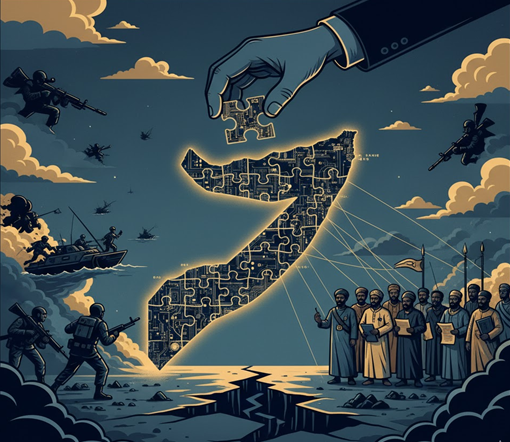
In today’s post-civil war Somalia, the Puntland State stands as a critical case study in sub-national state-building. This article analyzes how Puntland developed a hybrid model of governance and security, fusing indigenous clan kinships with externally sponsored professional capacity, to become a bulwark against jihadist expansion. Its recent military successes against an Islamic State affiliate have fueled a political schism with the Somali Federal Government, representing an iatrogenic outcome of a counterterrorism framework that prioritizes kinetic partnerships over national political cohesion.
Genesis of a Federal State—Forging Order from Chaos (1991-2012)
The formation of the Puntland State of Somalia was a direct consequence of the catastrophic failure to reconstitute a national government following the 1991 ouster of Siad Barre. For nearly a decade, Somalia was effectively stateless, a condition the leaders of the northeastern regions found untenable. This culminated in the 1998 Garowe Constitutional Conference, a seminal event in modern Somali history. Over three months, a broad-based assembly of the region’s political elite, traditional elders (Issims), business leaders, and intellectuals gathered to chart their own course in a home-grown, bottom-up process. The result was the establishment of the Puntland State on August 1, 1998, with Colonel Abdullahi Yusuf Ahmed as its founding president.
From its inception, Puntland made a foundational choice that distinguished it from its northwestern neighbor, Somaliland, which declared outright independence. Puntland’s founders envisioned an autonomous state within a future federal Somalia. This federalist stance was a core security doctrine, born from a deep-seated mistrust of the concentrated power that characterized Barre’s oppressive regime. Federalism was seen as the only viable model to prevent the re-emergence of an authoritarian central government and safeguard regional autonomy. This principle was enshrined in its evolving constitutional framework, from the 1998 provisional charter to the permanent constitution ratified in 2012.

This formal structure is built upon a powerful, unwritten foundation of clan legitimacy, creating a hybrid political order. Puntland was established primarily as a “homeland” for the Harti clan confederation, providing a degree of internal cohesion absent in southern Somalia. This model, where modern state institutions are grafted onto a substrate of traditional authority, reflects a pragmatic approach to state-building in a fragmented society. However, it also establishes the clan-based power-sharing arrangement as the state’s ultimate social contract. Any attempt to dismantle this delicate balance, as seen in the 2024 election crisis, is perceived not as a political reform but as an existential threat to the state’s foundational consensus.
Building the Spear of Puntland’s Security Apparatus
The security and economic landscape of early Puntland was dramatically shaped by the explosion of maritime piracy off its shores. The phenomenon was an outgrowth of state collapse, as illegal fishing by international trawlers and the dumping of toxic waste destroyed local livelihoods, prompting fishing communities to form armed “coast guards” that evolved into criminal enterprises. Between 2005 and 2012, Puntland became the global epicenter of piracy, with ransoms in 2008 alone estimated between $50 million and $150 million. This illicit economy became a form of resource curse, deeply embedding itself in coastal communities and creating a complex security challenge that local militias could not handle. UN reports even alleged complicity among some Puntland officials.
This crisis, however, had a transformative effect. The international scale of the piracy problem created an urgent demand for a professional maritime security force that could not be met by Puntland’s internal resources or the weak Transitional Federal Government (TFG) in Mogadishu. This security vacuum created a unique opportunity for external actors to engage directly with Puntland, bypassing dysfunctional national structures. The global piracy crisis inadvertently became the gateway for the internationalization of Puntland’s security sector.
This led to the development of a hybrid security architecture. The primary terrestrial body, the Puntland Security Force (PSF), is a conventional army of around 15,000 personnel formed in 1998. Its development reflects an effort to move from a purely clan-based force toward a professional military, but this transition remains incomplete, with clan loyalties persisting as a potential fracture point.

The most striking example of Puntland’s security development is the Puntland Maritime Police Force (PMPF). Established in 2010 after Puntland passed Somalia’s first Anti-Piracy Law, its creation was a direct response to requests from the UN Security Council for local institutions to combat piracy at its source. The concept is credited to Erik Prince, founder of the private military company Blackwater, who saw the need for a land-based force to dismantle pirate networks.
The United Arab Emirates emerged as the PMPF’s indispensable patron, providing an estimated $50 million annually for training, equipment, and salaries. This relationship can be analyzed through a principal-agent framework, where the UAE (the principal) funds the PMPF (the agent) to achieve its security objectives. This reliable funding stream distinguishes the PMPF from other Somali units plagued by inconsistent pay and logistical failure. To stand up the force, Puntland and its Emirati backers turned to private military contractors, initially Saracen International (later Sterling Corporate Services). This period was controversial, with the UN Monitoring Group on Somalia and Eritrea accusing the firms of violating the UN arms embargo and raising allegations of human rights abuses. Despite this troubled genesis, the PMPF emerged as a highly capable force, less beholden to clan interests and corruption due to its merit-based recruitment and consistent UAE-funded salaries.
The War on Two Fronts—From Counter-Piracy to Counterinsurgency
The PMPF’s primary contribution to defeating piracy was its land-based strategy of denying pirates onshore sanctuaries in hubs like Eyl and Hafun. The force’s capability was demonstrated in the December 2012 rescue of the crew of the MV Iceberg 1, the first successful hostage rescue mission by an indigenous Somali force. By the mid-2010s, the combination of the PMPF’s onshore pressure and international naval patrols had effectively broken the piracy business model. However, as the PMPF was repurposed to confront terrorism, its maritime focus diminished, correlating with a resurgence in piracy since late 2023.
As the piracy threat waned, the PMPF pivoted to become Puntland’s premier counterterrorism force, confronting a persistent insurgency from Al-Shabaab in the Galgala mountains and repelling a major seaborne assault by the group in 2016. A more complex threat emerged in 2015 with the formation of Islamic State in Somalia (ISSOM), a faction led by Abdul Qadir Mu’min that pledged allegiance to Abu Bakr al-Baghdadi. Pushed out of southern Somalia by the rival Al-Shabaab, ISSOM established its sanctuary in the remote Cal Miskaad mountains in Puntland’s Bari region.

While small, ISSOM holds strategic importance far outweighing its size. The US government has identified it as a key node in the Islamic State’s global network, operating the “Al Karrar” office, a hub that facilitates funds and personnel for ISIS affiliates across Africa and as far as Afghanistan. One of its key financiers, Bilal al-Sudani, killed in a US raid in Puntland in January 2023, was responsible for developing funding networks across the continent. This elevates the fight in Puntland from a local counterinsurgency to a globally significant counterterrorism effort.
In late 2024, the Puntland government launched Operation Hilaac (“Lightning”), its largest military offensive since 2016, to dismantle ISSOM’s mountain strongholds. The operation, executed in several phases, involved repelling a sophisticated suicide assault by ISSOM fighters on a military base and advancing deep into ISSOM territory, capturing the Togjaceel Valley, and discovering a reinforced underground command center. By June 2025, President Said Abdullahi Deni announced that Puntland forces had recaptured 98% of the Cal Miskaad mountain range. The offensive reportedly killed over 700 militants, many of them foreign fighters, confirming the group’s role as a regional jihadist hub. This ground offensive was critically enabled by international airpower from the UAE and the United States, operating in direct support of Puntland’s forces and entirely outside the Federal Government of Somalia’s security architecture. Operation Hilaac is the quintessential demonstration of the “Puntland Model”: a state-led, locally-manned ground offensive, enabled by precision foreign airpower, executing a strategically vital counterterrorism mission.
The Iatrogenic Crisis: State Deconstruction as a Consequence of Success
While Puntland’s security forces achieved remarkable battlefield successes, its political landscape became increasingly fractured. The period leading up to the January 2024 presidential election was marked by intense polarization. Incumbent President Said Abdullahi Deni championed a move from the traditional indirect, clan-based electoral system to a direct, “One Person, One Vote” (OPOV) model. This was met with fierce resistance from opposition politicians and clan elders, who feared it was an attempt to dismantle the delicate clan-based power-sharing arrangements that have underpinned Puntland’s stability. The dispute was a proxy war over the state’s fundamental political settlement. The traditional system functions as an elite pact ensuring predictability and inclusion by rotating offices among major sub-clans. The standoff led to violent clashes in Garowe in June 2023, resulting in over 25 deaths. Under pressure, Deni reversed course, and the traditional indirect election proceeded, granting him a second term.
These internal tensions were soon overshadowed by a constitutional crisis with the FGS. On March 30, 2024, the federal parliament in Mogadishu, without Puntland’s participation, passed sweeping constitutional amendments, including a transition to a presidential system. Puntland’s reaction was swift. On March 31, 2024, it formally withdrew its recognition of the federal government, declaring it would operate as a functionally independent state until a new, comprehensive constitution could be negotiated. This move represents the logical culmination of Puntland’s history. The FGS’s unilateral amendments were the final trigger that transformed a de facto reality into a de jure policy, seen as a hostile act of centralization that the state was created to resist.

In a Tillyan sense, Puntland’s externally-funded security apparatus emerged as a ‘protection racket.’ A government that produces both the danger and the shield against it inevitably operates like a racketeer through this rhetoric. While Puntland did not create piracy, its ability to offer a credible shield against it, which was a service the federal government could not provide, was thereby instrumental in legitimizing its authority and building its state capacity. This is an extractive state-building philosophy where security provision becomes a means of power and resource accumulation with little room for ethics.
This crisis is a deeply iatrogenic outcome of the prevailing counterterrorism paradigm. The term, from medicine, refers to an adverse effect caused by treatment. Here, the “treatment”—direct security assistance to a sub-national actor via the “by, with, and through” model—has induced the “disease” of state fragmentation. By directly funding, training, and equipping Puntland’s forces to combat piracy and terrorism, international partners like the US and UAE have empowered it to the point where it can credibly defy the central state. The policy designed to fight instability has actively generated a new, more profound political instability, leading to potential optical resemblance to political balkanization.
Conclusion: Puntland at a Crossroads—A Consequence of Counterterrorism
Puntland has evolved from a clan-based project for survival into a highly securitized statelet, a direct product of two decades of externally-driven security policy. Its hybrid model has produced undeniable tactical successes against piracy and the Islamic State. However, this very success—and the de facto independence it has fostered—is a feature, and not a bug, of the prevailing counterterrorism paradigm. The current political breaking point, which threatens the foundational concept of a federal Somalia, is the predictable outcome of a framework that consistently prioritizes creating capable kinetic partners over the painstaking work of building cohesive national political structures, and inclines one to better understand the path dependency on international relations in tangent with the timescales of security gains.
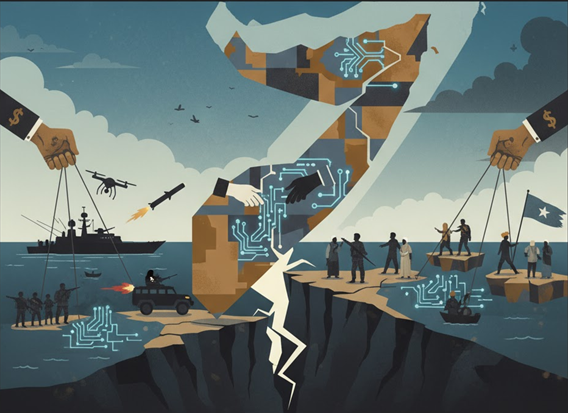
President Said Abdullahi Deni’s second term is defined by immense challenges. The high operational tempo of Operation Hilaac creates a political trap where the state’s relevance to its international partners is contingent on the existence of a perpetual threat. The schism with Mogadishu is the logical endpoint of a security assistance model that fosters the very fragmentation it purports to oppose. For international partners, this crisis demands a fundamental re-evaluation of a counterterrorism strategy that is achieving tactical ‘victories’ at the cost of strategic political cohesion.
Policymakers must critically re-evaluate the “by, with, and through” model, recognizing how direct security partnerships with sub-state actors fuel state fragmentation. Future assistance must be subordinated to a unified, Somali-led political strategy. Kinetic action must be subordinated to political reconciliation. The primary objective should not be the military defeat of ISSOM but the resolution of the constitutional crisis threatening the entire Somali state. Key partners, particularly the United States and the UAE, must use their considerable leverage to prioritize dialogue between Garowe and Mogadishu.


