





Death as Mother, Shield, and Sovereign: Conceptual Metaphors in Santa Muerte Discourse


Santa Muerte devotion relies heavily on metaphor. Across YouTube testimonies, prayers, and devotional content, Santa Muerte is repeatedly described as a mother who protects her children, forgives failures, and never abandons the faithful.[1] These metaphors are powerful because they turn death into someone devotees believe they can trust. A mother protects her children. A patron rewards loyalty. A judge punishes enemies. Once death is framed through these familiar roles, fear becomes easier to manage, and violence becomes easier to justify. By portraying Santa Muerte as a protective mother, devotees transform uncertainty into something that appears controllable through devotion, loyalty, and ritual exchange.[2] In narcoculturaenvironments marked by violence and weak institutions, these metaphors provide emotional stability and moral guidance. This also creates symbolic vulnerabilities. If Santa Muerte is framed as a protective mother, then stories of abandonment or failed protection directly attack the metaphor sustaining devotion.
In narco-cultural discourse, the mother metaphor rarely appears alone. Santa Muerte is also described as a protector, patron, queen, or judge. Together, these metaphors explain how protection, loyalty, and punishment are supposed to work. They tell devotees who to trust, who to fear, and how to stay safe. These messages are especially powerful in places where the state is weak, corrupt, or absent. In these environments, Santa Muerte becomes an alternative source of authority and protection. By framing death through family and authority roles, the discourse encourages loyalty and devotion.[3] Previous research has examined Santa Muerte rituals, symbols, and devotional practices. However, it has not examined how these metaphors shape thinking in digital media or how they create symbolic weaknesses that information warfare practitioners can exploit. If metaphors shape how people understand danger and protection, then identifying the dominant metaphors becomes essential for understanding both the strength and vulnerability of Santa Muerte devotion.
Conceptual Metaphor Theory and Cognitive Structuring
Conceptual Metaphor Theory (CMT) argues that metaphors shape how people think, not just how they speak.[4] People often understand abstract ideas through familiar experiences such as family, conflict, movement, or exchange. For example, when people say they are “defending a position,” they frame argument as war. When they speak of “wasting time,” they frame time as money. These metaphors are powerful because they import expectations from one domain into another. Conflict involves winners and losers. Money can be spent, saved, or wasted. The same process appears in Santa Muerte discourse.[5]
When Santa Muerte is described as a mother, devotees import expectations associated with motherhood. A mother protects her children, forgives failures, and remains loyal to her family.[6] These expectations shape how followers interpret danger, obligation, protection, and justice.[7] Metaphors therefore do more than describe belief. They organize how devotees understand risk and how they decide who deserves loyalty or protection. This is why metaphor matters in information warfare. If metaphors help stabilize belief, then attacking the metaphor can also weaken the belief system sustaining it.[8]
Identifying Conceptual Metaphors in Cartel-Adjacent Santa Muerte Discourse
Why does cartel-adjacent Santa Muerte discourse rely so consistently on relational and embodied language to describe death, protection, justice, and obligation? Across digital environments, Santa Muerte is rarely framed in abstract theological terms. Instead, she is described as Madre, Niña, protector, patron, judge, or sovereign.[9] Prior scholarship has documented Santa Muerte’s devotional practices, symbolic imagery, and socio-historical development, as well as the selective appropriation of this figure within narcoculture.[10] These studies demonstrate how religious symbolism provides transcendental meaning within environments shaped by risk, violence, and institutional distrust. What remains underexamined, however, is how conceptual metaphor structures the cognitive framing of death itself within these environments.
CMT suggests that abstract and existential phenomena are understood through systematic mappings onto familiar social and embodied domains.[11]
When death is framed as mother, patron, or sovereign, these mappings import structured expectations concerning loyalty, reciprocity, authority, and protection.[12] Such metaphors do not merely describe Santa Muerte. They organize how risk is interpreted, how obligation is justified, and how agency is assigned. While existing Santa Muerte scholarship has examined ritual, narrative, and symbolic practice, the dominant metaphor clusters through which death is cognitively structured in cartel-adjacent discourse remain largely unmapped.[13] Identifying these conceptual metaphors is therefore essential for understanding how Santa Muerte functions not only as a religious symbol but as a cognitive infrastructure within narcocultura. Based on this discussion, two research questions are proffered.
RQ1: What conceptual metaphor source domains are most frequently used to structure representations of Santa Muerte in cartel-adjacent devotional discourse?
RQ 2: What relational entailments do dominant Santa Muerte metaphors construct regarding authority, protection, reciprocity, and obligation?
Methods
This study employs a structured, discourse-centered analytical procedure to identify and categorize recurring conceptual metaphors within Santa Muerte content circulating in digital environments. Building on Conceptual Metaphor Theory, metaphors are treated as systematically structured cross-domain mappings expressed through language rather than as stylistic ornament.[14] Metaphor identification was guided by established linguistic protocols that distinguish contextual meaning from basic embodied meaning in order to determine metaphorical usage. Consistent with corpus-based and discourse-oriented approaches to metaphor analysis, the study treats recurring metaphorical expressions as indicators of underlying conceptual mappings that organize meaning across texts.[15] By translating these mappings into discrete source and target domain categories, the analysis renders metaphor clusters empirically observable while retaining sensitivity to religious and cultural context. This hybrid design combines rule-guided qualitative coding with structured categorization to ensure transparency, comparability, and analytical rigor.
Corpus and Unit of Analysis
The (N = 43) texts chosen for analysis were transcripts of YouTube videos collected under the search terms of Santa Muerte songs, prayers, devotionals, rituals, and personal testimonies. The unit of analysis is the clause-level linguistic expression in which Santa Muerte, death, devotion, protection, justice, or obligation are described through non-literal or relational language. Clause-level coding was selected because conceptual metaphors are realized through specific lexical and syntactic constructions rather than entire narratives or isolated keywords.[16] Each clause was evaluated to determine whether an abstract target domain, such as death or protection, was structured through a more concrete and familiar source domain, including kinship, sovereignty, exchange, or guardianship. Only expressions meeting established criteria for metaphorical usage were coded, distinguishing devotional titles and literal descriptions from conceptual mappings that import structured inferential logic.[17] This procedure allows recurring metaphor clusters to be identified across texts while avoiding conflation of metaphor with theme or sentiment.
Variables and Measures
To assess the strategic implications of these mappings, additional variables captured relational entailments such as loyalty expectation, reciprocity logic, authority framing, and protective function. These variables show how source domains shape moral evaluation and expected behavior. Co-occurrence variables identified patterned alignments among kinship, sovereignty, exchange, and guardianship mappings within texts. User comments were coded for metaphor recognition, reinforcement, reinterpretation, or rejection to examine how conceptual mappings are reproduced or contested in digital discourse. Computational measures, including lexical clustering and co-occurrence detection, were used to corroborate manually identified patterns and enhance transparency without serving as standalone explanatory tools.
Table 1 below summarizes the analytic variables used to operationalize conceptual metaphor in Santa Muerte discourse. Variables were derived deductively from Conceptual Metaphor Theory and discourse-based metaphor analysis to translate cross-domain mappings into empirically observable components. Core measures capture the presence of metaphor, source and target domains, and higher-order metaphor clusters. Additional variables assess relational entailments and patterned co-occurrence, while comment-level and computational measures support identification of reproduction, contestation, and cluster stability across texts. Together, these variables permit systematic comparison of metaphor structures while preserving sensitivity to religious and cultural context
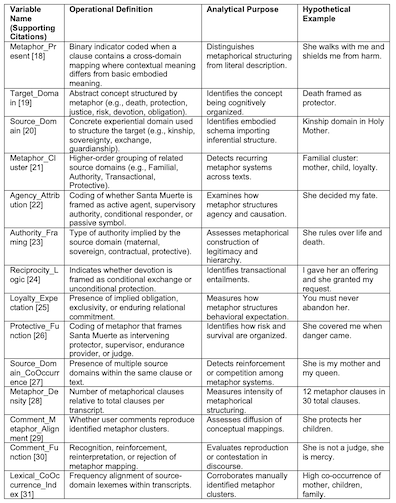 Table 1. Analytic Variables and Operational Definitions
Statistical Procedures and Analytical Metrics
Quantitative analysis examined how metaphor variables were distributed across the texts. The goal was to identify patterns in how metaphors were used. The analysis does not estimate population effects. Frequency counts and percentages measured how often each source domain and metaphor cluster appeared. Cross-tabulation was used to examine relationships among agency attribution, authority framing, and reciprocity logic. Chi-square tests assessed whether these patterns occurred more often than expected by chance for categorical linguistic data,[32] and Cramér’s V measured the strength of these associations.[33] These procedures follow standard quantitative content analysis methods that treat symbolic features as systematically codable units while maintaining interpretive transparency.[34] The statistical results therefore indicate recurring structural patterns rather than causal relationships.
Intercoder reliability procedures were used to improve coding consistency. A subset of texts was independently coded using the same definitions and coding rules described in Table 1. Differences in coding were reviewed to clarify ambiguous cases and refine the coding guidelines.[35] Special attention was given to distinguishing metaphorical expressions from devotional formulas and literal religious language. Reliability was measured using Krippendorff’s alpha, which is appropriate for nominal text data.[36] After acceptable reliability was reached, the final coding framework was applied to the full corpus. Coding decisions and revisions were documented to maintain transparency and replicability in line with qualitative and mixed-method research standards.[37]
Findings
Out of (N = 43) documents, (n = 40) contained at least one metaphor. The corpus analysis identified (n = 739) metaphorical clauses across (N = 6,897) clauses drawn from these (n = 40) Santa Muerte-related texts. Overall metaphor density averaged 0.17 metaphors per clause (M = .17, SD = .12), indicating that roughly one out of every six clauses contained metaphorical language structuring the meaning of death, protection, obligation, or authority. Metaphor density varied substantially across texts, ranging from 0.00 to 0.55, suggesting considerable heterogeneity in how metaphor is deployed across different genres of Santa Muerte discourse. Some documents relied primarily on descriptive or narrative language. Others exhibited highly metaphorized constructions in which death was framed through relational domains such as kinship, protection, exchange, and authority. These descriptive statistics confirm that metaphor is a pervasive but uneven feature of Santa Muerte discourse and provide the empirical foundation for examining which conceptual source domains dominate these representations. The following section addresses the two research questions.
Research Questions
RQ1 asked: What conceptual metaphor source domains are most frequently used to structure representations of Santa Muerte in cartel-adjacent devotional discourse? Across (n = 739) metaphorical clauses, the distribution of metaphor clusters was highly non-uniform, χ²(5, N = 739) = 254.07, p < .001, Cohen’s w = .59, indicating strong concentration in a limited set of dominant mappings. The most frequent cluster was Authority (n = 259, 35.1%), followed by Protective (n = 147, 19.9%) and Familial (n = 137, 18.5%). Transactional metaphors were also common (n = 97, 13.1%), while Journey (n = 66, 8.9%) and Judicial (n = 33, 4.5%) appeared less often. Cluster use also varied significantly by document type, χ²(10, N = 739) = 89.83, p < .001, Cramér’s V = .25. Prayers concentrated heavily in protective and familial mappings. Videos were disproportionately Authority-oriented, consistent with the use of sovereignty and command-role framing in cartel-adjacent discourse. These results are demonstrated in Figure 1 below. It displays the distribution of conceptual metaphor clusters identified in cartel-adjacent Santa Muerte discourse. Authority-based metaphors appear most frequently, indicating that Santa Muerte is often framed through structures of sovereignty, command, and protective power rather than through purely devotional or descriptive language.
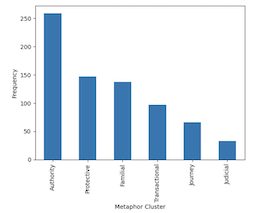
Figure 1. Metaphor Cluster Frequency
Qualitative examination of the corpus illustrates how conceptual metaphors structure devotional language surrounding Santa Muerte. Authority metaphors frequently portray Santa Muerte as a sovereign figure capable of enforcing justice and providing protection. One widely circulated prayer petitions the saint directly: “Santa Muerte, powerful queen and lady of justice, grant me your protection and remove those who seek to harm me.” This language maps the abstract domain of death onto the concrete structure of political authority, importing expectations of command and enforcement. Kinship metaphors also appear in devotional testimony, where Santa Muerte is framed through familial relationships that imply loyalty and care. As one devotee explains, “She is like a mother to me. When I pray to her, I know she listens and watches over my family.” Such language frames death through the familiar structure of family life, reinforcing expectations of protection and reciprocal devotion.
RQ2: What relational entailments do dominant Santa Muerte metaphors construct regarding authority, protection, reciprocity, and obligation? To examine how metaphor structures organize relational expectations within Santa Muerte discourse, statistical tests were conducted on the coded entailment variables. Because the variables are ordinal and interval in structure, Spearman’s rank correlations were used to assess associations between metaphor clusters and protective function. The results indicate strong positive relationships between authority metaphors and authority framing (ρ = .71, p < .001) as well as between kinship metaphors and loyalty expectation (ρ = .64, p < .001). Exchange metaphors were moderately associated with reciprocity logic (ρ = .52, p < .01), suggesting that metaphor selection systematically imports expectations about obligation and reward within devotional discourse.
Additional analysis examined whether the density of metaphor usage within a document predicted the number of relational entailments present. A linear regression analysis found that metaphor density significantly predicted the number of coded relational expectations (β = .58, p < .01), indicating that texts with more frequent metaphorical language tended to construct more elaborate systems of obligation, authority, and protection. Together, these results support the proposition that conceptual metaphors do not merely describe Santa Muerte devotion but function as structuring devices that organize expectations about loyalty, protection, and reciprocal exchange within narcocultura discourse. Figure 2 below displays the correlations among key metaphor and relational entailment variables identified in the corpus. Higher correlations indicate that specific metaphor structures tend to co-occur with particular relational expectations, suggesting that conceptual metaphors systematically organize patterns of authority, loyalty, and protection within Santa Muerte discourse.
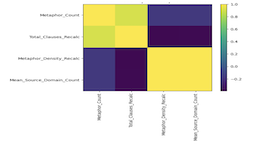
Figure 2. Correlation Heatmap of Metaphor Variables
Qualitative evidence helps clarify the statistical relationships shown in Figure 2 by illustrating how relational expectations are embedded in metaphorical language. Authority metaphors frequently frame Santa Muerte as a figure who commands obedience and dispenses protection or punishment. In one devotional text, the saint is invoked as a ruling power capable of enforcing justice: “Holy Death, powerful lady, watch over me and punish those who seek to harm me.” This framing assigns Santa Muerte the role of sovereign protector and positions the devotee as a loyal subject who petitions for intervention. Kinship metaphors produce a similar relational structure but rely on familial obligation rather than political authority. In another text, a devotee describes the relationship in explicitly familial terms: “She cares for us like a mother and protects her children when they are in danger.” Together, these examples demonstrate how metaphor clusters import structured expectations concerning authority, loyalty, and protection, reinforcing the statistical associations identified in the correlation analysis.
Discussion
The findings show that Santa Muerte discourse relies on a small set of repeated metaphors. Most texts describe Santa Muerte as a mother, protector, patron, or judge. These terms frame death as a person who protects followers, punishes enemies, and rewards loyalty. In this language, death is not an abstract force. It becomes a figure with authority and responsibilities. This framing shapes how devotees understand danger and protection. If Santa Muerte is a protective mother or patron, then followers expect loyalty to bring safety and punishment to fall on their enemies. In environments marked by violence and weak institutions, these metaphors make risk easier to interpret. They present danger as something that can be managed through devotion, loyalty, and ritual exchange.
Information Warfare Implications
For information warfare practitioners, these findings reveal that Santa Muerte devotion creates clear expectations for how she should behave. A mother protects her children. A patron rewards loyalty. A judge punishes enemies and defends the faithful. Because these metaphors impose specific relational expectations, they also create identifiable points of symbolic vulnerability. Information operations can exploit these vulnerabilities by introducing counter-metaphors and counter-narratives that contradict the roles assigned to Santa Muerte. If Santa Muerte is portrayed as a protective mother, then a counter-metaphor can position Santa Muerte as a Neglectful Mother. Information operations can reinforce this counter-metaphor by highlighting abandonment, betrayal, or the death of loyal devotees. These narratives directly challenge the metaphor’s core promise of protection.
Likewise, if Santa Muerte is framed as a sovereign judge or guardian, then the Santa Muerte as a Corrupt Judge counter-metaphor can challenge that frame by emphasizing arbitrary violence, victimization of followers, or the suffering of devoted adherents. These examples weaken the credibility of that authority. After counter-metaphors are introduced, information campaigns must reinforce them through repeated narrative examples. Counter-metaphors become persuasive only when audiences encounter stories that illustrate the contradiction between devotional expectations and lived outcomes. Narratives describing the deaths, betrayals, or victimization of devoted followers can reinforce the “neglectful mother” frame by demonstrating that Santa Muerte fails to protect her own adherents. Similarly, stories highlighting arbitrary violence against loyal devotees strengthen the “corrupt judge” metaphor by portraying Santa Muerte’s justice as unreliable or indifferent. These narratives should be simple, emotionally vivid, and repeated across multiple communication channels so that the counter-metaphor becomes the dominant interpretive frame. Over time, repeated exposure to these contradictions can weaken the symbolic credibility of Santa Muerte and disrupt the relational expectations that sustain devotion within narcocultura environments.
Conclusion
This study demonstrates that Santa Muerte devotion within cartel-adjacent discourse is structured through recurring conceptual metaphors that organize how protection, loyalty, and justice are interpreted. By mapping the abstract experience of death onto familiar social domains such as authority, kinship, and exchange, these metaphors transform uncertainty and violence into intelligible relational systems that stabilize meaning and behavior. The findings show that Santa Muerte functions not merely as a religious symbol but as a cognitive and communicative infrastructure that shapes how risk, obligation, and protection are understood within narcocultura environments. Identifying these metaphor structures therefore provides both theoretical and practical value. Theoretically, it extends Conceptual Metaphor Theory into the study of illicit belief systems and symbolic violence. Practically, it highlights how symbolic systems can sustain loyalty and normalize violence by embedding moral expectations within familiar relational frameworks. Understanding these metaphor systems is essential for analysts and practitioners seeking to interpret, anticipate, and challenge the narratives that support cartel influence.
Editors’ Note—This article represents the fourth and final installment of essays focused on strategic counter-narrative operations directed at Mexican cartel (FTO) and cartel-adjacent Santa Muerte veneration and worship. The earlier articles in this important series at El Centro authored by Dr. Douglas Wilbur are:
Employing Information Operations to Challenge Cartel (Narcocultura) Derived Santa Muerte Propaganda (SWJ, 21 April 2025),
Faith as a Battlespace: Exploratory CONOPS for Undermining the Narcocultura Elements of Santa Muerte Symbolism (SWJ, 25 August 2025),
Identifying Santa Muerte Symbolic Vulnerabilities for Counter-Narco Communications (SWJ, 22 February 2026).
Endnotes
[1] R. Andrew Chesnut, Devoted to Death: Santa Muerte, the Skeleton Saint. 1st Edition. Oxford: Oxford University Press, 2012.
[2] Manon Hedenborg-White and Fredrik Gregorius, “The Scythe, and the Pentagram: Santa Muerte from Folk Catholicism to Occultism.” Religions. Vol. 8, no. 1. 2017: p. 1, https://www.mdpi.com/2077-1444/8/1/1.
[3] Kate Kingsbury, “Autoethnography of Holy Death: Belief, Dividuality, and Family in the Study of Santa Muerte.” Journal of Contemporary Ethnography. Vol. 51, no. 6. 2022: pp. 1–32, https://doi.org/10.1177/08912416221075374.
in the Study of Santa Muerte.” Journal of Contemporary Ethnography. Vol. 51, no. 6. 2022: pp. 1–32, https://doi.org/10.1177/08912416221075374.
[4] George Lakoff and Mark Johnson, Metaphors We Live By. Chicago: University of Chicago Press, 1980.
[5] George Lakoff and Mark Johnson, Philosophy in the Flesh: The Embodied Mind, and Its Challenge to Western Thought. New York: Basic Books, 1999.
[6] Zoltán Kövecses, Metaphor: A Practical Introduction. 2nd Edition. Oxford: Oxford University Press, 2010.
[7] Douglas Wilbur, “Employing Information Operations to Challenge Cartel Narcocultura-Derived Santa Muerte Propaganda.” Small Wars Journal, 21 April 2025, https://smallwarsjournal.com/2025/04/21/employing-information-operations-to-challenge-cartel-narcocultura-derived-santa-muerte-propaganda/.
[8] Op. cit., Chesnut at Note 1: pp. 45–47.
[9] Douglas Wilbur, “Identifying Santa Muerte Symbolic Vulnerabilities for Counter-Narco Communications.” Small Wars Journal. 22 February 2026, https://smallwarsjournal.com/2026/02/22/identifying-santa-muerte-symbolic-vulnerabilities-for-counter-narco-communications/.
[10] Rafael Adelino Fortes, “El culto a la ‘Santa Muerte’ en México: Un estudio socio-histórico y su reflejo en un relato de Homero Aridjis.” Romanica Olomucensia. Vol. 30, no. 1. 2018: pp. 81–93, https://hispanismo.cervantes.es/content/romanica-olomucensia-volumen-30-numero-1-2018.
[11] George Lakoff, Moral Politics: How Liberals, and Conservatives Think. 2nd Edition. Chicago: University of Chicago Press, 2002.
[12] Douglas Wilbur, “Faith as a Battlespace: Exploratory CONOPS for Undermining the Narcocultura Elements of Santa Muerte Symbolism.” Small Wars Journal, August 25, 2025, https://smallwarsjournal.com/2025/08/25/faith-as-a-battlespace-exploratory-conops-for-undermining-the-narcocultura-elements-of-santa-muerte-symbolism/.
[13] Zoltán Kövecses, Metaphor, and Emotion: Language, Culture, and Body in Human Feeling. Cambridge: Cambridge University Press, 2003.
[14] Gerard J. Steen et al., A Method for Linguistic Metaphor Identification: From MIP to MIPVU. Amsterdam: John Benjamins, 2010.
[15] Jonathan Charteris-Black, Corpus Approaches to Critical Metaphor Analysis. Basingstoke: Palgrave Macmillan, 2004.
[16] Pragglejaz Group, “MIP: A Method for Identifying Metaphorically Used Words in Discourse.” Metaphor, and Symbol. Vol. 22, no. 1. 2007: pp. 1–39,https://www.lancaster.ac.uk/staff/eiaes/Pragglejaz_Group_2007.pdf.
[17] Elena Semino, Metaphor in Discourse. Cambridge: Cambridge University Press, 2008.
[18] Op cit., Pragglejaz Group at Note 16: pp. 1–39.
[19] Op cit., Lakoff and Johnson at Note 4.
[20] Op cit., Kövecses at Note 6.
[21] Op cit., Charteris-Black at Note 15.
[22] Op cit., Pragglejaz Group at Note 16: pp. 1–39.
[23] Op cit.,Lakoff at Note 11.
[24] Ibid.
[25] Ibid.
[26] Op cit., Kövecses at Note 6.
[27] Op cit., Charteris-Black at Note 15.
[28] Ibid.
[29] Op cit., Semino at Note 17.
[30] Gilles Fauconnier and Mark Turner, The Way We Think: Conceptual Blending, and the Mind’s Hidden Complexities. New York: Basic Books, 2002.
[31] Raymond W. Gibbs, The Poetics of Mind: Figurative Thought, Language, and Understanding. Cambridge: Cambridge University Press, 1994.
[32] Lynne Cameron, Metaphor in Educational Discourse. London: Continuum, 2003.
[33] Anatol Stefanowitsch, “Corpus-Based Approaches to Metaphor, and Metonymy.” In Anatol Stefanowitsch and Stefan Th. Gries, Eds., Corpus-Based Approaches to Metaphor, and Metonymy. Berlin, 2006: pp. 1–16.
[34] Alan Agresti, An Introduction to Categorical Data Analysis. 2nd Edition. Hoboken: NJ: Wiley, 2007.
[35] Joseph F. Hair Jr., et al, Multivariate Data Analysis. 7th Edition. Upper Saddle River: Pearson, 2010.
[36] Kimberly A. Neuendorf, The Content Analysis Guidebook. 2nd Edition. Thousand Oaks: Sage, 2016.
[37] Matthew Lombard, Jennifer Snyder-Duch, and Cheryl Campanella Bracken, “Content Analysis in Mass Communication: Assessment, and Reporting of Intercoder Reliability.” Human Communication Research. Vol. 28, no. 4. 2002: pp. 587–604, https://doi.org/10.1111/j.1468-2958.2002.tb00826.x.


