Missile Defense, The Future of Arms Control, and the Three-Body Problem
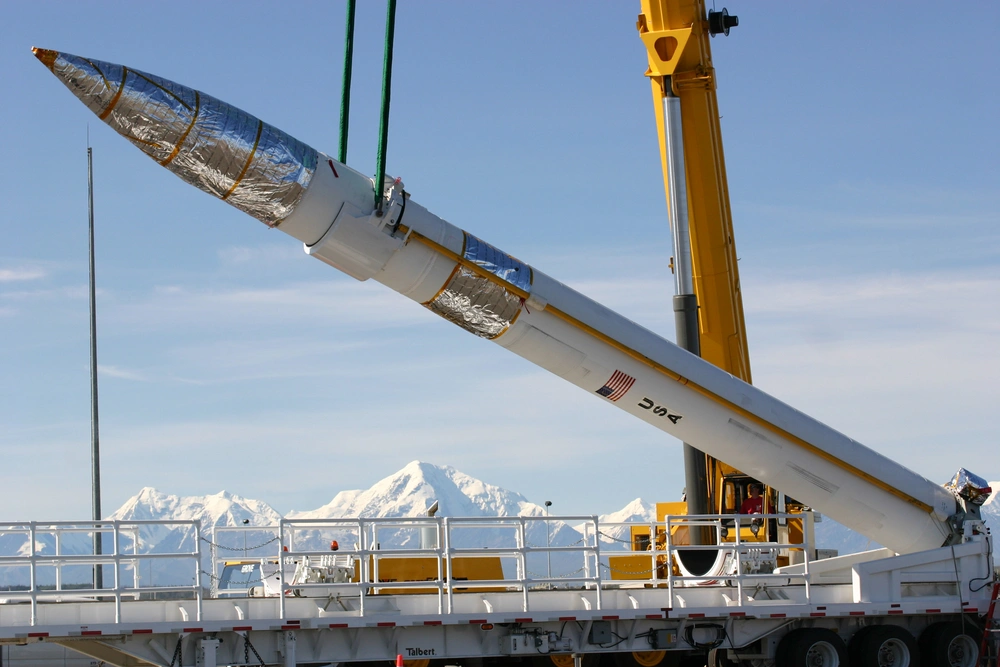

The expiration of New START and China’s impending intercontinental ballistic missile parity have rendered the bilateral logic of Mutual Assured Destruction inadequate for managing an emerging three-way nuclear competition. This article draws on David Goldfischer’s Mutual Defense Emphasis (MDE) framework – in which treaty-limited ground-based defenses expand only as offensive forces decline – and explores how it can be applied to trilateral nuclear competition. It argues that Joint Data Exchange Centers provide the transparency infrastructure necessary to make MDE’s offense-defense linkage viable.
Introduction
Nuclear weapons have long posed the greatest threat to human survival. The February 5 expiration of the New START Treaty has now raised the level of danger. Even if leaders of the major nuclear powers recognize the emerging danger of unfettered competition in strategic nuclear forces, the search for a new agreement faces two formidable obstacles. First, China’s impending achievement of parity in intercontinental-range ballistic missiles fundamentally challenges any regime based on bilateral capabilities for mutual assured destruction (MAD). Second, progress in missile defense technologies has overtaken the willingness to base agreements on complete vulnerability to nuclear attack.
These developments necessitate two linked arms control objectives. First, China’s rise toward nuclear parity increases the need for trilateral transparency mechanisms that reduce ambiguity surrounding missile launches and defensive deployments. Joint Data Exchange Centers (JDEC) provide a framework for combining technical cooperation with verification and reduce ambiguity around launches that repeatedly brought nuclear states to the edge of war. Second, Russia, China, and the United States should find ways to integrate negotiated ground-based missile defense deployments with limits on offensive forces. The initial goal should be agreement on limited defenses against threats posed by accidental launches or other small-scale attacks, while ensuring that all three states retain secure second-strike capabilities and no incentive to strike first.
These objectives are grounded in logic distinct from both MAD and nuclear warfighting, termed Mutual Defense Emphasis (MDE).
From Oppenheimer to Nitze
MDE is not a new idea. During the bomber age, J. Robert Oppenheimer’s Panel on Consultants on Disarmament explored how defenses could result in lowered force levels and offset the coming nuclear arms race. During the missile age, Donald Brennan, Freeman Dyson , Alvin Weinberg and Jack Barkenbus, and Paul Nitze reached the same conclusion. Together, their work establishes six workable claims.
First, limited ground-based defenses are stabilizing when verifiably constrained and linked to offensive reductions – they provide insurance against cheating that makes deep cuts viable.
Second, defensive deployments may only expand as offensive forces decline, with very low or zero offenses as the endpoint, not a heavily armed world with defenses added on.
Third, deterrence under MDE is measured by relative damage rather than absolute destruction. A potential aggressor must expect to end up at least as badly off as its victim. Even imperfect defenses preserve deterrence by ensuring no favorable post-war calculus exists for the attacker.
Fourth, imperfect defenses still work through virtual attrition. Even imperfect defenses force an attacker to commit more of their offensive potential to penetration aids rather than warheads, raising the threshold for any strike that could be considered decisive. Moreover, the need to redirect part of one’s offensive force to ensure the destruction of defended targets spares those targets that cannot be attacked.
Fifth, space-based defensive architectures are not compatible with MDE. They fail the basic arms control because they cannot be distinguished from offensive systems and introduce ineradicable fears that a first strike is being enabled.
Sixth, transparency is the mechanism that makes the transition from an offense-based nuclear regime to a defensive one possible. Shared launch data, telemetry exchange, and jointly observed interceptor tests allow states to validate that defenses are limited and non-deceptive without exposing the sensitive details of their nuclear forces.
Lastly, offensive arms control alongside a transition to defense makes the system more viable. Single-warhead missiles reduce the first-strike advantages created by multiple independently targetable re-entry vehicle (MIRV)ed systems, and defenses are correspondingly more potent. An attacker must expend a larger share of its force to achieve a decisive strike.
The most serious objection to MDE is that limited defenses simply recreate instability at lower force levels by enabling future breakout behind protective shields. Yet breakout risks already exist under MAD – MIRVed upload capacity, opacity incentives, and unilateral missile defense deployments all exist under a MAD framework. More bespoke technologies like AI enabled sensors, cyberattacks, hypersonic glide vehicles are all equally as threatening if not more so to a MAD regime. MDE does not assume cheating becomes impossible; rather, the intention is to make offensive reconstitution slower, more visible, and more politically risky through transparency mechanisms, de-MIRVing, and treaty-linked defensive limits.
| Framework | Core Assumption | View of Defense | Stability Mechanism | Primary Risk | Arms Control Implication |
|---|---|---|---|---|---|
| Mutual Assured Destruction (MAD) | Vulnerability to annihilation prevents war | Defenses destabilize mutual deterrence | Fear of society-destroying retaliation | Arms racing through counterforce and/or defense modernization | Preserve mutual vulnerability to societal annihilation |
| Nuclear Warfighting | Superiority can produce victory | Defenses enable strategic advantage | Damage limitation and escalation dominance | First-strike incentives | Arms control unnecessary or disadvantageous |
| Mutual Defense Emphasis (MDE) | MAD is unacceptably dangerous; MDE enables meaningful offensive reductions. | Negotiated ground-based defenses reinforce mutual deterrence while saving lives if deterrence fails | Offensive reductions verified and protected by treaty-limited defenses | Concern that fear of escalation to MAD is crucial to avoiding major power war. | Negotiated offensive reductions, enabled by treaty-limited defensive deployments — toward very low or zero offenses |
MDE differs from both MAD and nuclear warfighting. Defensive deployments are the instrument by which offensive reductions become verifiable and safe. The endpoint is very low or zero offenses, not a heavily armed world with defenses added on top.
The Two-Body Problem: Post Cold-War Missile Defense Debates
Modern missile defense debates are rooted in three developments at the end of the Cold War: (1) fears that post-Soviet instability raised risks of accidental or unauthorized launches, (2) concerns over rogue state nuclear acquisition, and (3) meaningful U.S. progress in non-nuclear ballistic missile defenses. Together, these forces destabilized the Anti-Ballistic Missile (ABM) Treaty’s central premise: mutual vulnerability between two superpowers is stable and enforceable so long as accidental launches or irrational actors do not decide to launch a strike. What followed was not a linear transition away from the ABM framework, but an often-forgotten history of attempted adaptation in which both the U.S. and Russia sought to reconcile emerging defensive technologies with inherited assumptions of bilateral mutual assured destruction. The result was a series of partial agreements, contested interpretations, and ultimately incompatible expectations about the role of missile defense in nuclear parity.
Between 1993 and 1997, Deputy Foreign Minister Yuri Mamedov and his U.S. counterpart Dennis Ross engaged in demarcation negotiations to set specific technical limits on interceptor speed and range to ensure that theatre missile defenses (TMD) could not be upgraded to target ICBMs. These talks culminated in the 1997 Helsinki Demarcation Agreements. The accords were an attempt to accommodate American progress and eagerness for National Missile Defense (NMD), while preserving the ABM Treaty. On September 26, 1997, the first and second agreed statements on demarcation were officially signed.
In January 1999, President Clinton proposed a limited National Missile Defense under pressure from a Republican-led, pro-missile defense Congress. Clinton’s plan called for 100 interceptor missiles at a single site in Alaska that would deter 20 offensive missiles. Plans were later expanded to 200-250 interceptors at one or more sites. In March 1999, the U.S. Congress passed the National Missile Defense Act of 1999 with veto-proof majorities, making it official U.S. policy to deploy an effective NMD system as soon as technologically possible. Clinton also noted that the modifications would likely include upgraded and modernized space-based sensors and components banned by the ABM treaty. He hoped to address Russian concerns about ABM treaty violation by suggesting the renegotiation of the treaty to accommodate expanded defenses. To further placate Russian concerns, Clinton championed the Joint Data Exchange Center (JDEC)–agreed to in 1998-and the 1992 Russian-American Observation Satellite (RAMOS)-to jointly detect and track ballistic missiles during their midcourse phase. Despite a memorandum of agreement in June 2000, the initiative stagnated due to complex legal and tax disputes regarding U.S. personnel. Ultimately, the JDEC remained a paper agreement. The RAMOS also faltered, signaling the end of substantive U.S.-Russian efforts at technical cooperation.
The Russian Response
Russian opposition to U.S. NMD was not simply a reaction to specific interceptor deployments, but what Russia perceived as the erosion of the offense-defense balance underpinning MAD. Even limited U.S. National Missile Defense capabilities threatened to undermine the credibility of Russia’s second-strike deterrent, particularly if offensive force levels declined under successive START agreements. Russian arms control scholars like Sergei Rogov and Alexander Pikayev argued that the proposed interceptor deployments would grant the United States a disarming first-strike capability. Once the U.S. established space-based sensors and infrastructure for a limited Ballistic Missile Defense (BMD) system, it could be rapidly expanded into a full-scale shield capable of negating Russia’s retaliatory second-strike. Alexi Arbatov argued that Russia should take appropriate steps to guarantee its deterrent, such as MIRVing, relying on tactical nuclear weapons. Arbatov criticized Russian leadership for committing to offensive reductions before negotiating with the U.S. – Boris Yeltsin and later Vladimir Putin concurred. Putin, after assuming the presidency in 2000, remarked, “People must realize that the mutual reduction of strategic attack weapons the most dangerous of all nuclear weapons – is possible only when the ABM treaty continues to hold. Scrapping it would make a further reduction of strategic attack weapons according to START-I impossible. Start II would not come into force either, as it would be impossible to conclude START III…”
Yeltsin and Putin’s fears were based not only on strategic force reductions future START agreements would impose on Russia, but on its already deteriorating strategic force posture. Throughout the 1990s, Russia’s nuclear arsenal was aging faster than it could be modernized. Russia had started the decade with over 5,000 strategic warheads, but heavy ICBMs like the SS-18 Satan and SS-24 Scalpel were reaching the end of their service lives and were not being replaced at a one-to-one rate. If a hypothetical U.S. first strike using precision conventional or nuclear forces could destroy 80-90% of Russian silos on the ground, the U.S. NMD system would only need to intercept a retaliatory volley of 20–30 missiles. Pikayev calculated that a U.S. system of 250 interceptors would provide a high-probability kill ratio against such a small surviving force, effectively achieving a disarming first-strike capability.
Russia was not simply resisting arms control from a position of strength; it was fighting to preserve second-strike credibility while its arsenal declined to unsustainably low levels.
Russian Counterproposals
Amid discussions of modifying or ending U.S. participation in the ABM Treaty, Russia advanced a series of cooperative architectures designed to preserve the ABM Treaty while accommodating limited defensive needs. The Global Control System (GCS), introduced at the Conference on Disarmament in Geneva in 1999, proposed a multilateral launch notification regime, a joint data exchange center, and security guarantees for states renouncing ballistic missile acquisition. Putin’s Euro-ABM proposal, advanced from 2000 to 2001, envisioned a joint NATO-Russia mobile theater defense system deployed at the borders of hostile states to intercept medium-range missiles without violating the ABM Treaty’s ban on strategic defenses. Rather than prohibiting missile defense outright, Russian initiatives sought to embed it within a shared verification and operational framework that would prevent any single actor from gaining a decisive advantage in interception capability.
This dual-track posture–threatening offensive expansion while simultaneously advancing cooperative proposals was deliberate. Cooperative proposals served as Russia’s preferred outcome, while modernization threats were the cost the U.S. would pay for rejecting them. Putin’s statement that strategic offensive reductions were “possible only when the ABM Treaty continues to hold” made the linkage explicit. Although these proposals were consistently rejected or deprioritized by the U.S., they represent an important alternative vision of post–Cold War strategic stability.
Even after President George W. Bush withdrew from the ABM Treaty in 2001, Russia continued to make cooperative proposals but withdrew from START II the same day. De-MIRVed forces and unconstrained defenses were incompatible; Russia would not accept both simultaneously. In 2007, Russia offered to share data from Russian-leased radars at Gabala and Armavir to monitor Iranian launches as an alternative to deploying American radar and interceptors in Eastern Europe. At the 2010 NATO–Russia Council summit, Russian President Medvedev proposed a “Sectoral” defense architecture in which Russia would intercept Europe-bound missiles crossing its territory, while NATO defenses would protect Russia.
The U.S. and NATO rejected the GCS and Euro-ABM architecture as technically infeasible; the Gabala and Armavir radar stations were dismissed as technically deficient. The Gabala facility relied on dated VHF-band technology only designed for early warning reporting and the Armavir Radar relied on UHF band–persistent coverage radar and a phased array for data transmission. TPY-2 Transportable radar proposed by the United States offered X-band-persistent coverage, precision tracking, and a phased array. Additionally, issues with the geographic orientation of Gabala and Armavir radars meant they did not actually provide comprehensive coverage of Iranian missile trajectories. The Sectoral Defense plan was dismissed as a threat to Article 5 mutual defense obligations.
Russia’s cooperative missile defense proposals served a reputational function—demonstrating that Russia remained a relevant strategic opposite capable of engaging the U.S. as an equal, even as its offensive arsenal declined relative to American conventional and nuclear advantages. Additionally, it is worth noting that Putin’s cooperative missile defense plans were shrewd diplomatic maneuvers. They likely offered a system with known technical deficiencies while casting the U.S. as unreasonable for rejecting them, attempting to create a wedge between the U.S. and its European allies, some of whom were more responsive to cooperative frameworks.
The Bush Administration and ABM Treaty Withdrawal
While the Clinton administration sought to negotiate amendments to the ABM Treaty, the Bush administration viewed the Treaty as ancient history and an obstacle to a new strategic framework. Senior officials, including Secretary of Defense Donald Rumsfeld and Secretary of State Colin Powell, argued that the treaty was no longer relevant. NMD hawks argued that Russia had a long history of violating and hollowing out the ABM Treaty, and fears of Iraqi scuds during the first Gulf War prompted a desire to escape vulnerability. Consequently, the administration refused to offer specific proposals for Treaty amendments during consultations with Russia, as they sought a clean break that would allow for a robust, layered defense involving land, sea, and space-based interceptors. On May 1, 2001, George W. Bush stated, “we can draw on already established technologies that might involve land-based and sea-based capabilities to intercept missiles in mid-course, or after they re-enter the atmosphere.”
Following its withdrawal from the ABM Treaty in 2002, the U.S. began deployment of its Ground-based Midcourse Defense System (GMD) in 2004, placing GBIs at Fort Greely, Alaska, and Vandenberg Air Force Base in California. These systems were supported by upgraded early warning radars (UEWR) and space-based infrared systems (SBIRS) for global launch detection and tracking. Between 2006 and 2008, the Bush administration awarded contracts for a Third Site in Europe, planning an advanced X-band radar in the Czech Republic and ten GBIs in Poland. The U.S. Navy expanded its theater defense capabilities, deploying Standard Missile-3 (SM-3) interceptors on more than a dozen Aegis-equipped warships by 2008.
The Obama Reset, EPAA and The Limits of Capability Concessions
In September 2009, the incoming Obama administration attempted to reset relations around BMD by cancelling Bush’s planned third site in the Czech Republic and Poland in order to make headway on New START. To achieve progress in strategic offensive warhead reduction efforts, BMD anti-ICBM plans were scaled down and the European Phased Adaptive Approach (EPAA) was introduced to focus on theatre missile defense and placating Russian BMD fears to achieve a deal. The decision was also guided by an intelligence community threat assessment that Iran’s short and medium-range ballistic missiles were developing faster than previously projected, but ICBM threats were developing slower than expected. The EPAA was designed as a four-phase deployment utilizing Aegis ships and Standard Missile-3 (SM-3) interceptors to defend against Iranian short and medium-range threats. Phase I became operational in 2011, established the foundation of this shield by deploying a forward-based AN/TPY-2 radar in Turkey and Aegis-equipped ships armed with SM-3 Block IA interceptors. In 2015, Phase II deployed improved SM-3 Block IB interceptors and activated the first Aegis Ashore site in Deveselu, Romania. The architecture further matured in 2018 with Phase III, which introduced the more advanced SM-3 Block IIA interceptor and a second Aegis Ashore facility in Redzikowo, Poland to counter intermediate-range missiles. A fourth phase envisioned the deployment of SM-3 Block IIB interceptors capable of reaching the high velocities necessary to intercept intercontinental ballistic missiles (ICBMs).
Russian political and military leadership initially welcomed the EPAA and the cancellation of the Bush administration’s planned third site, as the EPAA’s early phases did not possess the velocity or range to threaten Russian ICBMs. However, the fear of open-ended BMD infrastructure persisted. The goodwill helped facilitate the successful negotiation of the 2010 New START treaty, though in meetings with Medvedev and then Prime Minister Putin, Russia continued to insist on linking nuclear arms reductions to U.S. BMD plans in Europe. On July 6, 2009, Medvedev made it clear that a top priority was convincing the U.S. to reconsider the Bush-era plans to build a missile defense system in Poland and the Czech Republic. He demanded that missile defense limits be folded directly into the upcoming New START negotiations. Obama refused to grant this request, unwilling to let the new arms control treaty dictate U.S. missile defense policy, though he acknowledged it was in the U.S. interest to reduce Russian anxieties. When Obama sat down with Putin, a 45-minute airing of grievances began. Putin criticized the United States for invading Iraq, destabilizing the Middle East, and for its withdrawal from the ABM Treaty. He warned Obama that U.S. plans to house missile defenses on Russia’s border remained a core concern. Obama disputed Putin’s claim that it would disrupt the strategic balance but promised to do a comprehensive review before further deployments.
Track I.5 and Track II and Cooperative BMD Proposals
While Russia continued to propose Cooperative Missile Defense and updated its nuclear triad, the most significant effort to break the diplomatic deadlock on BMD was Track 1.5 and Track II dialogues. Non-governmental meetings like the Euro-Atlantic Security Initiative (EASI), expert forums like the Albright-Talbott-Ivanov-Dynkin dialogue, and National Academy of Science and Russian Academy of Science joint studies explored how to maintain strategic parity, reduce tensions, and incorporate the two states’ missile defense perspectives. These transnational efforts of arms control scholars, retired military officers, and former policy makers resulted in high-quality cooperative BMD and information-sharing architectures that demonstrated how the U.S., NATO, and Russia could cooperatively deploy missile defenses without compromising their sovereign command or nuclear deterrents.
In 2012, the Euro-Atlantic Security Initiative (EASI) commission, led by former U.S. National Security Advisor Stephen Hadley, Russian Deputy Foreign Minister Vyacheslav Trubnikov, and former German Defense Minister Volker Rühe, proposed a compromise to assuage Article Five concerns raised during the sectoral defense proposal. The policy recommendation maintained separate national command and control over intercept decisions. A system of data filters and screens for advanced radar algorithms and interceptor information was recommended before data was shared at cooperation centers. Although it was focused on theater missile defense rather than strategic defenses, the proposal illustrated how cooperative transparency and shared defensive architectures could partially supplement traditional MAD-based stability. A National Academy of Sciences and Russian Academy of Sciences study confirmed that the proposed sensor integration was feasible, and that pooling data doubled defense efficiency in computer simulations.
EPAA Cancellation and the Gap Between Capability Concessions and Arms Control
In March 2013, Obama cancelled Phase IV of the EPAA. He intended to reassure Russia that there was no intention to target Russia’s strategic deterrent, likely after his contentious meeting with Putin. However, it demonstrated that capability concessions alone could not stabilize the offense-defense relationship without accompanying transparency measures and linked offensive limits. While the cancellation theoretically addressed the distinguishability problem by cancelling plans to deploy interceptors capable of targeting Russian ICBMs, the gesture lacked the reciprocal transparency or shared operating infrastructure proposed by the EASI commission. In Putin’s March 2018 Federal Assembly address, he pledged to expand launch-vehicle modernization efforts as a necessary response to what he characterized as deceptive and unchecked U.S. missile defense expansion. In 2019, Russia withdrew from the Intermediate-Range Nuclear Forces (INF) Treaty, arguing that Aegis Ashore sites in Romania and Poland could be converted to launch offensive cruise missiles, violating the treaty’s spirit.
The EPAA experience illustrates a core component of what makes MDE work: missile defense architecture decisions and offensive arms control cannot be sequenced separately, they must be negotiated in tandem or they will undermine efforts to introduce stability.
Why the Two-Body Framework Failed: The JDEC Gap
A JDEC addresses the failure of the post-Cold War offense-defense discussions. Neither capability concessions nor cooperative proposals could stabilize the relationship without shared infrastructure to make transparency credible. By confirming that defensive deployments are limited, ground-based, and non-deceptive through shared telemetry and jointly observed interceptor tests, a JDEC allows each participant to validate the non-threatening character of others’ defensive systems without exposing the sensitive details of their deterrents. Verification was the problem that stymied every cooperative proposal Russia advanced to prevent or reverse U.S. withdrawal from the ABM Treaty. Data filtering and segmented sharing accommodate asymmetric strategic priorities. The United States, Russia, and China operate under different force structures and transparency thresholds. A JDEC offers assurance that each party receives the information it needs to ensure that defenses are not being covertly upgraded into first-strike enablers.
Proposed MDE Framework for the Trilateral Era
| Component | Purpose | Stabilizing Effect | MDE Principle |
|---|---|---|---|
| Joint Data Exchange Centers (JDEC) | Share launch and telemetry data in real time | Reduces accidental escalation and launch ambiguity | Transparency as the prerequisite for verified offensive reductions |
| Defensive deployments conditioned on offensive reductions | Ensure ground-based interceptor expansion is proportional to and contingent on offensive cuts | Maintains second-strike survivability as offenses decline — defenses protect against cheating, not to achieve superiority | Defense enables disarmament. Negotiated reduction of offensive forces, enabled and verified by treaty-limited ground-based defensive deployments. |
| Treaty-limited offensive ceilings with verified drawdown | Prevent strategic breakout; ensure offensive reductions are binding and verifiable | Removes incentives for offensive expansion as defenses provide cheating insurance | Offensive reductions are the goal; defensive deployments are the instrument |
| Data filtering and segmented sharing | Protect sensitive national capabilities while enabling transparency | Makes verification politically feasible without compromising deterrent | Sovereignty preserved within cooperative framework |
| Distinction between theater and strategic systems | Reduce dual-use ambiguity; ground-based systems are verifiably limited | Clarifies defensive intent; confirms defenses cannot enable first strike | Ground-based, limited systems are distinguishable — space-based are not |
| Cooperative deterrence-by-denial | Protect all parties against accidental launches, rogue actors, and small-scale attacks | Supplements punishment-based deterrence; reduces pressure to maintain bloated offensive arsenals | Shared defensive function reduces the offensive force levels needed for security |
Each component addresses a distinct failure mode in the post-Cold War record. Critically, defensive deployments are conditioned on and proportional to offensive reductions; defenses provide the cheating insurance that makes deep offensive cuts politically viable, not a parallel expansion of both offense and defense.
The Three Body Problem and Why MAD Cannot Manage Trilateral Competition
The most dangerous consequence of attempting to apply MAD to the emerging nuclear arms race is the parity and arms race trap. Vipin Narang, former Acting Assistant Secretary of Defense for Space Policy has stated there is no chance of China joining a multilateral equivalent of New START. Even more dangerous, he, and other MAD scholars have argued the most likely outcome of Chinese nuclear buildup is that they will at least build to equivalent force levels of Russia and the United States. Aside from the simple danger of more nuclear weapons and more chances for accidents, the most likely outcome is a nuclear arms race, and one that will be much more dangerous than the last. This is reminiscent of the late 1940’s and 1950’s when the Truman and Eisenhower administrations struggled to maintain nuclear superiority over the Soviet Union, leading to ever upward reaching force levels. Worse however, is that with MAD as the basis for nuclear parity, an attacker must be worse off, or as bad off as victim. In a three-way exchange, if state A attacks state B, state C’s forces are untouched. State A must now deter two retaliatory forces simultaneously, meaning that state A needs superiority over B and C combined just to maintain a credible first-strike deterrent, and this logic applies to both state B and C. This means that under MAD, there is no stable parity which produces a spiraling offensive arms race.
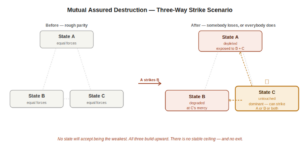
Aside from the counting issues that make MAD invalid for managing a three-way-nuclear arms race. China views Western transparency initiatives as tools of mōdǐ, “probing its capabilities” and shexian, “setting limits on its rise.” It has instead prioritized bǎojià hùháng, or “safeguarding its modernization”, over arms control. With a smaller arsenal than the United States and Russia, China has resisted risk-reduction dialogues because silence is leverage, and technical transparency requires a foundation of political trust that does not yet exist. Standard arms control approaches that demand symmetric participation from asymmetric actors have predictably failed. The consequence of MAD as the basis for stability is to simply wait for Chinese participation: this assumes that China will ever participate in an inherently unstable framework. Moreover, the longer it takes to achieve an agreement on strategic warhead reductions, the higher the force levels from which reductions must begin.
An MDE framework reframes the terms of engagement in ways that MAD arms control cannot. China’s core objection to transparency is rational under MAD logic–revealing capabilities without receiving binding security guarantees in return is a bad deal. MDE’s conditionality changes the calculus. If defensive deployments expand only as offensive forces decline, and if ground-based interceptor limits with data filters can be verified without exposing arsenal locations, then transparency becomes mutually beneficial rather than unilaterally costly. More importantly, the primary objective of an MDE transition is to constrain U.S. and Russian offensive forces, which is directly in China’s strategic interest. A framework that credibly commits the U.S. and Russia to offensive reductions offers China something no previous arms control proposal has, a path toward parity that does not require China to freeze its modernization before that parity is achieved.
The asymmetry objection – that China cannot accept limits while US and Russian arsenals remain orders of magnitude larger – is addressed by MDE’s sequencing. Rather than demanding simultaneous trilateral reductions from unequal baselines, an MDE transition asks China to pause its expansion while the United States and Russia reduce to comparable force levels. The initial defensive deployments under this framework are hard point only, protecting retaliatory forces rather than populations. Once rough parity is reached under that defensive umbrella, all three powers reduce together toward very low force levels, at which point population defenses become viable. Oppenheimer’s logic holds: any cheating would require preparations too vast to conceal or too small to matter strategically. De-MIRVing also makes this significantly easier. China’s arsenal is already largely single warhead, but rapidly MIRVing, meaning a de-MIRVing commitment from the U.S. and Russia would be one of the more credible signals of seriousness in offensive reduction. This is the Defense-Protected Build-Down applied trilaterally. Defenses make the descent safe for the larger powers and the descent makes participation rational for the smaller ones.
This does not mean Chinese participation is immediate or guaranteed. A JDEC creates the transparency infrastructure and political precedent for eventual trilateral inclusion rather than assuming it from the outset. U.S.-Russian data sharing verified ground-based deployments, and linked offensive ceilings, demonstrate the seriousness of the offensive reduction commitment that China has always demanded as a precondition for engagement. Whether they choose to enter that framework depends on political conditions that no technical architecture can fully determine. But an MDE transition gives China a reason to engage in offensive reductions in a way that unilateral missile defense expansion would not. Now consider the state A, B, and C first strike scenario under MDE.
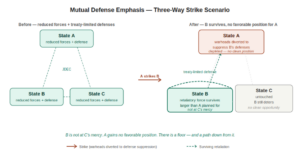
The Path Ahead
To further limit arms racing and the pursuit of destabilizing nuclear-warfighting doctrines, cooperative frameworks must formally link interceptor capacity to offensive ceilings. The 1997 Helsinki Demarcation Agreements offer an illustrative example. Setting a technical ceiling on interceptor speed was a precondition for Russian participation in offensive cuts. These negotiations demonstrate that offense-defense linkage is negotiable when political will exists. Through Joint Data Exchange Center transparency mechanisms, the United States, Russia, and China can ensure that when limits are placed upon defense and that they are being enforced verifiably.
The urgency of a transition to MDE is compounded by a structural shift in the survivability calculus that underpins nuclear deterrence. For decades, mobile missile systems, including road-mobile ICBMs, submarine-launched ballistic missiles, and dispersed Transporter Erector Launchers, provided survivability through concealment. Advances in synthetic aperture radar satellites, persistent ISR, and AI-enabled tracking are challenging concealability. As concealment becomes viable, the United States, Russia, and China may acknowledge a shared incentive to move toward cooperative deterrence-by-denial rather than continuing to depend on hiding. From an MDE perspective, this is not a threat, but a condition that hastens transparency. As concealment becomes fail-deadly, transparency becomes relatively less costly, and the case for cooperative defense correspondingly stronger.
The trilateral context also amplifies the strategic logic of virtual attrition in ways the bilateral literature has not fully appreciated. Even imperfect defenses force an aggressor to commit more warheads to penetrate defenses rather than targeting an adversary’s forces or population centers. In a three-power competition, this calculus compounds. A first strike must penetrate the defenders’ defenses while simultaneously retaining enough forces to deter a third power whose offensive forces are untouched.
A trilateral MDE framework also provides what a MAD regime based on mutual vulnerability cannot, a mechanism for the great powers to protect themselves from smaller nuclear powers, rogue states, or accidental launches. Shared JDEC data and coordinated limited defenses allow the United States, Russia, and China to intercept errant or unauthorized launches from North Korea, from an Indo-Pakistani exchange, or from any actor whose rationality cannot be assumed without placing their own strategic forces on high alert. This is MDE’s answer to the proliferation problem that David Goldfischer identified decades ago. In a world of multiple nuclear actors, the great powers have a shared interest in cooperative defense that extends well beyond their bilateral rivalries.
Conclusion
Robert Oppenheimer’s Panel on Consultants on Disarmament argued that meaningful offensive reductions required simultaneous investment in continental defense and that, in a defense-emphasis framework, cheating concealment would be either too vast to hide or too small to matter strategically. Paul Nitze’s 1984 Strategic Concept reached the same conclusion that defense and arms control are not opposites but complements; and that pursuing defensive development outside a negotiated arms control framework would produce exactly the modernization spiral the post-Cold War record confirms. The failure to pursue defensive expansion and offensive reductions is not a missed opportunity, but an ongoing cost, measured in unconstrained arsenals, eroded treaties, and the absence of any agreed framework capable of managing a three-way nuclear competition.
The question is not whether cooperation is technically achievable-the NAS/RAS joint study demonstrated that it is, designing its blueprint explicitly for implementation when political conditions permit. The framers expressed confidence that “there will come a time when it will be politically feasible for the Russian Federation and the United States to cooperate in ways that directly enhance the security of both nations.” The framework proposed here is designed for that moment. The question is whether the architecture will be ready when the opportunity arrives.
In an era of three-way nuclear competition, transparency around mutual missile defense may become the prerequisite for future arms reductions rather than the obstacle to them.
The author thanks Dr. David Goldfischer for his guidance and foundational contribution to the scholarship of Mutual Defense Emphasis.